Located in Bloomfield Hills, MI
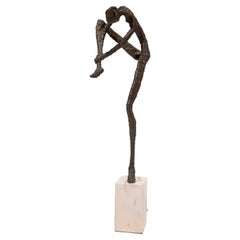
Titled “Ballerina” this sculpture captures the balance and dexterity dancers have in order to perform their beautiful and inspiring performances. Like some of Edgar Degas' ballerinas in the late 19th century, Tom Brun has captured an off moment when a dancer can be found in a slightly awkward pose adjusting a strap or a shoe - capturing a position that is, nonetheless, charming and complicated. This ballerina is engrossed in a problem with her foot or ballet shoe. It seems we have been invited backstage or to the rehearsal studio by the sculptor to witness the struggles and hard work that supports creative dance.
The “Ballerina” is abstracted to just elements of her person, limbs, hands, feet, and a head without a face, a representation of a dancer and as such speaks for all dancers. In this respect “Ballerina” is reminiscent of Alberto Giacometti’s tall, thin stick figures that were more spiritual or intellectual presences than flesh and blood individuals. This quality is present in Tom Brun’s skeletal figures.
As a sculptor and Zookeeper, Tom Brun, is well-known for his wood sculptures in addition to his many works in stone, marble, ceramics and ivory. He worked as a Zookeeper at the Detroit Zoo in Michigan, retiring after 12 years to devote him-self entirely to his art practice. In addition to sculpting animals, Tom was equally interested in the human figure.
Brun was born in England in 1913. A few years after the end of World War I his father moved the family in 1919 to Detroit, Michigan. In 1935 at age 23, he officially became a U.S. citizen. He served in the army during World War II for five years and upon discharge and at the age of 36 took advantage of the GI Bill and applied for admission to Society of Arts and Crafts (now known as the College for Creative Studies) where he was gladly accepted.
While at Arts and Crafts his instructors and established artists such as Sarkis Sarkisian, John P. Foster, Morris Brose, Richard Koslow, Patricia Burnett, Lloyd and Renee Radell , and the famous Eliel Saarinen Architect family took to him immediately. His natural carving and fast learning abilities created the fuel for his fast growing reputation while in school.
After graduation Tom went to work at the Detroit Zoo temporarily. You might say, as a Zookeeper, he lived on a daily basis with his models learning their personalities that he later captured in sculptures. He loved the animals and from the many photos in his archives, the animals appear to have trusted and respected him. He eventually became the Great Ape exhibit keeper. Tom has said of the apes: “They were the gentlest of creatures shy and full of affection.” He began working at the zoo in 1951 for the same reason he would leave 12 years later – to pursue his art career.
Tom Brun was one of the numerous well-known and practicing artists that attended Detroit Society of Arts and Crafts founded in 1906 and now known as College for Creative Studies (formerly Center for Creative Studies.) Faculty and graduates include Richard Jerzy, Harry Bertoia, Doug Chaing (currently director of Lucas Film), Stephen Dinehart (game maker, writer, designer connected with The David Lynch Foundation), Tyree Guyton (international artist), Herb Babcock, Jerome Feretti, Kevin Siembieda (writer, designer and publisher of role-playing games), Renee Radell, Philip Pearlstein, Charles McGee (nationally recognized African American sculptor of animal and dancing spirits), Philip Pearlstein (2000 Honorary Doctorate, Modern Realism style), John Louis Krieger...
Category
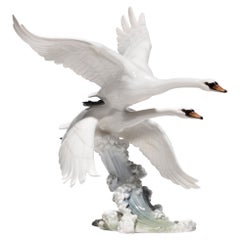
Mid-20th Century American Modern Michigan - Porcelain