Palm Beach - Art

to
139
639
484
449
464
1,177
Overall Width
to
Overall Height
to
17
165
1,459
1,572
95
98
93
76
74
102
116
114
126
94
15
673
612
220
208
106
48
37
36
30
25
21
12
2
1
1,390
1,041
327
1,138
607
354
348
291
180
173
168
158
141
133
128
123
122
119
118
115
113
108
107
1,622
889
614
599
535
59
54
53
50
48
1,155
191
232,567
169,514
Item Ships From: Palm Beach
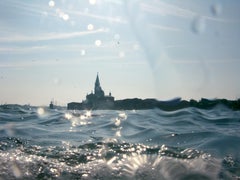
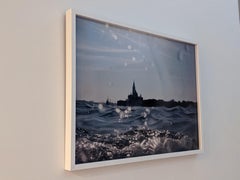
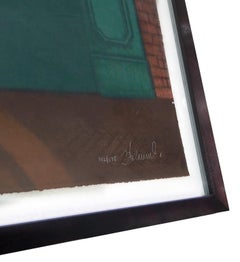
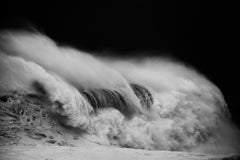
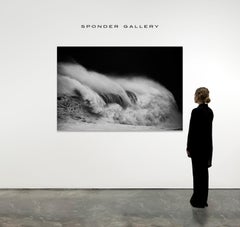
Baiser de Soleil

Baiser de Soleil

By Christophe von Hohenberg

Located in New York, NY

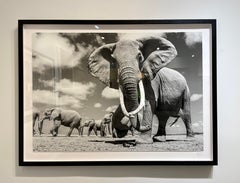
AP 1, includes white frame. "Baiser de Soleil" is part of Christophe von Hohenberg's ongoing series of minimal, dreamlike images captured on the beaches of America’s Northeastern sh...

Category

2010s Palm Beach - Art

Materials

Archival Pigment

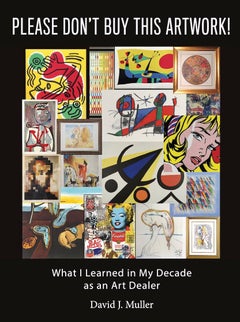
Please Don't Buy This Artwork!    Coffee Table Book by David J. Muller

Please Don't Buy This Artwork! Coffee Table Book by David J. Muller

By David Muller

Located in Boca Raton, FL

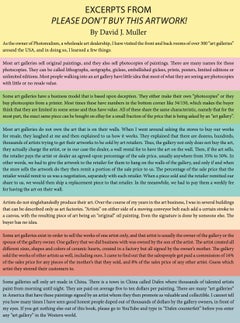
Signed and inscribed copy of “Please Don’t Buy This Artwork” by David J. Muller 11” x 9”, 450 pages. Condition: New. See attached photos. EXCERPTS FROM PLEASE DON'T BUY THIS ARTWORK! BY DAVID J. MULLER As the owner of Photorealism, a wholesale art dealership, I have visited the front and back rooms of over 300 "art galleries" around North America, and in doing so, I learned a few things: Most art galleries sell original paintings, and they also sell photocopies of paintings. There are many names for these photocopies. They can be called lithographs, serigraphs, giclees, embellished giclees, prints, posters, limited editions...

Category

2010s Other Art Style Palm Beach - Art

Materials

Paper

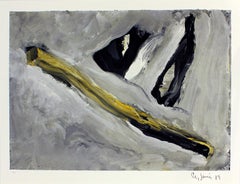
Musta Been Something

Musta Been Something

By Guadalupe Laiz

Located in New York, NY

Ed. 2/12, includes black frame. Guadalupe Laiz is an international artist, photographer and explorer born and raised in Argentina. Guadalupe’s main focus for the past ten years has ...

Category

2010s Palm Beach - Art

Materials

Archival Pigment

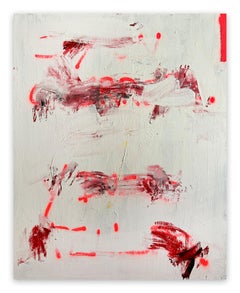
Squeeze Me, Los Angeles, CA

Squeeze Me, Los Angeles, CA

By Vincent Ricardel

Located in New York, NY

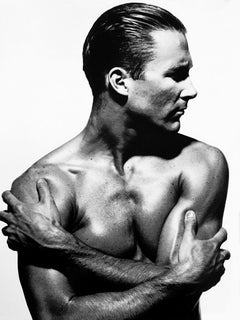
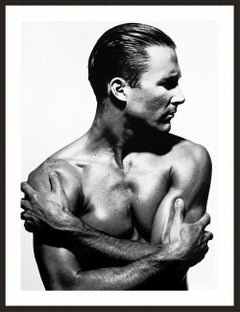
Ed. of 3, includes black frame with white mat. Vincent Ricardel is a photographic artist whose career has spanned the editorial, commercial and fine...

Category

1990s Palm Beach - Art

Materials

Silver Gelatin

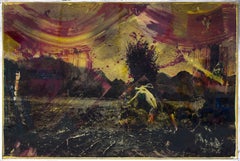
Punta Della Dogana
Punta Della Dogana

Punta Della Dogana

By Mona Kuhn

Located in Palm Beach, FL

Signed C-print, numbered 5 of 8. Acclaimed for her contemporary depictions, Kuhn is considered a leading artist in the world of figurative discourse. Throughout a career spanning m...

Category

2010s Contemporary Palm Beach - Art

Materials

C Print

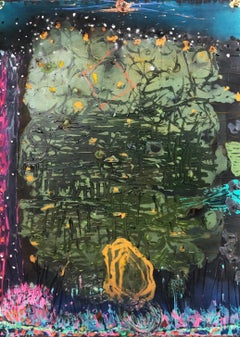
Gonetimesgonethatseethe

Gonetimesgonethatseethe

By Stanley Boxer

Located in Boca Raton, FL

Stanley Boxer devoted nearly five decades to the development of an expressive, abstract practice, encompassing drawing, sculpture, and printmaking. “In the manufacture of my art, I u...

Category

20th Century Contemporary Palm Beach - Art

Materials

Canvas, Mixed Media

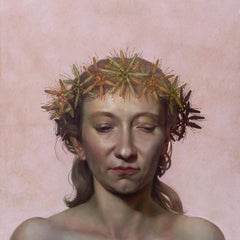
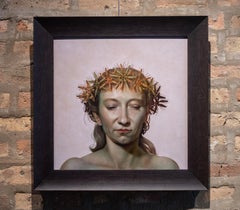
Portrait with Wreath Arrangement

Portrait with Wreath Arrangement

By Zane York

Located in Palm Beach, FL

Zane York coaxes and cajoles with a bit of humor which belies a deeper sensitivity. His eye-catching subjects never fail to cause a double-take. In our age of nearly constant visual ...

Category

21st Century and Contemporary Contemporary Palm Beach - Art

Materials

Copper

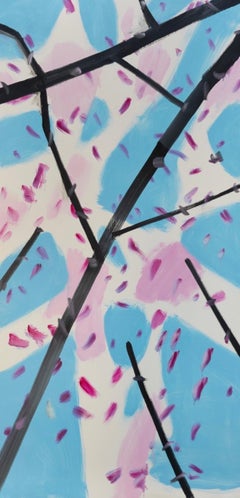
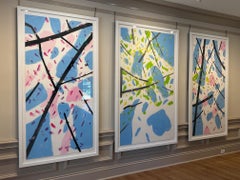
Spring 1
Spring 1

Spring 1

By Alex Katz

Located in Boca Raton, FL

The Spring series represents Katz’s profound engagement with the cyclical nature of time. The abstracted compositions of falling leaves or budding branches embody a conceptual rather...

Category

21st Century and Contemporary Pop Art Palm Beach - Art

Materials

Screen

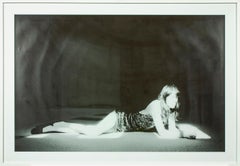
"Bleary" 35 MM Ilford black and white photograph by Sofia Malamute

"Bleary" 35 MM Ilford black and white photograph by Sofia Malamute

Located in Boca Raton, FL

"Bleary" 35MM Ilford black and white photograph by fine art and fashion photographer Sofia Malamute. Photograph of model Jamie Bochert shot for MAD Fall/Winter 2014. Image size 25 x ...

Category

2010s Contemporary Palm Beach - Art

Materials

Photographic Paper

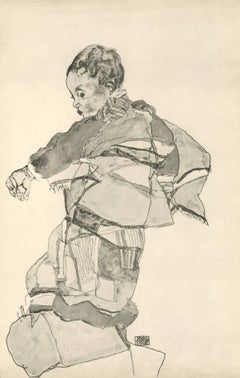
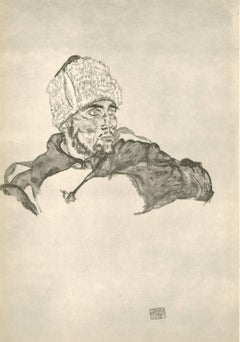
R. Layni, Zeichnungen folio, "Portrait of a Child" Collotype plate X

R. Layni, Zeichnungen folio, "Portrait of a Child" Collotype plate X

Located in Palm Beach, FL

Egon Schiele (1890 – 1918), AUSTRIA “ART CANNOT BE MODERN, ART IS PRIMORDIALLY ETERNAL.” -SCHIELE Defiantly iconoclastic in life and art, Egon Schiele is esteemed for his masterful draftsmanship and precocious insight into the human condition. Part of the first wave of Austrian Modernism, he was swept away by the Viennese fascination with the tension between Life and Death (known in the works of Freud and his later interpreters as Eros and Thanatos). Life, identified with attraction, love, sexuality, and reproduction, and Death, represented by distortion, disease, repulsion, and hysteria, often appeared in the same composition, thereby suggesting the frightening life cycle of the human mind and body. Young throughout his career, Schiele universalized his childhood traumas, thriving libido, insecurities, fears, and longings. His contorted line, jarring contrasts, and flat areas of color, demonstrate an early alliance with Expressionist philosophy and artists who were relentlessly frustrated by conventionality in all its forms. Schiele’s work embodied man’s disorientation and confusion in a seemingly absurd world, a world plagued by disease and war. It continues to be astonishingly relevant today, not just because it helped define Modernism but also because it revealed the dark and immutable aspects of the human condition. Zeichnungen is a fine art print portfolio published by Verlag der Buchhandlung Richard Lanyi, Vienna, 1917, printed by Max Jaffe...

Category

1910s Vienna Secession Palm Beach - Art

Materials

Paper

R. Layni, Zeichnungen folio, "Russian Soldier" Collotype plate VII

R. Layni, Zeichnungen folio, "Russian Soldier" Collotype plate VII

Located in Palm Beach, FL

Egon Schiele (1890 – 1918), AUSTRIA “ART CANNOT BE MODERN, ART IS PRIMORDIALLY ETERNAL.” -SCHIELE Defiantly iconoclastic in life and art, Egon Schiele is esteemed for his masterful draftsmanship and precocious insight into the human condition. Part of the first wave of Austrian Modernism, he was swept away by the Viennese fascination with the tension between Life and Death (known in the works of Freud and his later interpreters as Eros and Thanatos). Life, identified with attraction, love, sexuality, and reproduction, and Death, represented by distortion, disease, repulsion, and hysteria, often appeared in the same composition, thereby suggesting the frightening life cycle of the human mind and body. Young throughout his career, Schiele universalized his childhood traumas, thriving libido, insecurities, fears, and longings. His contorted line, jarring contrasts, and flat areas of color, demonstrate an early alliance with Expressionist philosophy and artists who were relentlessly frustrated by conventionality in all its forms. Schiele’s work embodied man’s disorientation and confusion in a seemingly absurd world, a world plagued by disease and war. It continues to be astonishingly relevant today, not just because it helped define Modernism but also because it revealed the dark and immutable aspects of the human condition. Zeichnungen is a fine art print portfolio published by Verlag der Buchhandlung Richard Lanyi, Vienna, 1917, printed by Max Jaffe...

Category

1910s Vienna Secession Palm Beach - Art

Materials

Paper

Mare 351
Mare 351

Mare 351

By Alessandro Puccinelli

Located in Boca Raton, FL

Unframed. Edition of 3.

Category

21st Century and Contemporary Contemporary Palm Beach - Art

Materials

Archival Pigment

Untitled
Untitled

Untitled

Located in Boca Raton, FL

Media = carbon and oil on wood.

Category

21st Century and Contemporary Abstract Palm Beach - Art

Materials

Mixed Media

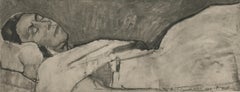
"Dying Woman" Copper Plate Heliogravure

"Dying Woman" Copper Plate Heliogravure

By Ferdinand Hodler & R. Piper & Co.

Located in Palm Beach, FL

2018 marks the centenary anniversary of Ferdinand Hodler’s death. In that 100 years time, the art world’s esteem of this important artist has proved fickle. It has shifted from extol...

Category

1910s Symbolist Palm Beach - Art

Materials

Paper

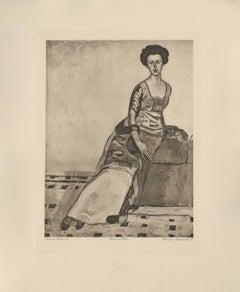
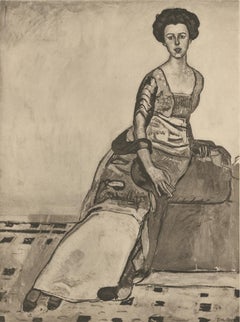
"Portrait of Mrs. Gertrude Miller" Copper Plate Heliogravure

"Portrait of Mrs. Gertrude Miller" Copper Plate Heliogravure

By Ferdinand Hodler & R. Piper & Co.

Located in Palm Beach, FL

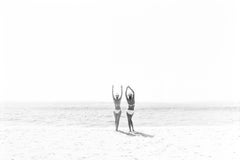
2018 marks the centenary anniversary of Ferdinand Hodler’s death. In that 100 years time, the art world’s esteem of this important artist has proved fickle. It has shifted from extolling his artistic merits during his lifetime to showing something of a feigned disdain- more reflective of the world political order than a true change of heart for Hodler’s work. After years of Hodler being all but a footnote in the annals of art history and generally ignored, finally, the pendulum has righted itself once again. Recent retrospective exhibitions in Europe and the United States have indicated not only a joyful rediscovery of Hodler’s art but a firm conviction that his work and world view hold particular relevance today. DAS WERK FERDINAND HODLERS is not only a collection of printed work reflecting the best of all of his painted work created up to 1914 just before the outbreak of World War I, the portfolio itself is an encapsulation of Hodler’s ethos, Parallelisme. Hodler developed his philosophy of Parallelisme as a unifying approach to art which strips away detail in search of harmony. By means of abstraction, symmetry and repetition, Hodler sought ways to depict Nature’s essence and her fundamental, universal order. He believed these universal laws governing the natural, observable world extend to the spiritual realm. Symbolist in nature with Romantic undertones, his works are equally portraits of these universal concepts and feelings governing all life as they are a visual portrait in the formal sense. Whether his subject is a solitary tree, a moment in battle, mortal fear, despair, the awe inspired by a vast mountain range, a tender moment or even the collective conviction in a belief, Hodler unveils this guiding principle of Parallelisme. Several aspects of Hodler’s portfolio reinforce his tenets of Parallelisme. The Table of Contents clearly preferences a harmonious design over detail. The two columns, consisting of twenty lines each, list the images by order of appearance using their German titles. The abbreviated titles are somewhat cryptic in that they obscure the identities of the sitters. Like the image Hodler presents, they are distillations of the sitter without any extraneous details. This shortening was also done in an effort to maintain a harmonious symmetry of the Table of Contents, themselves, and keep titles to a one-line limit. The twenty-fourth title: “Bildnis des Schweizerischen Gesandten C.” was so long, even with abbreviation, that it required two lines; so, for the sake of maintaining symmetry, the fortieth title: “Bauernmadchen” was omitted from the list. This explains why the images are not numbered. Hodler’s reasoning is not purely esoteric. Symmetry and pattern reach beyond mere formal design principles. Finding sameness and imposing it over disorder goes to the root of Hodler’s identity and his art. A Swiss native, Hodler was bi-lingual and spoke German and French. Each printed image, even number forty, have titles in both of Hodler’s languages. Certainly, there was a market for Hodler’s work among francophones and this inclusion may have been a polite gesture to that end; however, this is the only place in the portfolio which includes French. With German titles at the lower left of each image, Hodler’s name at bottom center and corresponding French titles at the lower right of each image, there is a harmony and symmetry woven into all aspects of the portfolio. This holds true for the page design, as it applies to each printed image and as it describes the Swiss artist himself. Seen in this light, Hodler’s portfolio of printed work is the epitome of Hodler’s Parallelisme. DAS WERK FERDINAND HODLERS is also one of the most significant documents to best tell the story of how Hodler, from Switzerland, became caught between political cross-hairs and how the changing tides of nations directly impacted the artist during his lifetime as well as the accessibility of his art for generations to come. The Munich-based publisher of the portfolio, R. Piper & Co., Verlag, plays a crucial role in this story. Publishing on a wide range of subjects from philosophy and world religion to music, literature and the visual arts; the publisher’s breadth of inquiry within any one genre was equal in scope. Their marketing strategy to publish multiple works on Hodler offers great insight as to what a hot commodity Hodler was at that time. R.Piper & Co.’s Almanach, which they published in 1914 in commemoration of their first ten years in business, clearly illustrates the rapid succession- strategically calculated for achieving the deepest and broadest impact - in which they released three works on Hodler to hit the market by the close of 1914. DAS WERK FERDINAND HODLERS was their premier publication. It preceded C.A. Loosli’s Die Zeichnungen Ferdinand Hodlers, a print portfolio after 50 drawings by Hodler which was released in Autumn of 1914 at the mid-level price-point of 75-150 Marks; and a third less expensive collection of prints after original works by Hodler, which had not been included in either of the first two portfolios, was released at the end of that year entitled Ferdinand Hodler by Dr. Ewald Bender. The title and timing of DAS WERK FERDINAND HODLERS' debut leaves little doubt as to the connection it has with another avant-garde portfolio of art prints, Das Werk Gustav Klimts, released in 5 installments from 1908 -1914 by Galerie Miethke in Vienna. Hodler, himself, was involved in Klimt’s ground-breaking project. As the owner of Klimt’s 1901 painting, “Judith with the Head of Holifernes” which appears as the ninth collotype print in the second installment of Das Werk Gustav Klimts, Hodler was obliged to grant access of the painting to the art printers in Vienna for them to create the collotype sometime before 1908. Hodler had been previously invited in 1904 to take part in what would be the last exhibition of the Vienna Secession before Klimt and others associated with Galerie Miethke broke away. In an interview that same year, Hodler indicated that he respected and was impressed by Klimt. Hodler’s esteem for Klimt went beyond the art itself; he emulated Klimt’s method aimed at increasing his market reach and appeal to a wider audience by creating a print portfolio of his painted work. By 1914, Hodler and his publisher had the benefit of hindsight to learn from Klimt’s Das Werk publication. Responding to the sluggish sales of Klimt’s expensive endeavor, Hodler’s publisher devised the same diversified 1-2-3 strategy for selling Hodler’s Das Werk portfolio as they did with regards to all three works on Hodler they published that year. For their premium tier of DAS WERKS FERDINAND HODLERS, R. Piper & Co. issued an exclusive Museum quality edition of 15 examples on which Hodler signed each page. At a cost of 600 Marks, this was generally on par with Klimt’s asking price of 600 Kronen for his Das Werk portfolio. A middle-tiered Preferred edition of 30, costing somewhat less and with Hodler’s signature only on the Title Page, was also available. The General edition, targeting the largest audience with its much more affordable price of 150 Marks, is distinguishable by its smaller size. Rather than use the subscription format Miethke had chosen for Klimt’s portfolios which proved to have had its challenges, R. Piper & Co. employed a different strategy. In addition to instantly gratifying the buyer with all 40 of the prints comprising DAS WERK FERDINAND HODLERS and the choice among three price points, they advertised in German journals a fourth possibility of ordering single prints from them directly. These printed images are easily discernible from the three complete folio editions. The paper size of the single purchased images is of the larger format like the Museum and Preferred editions, measuring 65 h x 50 w cm; however, the paper itself is the same copper print paper used in the General edition and then mounted on poster board. The publishing house positioned itself to be a direct retailer of Hodler’s art. They astutely recognized the potential for profitability and the importance, therefore, of having proprietary control over his graphic works. R. Piper & Co. owned the exclusive printing rights to Hodler’s best work found in their three publications dating from 1914. That same year, a competing publication out of Weimar entitled Ferdinand Hodler: Ein Deutungsversuch von Hans Muhlestein appeared. Its author, a young scholar, expressed his frustration with the limited availability of printable work by Hodler. In his Author’s Note on page 19, dated Easter, 1914, Muhlestein confirms that the publisher of Hodler’s three works from that same year owned the exclusive reproductive rights to Hodler’s printed original work. He goes further to explain that even after offering to pay to use certain of those images in his book, the publisher refused. Clearly, a lot of jockeying for position in what was perceived as a hot market was occurring in 1914. Instead, their timing couldn’t have been more ill-fated, and what began with such high hopes suddenly found a much different market amid a hostile climate. The onset of WWI directly impacted sales. Many, including Ferdinand Hodler, publicly protested the September invasion by Germany of France in which the Reims Cathedral, re-built in the 13th century, was shelled, destroying priceless stained glass and statuary and burning off the iron roof and badly damaging its wooden interior. Thomas Gaehtgens, Director of the Getty Research Institute describes how the bombing of Reims Cathedral triggered blindingly powerful and deeply-felt ultra-nationalistic responses: “The event profoundly shocked French intellectuals, who for the most part had an intense admiration for German literature, music and art. By relying on press accounts and abstracting from the visual propagandistic content, they were unable to interpret the siege of Reims without turning away from German culture in disgust. Similarly, the German intelligentsia and bourgeoisie were also shocked to find themselves described as vandals and barbarians. Ninety-three writers, scientists, university professors, and artists signed a protest, directed against the French insults, that defended the actions of the German army.” In similar fashion, a flurry of open letters published in German newspapers and journals as well as telegrams and postcards sent directly to Hodler following his outcry in support of Reims reflected the collectively critical reaction to Hodler’s position. Loosli documents that among the list of telegrams Hodler received was one from none other than his publisher in Germany, R.Piper & Co. Allegiances were questioned. The market for Hodler in Germany immediately softened. Matters worsened for the publisher beyond the German backlash to Hodler and his loss of appeal in the home market; with the war in full swing until 1918, there was little chance a German publisher would have much interest coming from outside of Germany and Austria. Following the war and Hodler’s death in 1918, the economy in Germany continued to spiral out and just 5 years later, hyper-inflation had rendered its currency worthless vis-a-vis its value in the pre-war years. Like the economy, Hodler’s reputation was slow to find currency in these difficult times. Even many French art fans had turned sour on Hodler as they considered his long-standing relationship in German and Austrian art circles. Thus, the portfolio’s rarity in Hodler’s lifetime and, consequently, the availability of these printed images from DAS WERK FERDINAND HODLERS since his death has been scarce. In many ways, Hodler and his portfolios were casualties of war. Thwarted from their intended purpose of reaching a wide audience and show-casing Parallelisme, Hodler’s unique approach to art, this important, undated work has been both elusive and shrouded in mystery. Perhaps DAS WERK FERDINAND HODLERS was left undated as a means of affirming the timelessness of Hodler’s art. Digging back into the past, Hodler’s contemporaries, like R. Piper, C.A. Loosli and Hans Muhlestein, indeed provide the keys to unequivocally clarify what has largely been mired in obscurity. Just after Hodler’s death, the May, 1918 issue of the Burlington Review ran a small column which opined hope for better access to R.Piper & Co.’s DAS WERK FERDINAND HODLERS; 100 years later, it is finally possible. Hodler’s voice rings out through these printed works. Once more, his modern approach to depicting portraits, landscapes and grand scale scenes of Swiss history speak to us of what is universal. Engaging with any one of these images is the chance to connect to Hodler’s vision and his world view- weltanschauung in German, vision du monde in French- however one expresses these concepts through language, its message embedded in his work is the same: “We differ from one another, but we are like each other even more. What unifies us is greater and more powerful than what divides us.” Today, Hodler’s art couldn’t be more timely. FERDINAND HODLER (SWISS, 1853-1918) explored Parallelisme through figurative poses evocative of music, dance and ritual. His images of sex, night, desertion and death as well as his many landscapes exploring the universal longing for harmony with Nature are unique and important works embodying a Symbolist paradigm. Truly a Modern Master, Hodler’s influence can be felt in the work of Gustav Klimt and Kolomon Moser...

Category

1910s Symbolist Palm Beach - Art
Materials

Paper

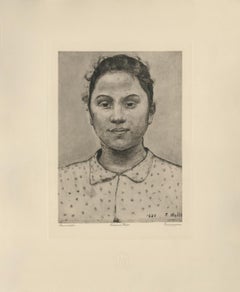
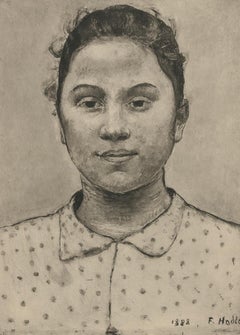
"Young Peasant Girl" Copper Plate Heliogravure

"Young Peasant Girl" Copper Plate Heliogravure

By Ferdinand Hodler & R. Piper & Co.

Located in Palm Beach, FL

2018 marks the centenary anniversary of Ferdinand Hodler’s death. In that 100 years time, the art world’s esteem of this important artist has proved fickle. It has shifted from extol...

Category

1910s Symbolist Palm Beach - Art
Materials

Paper

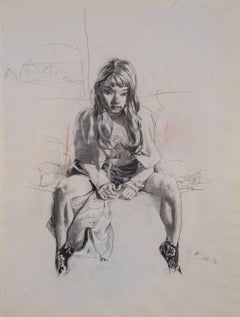
"Stare At Me" Mixed Media Drawing

"Stare At Me" Mixed Media Drawing

By Kent Williams

Located in Palm Beach, FL

Kent Williams’ work melds the rigor of technical prowess with the iconoclast’s impulse to disrupt. Juxtaposing beautifully rendered classical forms with elements of abstraction and s...

Category

21st Century and Contemporary Contemporary Palm Beach - Art

Materials

Mixed Media

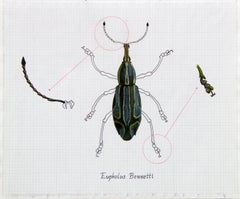
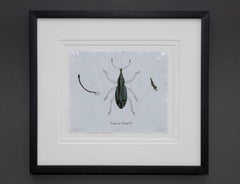
"Eupholus Bennetti (Blue Beetle)" Realism Painting/Drawing

"Eupholus Bennetti (Blue Beetle)" Realism Painting/Drawing

By Zane York

Located in Palm Beach, FL

Zane York deftly walks the line between playfulness and profundity. Drawing inspiration from the inherent strangeness of the natural world, York imbues quotidian scenes with subtle e...

Category

21st Century and Contemporary Contemporary Palm Beach - Art

Materials

Ink, Oil, Color Pencil

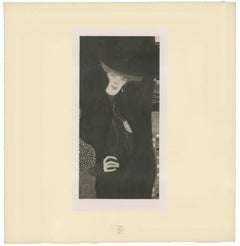
H.O. Miethke Das Werk folio "Portrait of Lady in Red and Black" collotype print

H.O. Miethke Das Werk folio "Portrait of Lady in Red and Black" collotype print

By Gustav Klimt & K.K. Hof-und Staatsdruckerei

Located in Palm Beach, FL

DAS WERK GUSTAV KLIMTS, a portfolio of 50 prints, ten of which are multicolor collotypes on chine colle paper laid down on hand-made heavy cream wove paper with deckled edges; under each of the 50 prints is a gold signet intaglio...

Category

Early 1900s Vienna Secession Palm Beach - Art

Materials

Paper

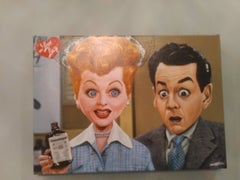
I Love Lucy TM Vitameatavegamin TM Licensed Artwork on Canvas

I Love Lucy TM Vitameatavegamin TM Licensed Artwork on Canvas

By Rich Conley

Located in Boca Raton, FL

Notice -- This is NOT a poster in a tube like many items you see for sale on 1stdibs. This is a giclee on professional CANVAS and arrives to you READY TO HANG on your wall. This piece is on 1.5 inch museum-quality stretcher bars. What a great gift for the Lucy fan! Rich Conley is regarded as one of this generation's foremost caricaturists. Conley is an authorized, licensed artist of The Three Stooges (C3 Entertainment) and I Love Lucy...

Category

2010s Contemporary Palm Beach - Art

Materials

Canvas, Inkjet

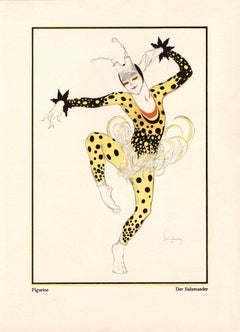
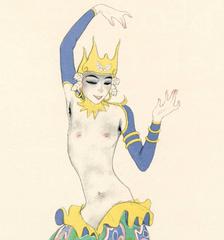
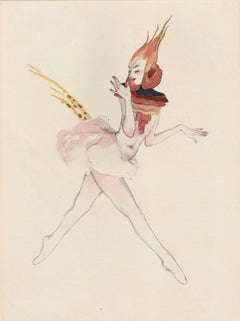
Kostume, Plakate, und Dekorationen, "Der Salamander"

Kostume, Plakate, und Dekorationen, "Der Salamander"

By Walter Schnackenberg

Located in Palm Beach, FL

Walter Schnackenberg’s style changed several times during his long and successful career. Having studied in Munich, the artist traveled often to Paris where he fell under the spell of the Henri de Toulouse-Lautrec’s colorful and sensuous posters depicting theatrical and decadent subjects. Schnackenberg became a regular contributor of similar compositions to the German magazines Jugend and Simplicissimus before devoting himself to the design of stage scenery and costumes. In the artist’s theatrical work, his mastery of form, ornamentation, and Orientalism became increasingly evident. He excelled at combining fluid Art Nouveau outlines, with spiky Expressionist passages, and the postures and patterns of the mysterious East...

Category

1910s Expressionist Palm Beach - Art

Materials

Lithograph

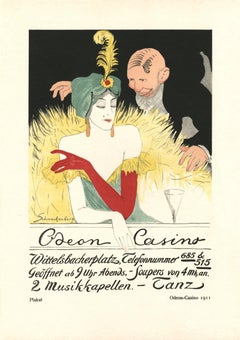
Kostume, Plakate, und Dekorationen, "Odeon-Casino 1911"

Kostume, Plakate, und Dekorationen, "Odeon-Casino 1911"

By Walter Schnackenberg

Located in Palm Beach, FL

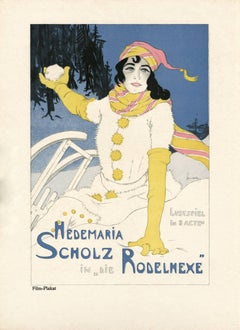
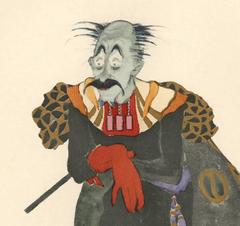
Walter Schnackenberg’s style changed several times during his long and successful career. Having studied in Munich, the artist traveled often to Paris where he fell under the spell of the Henri de Toulouse-Lautrec’s colorful and sensuous posters depicting theatrical and decadent subjects. Schnackenberg became a regular contributor of similar compositions to the German magazines Jugend and Simplicissimus before devoting himself to the design of stage scenery and costumes. In the artist’s theatrical work, his mastery of form, ornamentation, and Orientalism became increasingly evident. He excelled at combining fluid Art Nouveau outlines, with spiky Expressionist passages, and the postures and patterns of the mysterious East. In his later years, Schnackenberg explored the unconscious, using surreal subject matter and paler colors that plainly portrayed dreams and visions, some imbued with political connotations. His drawings, illustrations, folio prints, and posters are highly sought today for their exceedingly imaginative qualities, enchanting subject matter, and arresting use of color. SCHNACKENBERG: KOSTUME, PLAKATE UND DEKORATIONEN, a cardboard bound art book consisting of 43 prints of work by Walter Schnackenberg, 30 of which are color lithographs that are signed and some are titled and dated in the plate, as well as black and white prints and photographs with accompanying text by Oskar Bie; lithographs printed at Kunstanstalt Oskar Consee in Munich, other images printed by Gesellschaft Pick & Co. in Munich, the text and cover with color images by Schnackenberg front and verso printed by R. Oldenbourg in Munich; published by Musarion Verlag, Munich, 1920. The majority of Walter Schnackenberg’s artistic output was destroyed by bomb attacks in Munich in 1944. The highly publicized 2013 auction in New York of the recovered pre-war poster collection once belonging to German poster aficionado, Hans Sachs has reintroduced the world to Walter Schnackenberg’s graphic genius and priceless ephemeral art from a lost era. Besides the museum world, designer Karl Lagerfeld is one of the most prodigious collectors of Schnackenberg. Flipping through the pages of Kostume, Plakate und Dekorationen, it becomes quite clear that Schnackenberg’s collection is ground zero at the crossroads of early modern fashion where the cult of celebrity meets up with dance, music, theater and cabaret, film and the graphic medium. Berlin and Munich under Germany’s Weimar Republic in the first quarter of the 20th century produced just the atmosphere to feed this burgeoning industry. Rising inflation sparked a recklessness to live large for the moment and heightened a desire for escapism. An influx of Indian and East Asian dancers and musicians added to the artsy bohemian cultural mix. A new decadence and tolerance resulted. Film boldly featured provocative subject matter. Cabarets became popular venues giving rise to the demi-monde in which people from all social stations mixed more freely in a thriving underground economy and culture where there was a blurring of boundaries and of social codes. Noted art historian and cultural doyen, Oskar Bie astutely observes in his introduction to Schnackenberg’s publication that what unites the images is fantasy and advertisement. Schnackenberg uses the eye as an instrument to brilliantly construct and convey this double message. His personages never directly confront the viewer. Their eyes gaze off in the distance like those of the screenplayer and film star Hedamaria Scholz in Schnackenberg’s “Die Rodelhexe” movie poster. Their eyes follow the path of a dance composition or become a transfixed and ogling male gaze such as the iconic 1911 Odeon Casino...

Category

1910s Expressionist Palm Beach - Art

Materials

Lithograph

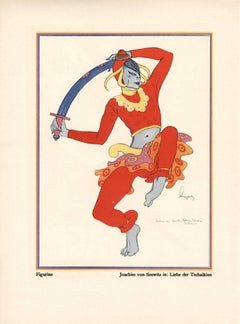
Kostume, Plakate, und Dekorationen, "Joachim von Seewitz"

Kostume, Plakate, und Dekorationen, "Joachim von Seewitz"

By Walter Schnackenberg

Located in Palm Beach, FL

Walter Schnackenberg’s style changed several times during his long and successful career. Having studied in Munich, the artist traveled often to Paris where he fell under the spell of the Henri de Toulouse-Lautrec’s colorful and sensuous posters depicting theatrical and decadent subjects. Schnackenberg became a regular contributor of similar compositions to the German magazines Jugend and Simplicissimus before devoting himself to the design of stage scenery and costumes. In the artist’s theatrical work, his mastery of form, ornamentation, and Orientalism became increasingly evident. He excelled at combining fluid Art Nouveau outlines, with spiky Expressionist passages, and the postures and patterns of the mysterious East. In his later years, Schnackenberg explored the unconscious, using surreal subject matter and paler colors that plainly portrayed dreams and visions, some imbued with political connotations. His drawings, illustrations, folio prints, and posters are highly sought today for their exceedingly imaginative qualities, enchanting subject matter, and arresting use of color. SCHNACKENBERG: KOSTUME, PLAKATE UND DEKORATIONEN, a cardboard bound art book consisting of 43 prints of work by Walter Schnackenberg, 30 of which are color lithographs that are signed and some are titled and dated in the plate, as well as black and white prints and photographs with accompanying text by Oskar Bie; lithographs printed at Kunstanstalt Oskar Consee in Munich, other images printed by Gesellschaft Pick & Co. in Munich, the text and cover with color images by Schnackenberg front and verso printed by R. Oldenbourg in Munich; published by Musarion Verlag, Munich, 1920. The majority of Walter Schnackenberg’s artistic output was destroyed by bomb attacks in Munich in 1944. The highly publicized 2013 auction in New York of the recovered pre-war poster collection once belonging to German poster aficionado, Hans Sachs has reintroduced the world to Walter Schnackenberg’s graphic genius and priceless ephemeral art from a lost era. Besides the museum world, designer Karl Lagerfeld is one of the most prodigious collectors of Schnackenberg. Flipping through the pages of Kostume, Plakate und Dekorationen, it becomes quite clear that Schnackenberg’s collection is ground zero at the crossroads of early modern fashion where the cult of celebrity meets up with dance, music, theater and cabaret, film and the graphic medium. Berlin and Munich under Germany’s Weimar Republic in the first quarter of the 20th century produced just the atmosphere to feed this burgeoning industry. Rising inflation sparked a recklessness to live large for the moment and heightened a desire for escapism. An influx of Indian and East Asian dancers and musicians added to the artsy bohemian cultural mix. A new decadence and tolerance resulted. Film boldly featured provocative subject matter. Cabarets became popular venues giving rise to the demi-monde in which people from all social stations mixed more freely in a thriving underground economy and culture where there was a blurring of boundaries and of social codes. Noted art historian and cultural doyen, Oskar Bie astutely observes in his introduction to Schnackenberg’s publication that what unites the images is fantasy and advertisement. Schnackenberg uses the eye as an instrument to brilliantly construct and convey this double message. His personages never directly confront the viewer. Their eyes gaze off in the distance like those of the screenplayer and film star Hedamaria Scholz in Schnackenberg’s “Die Rodelhexe” movie poster. Their eyes follow the path of a dance composition or become a transfixed and ogling male gaze such as the iconic 1911 Odeon Casino...

Category

1910s Expressionist Palm Beach - Art

Materials

Lithograph, Paper

Kostume, Plakate, und Dekorationen, "Lo Hesse"

Kostume, Plakate, und Dekorationen, "Lo Hesse"

By Walter Schnackenberg

Located in Palm Beach, FL

Walter Schnackenberg’s style changed several times during his long and successful career. Having studied in Munich, the artist traveled often to Paris where he fell under the spell of the Henri de Toulouse-Lautrec’s colorful and sensuous posters depicting theatrical and decadent subjects. Schnackenberg became a regular contributor of similar compositions to the German magazines Jugend and Simplicissimus before devoting himself to the design of stage scenery and costumes. In the artist’s theatrical work, his mastery of form, ornamentation, and Orientalism became increasingly evident. He excelled at combining fluid Art Nouveau outlines, with spiky Expressionist passages, and the postures and patterns of the mysterious East. In his later years, Schnackenberg explored the unconscious, using surreal subject matter and paler colors that plainly portrayed dreams and visions, some imbued with political connotations. His drawings, illustrations, folio prints, and posters are highly sought today for their exceedingly imaginative qualities, enchanting subject matter, and arresting use of color. SCHNACKENBERG: KOSTUME, PLAKATE UND DEKORATIONEN, a cardboard bound art book consisting of 43 prints of work by Walter Schnackenberg, 30 of which are color lithographs that are signed and some are titled and dated in the plate, as well as black and white prints and photographs with accompanying text by Oskar Bie; lithographs printed at Kunstanstalt Oskar Consee in Munich, other images printed by Gesellschaft Pick & Co. in Munich, the text and cover with color images by Schnackenberg front and verso printed by R. Oldenbourg in Munich; published by Musarion Verlag, Munich, 1920. The majority of Walter Schnackenberg’s artistic output was destroyed by bomb attacks in Munich in 1944. The highly publicized 2013 auction in New York of the recovered pre-war poster collection once belonging to German poster aficionado, Hans Sachs...

Category

1910s Expressionist Palm Beach - Art

Materials

Lithograph

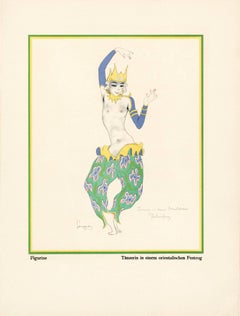
Kostume, Plakate, und Dekorationen, "Dancer in an Oriental Pageant"

Kostume, Plakate, und Dekorationen, "Dancer in an Oriental Pageant"

By Walter Schnackenberg

Located in Palm Beach, FL

Walter Schnackenberg’s style changed several times during his long and successful career. Having studied in Munich, the artist traveled often to Paris where he fell under the spell o...

Category

1910s Expressionist Palm Beach - Art

Materials

Paper

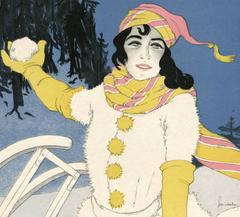
Kostume, Plakate, und Dekorationen, "Die Rodelhexe"

Kostume, Plakate, und Dekorationen, "Die Rodelhexe"

By Walter Schnackenberg

Located in Palm Beach, FL

Walter Schnackenberg’s style changed several times during his long and successful career. Having studied in Munich, the artist traveled often to Paris where he fell under the spell of the Henri de Toulouse-Lautrec’s colorful and sensuous posters depicting theatrical and decadent subjects. Schnackenberg became a regular contributor of similar compositions to the German magazines Jugend and Simplicissimus before devoting himself to the design of stage scenery and costumes. In the artist’s theatrical work, his mastery of form, ornamentation, and Orientalism became increasingly evident. He excelled at combining fluid Art Nouveau outlines, with spiky Expressionist passages, and the postures and patterns of the mysterious East. In his later years, Schnackenberg explored the unconscious, using surreal subject matter and paler colors that plainly portrayed dreams and visions, some imbued with political connotations. His drawings, illustrations, folio prints, and posters are highly sought today for their exceedingly imaginative qualities, enchanting subject matter, and arresting use of color. SCHNACKENBERG: KOSTUME, PLAKATE UND DEKORATIONEN, a cardboard bound art book consisting of 43 prints of work by Walter Schnackenberg, 30 of which are color lithographs that are signed and some are titled and dated in the plate, as well as black and white prints and photographs with accompanying text by Oskar Bie; lithographs printed at Kunstanstalt Oskar Consee in Munich, other images printed by Gesellschaft Pick & Co. in Munich, the text and cover with color images by Schnackenberg front and verso printed by R. Oldenbourg in Munich; published by Musarion Verlag, Munich, 1920. The majority of Walter Schnackenberg’s artistic output was destroyed by bomb attacks in Munich in 1944. The highly publicized 2013 auction in New York of the recovered pre-war poster collection once belonging to German poster aficionado, Hans Sachs has reintroduced the world to Walter Schnackenberg’s graphic genius and priceless ephemeral art from a lost era. Besides the museum world, designer Karl Lagerfeld is one of the most prodigious collectors of Schnackenberg. Flipping through the pages of Kostume, Plakate und Dekorationen, it becomes quite clear that Schnackenberg’s collection is ground zero at the crossroads of early modern fashion where the cult of celebrity meets up with dance, music, theater and cabaret, film and the graphic medium. Berlin and Munich under Germany’s Weimar Republic in the first quarter of the 20th century produced just the atmosphere to feed this burgeoning industry. Rising inflation sparked a recklessness to live large for the moment and heightened a desire for escapism. An influx of Indian and East Asian dancers and musicians added to the artsy bohemian cultural mix. A new decadence and tolerance resulted. Film boldly featured provocative subject matter. Cabarets became popular venues giving rise to the demi-monde in which people from all social stations mixed more freely in a thriving underground economy and culture where there was a blurring of boundaries and of social codes. Noted art historian and cultural doyen, Oskar Bie astutely observes in his introduction to Schnackenberg’s publication that what unites the images is fantasy and advertisement. Schnackenberg uses the eye as an instrument to brilliantly construct and convey this double message. His personages never directly confront the viewer. Their eyes gaze off in the distance like those of the screenplayer and film star Hedamaria Scholz in Schnackenberg’s “Die Rodelhexe” movie poster. Their eyes follow the path of a dance composition or become a transfixed and ogling male gaze such as the iconic 1911 Odeon Casino poster...

Category

1910s Expressionist Palm Beach - Art

Materials

Lithograph

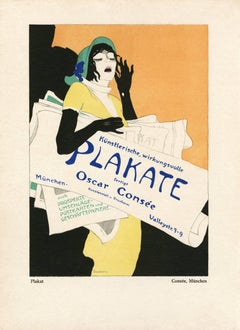
Kostume, Plakate, und Dekorationen, "Consee"

Kostume, Plakate, und Dekorationen, "Consee"

By Walter Schnackenberg

Located in Palm Beach, FL

Walter Schnackenberg’s style changed several times during his long and successful career. Having studied in Munich, the artist traveled often to Paris where he fell under the spell of the Henri de Toulouse-Lautrec’s colorful and sensuous posters depicting theatrical and decadent subjects. Schnackenberg became a regular contributor of similar compositions to the German magazines Jugend and Simplicissimus before devoting himself to the design of stage scenery and costumes. In the artist’s theatrical work, his mastery of form, ornamentation, and Orientalism became increasingly evident. He excelled at combining fluid Art Nouveau outlines, with spiky Expressionist passages, and the postures and patterns of the mysterious East...

Category

1910s Expressionist Palm Beach - Art

Materials

Lithograph

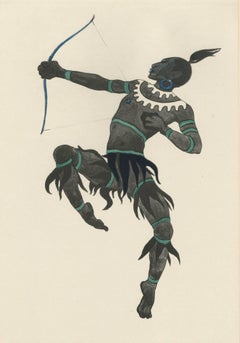
Ballet und Pantomime "Der Paradiesvogel" (Bird of Paradise) plate #1.

Ballet und Pantomime "Der Paradiesvogel" (Bird of Paradise) plate #1.

By Walter Schnackenberg

Located in Palm Beach, FL

Walter Schnackenberg’s style changed several times during his long and successful career. Having studied in Munich, the artist traveled often to Paris where he fell under the spell o...

Category

1920s Art Deco Palm Beach - Art

Materials

Paper

Ballet und Pantomime "Der bose Zauberer" (The Evil Wizard), plate #6.

Ballet und Pantomime "Der bose Zauberer" (The Evil Wizard), plate #6.

By Walter Schnackenberg

Located in Palm Beach, FL

Walter Schnackenberg’s style changed several times during his long and successful career. Having studied in Munich, the artist traveled often to Paris where he fell under the spell o...

Category

1920s Art Deco Palm Beach - Art

Materials

Paper

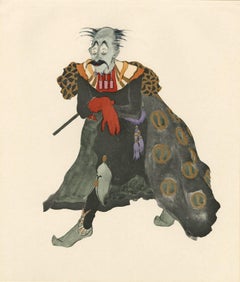
Ballet und Pantomime "Der Vogelfanger" (The Bird Catcher), plate #19.

Ballet und Pantomime "Der Vogelfanger" (The Bird Catcher), plate #19.

By Walter Schnackenberg

Located in Palm Beach, FL

Walter Schnackenberg’s style changed several times during his long and successful career. Having studied in Munich, the artist traveled often to Paris where he fell under the spell o...

Category

1920s Art Deco Palm Beach - Art

Materials

Paper

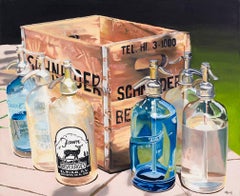
Seltzer
Seltzer

Seltzer

By Mark Schiff

Located in Boca Raton, FL

OPAC The Organization of Photorealist Artists and Collectors presents Seltzer, a signed and numbered giclee on canvas by famed photorealist Mark Schiff. This piece is 28" x 34". The ...

Category

2010s Photorealist Palm Beach - Art
Materials

Canvas, Ink

Tempest

Tempest

By Gino Miles

Located in Boca Raton, FL

overall dimension 96 x 28 x 28 inches sculpture measures 80 x 28 x 28 inches and base is 16 x 16 x 16 inches

Category

21st Century and Contemporary Abstract Palm Beach - Art

Materials

Bronze

Luminations Abstract Painting on Archival Paper, Framed, 1990s, Signed

Luminations Abstract Painting on Archival Paper, Framed, 1990s, Signed

By Frank Monaco

Located in Lake Worth Beach, FL

Luminations Series Gallery wrap, artist signed upper left corner, frame under plexiglass. Frank Monaco. Studied and worked with Marilyn Stiles of The Art Institute of Chicago/ Art...

Category

1990s Abstract Palm Beach - Art

Materials

Acrylic, Vinyl, Archival Paper

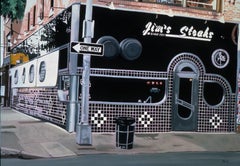
Jim's Steaks  Philadelphia Iconic Restaurant

Jim's Steaks Philadelphia Iconic Restaurant

By Mark Schiff

Located in Boca Raton, FL

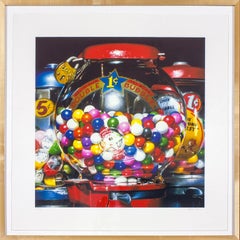
Please see accompanying video. We are a 1stdibs Platinum Seller with 100% 5-star reviews. One cannot appreciate this painting on a computer screen; in real life, it is absolutely amazing. Because you cannot appreciate it on a computer screen, our gallery has a unique policy. When purchasing from us, the buyer has sixty days to determine if they want to keep the artwork. If not, the buyer returns to piece to us for full refund, and we pay the shipping both ways! A collector should consider several factors when deciding from whom to purchase artwork online. Check the location of the seller. When one buys from a foreign seller, one also has to consider the problems of getting the piece through Customs. There are often delays and considerable fees to pay in order to import the item. When purchasing from us, we ship the same day and you receive it via FedEx the next day, no problems or hassles. When one purchases from an auction house, one pays a buyer’s premium of anywhere from 23% to 28% over the “hammer price”. So when one “wins” an auction for $20,000, the actual price paid is more like $25,000. By contrast, when purchasing from us, the price agreed to is the price paid by the buyer, no hidden fees. Secondly, when one purchases from an auction house, the buyer pays the packing and shipping fee, which are usually exorbitant. By contrast, when purchasing from us, the price includes packing and shipping. Thirdly, when one purchases from an auction house, the sale is final. If one receives the piece and is not 100% satisfied with it, there is nothing the buyer can do about it. They are stuck with it. By contrast, when purchasing from us, the buyer has sixty days to determine if they want to keep it. If not, the buyer returns to piece to us for full refund, and we pay the shipping both ways. About Mark Schiff — Animated by photographs that reflect his personal life, Mark Schiff’s paintings are fueled by what makes him happy. Through his open touch and signature blending method, he lends his artistic perception to the original photographic compositions captured on his Leica. Mark’s creative vision has been alive since he was a boy. As a child he spent his summers observing life as he rode the trolley back and forth to art classes at the Pratt Institute. During his future travels to Europe, Mark’s eye for light and photography merged with his passion for painting at the Jeu de Paume in Paris; which triggered his career in photorealism. Mark is well known for painting objects that people can identify and emotionally connect with. His work is distinctly marked by a rich palette and the luminous range of light he paints into his compositions. Each painting is a true extension of his vision and can take up to 200 hours to complete. Mark Schiff’s work has been commissioned by the well-known brands The Hershey Company and Tropicana. His private collectors include A-list celebrities and also corporate collectors in the US and abroad. Possessing a strong philanthropic nature, Mark donates both his time and works to charitable organizations such as Big Brothers Big Sisters, The Ronald McDonald House, Make-A-Wish Foundation, The Humane Society and the Special Olympics. Photorealism is widely viewed as one of this century’s most exciting genres of art. When a photorealistic painting is viewed from afar, it looks like a photograph. Only when getting very close to the art does the viewer realize that it is in fact not a photo, but rather an oil painting. Photorealism can also refer to sculptures. Duane Hanson is known as the greatest photorealistic sculptor of all time. Some of the greatest photorealistic painters include Mark Schiff, Richard Estes, Ralph Goings, Charles Bell and Audrey Flack. Photorealist Mark Schiff was born in Bedford Stuyvesant, Brooklyn, in a neighborhood known as a kuchalane, a Yiddish word which Schiff defines as a place where everyone (from the Old Country) ended up living on the same street, and most likely knowing each other’s business. His Russian grandfather came to the US before the revolution and both his parents were first generation American. Even at five years of age, Mark showed exceptional talent. In the summer, his mother permitted him to travel by himself on the trolley for art classes at the Pratt institute. He continued studying there until he was eleven and the family moved to Great Neck. Except for a few art classes in high school and playing baritone horn in the band, Mark focused on other things besides art, especially when his mother worried for his financial future, kept insisting “that Jewish boys don’t starve to death.” His father made a good living as a production man in textiles so Mark, who had spent years doing the rounds of knitting mills with his father, decided to major in textile chemistry at North Carolina State. ROTC was mandatory on his campus and he did two years in order to be eligible for officer status. He won the Armed Forces Chemical Association award and thought for sure that he would be assigned chemical work, but instead was made a tank commander and stationed at Fort Knox. Not exactly what his heart yearned for, but a good job awaited him at Sandoz, a Swiss company that made dyestuff. What perfect training for someone who would soon be working in wonderful rich colors on canvas. He went on to receive his MBA degree from Hofstra University, left Sandoz and was hired to sell at a spinning mill. He liked it. In 1976 he joined Bennett Berman Associates and had an opportunity to buy the spinning mill Spun Fibers. But what of art? In the early days, Elsie, his wife of fifty-two years, had a problem with the large amount of space his canvases occupied in their one bedroom apartment. Mark took up photography instead, which only required a small darkroom. Photography was a natural ally for his eventual return to painting in the photorealistic style. It was on his second trip to Europe that Mark fell in love with painting all over again. The impressionistic museum, Jeu de Paume in Paris, renewed his passion and it’s been non-stop since then. Out came the brushes, but this time, he used his love and skill of photography, and built a style based on the photographs he had taken, bringing them to life with paint. Mark was still not painting to sell until in 1990 when someone discovered and desperately wanted his candy bar (Sweet Series) painting. Mark didn’t want to let go of that particular piece, but was finally convinced to sell it and a second candy painting to this ardent art and candy lover. Two years later, Mark was commissioned to make three paintings of this man’s new Ferrari. Some of the artists who have inspired his work are Richard Estes, Sandy Scott, Chuck Close, and Charles Bell. He appreciates the work of Ken Keeley, but unlike Keeley’s hard-lined/tape and ruler style, Mark prefers an open touch, using the blending method. Mark’s subject matters range from candy bars to spice racks to soda cans and soda bottles. He photographs with a Leica M-7 and each painting can take up to 200 or more hours to complete. His palette is rich; his subjects, be it a fire engine or a pretzel cart, take on a luminous quality, always photoreal, but even more beautiful. Mark developed his own technique for working with bottles by painting a canvas all black, so that the transparency of the bottles allows a wonderful range of light to filter through. The same light and reflection can be seen in the black rotary phone...

Category

Early 2000s American Realist Palm Beach - Art
Materials

Canvas, Oil

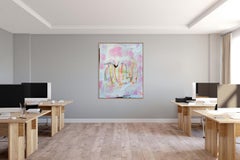
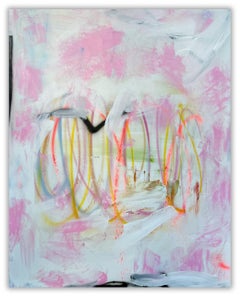
Holograms Cascade (Abstract painting)

Holograms Cascade (Abstract painting)

By Tommaso Fattovich

Located in London, GB

Holograms Cascade (Abstract painting) Oil and acrylic on canvas - Unframed. This artwork will be shipped flat within the US. If shipped outside of the US this work will be shipped r...

Category

2010s Abstract Palm Beach - Art

Materials

Canvas, Oil, Acrylic

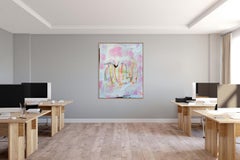
Holograms Cascade (Abstract painting)

Holograms Cascade (Abstract painting)

By Tommaso Fattovich

Located in London, GB

Holograms Cascade (Abstract painting) Oil and acrylic on canvas - Unframed. This artwork will be shipped flat within the US. If shipped outside of the US this work will be shipped r...

Category

2010s Abstract Palm Beach - Art

Materials

Canvas, Oil, Acrylic

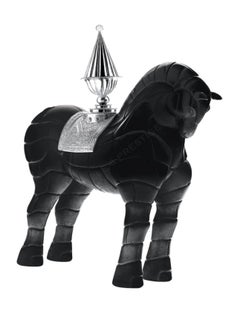
Horse Carrying Fire by Hilton McConnico

Horse Carrying Fire by Hilton McConnico

By Daum

Located in Boca Raton, FL

A mythical piece of Daum's legacy, "Horse Carrying Fire" is inspired by legend. This magnificent horse with its fine silver embellishment appears to have stepped straight out of a th...

Category

20th Century Art Deco Palm Beach - Art

Materials

Glass

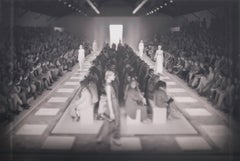
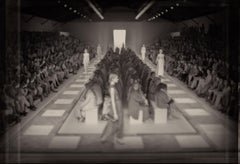
"Spirits of Valentino, Fall/Winter 2012" inkjet on canvas by Simon Procter

"Spirits of Valentino, Fall/Winter 2012" inkjet on canvas by Simon Procter

By SIMON PROCTER

Located in Boca Raton, FL

"Spirits of Valentino, Fall/Winter 2012" photograph of a runway show for the renowned Italian fashion house taken by fine art photographer Simon Procter. Specialist inkjet on gallery...

Category

2010s Contemporary Palm Beach - Art

Materials

Canvas, Screen

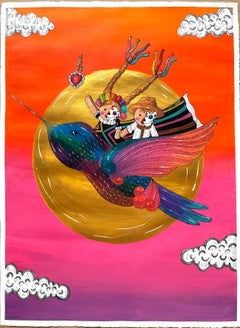
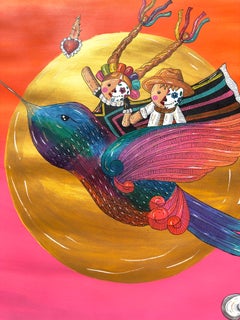
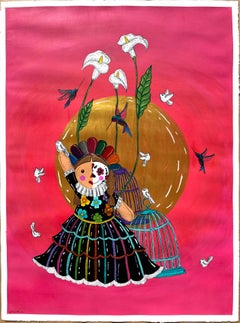
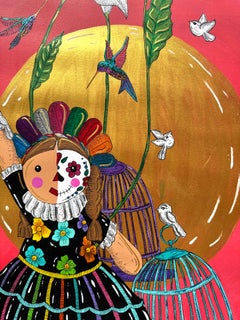
Carmesi Crimson Mixed Media on Paper

Carmesi Crimson Mixed Media on Paper

By Gabriela Fournier

Located in Lake Worth Beach, FL

Carmesi Artist signed and titled. Acrylic, Indian Ink on Archival Paper. Gabriela Fournier emerging young Mexican artist, born in Guanajuato 2001. She discovered art at a very you...

Category

2010s Contemporary Palm Beach - Art

Materials

India Ink, Acrylic, Archival Paper

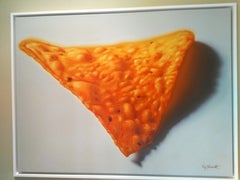
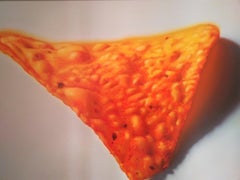
Dorito -- Original Oil Painting

Dorito -- Original Oil Painting

By Doug Bloodworth

Located in Boca Raton, FL

This is an original oil painting on canvas This artwork is produced under a license from the Frito-Lay® company. We are a 1stdibs Platinum Seller. Th...

Category

2010s Photorealist Palm Beach - Art
Materials

Wood, Oil

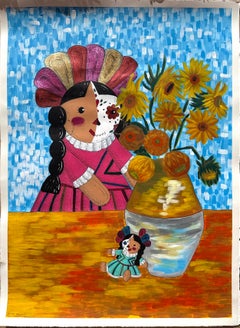
Los Amigos De Lele Lele's Friends Mixed Media On Paper

Los Amigos De Lele Lele's Friends Mixed Media On Paper

By Gabriela Fournier

Located in Lake Worth Beach, FL

Los Amigos De Lele Artist signed and titled. Acrylic, Indian Ink on Archival Paper. Gabriela Fournier emerging young Mexican artist, born in Guanajuato 2001. She discovered art at ...

Category

2010s Contemporary Palm Beach - Art

Materials

India Ink, Acrylic, Archival Paper

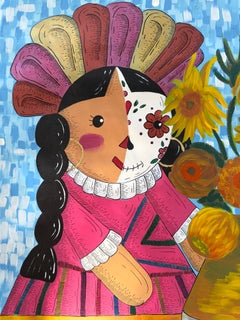
Los Girasoles De Lele, Lele's Sunflowers

Los Girasoles De Lele, Lele's Sunflowers

By Gabriela Fournier

Located in Lake Worth Beach, FL

Los Girasoles De Lele Artist signed and titled. Acrylic, Indian Ink on Archival Paper. Gabriela Fournier emerging young Mexican artist, born in Guanajuato 2001. She discovered art ...

Category

2010s Contemporary Palm Beach - Art

Materials

India Ink, Acrylic, Archival Paper

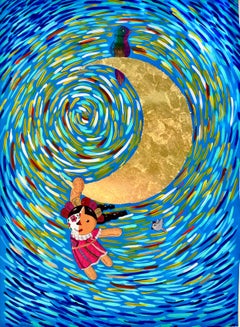
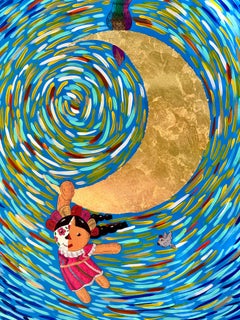
La Noche De Lele, Lele's Night Mixed Media On Paper

La Noche De Lele, Lele's Night Mixed Media On Paper

By Gabriela Fournier

Located in Lake Worth Beach, FL

La Noche De Lele Artist signed and titled. Acrylic, Indian Ink on Archival Paper. Gabriela Fournier emerging young Mexican artist, born in Guanajuato born 2001. She discovered art...

Category

2010s Palm Beach - Art

Materials

India Ink, Acrylic, Archival Paper

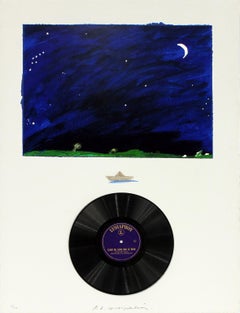
"Untitled" screenprint and collage by Raymond E. Waydelich from "Kinderstern"

"Untitled" screenprint and collage by Raymond E. Waydelich from "Kinderstern"

By Raymond Waydelich

Located in Boca Raton, FL

"Untitled" screenprint and collage by artist Raymond E. Waydelich from the "Kinderstern" portfolio, published in 1989 by Edition Domberger to raise money to house families of childre...

Category

1980s Contemporary Palm Beach - Art

Materials

Screen, Mixed Media

Soy Un Guerrero. Y Busco Peligro. (Abstract painting)

Soy Un Guerrero. Y Busco Peligro. (Abstract painting)

By Tommaso Fattovich

Located in London, GB

Soy Un Guerrero. Y Busco Peligro. (Abstract painting) Oil and acrylic on canvas - Unframed. This artwork will be shipped flat within the US. If shipped outside of the US this work ...

Category

2010s Abstract Palm Beach - Art
Materials

Canvas, Oil, Acrylic

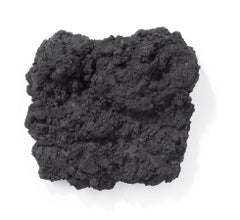
Controlling Chaos 30 X 30

Controlling Chaos 30 X 30

By José Castro

Located in West Palm Beach, FL

Controlling Chaos. 2023 30 X 30 Acrylic, gesso, plaster of Paris and ink on cradled birchwood. Jose Castro was born in Matanzas, Cuba in 1947. In 1961, when he was 14, he was sent to...

Category

2010s Contemporary Palm Beach - Art
Materials

Gesso, Plaster, Ink, Acrylic, Wood Panel