5,407 results for "cubism"

to
2,340
3,560
1,637
1,010
662
3,275
1,726
262
2,515
1,095
843
410
518
Overall Height
to
Overall Width
to
1,355
673
576
445
434
251
71
53
53
29
13
7
6
1,597
916
859
633
581
485
322
291
178
102
92
84
75
68
65
64
64
62
62
60
1
26
4,241
1,138
16
62
244
300
319
745
1,019
498
259
77
1
382
275
129
109
93
2,268
1,869
1,079
790
748
Frank Stella, Rabat, from Ten Works by Ten Painters, 1964

Frank Stella, Rabat, from Ten Works by Ten Painters, 1964

By Frank Stella

Located in Southampton, NY

This exquisite silkscreen by Frank Stella (1936–2024), titled Rabat, originates from the landmark 1964 folio X + X (Ten Works by Ten Painters). Published by the Wadsworth Atheneum Mu...

Category

1960s Minimalist Landscape Prints

Materials

Screen

Georges Braque, Landscape at L'Estaque, from Fauves, VII, 1972 (after)

Georges Braque, Landscape at L'Estaque, from Fauves, VII, 1972 (after)

By Georges Braque

Located in Southampton, NY

This exquisite lithograph after Georges Braque (1882–1963), titled Paysage a L'estaque (Landscape at L'Estaque), from the folio Fauves, VII, Collection Pierre Levy, 1972, originates ...

Category

1970s Fauvist Landscape Prints

Materials

Lithograph
Marc Chagall, The Accordionist, from Chagall, 1957

Marc Chagall, The Accordionist, from Chagall, 1957

By Marc Chagall

Located in Southampton, NY

This exquisite lithograph by Marc Chagall (1887–1985), titled L’Accordeoniste (The Accordionist), from the album Chagall, originates from the 1957 edition published by Maeght Editeur...

Category

1950s Expressionist Figurative Prints

Materials

Lithograph
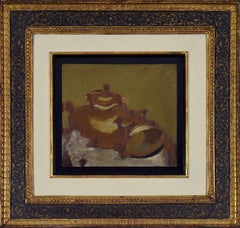
Joan Miró - MARAVILLAS CON VARIACIONES... Lithograph Contemporary Art Abstract
Joan Miró - MARAVILLAS CON VARIACIONES... Lithograph Contemporary Art Abstract
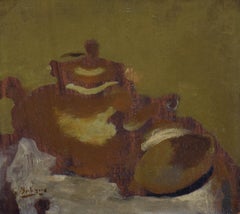
By Joan Miró

Located in Madrid, Madrid

Joan Miró - Maravillas con variaciones acrósticas en el jardín de Miró XVIII Date of creation: 1975 Medium: Lithograph on Gvarro paper Edition: 1500 Size: 49,5 x 35,5 cm Observations...
Category

1970s Abstract Abstract Prints

Materials

Lithograph
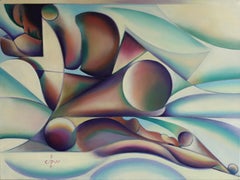
Marc Chagall, The Horsewoman with the Red Horse, from XXe Siecle, 1957

Marc Chagall, The Horsewoman with the Red Horse, from XXe Siecle, 1957

By Marc Chagall

Located in Southampton, NY

This exquisite lithograph and pochoir by Marc Chagall (1887–1985), titled L'ecuyere au cheval rouge (The Horsewoman with the Red Horse), from the album XXe Siecle, Nouvelle serie No....
Category

1950s Expressionist Figurative Prints

Materials

Lithograph
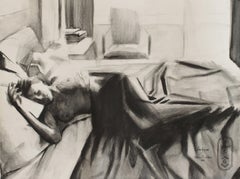
Single Leaf With Red - vibrant, abstract, cubist, modernist, acrylic on canvas

Single Leaf With Red - vibrant, abstract, cubist, modernist, acrylic on canvas

By Otto Rogers

Located in Bloomfield, ON

A leaf shape is poised within balanced passages of red, green and blue in this masterful acrylic by Otto Rogers. Painted in 2018, this vibrant yet contemplative composition is an exp...

Category

2010s Contemporary Abstract Paintings

Materials

Canvas, Acrylic

The Struggle is Real - Large Colorful Original Abstract Painting on Canvas

The Struggle is Real - Large Colorful Original Abstract Painting on Canvas

By Bruce Rubenstein

Located in Los Angeles, CA

The paintings of Bruce Rubenstein seamlessly marry sophistication with affordability. His original art merges the creative attitudes of the two distinct art hot spots of New York and...

Category

21st Century and Contemporary Abstract Mixed Media

Materials

Canvas, Mixed Media, Acrylic

Statimque Tobias Visum Recepit - Lithograph - 1967- 1969
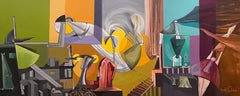
Statimque Tobias Visum Recepit - Lithograph - 1967- 1969
By Salvador Dalí­

Located in Roma, IT

Statimque Tobias visum recepit ("And immediately Tobit revovered his sight") is an artwork realized in 1964. It is part of Biblia Sacra vulgatæ editionis published by Rizzoli-Mediola...

Category

1970s Surrealist Figurative Prints

Materials

Lithograph
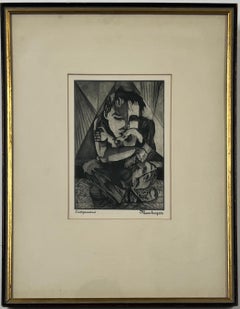
Piet Mondrian, Sans titre, from XXe Siecle, 1957 (after)

Piet Mondrian, Sans titre, from XXe Siecle, 1957 (after)

By Piet Mondrian

Located in Southampton, NY

This exquisite lithograph and pochoir after Piet Mondrian (1872–1944), titled Sans titre (Untitled), from the album XXe Siecle, Nouvelle serie N°9 (double), Juin 1957, originates fro...

Category

1950s Abstract Geometric Abstract Prints

Materials

Lithograph
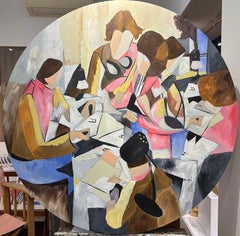
Marie Laurencin, Untitled, from Les Biches, 1924

Marie Laurencin, Untitled, from Les Biches, 1924

By Marie Laurencin

Located in Southampton, NY

This exquisite lithograph and pochoir by Marie Laurencin (1883–1956), titled Sans titre (Untitled), from the album Les Biches (The Does), originates from the 1924 edition published b...

Category

1920s Modern Landscape Prints

Materials

Lithograph, Stencil

Joan Miro, Untitled, from The Sun Bird, The Moon Bird, Sparks, 1967 (after)

Joan Miro, Untitled, from The Sun Bird, The Moon Bird, Sparks, 1967 (after)

By Joan Miró

Located in Southampton, NY

This exquisite lithograph and pochoir after Joan Miro (1893–1983), titled Sans titre (Untitled), from the album Miro, L'Oiseau solaire, L'Oiseau lunaire, Etincelles (Miro, The Sun Bi...

Category

1960s Surrealist Abstract Prints

Materials

Lithograph
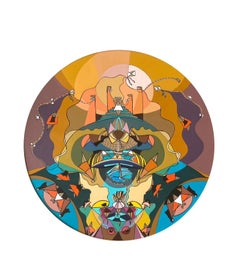
Machine Age Industrial WPA Era American Scene Social Realism Mid 20th Century

Machine Age Industrial WPA Era American Scene Social Realism Mid 20th Century

By Jo Cain

Located in New York, NY

Machine Age Industrial WPA Era American Scene Social Realism Mid 20th Century Jo Cain (1904 - 2003) Elliot 17 ¼ x 35 ¾ inches Gouache on board, c. 1930s Signed lower left 27 x 46 in...

Category

1930s Interior Drawings and Watercolors

Materials

Gouache, Board

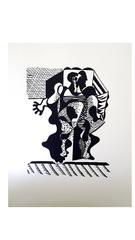
Pablo Picasso, Seated Woman and Two Dancers, from The Honeysuckle, 1943

Pablo Picasso, Seated Woman and Two Dancers, from The Honeysuckle, 1943

By Pablo Picasso

Located in Southampton, NY

This exquisite zincograph by Pablo Picasso (1881–1973), titled Femme assise et deux danseurs (Seated Woman and Two Dancers), from the album Le Chevre-Feuille (The Honeysuckle), origi...

Category

1940s Cubist Abstract Prints

Materials

Lithograph
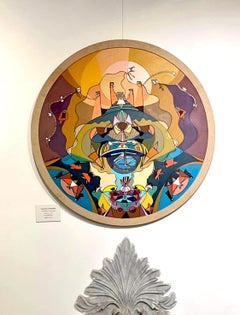
Proelium Magnum in Caelo - Lithograph - 1967
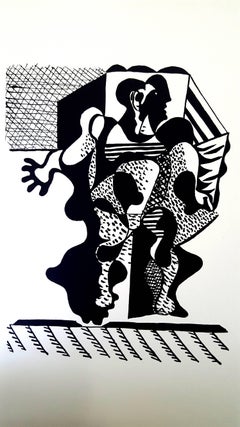
Proelium Magnum in Caelo - Lithograph - 1967
By Salvador Dalí­

Located in Roma, IT

Proelium Magnum in Caelo is a Color lithograph on heavy rag paper realized in 1964 by Salvador Dalì, It is part of Biblia Sacra vulgatæ edition is published by Rizzoli-Mediolani betw...
Category

1960s Surrealist Figurative Prints

Materials

Lithograph
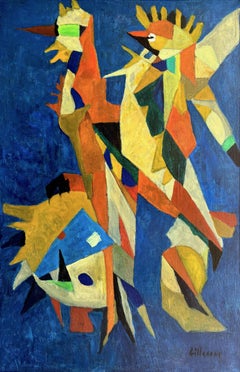
French Neo-Impressionist Pointillist Abstract Mid 20th Century Painting

French Neo-Impressionist Pointillist Abstract Mid 20th Century Painting

By Louis Bellon

Located in Cirencester, Gloucestershire

Pointillist Abstract Design by Louis Bellon (French 1908-1998) initialled lower right gouache painting on paper, unframed measurements: 8.75 x 6 inches (overall the sheet measures 11...

Category

Mid-20th Century Pointillist Abstract Paintings

Materials

Watercolor, Gouache

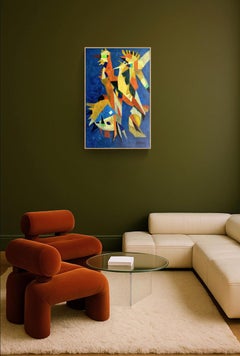
Wifredo Lam, Figure, from XXe siecle, 1974

Wifredo Lam, Figure, from XXe siecle, 1974

By Wifredo Lam

Located in Southampton, NY

This exquisite lithograph by Wifredo Lam (1902–1982), titled Personnage (Figure), from the album XXe siecle, Nouvelle serie, XXXVIe Annee, No. 42, originat...
Category

1970s Modern Abstract Prints

Materials

Lithograph
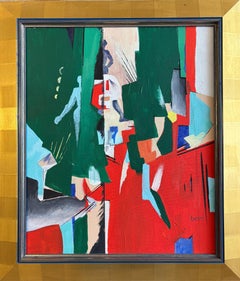
Giacometti, Composition, Derrière le miroir (after)

Giacometti, Composition, Derrière le miroir (after)

By Alberto Giacometti

Located in Southampton, NY

Lithograph on vélin paper. Inscription: Unsigned and unnumbered, as issued. Good condition. Notes: From Derrière le miroir, N° 148, 1964. Published by Aimé Maeght, Éditeur, Paris; pr...
Category

1960s Modern Abstract Prints

Materials

Lithograph
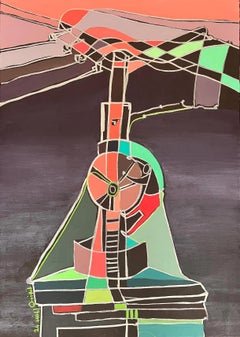
French Neo-Impressionist Pointillist Abstract Mid 20th Century Small Painting

French Neo-Impressionist Pointillist Abstract Mid 20th Century Small Painting

By Louis Bellon

Located in Cirencester, Gloucestershire

Pointillist Abstract Design by Louis Bellon (French 1908-1998) initialled lower right in the image and again in the margin gouache painting on paper, unframed unfinished sketch on th...

Category

Mid-20th Century Pointillist Abstract Paintings

Materials

Watercolor, Gouache

Le Serment des femmes (Bloch 267-272; Cramer 24), Lysistrata, Pablo Picasso

Le Serment des femmes (Bloch 267-272; Cramer 24), Lysistrata, Pablo Picasso

By Pablo Picasso

Located in Southampton, NY

Etching on vélin de Rives BFK paper. Paper Size: 11.5 x 9 inches. Inscription: Unsigned and unnumbered, as issued. Notes: From the album, Lysistrata, 1934. Published by The Limited E...

Category

1930s Cubist Abstract Prints

Materials

Etching

Marc Chagall - Original Lithograph

Marc Chagall - Original Lithograph

By Marc Chagall

Located in Collonge Bellerive, Geneve, CH

Marc Chagall Original Lithograph 1963 Dimensions: 32 x 24 cm Reference: Chagall Lithographe 1957-1962. VOLUME II. Condition : Excellent Marc Chagall (born in 1887) Marc Chagall was born in Belarus in 1887 and developed an early interest in art. After studying painting, in 1907 he left Russia for Paris, where he lived in an artist colony on the city’s outskirts. Fusing his own personal, dreamlike imagery with hints of the fauvism and cubism popular in France at the time, Chagall created his most lasting work—including I and the Village (1911)—some of which would be featured in the Salon des Indépendants exhibitions. After returning to Vitebsk for a visit in 1914, the outbreak of WWI trapped Chagall in Russia. He returned to France in 1923 but was forced to flee the country and Nazi persecution during WWII. Finding asylum in the U.S., Chagall became involved in set and costume design before returning to France in 1948. In his later years, he experimented with new art forms and was commissioned to produce numerous large-scale works. Chagall died in St.-Paul-de-Vence in 1985. The Village Marc Chagall was born in a small Hassidic community on the outskirts of Vitebsk, Belarus, on July 7, 1887. His father was a fishmonger, and his mother ran a small sundries shop in the village. As a child, Chagall attended the Jewish elementary school, where he studied Hebrew and the Bible, before later attending the Russian public school. He began to learn the fundamentals of drawing during this time, but perhaps more importantly, he absorbed the world around him, storing away the imagery and themes that would feature largely in most of his later work. At age 19 Chagall enrolled at a private, all-Jewish art school and began his formal education in painting, studying briefly with portrait artist Yehuda Pen. However, he left the school after several months, moving to St. Petersburg in 1907 to study at the Imperial Society for the Protection of Fine Arts. The following year, he enrolled at the Svanseva School, studying with set designer Léon Bakst, whose work had been featured in Sergei Diaghilev's Ballets Russes. This early experience would prove important to Chagall’s later career as well. Despite this formal instruction, and the widespread popularity of realism in Russia at the time, Chagall was already establishing his own personal style, which featured a more dreamlike unreality and the people, places and imagery that were close to his heart. Some examples from this period are his Window Vitebsk (1908) and My Fianceé with Black Gloves (1909), which pictured Bella Rosenfeld, to whom he had recently become engaged. The Beehive Despite his romance with Bella, in 1911 an allowance from Russian parliament member and art patron Maxim Binaver enabled Chagall to move to Paris, France. After settling briefly in the Montparnasse neighborhood, Chagall moved further afield to an artist colony known as La Ruche (“The Beehive”), where he began to work side by side with abstract painters such as Amedeo Modigliani and Fernand Léger as well as the avant-garde poet Guillaume Apollinaire. At their urging, and under the influence of the wildly popular fauvism and cubism, Chagall lightened his palette and pushed his style ever further from reality. I and the Village (1911) and Homage to Apollinaire (1912) are among his early Parisian works, widely considered to be his most successful and representative period. Though his work stood stylistically apart from his cubist contemporaries, from 1912 to 1914 Chagall exhibited several paintings at the annual Salon des Indépendants exhibition, where works by the likes of Juan Gris, Marcel Duchamp and Robert Delaunay were causing a stir in the Paris art world. Chagall’s popularity began to spread beyond La Ruche, and in May 1914 he traveled to Berlin to help organize his first solo exhibition, at Der Sturm Gallery. Chagall remained in the city until the highly acclaimed show opened that June. He then returned to Vitebsk, unaware of the fateful events to come. War, Peace and Revolution In August 1914 the outbreak of World War I precluded Chagall’s plans to return to Paris. The conflict did little to stem the flow of his creative output, however, instead merely giving him direct access to the childhood scenes so essential to his work, as seen in paintings such as Jew in Green (1914) and Over Vitebsk (1914). His paintings from this period also occasionally featured images of the war’s impact on the region, as with Wounded Soldier (1914) and Marching (1915). But despite the hardships of life during wartime, this would also prove to be a joyful period for Chagall. In July 1915 he married Bella, and she gave birth to a daughter, Ida, the following year. Their appearance in works such as Birthday (1915), Bella and Ida by the Window (1917) and several of his “Lovers” paintings give a glimpse of the island of domestic bliss that was Chagall’s amidst the chaos. To avoid military service and stay with his new family, Chagall took a position as a clerk in the Ministry of War Economy in St. Petersburg. While there he began work on his autobiography and also immersed himself in the local art scene, befriending novelist Boris Pasternak, among others. He also exhibited his work in the city and soon gained considerable recognition. That notoriety would prove important in the aftermath of the 1917 Russian Revolution when he was appointed as the Commissar of Fine Arts in Vitebsk. In his new post, Chagall undertook various projects in the region, including the 1919 founding of the Academy of the Arts. Despite these endeavors, differences among his colleagues eventually disillusioned Chagall. In 1920 he relinquished his position and moved his family to Moscow, the post-revolution capital of Russia. In Moscow, Chagall was soon commissioned to create sets and costumes for various productions at the Moscow State Yiddish Theater...

Category

1960s Surrealist Figurative Prints

Materials

Lithograph

Andy Warhol - Roy Lichtenstein polaroid, Authenticated by the Warhol Foundation

Andy Warhol - Roy Lichtenstein polaroid, Authenticated by the Warhol Foundation

By Andy Warhol

Located in New York, NY

Andy Warhol Portrait of Roy Lichtenstein, 1975 Polaroid dye-diffusion print Authenticated by the Andy Warhol Foundation for the Visual Arts, bears the Foundation stamp verso Frame in...

Category

1970s Pop Art Portrait Photography

Materials

Polaroid

1963 original poster by Marc Chagall - Les peintres témoins de leur temps

1963 original poster by Marc Chagall - Les peintres témoins de leur temps

By Marc Chagall

Located in PARIS, FR

In 1963, the Musée Galliera in Paris hosted the exhibition Les Peintres Témoins de Leur Temps (Painters as Witnesses of Their Time), a significant event that brought together some of...

Category

1960s Prints and Multiples

Materials

Paper, Lithograph

"STILL LIFE FRUIT" MID CENTURY

"STILL LIFE FRUIT" MID CENTURY

By Michael Frary

Located in San Antonio, TX

Michael Frary (1918 - 2005) Austin Artist Image Size: 16 x 20 Frame Size: 17.5 x 21.5 Medium: Oil "Still Life Fruit" Biography Michael Frary (1918 - ...

Category

1960s American Modern Still-life Paintings

Materials

Oil

Juan Gris, Guitar, from Au Soleil du Plafond, 1955 (after)

Juan Gris, Guitar, from Au Soleil du Plafond, 1955 (after)

By Juan Gris

Located in Southampton, NY

This exquisite lithograph after Juan Gris (1887–1927), titled Guitare (Guitar), from the folio Au Soleil du Plafond (In the Sunlight of the Ceiling), originates from the 1955 edition...

Category

1950s Cubist Abstract Prints

Materials

Lithograph

Claude Lagouche Orignal 1970's French Psychedelic Abstract Drawing

Claude Lagouche Orignal 1970's French Psychedelic Abstract Drawing

Located in Cirencester, Gloucestershire

Artist: Claude Lagouche (French 1943-2020) Claude Lagouche was born January 2, 1943 in Naves, died January 16, 2020. He quickly gained recognition for his talent and his work, exh...

Category

Mid-20th Century Abstract Paintings

Materials

Acrylic

Return to Forever - Large Original Abstract Expressionism Painting on Canvas

Return to Forever - Large Original Abstract Expressionism Painting on Canvas

By Bruce Rubenstein

Located in Los Angeles, CA

The paintings of Bruce Rubenstein seamlessly marry sophistication with affordability. His original art merges the creative attitudes of the two distinct art hot spots of New York and...

Category

21st Century and Contemporary Abstract Mixed Media

Materials

Canvas, Charcoal, Oil Pastel, Mixed Media, Acrylic

Hestia, Etching by Georges Braque

Hestia, Etching by Georges Braque

By Georges Braque

Located in Long Island City, NY

Georges Braque, French (1882 - 1963) - Hestia, Medium: Etching, Size: 12.25 x 9 in. (31.12 x 22.86 cm), Reference: Vallier Pg 298, Provenance: From the collection of the late Larry ...

Category

1950s Modern Figurative Prints

Materials

Etching

Marc Chagall, Nocturne at Vence, from Chagall Lithographer II, 1963

Marc Chagall, Nocturne at Vence, from Chagall Lithographer II, 1963

By Marc Chagall

Located in Southampton, NY

This exquisite lithograph by Marc Chagall (1887–1985), titled Nocturne at Vence (Nocturne at Vence), from Chagall Lithographe II (Chagall Lithographer II), originates from the Septem...

Category

1960s Expressionist Abstract Prints

Materials

Lithograph

Projet de Tissus - Fauvist Flowers Watercolor & Gouache by Raoul Dufy

Projet de Tissus - Fauvist Flowers Watercolor & Gouache by Raoul Dufy

By Raoul Dufy

Located in Marlow, Buckinghamshire

Botanical watercolour and gouache on paper circa 1920 by French fauvist painter Raoul Dufy. The work depicts flowers in red, blue and green. This work was executed by Dufy as a fabric design. Dimensions: Framed: 19.5"x19.5" Unframed: 12"x12" Provenance: Private collection of works by Raoul Dufy for Bianchini Ferier Bianchini Ferrier Collection - Christie's London - July 2001 SF Fall Show Raoul Dufy was one of a family of nine children, including five sisters and a younger brother, Jean Dufy, also destined to become a painter. Their father was an accountant in the employ of a major company in Le Havre. The Dufy family was musically gifted: his father was an organist, as was his brother Léon, and his youngest brother Gaston was an accomplished flautist who later worked as a music critic in Paris. Raoul Dufy's studies were interrupted at the age of 14, when he had to contribute to the family income. He took a job with an importer of Brazilian coffee, but still found time from 1892 to attend evening courses in drawing and composition at the local college of fine arts under Charles Marie Lhullier, former teacher of Othon Friesz and Georges Braque. He spent his free time in museums, admiring the paintings of Eugène Boudin in Le Havre and The Justice of Trajan in Rouen. A municipal scholarship enabled him to leave for Paris in 1900, where he lodged initially with Othon Friesz. He was accepted by the École des Beaux-Arts, where he studied under Léon Bonnat, whose innate conservatism prompted Dufy to remark later that it was 'good to be at the Beaux-Arts providing one knew one could leave'. And leave he did, four years later, embarking with friends and fellow students on the rounds of the major Paris galleries - Ambroise Vollard, Durand-Ruel, Eugène Blot and Berheim-Jeune. For Dufy and his contemporaries, Impressionism represented a rejection of sterile academism in favour of the open-air canvases of Manet, the light and bright colours of the Impressionists, and, beyond them, the daringly innovative work of Gauguin and Van Gogh, Seurat, Cézanne, Toulouse-Lautrec and others. Dufy was an out-and-out individualist, however, and was not tempted to imitate any of these artists. He produced, between 1935 and 1937, Fée Electricité (Spirit of Electricity), the emblem for the French utilities company Electricité de France (EDF). Dufy visited the USA for the first time in 1937, as a member of the Carnegie Prize jury. In 1940, the outbreak of war (and his increasingly rheumatic condition) persuaded him to settle in Nice. When he eventually returned to Paris 10 years later, his rheumatism had become so debilitating that he immediately left for Boston to follow a course of pioneering anti-cortisone treatment. He continued working, however, spending time first in Harvard and then in New York City before moving to the drier climate of Tucson, Arizona. The cortisone treatment was by and large unsuccessful, although he did recover the use of his fingers. He returned to Paris in 1951 and decided to settle in Forcalquier, where the climate was more clement. Within a short time, however, he was wheelchair-bound. He died in Forcalquier in March 1953 and was buried in Cimiez. Between 1895 and 1898, Raoul Dufy painted watercolours of landscapes near his native Le Havre and around Honfleur and Falaise. By the turn of the century, however, he was already painting certain subjects that were to become hallmarks of his work - flag-decked Parisian cityscapes, Normandy beaches teeming with visitors, regattas and the like, including one of his better-known early works, Landing Stage at Ste-Adresse. By 1905-1906 Friesz, Braque, Matisse, Derain, Vlaminck, Van Dongen and Rouault were described collectively as Fauves (the wild beasts). What they had in common was a desire to innovate, but they felt constrained nonetheless to meet formally to set out the guiding principles of what promised to be a new 'movement'. Dufy quickly established that those principles were acceptable; moreover, he was most impressed by one particular painting by Henri Matisse ( Luxury, Calm and Voluptuousness) which, to Dufy, embodied both novelty and a sense of artistic freedom. Dufy promptly aligned himself with the Fauves. Together with Albert Marquet in particular, he spent his time travelling the Normandy coast and painting views similar...

Category

1920s Fauvist Still-life Drawings and Watercolors

Materials

Paper, Watercolor, Gouache

Paul Klee, Plan of a Machine Installation, from 12 Watercolors, 1964 (after)

Paul Klee, Plan of a Machine Installation, from 12 Watercolors, 1964 (after)

By Paul Klee

Located in Southampton, NY

This exquisite lithograph and pochoir after Paul Klee (1879–1940), titled Plan ciner Maschinenanlage (Plan of a Machine Installation), from the folio Paul Klee, 12 aquarelles (Paul K...

Category

1960s Modern Abstract Prints

Materials

Lithograph, Stencil

A Striking, Early Modern 1934 Abstract WC by Hananiah Harari, "Three Graces"

A Striking, Early Modern 1934 Abstract WC by Hananiah Harari, "Three Graces"

By Hananiah Harari

Located in Chicago, IL

A Striking, Early Modern, Figurative Abstract Watercolor by Notable New York Avant Garde Artist, Hannah Harari (Am. 1912-2000). Titled "Les trios graces" (The Three Graces), the art...

Category

1930s Abstract Abstract Drawings and Watercolors

Materials

Paper, Ink, Watercolor

Marc Chagall, The Dawn, from Color of Love, 1958 (after)

Marc Chagall, The Dawn, from Color of Love, 1958 (after)

By Marc Chagall

Located in Southampton, NY

This exquisite lithograph and pochoir after Marc Chagall (1887–1985), titled L'Aube (The Dawn), from the folio Couleur amour, 13 Aquarelles, Gouaches, Lavis (Color of Love, 13 Waterc...

Category

1950s Modern Figurative Prints

Materials

Stencil, Lithograph

'Still Life, Fruit & Flowers', Paris, Copenhagen, Royal Academy of Art, Denmark

'Still Life, Fruit & Flowers', Paris, Copenhagen, Royal Academy of Art, Denmark

By Victor Isbrand

Located in Santa Cruz, CA

Signed upper left, 'V. Isbrand' for Victor Isbrand (Danish, 1897-1989) and painted circa 1945. A vibrant Post-Impressionist still-life showing a view of a farmhouse interior with a...

Category

1940s Post-Impressionist Still-life Paintings

Materials

Canvas, Oil

Pierre Soulages, Untitled, from XXe Siecle, 1956

Pierre Soulages, Untitled, from XXe Siecle, 1956

By Pierre Soulages

Located in Southampton, NY

This exquisite lithograph and pochoir by Pierre Soulages (1919–2022), titled Sans titre (Untitled), from the album XXe Siecle, Nouvelle serie, No. 7 (double), Juin 1956, originates f...

Category

1950s Modern Abstract Prints

Materials

Lithograph

Pierre Soulages, Plate No. 2, from Painters of Today, 1962 (after)

Pierre Soulages, Plate No. 2, from Painters of Today, 1962 (after)

By Pierre Soulages

Located in Southampton, NY

This exquisite heliogravure after Pierre Soulages (1919–2022), titled Planche No. 2 (Plate No. 2), from the folio Pierre Soulages, Peintres d'aujourd'hui (Pierre Soulages, Painters o...

Category

1960s Modern Abstract Prints

Materials

Lithograph

ORIGINAL EXPRESSIONIST Scottish figurative oil painting by JEANETTE LASSEN

ORIGINAL EXPRESSIONIST Scottish figurative oil painting by JEANETTE LASSEN

Located in Cirencester, GB

ARTIST: Jeanette Lassen (1924-2008) Scottish TITLE: "Contemplating Their Next Move" SIGNED: lower left MEDIUM: oil on canvas SIZE: 67cm x 62cm inc frame CONDITION: excellent DETA...

Category

Late 20th Century Contemporary Figurative Paintings

Materials

Oil

Joan Miro, The Acid Melody, from La Melodie acide, 1980

Joan Miro, The Acid Melody, from La Melodie acide, 1980

By Joan Miró

Located in Southampton, NY

This exquisite lithograph by Joan Miro (1893–1983), titled La Melodie acide (The Acid Melody), from the folio 14 original lithographs by Joan Miro "La Melodie acide" (The Acid Melody...

Category

1980s Modern Abstract Prints

Materials

Lithograph

Portrait of a Lady with Red Fan, Oil on Canvas, Circa 1945

Portrait of a Lady with Red Fan, Oil on Canvas, Circa 1945

Located in Sitges, Barcelona

Artist: Francesc Domingo i Segura (Barcelona, 1893 – São Paulo, 1974) Title: Portrait of a Lady with Red Fan Technique: Oil on canvas Dimensions: 76 × 56 cm (29.9 × 22 in), unframed Signature: Signed lower left “F. Domingo” Estimated Date: ca. 1945–1955 Provenance: Private collection Condition Report: Homogeneous superficial craquelure across the surface, especially in the background; varnish possibly not original, with slight yellowing. No paint losses or visible dirt. Canvas stable and well-stretched. DESCRIPTION This female portrait depicts a distinguished woman dressed in a floral-patterned gown in green and pink tones, holding a red fan that provides contrast and character to the composition. The sitter, with a serene expression and a slightly melancholic gaze, is softly illuminated, highlighting the texture of her hair and the delicacy of her skin. The work exemplifies Francesc Domingo’s mature style, where his academic beginnings merge with a livelier palette and touches of modernity, particularly visible in the treatment of patterns. The pink background, with loose brushwork and an almost abstract texture, enhances the sitter’s presence. ARTIST BIOGRAPHY Francesc Domingo i Segura (Barcelona, 1893 – São Paulo, 1974) was one of the most versatile Catalan painters of the 20th century. Trained at the Escola Superior de Belles Oficis of the Mancomunitat, he began in the Noucentisme movement and later traveled to Paris, where he absorbed the influence of Cézanne, Cubism, and modern currents. In the 1930s, he cultivated social realism with scenes of Barcelona’s Paral·lel district and the working-class world. After the Spanish Civil War, he went into exile in Latin America, residing first in Buenos Aires and later in São Paulo, where he taught printmaking and co-founded the Grupo Bisonte. His work, with both European influences and local echoes, is represented in museums such as the MNAC and in international collections. SIMILAR ARTISTS For his focus on portraiture and the fusion of academicism and modernity, Francesc Domingo can be compared with: Ricardo Macarrón...

Category

1940s Academic Portrait Paintings

Materials

Canvas, Oil

Ecce Homo - Lithograph - 1964

Ecce Homo - Lithograph - 1964

By Salvador Dalí­

Located in Roma, IT

Ecce homo is a Color lithograph on heavy rag paper realized in 1964. It is part of Biblia Sacra vulgatæ edition is published by Rizzoli-Mediolani between 1967 and 1969. Signed and d...

Category

1960s Surrealist Figurative Prints

Materials

Lithograph

Pierre Soulages, Plate No. 5, from Painters of Today, 1962 (after)

Pierre Soulages, Plate No. 5, from Painters of Today, 1962 (after)

By Pierre Soulages

Located in Southampton, NY

This exquisite heliogravure after Pierre Soulages (1919–2022), titled Planche No. 5 (Plate No. 5), from the folio Pierre Soulages, Peintres d'aujourd'hui (Pierre Soulages, Painters o...

Category

1960s Modern Abstract Prints

Materials

Lithograph

The Pleasure of Being Alone

The Pleasure of Being Alone

By Julio de Diego

Located in Fairlawn, OH

The Pleasure of Being Alone Lithograph, 1931 Signed lower right (see photo) Very rare early suurealist lithograph Edition: 15 (15/15), numbered lower left (see photo) Impressions of...

Category

1930s Surrealist Nude Prints

Materials

Lithograph

Fernand Leger, Untitled, from Circus, 1950

Fernand Leger, Untitled, from Circus, 1950

By Fernand Léger

Located in Southampton, NY

This exquisite lithograph by Fernand Leger (1881–1955), titled Sans titre (Untitled), from the album Cirque, Lithographies Originales (Circus, Original Lithographs), originates from ...

Category

1950s Cubist Figurative Prints

Materials

Lithograph

Fleurs et Papillons - Fauvist Flowers Watercolor & Gouache by Raoul Dufy

Fleurs et Papillons - Fauvist Flowers Watercolor & Gouache by Raoul Dufy

By Raoul Dufy

Located in Marlow, Buckinghamshire

Botanical watercolour and gouache on paper circa 1920 by French fauvist painter Raoul Dufy. The work depicts flowers in red and butterflies in blues, yellows, black and white. This work was executed by Dufy as a fabric design. Dimensions: Framed: 17"x27" Unframed: 10"x20" Provenance: Private collection of works by Raoul Dufy for Bianchini Ferier Bianchini Ferrier Collection - Christie's London - July 2001 SF Fall Show Raoul Dufy was one of a family of nine children, including five sisters and a younger brother, Jean Dufy, also destined to become a painter. Their father was an accountant in the employ of a major company in Le Havre. The Dufy family was musically gifted: his father was an organist, as was his brother Léon, and his youngest brother Gaston was an accomplished flautist who later worked as a music critic in Paris. Raoul Dufy's studies were interrupted at the age of 14, when he had to contribute to the family income. He took a job with an importer of Brazilian coffee, but still found time from 1892 to attend evening courses in drawing and composition at the local college of fine arts under Charles Marie Lhullier, former teacher of Othon Friesz and Georges Braque. He spent his free time in museums, admiring the paintings of Eugène Boudin in Le Havre and The Justice of Trajan in Rouen. A municipal scholarship enabled him to leave for Paris in 1900, where he lodged initially with Othon Friesz. He was accepted by the École des Beaux-Arts, where he studied under Léon Bonnat, whose innate conservatism prompted Dufy to remark later that it was 'good to be at the Beaux-Arts providing one knew one could leave'. And leave he did, four years later, embarking with friends and fellow students on the rounds of the major Paris galleries - Ambroise Vollard, Durand-Ruel, Eugène Blot and Berheim-Jeune. For Dufy and his contemporaries, Impressionism represented a rejection of sterile academism in favour of the open-air canvases of Manet, the light and bright colours of the Impressionists, and, beyond them, the daringly innovative work of Gauguin and Van Gogh, Seurat, Cézanne, Toulouse-Lautrec and others. Dufy was an out-and-out individualist, however, and was not tempted to imitate any of these artists. He produced, between 1935 and 1937, Fée Electricité (Spirit of Electricity), the emblem for the French utilities company Electricité de France (EDF). Dufy visited the USA for the first time in 1937, as a member of the Carnegie Prize jury. In 1940, the outbreak of war (and his increasingly rheumatic condition) persuaded him to settle in Nice. When he eventually returned to Paris 10 years later, his rheumatism had become so debilitating that he immediately left for Boston to follow a course of pioneering anti-cortisone treatment. He continued working, however, spending time first in Harvard and then in New York City before moving to the drier climate of Tucson, Arizona. The cortisone treatment was by and large unsuccessful, although he did recover the use of his fingers. He returned to Paris in 1951 and decided to settle in Forcalquier, where the climate was more clement. Within a short time, however, he was wheelchair-bound. He died in Forcalquier in March 1953 and was buried in Cimiez. Between 1895 and 1898, Raoul Dufy painted watercolours of landscapes near his native Le Havre and around Honfleur and Falaise. By the turn of the century, however, he was already painting certain subjects that were to become hallmarks of his work - flag-decked Parisian cityscapes, Normandy beaches teeming with visitors, regattas and the like, including one of his better-known early works, Landing Stage at Ste-Adresse. By 1905-1906 Friesz, Braque, Matisse, Derain, Vlaminck, Van Dongen and Rouault were described collectively as Fauves (the wild beasts). What they had in common was a desire to innovate, but they felt constrained nonetheless to meet formally to set out the guiding principles of what promised to be a new 'movement'. Dufy quickly established that those principles were acceptable; moreover, he was most impressed by one particular painting by Henri Matisse ( Luxury, Calm and Voluptuousness) which, to Dufy, embodied both novelty and a sense of artistic freedom. Dufy promptly aligned himself with the Fauves. Together with Albert Marquet in particular, he spent his time travelling the Normandy coast and painting views similar...

Category

1920s Fauvist Still-life Drawings and Watercolors

Materials

Paper, Watercolor, Gouache

Joan Miro, Untitled, from Sculptures of Miro, 1973

Joan Miro, Untitled, from Sculptures of Miro, 1973

By Joan Miró

Located in Southampton, NY

This exquisite lithograph by Joan Miro (1893–1983), titled Sans titre (Untitled), originates from the 1973 album Sculptures de Miro, Ceramiques de Miro, et Llorens Artigas (Sculpture...

Category

1970s Surrealist Abstract Prints

Materials

Lithograph

Abstract Cubist Portrait - HFC 17" - Limited Edition Textured Canvas Print

Abstract Cubist Portrait - HFC 17" - Limited Edition Textured Canvas Print

By Irena Orlov

Located in Los Angeles, CA

Introducing "Abstract Cubist Portrait - HFC 17" - Limited Edition Textured Canvas Print Experience the brilliance of abstract art with "Abstract Cubist Portrait - HFC 17," a captivating limited edition textured canvas print inspired by the masterful works of Picasso. This artwork exudes originality and uniqueness, designed to leave a lasting impression. Artistic Craftsmanship: Feel the intricate brush strokes as you bring the essence of my studio into your home. Each canvas print is thoughtfully crafted to preserve the texture true to the original artwork, delivering an authentic and mesmerizing visual experience. Canvas Print Size: "Abstract Cubist Portrait - HFC 17" stands tall at an impressive size of 45" x 45", making it a striking centerpiece in any setting. Exclusive Limited Edition: To maintain the essence of exclusivity, only 300 prints of "Abstract Cubist Portrait - HFC 17" have been produced. Each print comes with a signature Certificate of Authenticity and a unique number, making it a collectible masterpiece. Fade-Resistant Inks: With archival eco-solvent inks, "Abstract Cubist Portrait - HFC 17" guarantees lasting brilliance and resistance to fading, ensuring its allure stands the test of time. Superior Quality: This canvas print is professionally hand-stretched over 1 ½" deep wood stretched bars...

Category

2010s Cubist Portrait Paintings

Materials

Acrylic, Giclée, Canvas, Paint, Cotton Canvas, Mixed Media, Digital, Inkjet

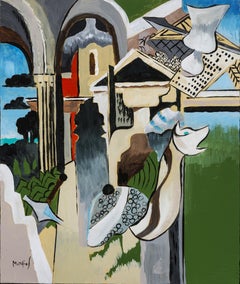
Post-Impressionist Painting The Church in Taormina, Sicily, 1914

Post-Impressionist Painting The Church in Taormina, Sicily, 1914

Located in Stockholm, SE

Dick Beer (b. London 1893 - d. Stockholm 1938) The Church in Taormina, Sicily (Kyrkan i Taormina) oil on canvas canvas dimensions 54 x 47 cm signed and dated Dick Beer 1914 painted 1914 Exhibited: Varias Konstsalong, Stockholm, 1916; Millesgården – Dick Beer – Impressionist & Kubist, 2012 Provenance: Within the family Beer until today Dick Beer (1893-1938) Dick Beer was born in London in 1893. His father, John Beer (1853-1906), was a Swedish painter from Stockholm who had a career mainly as a watercolour painter with motifs of horses from racetracks and fox hunts from the countryside. Barely fifteen years old, Dick Beer became an orphan and came to Sweden in 1907. Already in 1908-1909, he started at Althin's painting school in Stockholm. And later, at the Royal Academy of Arts from 1910-1912. His teachers were, among others, Gustaf Cederström, Oscar Björk and Alfred Bergström...

Category

1910s Post-Impressionist Landscape Paintings

Materials

Canvas, Oil

Georges Braque, Untitled, from The Intimate Sketchbooks, 1955 (after)

Georges Braque, Untitled, from The Intimate Sketchbooks, 1955 (after)

By Georges Braque

Located in Southampton, NY

This exquisite heliogravure after Georges Braque (1882-1963), titled Sans titre (Untitled), from Carnets Intimes de G. Braque, Verve: Revue Artistique et Litteraire, Vol. VIII, No. 3...

Category

1950s Cubist Abstract Prints

Materials

Lithograph