2 results for "stubbs sporting engraving"

to
1
1
1
2
1
1
Overall Height
to
Overall Width
to
2
1
1
1
2
2
2
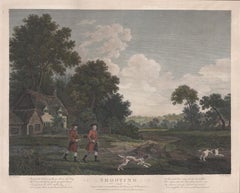
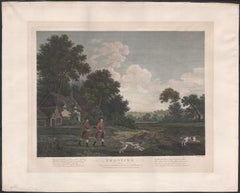
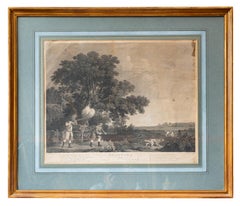
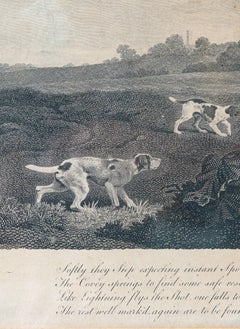
Shooting Engraving After George Stubbs, Late 18th Century Style

Shooting Engraving After George Stubbs, Late 18th Century Style

Located in GB

William Woollett (1735–1785) William Woollett was one of the most accomplished British engravers of the 18th century, renowned for his technical precision and his ability to translate the subtleties of painting into the language of print. Born in Maidstone, Kent, Woollett trained under John Tinney in London and quickly established himself as a master of landscape and historical engraving. He became particularly celebrated for his engravings after works by artists such as Richard Wilson, Claude Lorrain, and Benjamin West — notably The Death of General Wolfe (after West), which became one of the most famous British prints of its age. Woollett’s exceptional skill in combining line engraving with etching allowed him to reproduce painterly effects of light, texture, and atmosphere with remarkable delicacy. Elected an Associate Engraver of the Royal Academy in 1775, Woollett elevated the status of printmaking to that of a fine art. His works, characterized by technical brilliance and tonal richness, remain benchmarks of 18th-century British engraving. George Stubbs (1724–1806) George Stubbs is regarded as one of Britain’s greatest animal painters, celebrated for his scientific observation, anatomical accuracy, and artistic sensitivity. Born in Liverpool, he studied anatomy independently, dissecting horses to understand their musculature and structure — research that culminated in his celebrated publication The Anatomy of the Horse (1766). Stubbs’s paintings...

Category

Late 18th Century Academic Figurative Prints

Materials

Engraving

Related Items
Chamomile & Safflower: A 17th-18th C. Besler Hand-colored Botanical Engraving

Chamomile & Safflower: A 17th-18th C. Besler Hand-colored Botanical Engraving

Located in Alamo, CA

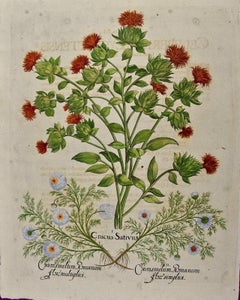
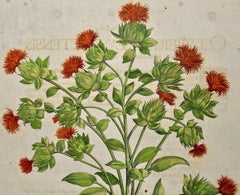
This is a hand-colored copper plate engraving entitled "Chamemelum Romanum flore simplici (Chamomile), Cincus Sativus (False saffron, Safflower), Chamaemelum Romanum Flore (Roman Chamomile)", depicting flowering Chamomile, Safflower and Roman Chamomile plants respectively from Basilius Besler's landmark work, Hortus Eystettensis (Garden at Eichstatt), first published in 1613 in Eichstatt, Germany near Nuremberg and later in 1640 and 1713. This beautiful colorful engraving is printed on thin laid chain-linked paper with wide margins. There are a few small spots and some irregularity of the lower edge. There is some bleed-through of text from the verso. The print is otherwise in excellent condition with striking hand-coloring. The sheet measures 22.25" high and 17.38" wide. Basilius Besler (1561–1629) was an apothecary and botanist. He was curator of the Willibaldsburg Castle garden of Johann Konrad von Gemmingen, prince bishop...

Category

Early 18th Century Academic Still-life Prints

Materials

Engraving

Roseate Spoonbill /// John James Audubon Natural History Ornithology Water Bird

Roseate Spoonbill /// John James Audubon Natural History Ornithology Water Bird

By John James Audubon

Located in Saint Augustine, FL

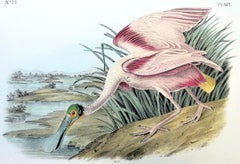
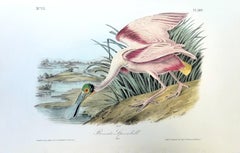
Artist: John James Audubon (American, 1785-1851) Title: "Roseate Spoonbill" (Plate 362, No. 73) Portfolio: The Birds of America (First Royal Octavo Edition) Year: 1840-1844 Medium: Original Hand-Colored Lithograph on wove paper Limited edition: approx. 1,200 Printer: John T. Bowen, Philadelphia, PA Publisher: John James Audubon and J.B. Chevalier, New York, NY and Philadelphia, PA Sheet size: 6.75" x 10.44" Image size: 5" x 7.63" Condition: In excellent condition Very rare The "Roseate Spoonbill" is one of the very top, absolute most desirable birds from Audubon's famous "Birds of America" series Notes: Provenance: private collection - Fleming Island, FL. Lithography and hand-coloring by American artist John T. Bowen (1801-c.1856). Comes from Audubon's famous seven volume portfolio "The Birds of America", (1840-1844) (First Royal Octavo Edition), which consists of 500 hand-colored lithographs. Based on a composition painted in Florida in 1831 or 1832. "This beautiful and singular bird" was prized for its wings and tail feathers which were made into fans in St. Augustine. The roseate spoonbill is a gregarious wading bird of the ibis and spoonbill family, Threskiornithidae. It is a resident breeder in both South and North America. The roseate spoonbill's pink color is diet-derived, consisting of the carotenoid pigment canthaxanthin, like the American flamingo. To make 'The Birds of America' more affordable and widely available, in 1839 John James Audubon began the first octavo edition, a smaller version of the folio which was printed and hand-colored by J. T. Bowen in Philadelphia. Employing a new invention, the camera lucida, the images were reduced in size, rendered in intermediate drawings by John James Audubon and his son John Woodhouse, and then drawn onto lithographic stones. These miniatures exhibit a remarkable amount of attention to quality and detail, as well as a meticulous fidelity to the larger works. Some compositional changes were made in order to accommodate the smaller format. Like the Havell edition, John James Audubon’s first...

Category

1840s Victorian Animal Prints

Materials

Watercolor, Lithograph
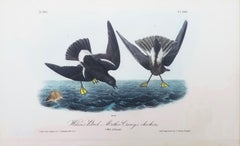
Wilson’s Petrel - Mother Carey’s Chicken /// Ornithology Bird Seascape Audubon

Wilson’s Petrel - Mother Carey’s Chicken /// Ornithology Bird Seascape Audubon

By John James Audubon

Located in Saint Augustine, FL

Artist: John James Audubon (American, 1785-1851) Title: "Wilson’s Petrel - Mother Carey’s Chicken" (Plate 460, No. 92) Portfolio: The Birds of America (F...

Category

1840s Victorian Animal Prints

Materials

Watercolor, Lithograph
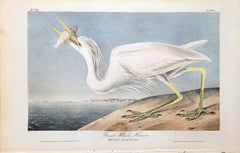
Great White Heron /// John James Audubon Ornithology Shorebird Key West Florida

Great White Heron /// John James Audubon Ornithology Shorebird Key West Florida

By John James Audubon

Located in Saint Augustine, FL

Artist: John James Audubon (American, 1785-1851) Title: "Great White Heron" (Plate 368, No. 74) Portfolio: The Birds of America (First Royal Octavo Edition) Year: 1840-1844 Medium: O...

Category

1840s Victorian Animal Prints

Materials

Watercolor, Lithograph
Large Classical Bird Color Print After John James Audubon, Wild Turkey

Large Classical Bird Color Print After John James Audubon, Wild Turkey

Located in Cirencester, Gloucestershire

Classical Bird print, after John James Audubon, printed by Harry N. Abrams, Publishers, New York unframed, 17 x 14 inches color print on paper condition: very good provenance: from...

Category

20th Century Victorian Animal Prints

Materials

Acrylic

Set of Four Hand-Colored Lithograph Ornithological Prints from "The Ibis" Birds

Set of Four Hand-Colored Lithograph Ornithological Prints from "The Ibis" Birds

Located in Saint Augustine, FL

Artist: Philip Lutley Sclater (English, 1829-1913) Titles: "Circus Spilonotus (Eastern Marsh Harrier)", "Accipiter Pectoralis (Gray-Bellied Hawk)", "Circaetus Beaudouini (Beaudouin's...

Category

1860s Victorian Animal Prints

Materials

Watercolor, Lithograph
Key-West Dove /// Ornithology Bird John James Audubon Shorebird Flowers Plant

Key-West Dove /// Ornithology Bird John James Audubon Shorebird Flowers Plant

By John James Audubon

Located in Saint Augustine, FL

Artist: John James Audubon (American, 1785-1851) Title: "Key-West Dove" (Plate 282, No. 57) Portfolio: The Birds of America (First Royal Octavo Edition) Year: 1840-1844 Medium: Origi...

Category

1840s Victorian Animal Prints

Materials

Watercolor, Lithograph
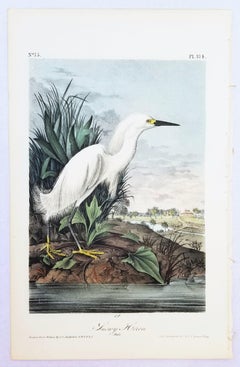
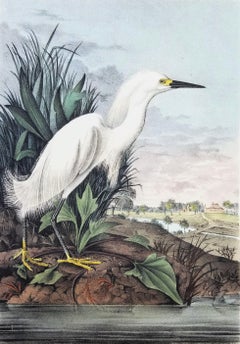
Snowy Heron /// John James Audubon Natural History Ornithology Snowy Egret Bird

Snowy Heron /// John James Audubon Natural History Ornithology Snowy Egret Bird

By John James Audubon

Located in Saint Augustine, FL

Artist: John James Audubon (American, 1785-1851) Title: "Snowy Heron" (Plate 374, No. 75) Portfolio: The Birds of America (First Royal Octavo Edition) Year: 1840-1844 Medium: Origina...

Category

1840s Victorian Animal Prints

Materials

Watercolor, Lithograph
Whooping Crane /// John James Audubon Ornithology Natural History Wading Birds

Whooping Crane /// John James Audubon Ornithology Natural History Wading Birds

By John James Audubon

Located in Saint Augustine, FL

Artist: John James Audubon (American, 1785-1851) Title: "Whooping Crane" (Plate 313, No. 63) Portfolio: The Birds of America (First Royal Octavo Edition) Year: 1840-1844 Medium: Orig...

Category

1840s Victorian Animal Prints

Materials

Watercolor, Lithograph
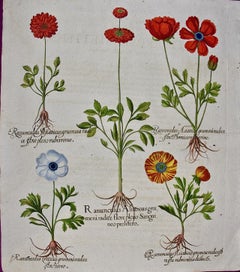
Sneezewort, Poppy, Strawflower: 17th C. Besler Hand-colored Botanical Engraving

Sneezewort, Poppy, Strawflower: 17th C. Besler Hand-colored Botanical Engraving

Located in Alamo, CA

This is a hand-colored copper plate engraving entitled "Ptarmica Vulgaris (Sneezewort), Papaver Spinosum (Mexican Poppy), Chrysocame Peregrina (Seaside Strawflower)", depicting flowering Sneezewort, Mexican Poppy and Seaside Strawberry plants respectively from Basilius Besler's landmark work, Hortus Eystettensis (Garden at Eichstatt), first published in 1613 in Eichstatt, Germany near Nuremberg and later in 1640 and 1713. This beautiful colorful engraving is printed on thin laid chain-linked paper. The left margin is thinner than the others and the left edge is somewhat irregular where the engraving was previously bound in the original publication. The print is otherwise in excellent condition with striking hand-coloring. The sheet measures 20" high and 16.38" wide. Basilius Besler (1561–1629) was an apothecary and botanist. He was curator of the Willibaldsburg Castle garden of Johann Konrad von Gemmingen, prince bishop...

Category

1640s Academic Still-life Prints

Materials

Engraving

The Alligator (In the Gardens of the Zoological Society) /// Natural History Art

The Alligator (In the Gardens of the Zoological Society) /// Natural History Art

Located in Saint Augustine, FL

Artist: Robert Huish (English, 1777-1850) Title: "The Alligator (In the Gardens of the Zoological Society)" (Plate 26) Portfolio: The Wonders of the Animal Kingdom; Exhibiting Deline...

Category

1830s Victorian Animal Prints

Materials

Watercolor, Etching

American Anhinga - Snake Bird /// John James Audubon Ornithology Natural History

American Anhinga - Snake Bird /// John James Audubon Ornithology Natural History

By John James Audubon

Located in Saint Augustine, FL

Artist: John James Audubon (American, 1785-1851) Title: "American Anhinga - Snake Bird" (Plate 420, No. 84) Portfolio: The Birds of America (First Royal Octavo Edition) Year: 1840-1844 Medium: Original Hand-Colored Lithograph on wove paper Limited edition: approx. 1,200 Printer: John T. Bowen, Philadelphia, PA Publisher: John James Audubon and J.B. Chevalier, New York, NY and Philadelphia, PA Sheet size: 10" x 6.69" Image size: 6.63" x 4.63" Condition: Minor toning to sheet and some faint discoloration in margins. Old glue staining along right binding edge as normal. It is otherwise in very good condition with strong colors Notes: Provenance: private collection - Cleveland, OH. Lithography and hand-coloring by American artist John T. Bowen (1801-c.1856). Comes from Audubon's famous seven volume portfolio "The Birds of America", (1840-1844) (First Royal Octavo Edition), which consists of 500 hand-colored lithographs. The preceding 1836 Havell edition of this work has a different title: "Black-bellied Darter", (Plate: CCCXVI - 396, No. 64). Based on a drawing inscribed "New Orleans 1822 - redrawn ... 1836". This conspicuous bird had various names including "water turkey" and "Bec à Lancette". The Anhinga, sometimes called snakebird, darter, American darter, or water turkey, is a water bird of the warmer parts of the Americas. The word anhinga comes from a'ñinga in the Brazilian Tupi language and means "devil bird" or "snake bird". To make 'The Birds of America' more affordable and widely available, in 1839 John James Audubon began the first octavo edition, a smaller version of the folio which was printed and hand-colored by J. T. Bowen in Philadelphia. Employing a new invention, the camera lucida, the images were reduced in size, rendered in intermediate drawings by John James Audubon and his son John Woodhouse, and then drawn onto lithographic stones. These miniatures exhibit a remarkable amount of attention to quality and detail, as well as a meticulous fidelity to the larger works. Some compositional changes were made in order to accommodate the smaller format. Like the Havell edition, John James Audubon’s first...

Category

1840s Victorian Animal Prints

Materials

Watercolor, Lithograph
Recommended For You