By Margaret Esther Rogers
Located in Soquel, CA
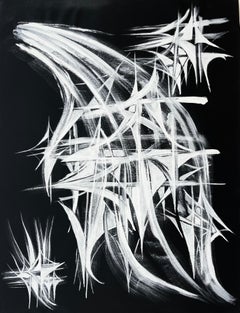
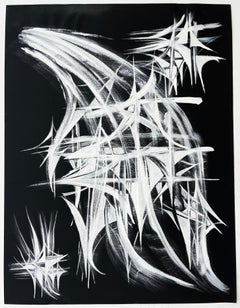
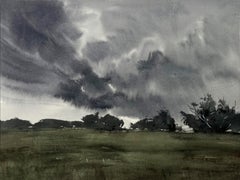
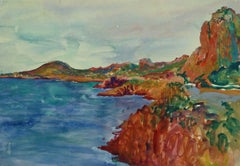
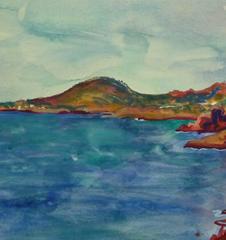
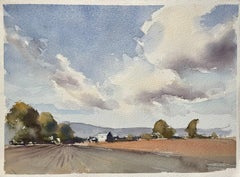
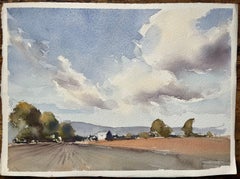
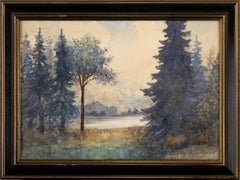
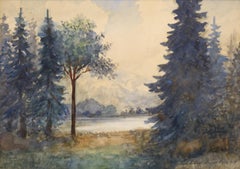
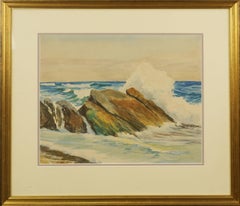
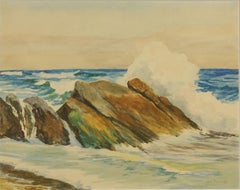
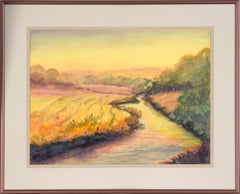
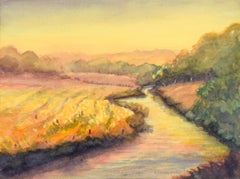
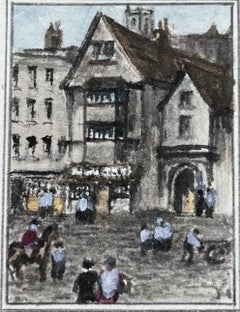
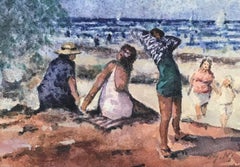
Classic mid-century California seascape watercolor of the crashing surf on the rocky coast by Santa Cruz, California artist Margaret E. Rogers (American, 1872-1961), c.1950. Rogers was one of the original "Jolly Daubers" who studied with Frank Heath and took wagon trips to the redwoods and Yosemite to paint.
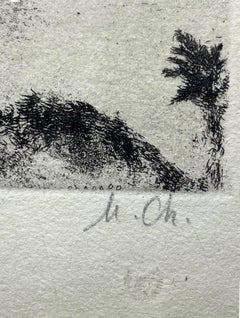
Signed "M.E. Rogers" lower right.
Presented in a rustic giltwood frame under glass.
Image, 16.5"H x 18.5"L.
Margaret Esther Rogers' (1872 - 1961) early childhood was spent in England. The Rogers were a cultured family who came to California for the father’s health and settled on a ranch in the King City area. Margaret grew up in the curiously paradoxical world of early California, breaking her own riding horses and roping cattle during the day, doing a man’s work, riding a man’s saddle, then sitting down to the piano to play classics in the evening after high tea. Margaret’s mother had the only piano for 80 miles around. Her father, Robert J. Rogers, had been an importer of fine tea, coffee, and spices in England. In Monterey County, he raised sheep and cattle and the family lived under comparatively rustic and modest conditions. When Margaret wasn’t riding, tending a herd, plowing a field, or playing the piano, she was painting. Art was an early love.
Fame caught up with her early. She was written up in a San Francisco newspaper as “Monterey County’s pretty girl who rides a man’s saddle, marks and brands stock, breaks wild colts, plows and sows, plays classical music and paints in oils.” Margaret’s mother was her first music and art teacher; later she took art lessons from Kate Baldwin in Salinas.
She had suitors and several proposals, but never married. In the year 1898, Margaret’s “intended” put in 700 acres of grain, spending all he had plus money he borrowed. Not a spear of grain grew, she wrote, and their plans to marry when the crop was sold dried up with the weather.
When her mother died, Margaret and her father moved to Soquel, taking along her favorite saddle horse. Now living in Santa Cruz County, Margaret at once became involved in art circles which were unofficially headed by Frank Heath and his wife, Lillian Dake Heath. Frank Heath and Margaret together founded Santa Cruz Art League in 1919, and a few months later were joined in their efforts by a Dutch woman named Cor de Gavere who arrived in Santa Cruz.
The two women artists, Margaret and Cor, became fast friends and remained so until Cor’s death in July 1955, while she was visiting relatives in Holland. They painted together almost every day and shared many meals at each other’s cottages which were just a few blocks apart in the Seabright area. However, those Victorian ladies, raised in the era of rigid social conventions, always addressed each other as ‘Miss Rogers’ and ‘Miss de Gavere’ as long as they lived. Money was never in great supply for either lady, but Cor managed to buy a small automobile, and after six driving lessons the two of them took off for southern California. Cor and Margaret took many camping and painting trips in Cor’s automobile. Sometime later, Margaret herself got brave enough to buy an auto.
From 1925 to 1947, Margaret made her home in the basement of the Arts and Crafts Building. She managed the Art League’s first gallery, which was started there. Holding informal court for friends who called, Margaret would open a can of sardines, put out a plate of crackers, and conversation about art or music would follow. During World War II, Margaret raised rabbits in cages. In later years, Margaret purchased a small studio-home on Alhambra Street – still in the Seabright area, which both women clung to as home territory.
In 1929, Margaret helped found the Art League’s first Statewide Show, which became an annual event. She served as show chairwoman for more than 20 years. A fine painter of landscapes, Margaret became better known for her strong marine scenes. Once she explained that the ocean was “the real challenge, because it won’t stand still.” She served as president of the Art League from 1925 to 1947. Short, stocky, outspoken and very talented, Margaret gained many honors in her later years. With her short haircut and her dark dresses...
Category
1950s American Impressionist Art by Medium: Watercolor
MaterialsPaper, Watercolor