Art by Medium: Woodcut

to
502
3,622
524
335
172
257
Overall Width
to
Overall Height
to
58
767
3,498
593
28
100
442
319
166
216
396
155
161
119
32
2,457
563
243
216
201
110
59
44
44
28
9
4
1
1
3,451
1,319
117
2,349
1,220
906
846
622
470
454
393
383
363
354
272
243
222
212
186
175
150
137
108
4,917
182,075
96,847
79,261
77,979
170
152
55
55
53
411
2,276
1,949
1,879
Medium: Woodcut
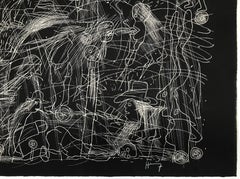
Abstract Monoprint by Charlie Hewitt

Abstract Monoprint by Charlie Hewitt

By Charlie Hewitt

Located in Long Island City, NY

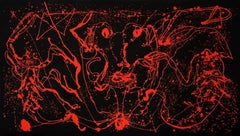
Artist: Charlie Hewitt, American (1946 - ) Title: Untitled - III Year: circa 1995 Medium: Woodblock Monoprint, Signed in Pencil Edition: 1/1 Size: 20 x 24 in. (50.8 x 60.96 cm)

Category

1990s Abstract Art by Medium: Woodcut

Materials

Monoprint, Woodcut

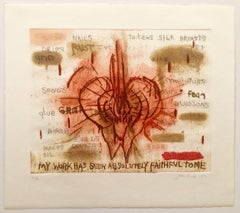
Woodcut Heart

Woodcut Heart

By Jim Dine

Located in New York, NY

This original color woodcut was created by the artist in 1993. Hand-monogrammed by the artist in pencil and numbered, from the edition of 500.

Category

20th Century Contemporary Art by Medium: Woodcut

Materials

Woodcut

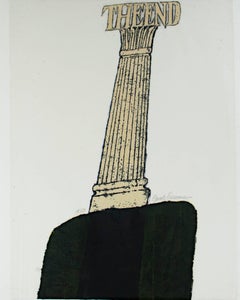
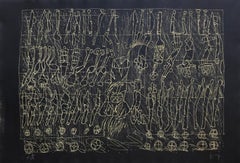
The Revolt

Italo ScangaThe Revolt, 1982

$840Sale Price|30% Off

The Revolt

By Italo Scanga

Located in New York, NY

Italo Scanga was born in the Calabria region of Italy, and at 14 immigrated to the United States with his family after World War II. Living in Detroit, he worked on the General Motor...

Category

1980s Contemporary Art by Medium: Woodcut

Materials

Woodcut

Sharing Abundant Space: Abstract Figurative Acrylic Painting, 51x51 cm

Sharing Abundant Space: Abstract Figurative Acrylic Painting, 51x51 cm

By Karnish Art

Located in Pretoria, Gauteng

Title: Sharing Abundant Space Sharing Abundant Space - Painting Figurative Maximalism Contemporary Floral Bold Invest In this one-of-a-kind abstract impressionism artwork by Karnis...

Category

2010s Abstract Impressionist Art by Medium: Woodcut

Materials

Gesso, Canvas, Wood, Acrylic, Woodcut, Stretcher Bars

Figurative, Engraving & Woodcut on paper, Blue, Grey by Indian Artist "In Stock"

Figurative, Engraving & Woodcut on paper, Blue, Grey by Indian Artist "In Stock"

By Kamal Mitra

Located in Kolkata, West Bengal

Kamal Mitra - Untitled - 12.25 x 15 inches (unframed size) Engraving & Woodcut on paper Inclusive of shipment in a roll form. About Kamal Mitra’s Works : While pursuing his Bachelor...

Category

2010s Contemporary Art by Medium: Woodcut

Materials

Paper, Engraving, Woodcut

Quai des Grands Augustins, Paris

Quai des Grands Augustins, Paris

By Auguste Lepère

Located in Middletown, NY

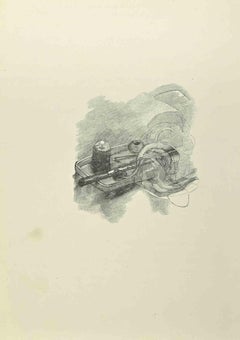
Wood engraving on onionskin paper, 14 1/2 x 9 inches (369 x 228 mm), the full sheet. In very good condition with minor cockling around the areas of the mount at the top corners. [Lo...

Category

Late 19th Century Old Masters Art by Medium: Woodcut

Materials

Engraving, Handmade Paper, Woodcut

Bucolique Moderne
Bucolique Moderne

Bucolique Moderne

By Auguste Louis Lepère

Located in Fairlawn, OH

Bucolique Moderne Color woodcut, 1901 Edition of 550 impressions on Holland paper (as here) and an edition of 200 impressions printed on Japan paper signed in pencil by the artist. References And Exhibitions: Published in Di Gesellschaft fur vervielfältigende Kunst à Vienne Reference: Lotz Brissonneau 271 v/V Illustrated: Musee D'Orsay, Auguste Lepere ou lerenouveau de bois grave, No. 20 Vital, Auguste Lepere 1849-1918, No. 171. Illustrated: Musee de le Vendee, no. 171 (see photo) Musee D'Orsay, Auguste Lepere ou lerenouveau de bois grave, No. 20 Vital, Auguste Lepere 1849-1918, No. 171. Auguste Louis Lepère...

Category

Early 1900s Impressionist Art by Medium: Woodcut

Materials

Woodcut

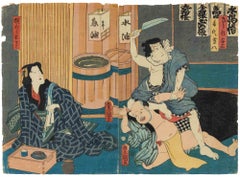
Inari Kozo Tasaburo- Kabuki

Inari Kozo Tasaburo- Kabuki

By Utagawa Toyokuni

Located in Fairlawn, OH

Inari Kozo Tasaburo- Kabuki Color woodcut, c. 1820 Signed: ‘Toyokuni’ Publisher: ‘Yamamoto Heikichi’ Censor: Hama and Magome Very good impression and color Sheet/Image size: 15 1/2 x...

Category

1820s Other Art Style Art by Medium: Woodcut

Materials

Woodcut

Mommy Why?

Mommy Why?

By Joan Snyder

Located in New York, NY

Joan Snyder has been called an autobiographical, even confessional artist, who draws from her experiences and surroundings to create her paintings. While her subjects vary widely, Sn...

Category

1980s Expressionist Art by Medium: Woodcut

Materials

Woodcut

Burst Variation 15 - Abstract Woodcut Print Metallic Silver Turquoise Blue, 2015

Burst Variation 15 - Abstract Woodcut Print Metallic Silver Turquoise Blue, 2015

By Eve Stockton

Located in Kent, CT

This woodcut print on paper is composed of a central, circular, metallic silver shape spreading outward into an abstract pattern over a bright turquoise blue background that contrast...

Category

2010s Contemporary Art by Medium: Woodcut

Materials

Archival Ink, Archival Paper, Monotype, Woodcut

The Vigil, Modern Art Woodcut Print by Kenneth Wilkinson

The Vigil, Modern Art Woodcut Print by Kenneth Wilkinson

By Kenneth Wilkinson

Located in Long Island City, NY

Artist: Kenneth Wilkinson Title: The Vigil Year: 1989 Medium: Woodcut in Colors, Signed l.r and verso Edition: 3/25 Size: 40 x 23.5 inches

Category

1980s Contemporary Art by Medium: Woodcut

Materials

Woodcut

Burst Variation 156 - Abstract Woodcut Print Circle Pattern Blue, 2025

Burst Variation 156 - Abstract Woodcut Print Circle Pattern Blue, 2025

By Eve Stockton

Located in Kent, CT

This woodcut print on paper is composed of a central, circular shape in violet on a blue patterned background. The monotype brings to mind the tradition of Japanese printing while be...

Category

2010s Contemporary Art by Medium: Woodcut

Materials

Archival Ink, Archival Paper, Monotype, Woodcut

Leviathin II # VIII

Leviathin II # VIII

By William T. Wiley

Located in Lyons, CO

Hand colored woodcut, Edition 10. William Wiley uses current political and social issues to comment on life in our time. His stunning draftsmanship, and freeform love of language ar...

Category

1990s Contemporary Art by Medium: Woodcut

Materials

Woodcut

Hopi by Lon Megargee, Original Signed Block Print ca. 1920s

Hopi by Lon Megargee, Original Signed Block Print ca. 1920s

Located in Phoenix, AZ

Title: Hopi ca. 1920s Artist: Lon Megargee Medium: Block Print Size: 11 x 11 inches (Sight Measurement) SHIPPING CHARGES INCLUDE SHIPPING, PACKAGING & INSURANCE Creator of Stetson's hat logo "Last Drop from his Hat" Image of Lon Megargee not included in purchase. Lon Megargee 1883 - 1960 At age 13, Lon Megargee came to Phoenix in 1896 following the death of his father in Philadelphia. For several years he resided with relatives while working at an uncle’s dairy farm and at odd jobs. He returned to Philadelphia in 1898 – 1899 in order to attend drawing classes at the Pennsylvania Academy of the Fine Arts. Back in Phoenix in 1899, he decided at the age of 16 to try to make his living as a cowboy. Lon moved to the cow country of Wickenburg, Arizona where he was hired by Tex Singleton’s Bull Ranch. He later joined the Three Bar R. . . and after a few years, was offered a job by Billy Cook of the T.T. Ranch near New River. By 1906, Megargee had learned his trade well enough to be made foreman of Cook’s outfit. Never shy about taking risks, Lon soon left Cook to try his own hand at ranching. He partnered with a cowpuncher buddy, Tom Cavness, to start the El Rancho Cinco Uno at New River. Unfortunately, the young partners could not foresee a three-year drought that would parch Arizona, costing them their stock and then their hard-earned ranch. Breaking with his romantic vision of cowboy life, Megargee finally turned to art full time. He again enrolled at the Pennsylvania Academy of Art and then the Los Angeles School of Art and Design during 1909 – 1910. The now well-trained student took his first trip to paint “en plein air” (outdoors) to the land of Hopi and Navajo peoples in northern Arizona. After entering paintings from this trip in the annual Territorial Fair at Phoenix, in 1911, he surprisingly sold his first oil painting to a major enterprise – the Santa Fe Railroad . . . Lon received $50 for “Navajos Watching the Santa Fe Train.” He soon sold the SFRR ten paintings over the next two years. For forty years the railroad was his most important client, purchasing its last painting from him in 1953. In a major stroke of good fortune during his early plein-air period, Megargee had the opportunity to paint with premier artist, William R. Leigh (1866 – 1955). Leigh furnished needed tutoring and counseling, and his bright, impressionistic palette served to enhance the junior artist’s sense of color and paint application. In a remarkable display of unabashed confidence and personable salesmanship, Lon Megargee, at age 30, forever linked his name with Arizona art history. Despite the possibility of competition from better known and more senior artists, he persuaded Governor George Hunt and the Legislature in 1913 to approve 15 large, historic and iconic murals for the State Capitol Building in Phoenix. After completing the murals in 1914, he was paid the then princely sum of roughly $4000. His Arizona statehood commission would launch Lon to considerable prominence at a very early point in his art career. Following a few years of art schooling in Los Angeles, and several stints as an art director with movie studios, including Paramount, Megargee turned in part to cover illustrations for popular Western story magazines in the 1920s. In the 1920s, as well, Lon began making black and white prints of Western types and of genre scenes from woodblocks. These prints he generally signed and sold singly. In 1933, he published a limited edition, signed and hard-cover book (about 250 copies and today rare)containing a group of 28 woodblock images. Titled “The Cowboy Builds a Loop,” the prints are noteworthy for strong design, excellent draftsmanship, humanistic and narrative content, and quality. Subjects include Southwest Indians and cowboys, Hispanic men and women, cattle, horses, burros, pioneers, trappers, sheepherders, horse traders, squaw men and ranch polo players. Megargee had a very advanced design sense for simplicity and boldness which he demonstrated in how he used line and form. His strengths included outstanding gestural (action) art and strong figurative work. He was superb in design, originality and drawing, as a study of his prints in the Hays collection reveals. In 1944, he published a second group of Western prints under the same title as the first. Reduced to 16 images from the original 28 subjects, and slightly smaller, Lon produced these prints in brown ink on a heavy, cream-colored stock. He designed a sturdy cardboard folio to hold each set. For the remainder of his life, Lon had success selling these portfolios to museum stores, art fairs and shows, and to the few galleries then selling Western art. Drawing on real working and life experiences, Lon Megargee had a comprehensive knowledge, understanding and sensitivity for Southwestern subject matter. Noted American modernist, Lew Davis...

Category

1920s American Impressionist Art by Medium: Woodcut

Materials

Woodcut

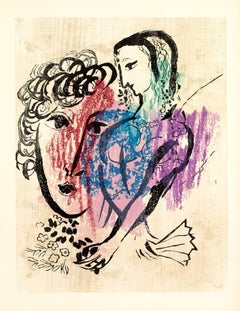
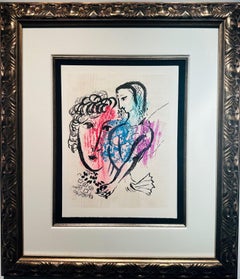
Marc Chagall -- POEMES: Dans ma Memoire

Marc Chagall -- POEMES: Dans ma Memoire

By Marc Chagall

Located in BRUCE, ACT

Marc Chagall Dans ma Memoire, 1968 LES POEMES #8 Colored woodcut on Rives paper Unsigned Edition: 96 / 226 Image size: c 24 * 32 cm Published by Cramer Editeur, Geneva LITERATUR...

Category

1960s Art by Medium: Woodcut

Materials

Woodcut

"Bag of Fruit"

"Bag of Fruit"

By Josef Zenk

Located in Lambertville, NJ

Signed Lower Right Edition # 9/18 Josef Zenk (1904 - 2000) Josef Zenk was born in New York City in 1904. After graduating from high school, he studied for three years at the Natio...

Category

20th Century Abstract Art by Medium: Woodcut

Materials

Color, Woodcut

Carp - Woodcut by Jean Lurçat - 1948

Carp - Woodcut by Jean Lurçat - 1948

By Jean Lurçat

Located in Roma, IT

Carp is a vintage woodcut print realized by Jean Lucrat in 1948. Good condition on a cream colored paper. No signature, on the back the title in french language. Jean Lurçat (French: 1 July 1892 – 6 January 1966) was a French artist noted for his role in the revival of contemporary tapestry. In order to fully appreciate and understand the works of Jean Lurçat, one must view them in the context of the history of tapestry, in particular, the downfall of its existence during the rise of the Renaissance. It was during this time that tapestry was somewhat re-invented, where by traditional techniques were misplaced in the likening of tapestry to paintings by artists of the likes of Raphael. Jean Lurçat is largely responsible for its revival in the 20th century when he redefined the importance of designing tapestry in a way that embraced the integrity of authentic tapestry...

Category

Mid-20th Century Modern Art by Medium: Woodcut

Materials

Woodcut

POLO
POLO

POLO

By Louis Schanker

Located in Portland, ME

Schanker, Louis (American, 1903-1981). POLO. Woodcut, 1937. Edition of 30. Signed, titled, and numbered, all in pencil. Printed on Japan paper. 7 7/8 x 7 1/4 inches (image), framed t...

Category

1930s Art by Medium: Woodcut

Materials

Woodcut

RAM - PROFILE
RAM - PROFILE

RAM - PROFILE

By Jacques Hnizdovsky

Located in Portland, ME

Hnizdovsky, Jacques. RAM. Tahir 86. Woodcut., 1969. Trial Proof aside from the Edition of 100. Signed, Titled, dated and inscrbed :Trial Proof, all in pencil. 21 x 4 3/4 (image),24 ...

Category

1960s Art by Medium: Woodcut

Materials

Woodcut

Mexican Modernist Kite Painting, Stencil, Woodcut Print Hand Signed

Mexican Modernist Kite Painting, Stencil, Woodcut Print Hand Signed

By Francisco Toledo

Located in Surfside, FL

Francisco Benjamín López Toledo (born July 17, 1940, Juchitán, Oaxaca) is a Mexican painter, sculptor, and graphic artist. He studied at the Escuela de Bellas Artes de Oaxaca and the Centro Superior de Artes Aplicadas del Instituto Nacional de Bellas Artes, Mexico, where he studied graphic arts with Guillermo Silva Santamaria...

Category

21st Century and Contemporary Modern Art by Medium: Woodcut

Materials

Paint, Woodcut, Stencil

Tristan's Fire -- Print, Reduction Woodcut by Tom Hammick

Tristan's Fire -- Print, Reduction Woodcut by Tom Hammick

By Tom Hammick

Located in London, GB

Tristan's Fire, 2020 Tom Hammick Reduction woodcut in colours Signed, titled, dated and numbered from the edition of 14 in pencil Published by the artist, London Sheet: 102 × 142 cm...

Category

2010s Contemporary Art by Medium: Woodcut

Materials

Woodcut

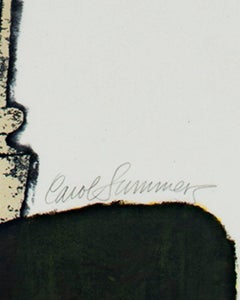
"Little Wolf's Last Camp, " Colored Woodblock A/P signed by Carol Summers

"Little Wolf's Last Camp, " Colored Woodblock A/P signed by Carol Summers

By Carol Summers

Located in Milwaukee, WI

"Little Wolf's Last Camp" is a colored woodblock A/P signed by Carol Summers. In the image, a mountain looms over a circle of teat the edge of a lake, a scene likely inspired by the life events of the Northern Cheyenne Chief Little Wolf (c. 1820-1904) and his leadership during the Northern Cheyenne Exodus. The drama of the image is enhanced by Summers' signature printmaking technique, which allows the ink from the woodblock to seep through the paper, blurring the edges of each form. Frame: 37 x 37 in This is an artist's proof from the edition of 100 Carol Summers (1925-2016) has worked as an artist throughout the second half of the 20th century and into the first years of the next, outliving most of his mid-century modernist peers. Initially trained as a painter, Summers was drawn to color woodcuts around 1950 and it became his specialty thereafter. Over the years he has developed a process and style that is both innovative and readily recognizable. His art is known for it’s large scale, saturated fields of bold color, semi-abstract treatment of landscapes from around the world and a luminescent quality achieved through a printmaking process he invented. In a career that has extended over half a century, Summers has hand-pulled approximately 245 woodcuts in editions that have typically run from 25 to 100 in number. His talent was both inherited and learned. Born in 1925 in Kingston, a small town in upstate New York, Summers was raised in nearby Woodstock with his older sister, Mary. His parents were both artists who had met in art school in St. Louis. During the Great Depression, when Carol was growing up, his father supported the family as a medical illustrator until he could return to painting. His mother was a watercolorist and also quite knowledgeable about the different kinds of papers used for various kinds of painting. Many years later, Summers would paint or print on thinly textured paper originally collected by his mother. From 1948 to 1951, Carol Summers trained in the classical fine and studio arts at Bard College and at the Art Students League of New York. He studied painting with Steven Hirsh and printmaking with Louis Schanker. He admired the shapes and colors favored by early modernists Paul Klee (Sw: 1879-1940) and Matt Phillips (Am: b.1927- ). After graduating, Summers quit working as a part-time carpenter and cabinetmaker (which had supported his schooling and living expenses) to focus fulltime on art. That same year, an early abstract, Bridge No. 1 was selected for a Purchase Prize in a competition sponsored by the Brooklyn Museum. In 1952, his work (Cathedral, Construction and Icarus) was shown the first time at the Museum of Modern Art in New York City in an exhibition of American woodcuts. In 1954, Summers received a grant from the Italian government to study for a year in Italy. Woodcuts completed soon after his arrival there were almost all editions of only 8 to 25 prints, small in size, architectural in content and black and white in color. The most well-known are Siennese Landscape and Little Landscape, which depicted the area near where he resided. Summers extended this trip three more years, a decision which would have significant impact on choices of subject matter and color in the coming decade. After returning from Europe, Summers’ images continued to feature historical landmarks and events from Italy as well as from France, Spain and Greece. However, as evidenced in Aetna’s Dream, Worldwind and Arch of Triumph, a new look prevailed. These woodcuts were larger in size and in color. Some incorporated metal leaf in the creation of a collage and Summers even experimented with silkscreening. Editions were now between 20 and 50 prints in number. Most importantly, Summers employed his rubbing technique for the first time in the creation of Fantastic Garden in late 1957. Dark Vision of Xerxes, a benchmark for Summers, was the first woodcut where Summers experimented using mineral spirits as part of his printmaking process. A Fulbright Grant as well as Fellowships from the Louis Comfort Tiffany Foundation and the Guggenheim Foundation followed soon thereafter, as did faculty positions at colleges and universities primarily in New York and Pennsylvania. During this period he married a dancer named Elaine Smithers with whom he had one son, Kyle. Around this same time, along with fellow artist Leonard Baskin, Summers pioneered what is now referred to as the “monumental” woodcut. This term was coined in the early 1960s to denote woodcuts that were dramatically bigger than those previously created in earlier years, ones that were limited in size mostly by the size of small hand-presses. While Baskin chose figurative subject matter, serious in nature and rendered with thick, striated lines, Summers rendered much less somber images preferring to emphasize shape and color; his subject matter approached abstraction but was always firmly rooted in the landscape. In addition to working in this new, larger scale, Summers simultaneously refined a printmaking process which would eventually be called the “Carol Summers Method” or the “ Carol Summers Technique”. Summers produces his woodcuts by hand, usually from one or more blocks of quarter-inch pine, using oil-based printing inks and porous mulberry papers. His woodcuts reveal a sensitivity to wood especially its absorptive qualities and the subtleties of the grain. In several of his woodcuts throughout his career he has used the undulating, grainy patterns of a large wood plank to portray a flowing river or tumbling waterfall. The best examples of this are Dream, done in 1965 and the later Flash Flood Escalante, in 2003. In the majority of his woodcuts, Summers makes the blocks slightly larger than the paper so the image and color will bleed off the edge. Before printing, he centers a dry sheet of paper over the top of the cut wood block or blocks, securing it with giant clips. Then he rolls the ink directly on the front of the sheet of paper and pressing down onto the dry wood block or reassembled group of blocks. Summers is technically very proficient; the inks are thoroughly saturated onto the surface of the paper but they do not run into each other. The precision of the color inking in Constantine’s Dream in 1969 and Rainbow Glacier in 1970 has been referred to in various studio handbooks. Summers refers to his own printing technique as “rubbing”. In traditional woodcut printing, including the Japanese method, the ink is applied directly onto the block. However, by following his own method, Summers has avoided the mirror-reversed image of a conventional print and it has given him the control over the precise amount of ink that he wants on the paper. After the ink is applied to the front of the paper, Summers sprays it with mineral spirits, which act as a thinning agent. The absorptive fibers of the paper draw the thinned ink away from the surface softening the shapes and diffusing and muting the colors. This produces a unique glow that is a hallmark of the Summers printmaking technique. Unlike the works of other color field artists or modernists of the time, this new technique made Summers’ extreme simplification and flat color areas anything but hard-edged or coldly impersonal. By the 1960s, Summers had developed a personal way of coloring and printing and was not afraid of hard work, doing the cutting, inking and pulling himself. In 1964, at the age of 38, Summers’ work was exhibited for a second time at the Museum of Modern Art. This time his work was featured in a one-man show and then as one of MOMA’s two-year traveling exhibitions which toured throughout the United States. In subsequent years, Summers’ works would be exhibited and acquired for the permanent collections of multiple museums throughout the United States, Europe and Asia. Summers’ familiarity with landscapes throughout the world is firsthand. As a navigator-bombardier in the Marines in World War II, he toured the South Pacific and Asia. Following college, travel in Europe and subsequent teaching positions, in 1972, after 47 years on the East Coast, Carol Summers moved permanently to Bonny Doon in the Santa Cruz Mountains in Northern California. There met his second wife, Joan Ward Toth, a textile artist who died in 1998; and it was here his second son, Ethan was born. During the years that followed this relocation, Summers’ choice of subject matter became more diverse although it retained the positive, mostly life-affirming quality that had existed from the beginning. Images now included moons, comets, both sunny and starry skies, hearts and flowers, all of which, in one way or another, remained tied to the landscape. In the 1980s, from his home and studio in the Santa Cruz mountains, Summers continued to work as an artist supplementing his income by conducting classes and workshops at universities in California and Oregon as well as throughout the Mid and Southwest. He also traveled extensively during this period hiking and camping, often for weeks at a time, throughout the western United States and Canada. Throughout the decade it was not unusual for Summers to backpack alone or with a fellow artist into mountains or back country for six weeks or more at a time. Not surprisingly, the artwork created during this period rarely departed from images of the land, sea and sky. Summers rendered these landscapes in a more representational style than before, however he always kept them somewhat abstract by mixing geometric shapes with organic shapes, irregular in outline. Some of his most critically acknowledged work was created during this period including First Rain, 1985 and The Rolling Sea, 1989. Summers received an honorary doctorate from his alma mater, Bard College in 1979 and was selected by the United States Information Agency to spend a year conducting painting and printmaking workshops at universities throughout India. Since that original sabbatical, he has returned every year, spending four to eight weeks traveling throughout that country. In the 1990s, interspersed with these journeys to India have been additional treks to the back roads and high country areas of Mexico, Central America, Nepal, China and Japan. Travel to these exotic and faraway places had a profound influence on Summers’ art. Subject matter became more worldly and nonwestern as with From Humla to Dolpo, 1991 or A Former Life of Budha, 1996, for example. Architectural images, such as The Pillars of Hercules, 1990 or The Raja’s Aviary, 1992 became more common. Still life images made a reappearance with Jungle Bouquet in 1997. This was also a period when Summers began using odd-sized paper to further the impact of an image. The 1996 Night, a view of the earth and horizon as it might be seen by an astronaut, is over six feet long and only slightly more than a foot-and-a-half high. From 1999, Revuelta A Vida (Spanish for “Return to Life”) is pie-shaped and covers nearly 18 cubic feet. It was also at this juncture that Summers began to experiment with a somewhat different palette although he retained his love of saturated colors. The 2003 Far Side of Time is a superb example of the new direction taken by this colorist. At the turn of the millennium in 1999, “Carol Summers Woodcuts...

Category

1970s Contemporary Art by Medium: Woodcut

Materials

Woodcut

"Pills" - Outsider Pop Art - Woodblock on Paper (#5/5)

"Pills" - Outsider Pop Art - Woodblock on Paper (#5/5)

Located in Soquel, CA

Vibrant multi-layer woodblock print by Robin Blake (American, 1955). Three layers of neon ink (yellow, magenta, and blue) form a zoomed-in composition of pills. The bright colors cre...

Category

2010s Outsider Art Art by Medium: Woodcut

Materials

Paper, Ink, Woodcut

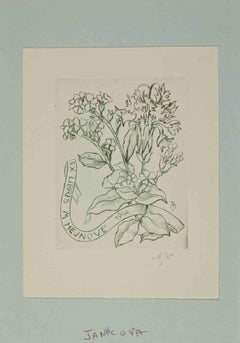
Ex Libris - Maria Van Der Kley Phons Schellart - Woodcut by A. Schellart - 1950s

Ex Libris - Maria Van Der Kley Phons Schellart - Woodcut by A. Schellart - 1950s

Located in Roma, IT

Ex Libris - Maria Van Der Kley Phons Schellart  is an Artwork realized in Mid 20th Century, by the artist A. Schellart.                                                               ...

Category

Mid-20th Century Modern Art by Medium: Woodcut

Materials

Woodcut

Touching and Tasting

Touching and Tasting

By Barbara Kuebel

Located in New Orleans, LA

Edition 1/5 BARBARA KUEBEL is a Daphne, AL-based artist who uses oil and pencil for her works on paper and on canvas. She was born and raised in Austria and earned two art degrees f...

Category

21st Century and Contemporary Contemporary Art by Medium: Woodcut

Materials

Paper, Woodcut

Nicolas Party, Portrait of a Seahorse Necklace - Original Woodcut, Signed Print

Nicolas Party, Portrait of a Seahorse Necklace - Original Woodcut, Signed Print

By Nicolas Party

Located in Hamburg, DE

Nicolas Party (Swiss, b. 1980) Portrait of a Seahorse Necklace, 2021 Medium: Woodcut on HM-5 gampi-shi Dimensions: 28.3 × 24.1 cm (11 1/10 × 9 ½ in) Edition of 100 + 8 AP: Hand-signe...

Category

21st Century and Contemporary Contemporary Art by Medium: Woodcut

Materials

Woodcut

Ex-Libris - De Chirico - woodcut - Mid 20th Century

Ex-Libris - De Chirico - woodcut - Mid 20th Century

Located in Roma, IT

Ex-Libris - De Chirico is an Artwork realized in Mid 20th Century. Woodcut on paper. Good conditions. The artwork represents a minimalistic, clean design, through preciseness .

Category

Mid-20th Century Modern Art by Medium: Woodcut

Materials

Woodcut

Ex-Libris - Navarra - woodcut - Mid 20th Century

Ex-Libris - Navarra - woodcut - Mid 20th Century

Located in Roma, IT

Ex-Libris - Navarra is an Artwork realized in Mid 20th Century. Woodcut on paper. Good conditions. The artwork represents a minimalistic, clean design, through preciseness .

Category

Mid-20th Century Modern Art by Medium: Woodcut

Materials

Woodcut

Horses - Woodcut Print - 1962

Horses - Woodcut Print - 1962

Located in Roma, IT

Horses is an original woodcut print on paper realized in 1962 by an Anonymous artist of the 20th Century. Hand-signed on the lower right and dated, ill...

Category

1960s Contemporary Art by Medium: Woodcut

Materials

Woodcut

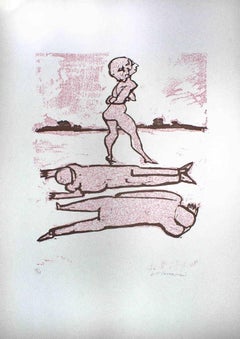
Horsewoman - Original Woodcut Print by Arturo Martini - Early 20th Century

Horsewoman - Original Woodcut Print by Arturo Martini - Early 20th Century

By Arturo Martini

Located in Roma, IT

Horsewoman is a woodcut print on ivory-colored, realized at the beginning of the XX century by the Italian artist Arturo Martini (Treviso, 1889 - Milan, 1947). On the lower margin, the printed inscriptions with the title and the author: "La cavallerizza / Martini de la Valle...

Category

Early 20th Century Art by Medium: Woodcut

Materials

Woodcut

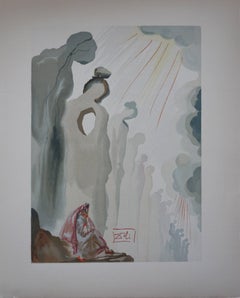
The Slothful - Woodcut - 1963

The Slothful - Woodcut - 1963

By Salvador Dalí­

Located in Roma, IT

The Slothful -  "The Divine Comedy" - Song 18 -  Purgatory is a woodcut print realized in 1963 for a series illustrating the Medieval poem of the "Divine Comedy" by Dante Alighieri. ...

Category

1960s Surrealist Art by Medium: Woodcut

Materials

Woodcut

Ex libris - Fr. Novy - Woodcut by Ladislav Rusek - 1967

Ex libris - Fr. Novy - Woodcut by Ladislav Rusek - 1967

Located in Roma, IT

Ex- Libris - Fr. Novy is an Artwork realized in 1967 by the Artist Ladislav Rusek (1927-2012) Woodcut print on ivory paper. The work is glued on green cardboard. Hand Signed on the ...

Category

1960s Modern Art by Medium: Woodcut

Materials

Paper, Woodcut

'La Danse' (Dance) — French Cubist Woodcut

'La Danse' (Dance) — French Cubist Woodcut

By Raoul Dufy

Located in Myrtle Beach, SC

Raoul Dufy, 'La Danse' (Dance), woodcut, 1910. A proof impression before the second edition of 220 in 1953; with the estate stamp 'ATELIER RAOUL DUFY' in the lower right margin; the blind stamp 'GG' in the lower left sheet corner. Annotated 'E/Z' in pencil, beneath the estate stamp; and 'bois original' in the margin, lower left. Titled in the block, lower right. A superb, richly-inked impression, on heavy, cream wove paper; the full sheet with wide margins (3 1/2 to 6 3/4 inches); slight toning at the bottom and right sheet edges, well away from the image, otherwise in excellent condition. Archivally sleeved, unmatted. Image size 12 5/16 x 12 1/2 inches (313 x 318 mm); sheet size 19 3/4 x 25 3/4 inches (502 x 654 mm). Collections: Art Gallery of New South Wales (Australia), Brooklyn Museum, Cleveland Art Museum, Fine Arts Museums of San Francisco, Minneapolis Institute of Art, Museum of Fine Arts, Boston, The Nelson-Atkins Museum of Art, Nasher Museum of Art (Duke University), Toledo Art Museum. From the suite of four woodcuts entitled 'Les Plaisirs de la Paix' (The Pleasures of Peace), published by Éditions de La Sirène, Paris in 1926. The other three works in the series are 'La Peche' (Fishing), 'La Chase' (The Hunt), and 'L'amore' (Love). See our other listings for 'La Peche' and 'L'amore'. Collections: Brooklyn Museum, Art Gallery of New South Wales, Cleveland Museum of Art, Dallas Museum of Art, Fine Arts Museums of San Francisco, Minneapolis Art...

Category

1910s Cubist Art by Medium: Woodcut

Materials

Woodcut

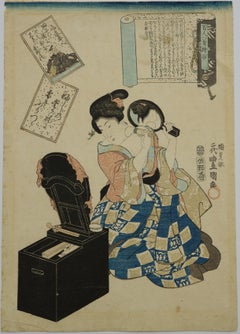
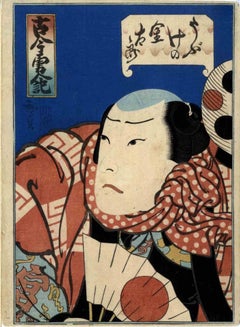
Japanese Accessories - Woodcut  after Utagawa Kunisada - Late-19th century

Japanese Accessories - Woodcut after Utagawa Kunisada - Late-19th century

By Utagawa Kunisada (Toyokuni III)

Located in Roma, IT

Japanese Accessories is a Woodcut print realized in the first half of the 19th century by Utagawa Kunisada. Good condition. This wonderful modern artwork represents Japanese acce...

Category

Late 19th Century Modern Art by Medium: Woodcut

Materials

Woodcut

Figure -  Woodcut Print - Mid 20th Century

Figure - Woodcut Print - Mid 20th Century

Located in Roma, IT

Figure is an Original Woodcut Print realized by Charles Sterns in the mid-20th Century. The little artwork is in good condition on a cream colored cardboard. No signature.

Category

Mid-20th Century Modern Art by Medium: Woodcut

Materials

Woodcut

WOMAN DRAWING
WOMAN DRAWING

WOMAN DRAWING

Located in Portland, ME

Packard, Emmy Lou (American, 1914 - 1998). WOMAN DRAWING. Color Woodcut, not dated. Edition size not known. Signed in pencil. 18 1/16" x 14 1/8" inches (...

Category

1940s Art by Medium: Woodcut

Materials

Woodcut

Woman - Woodcut after Jean Paul Sauget - 1921

Woman - Woodcut after Jean Paul Sauget - 1921

Located in Roma, IT

Woman is a woodcut print print on paper, realized after Jean Paul Sauget for Maurice Magre's Les Soirs d'Opium. Published in 1921. Good conditions.

Category

1920s Modern Art by Medium: Woodcut

Materials

Woodcut

Woodcut art for sale on 1stDibs.

Find a wide variety of authentic Woodcut art available on 1stDibs. While artists have worked in this medium across a range of time periods, art made with this material during the 21st Century is especially popular. If you’re looking to add art created with this material to introduce a provocative pop of color and texture to an otherwise neutral space in your home, the works available on 1stDibs include elements of orange, yellow, purple, blue and other colors. There are many well-known artists whose body of work includes ceramic sculptures. Popular artists on 1stDibs associated with pieces like this include Mino Maccari, Utagawa Kunisada (Toyokuni III), Eric Gill, and Utagawa Hiroshige. Frequently made by artists working in the Modern, Contemporary, all of these pieces for sale are unique and many will draw the attention of guests in your home. Not every interior allows for large Woodcut art, so small editions measuring 0.04 inches across are also available