Art by Medium: Woodcut

to
646
3,615
512
325
176
258
Overall Width
to
Overall Height
to
57
771
3,466
598
29
102
435
318
166
216
391
155
163
118
32
2,452
567
237
215
206
112
58
44
41
28
9
3
1
1
3,438
1,307
119
2,334
1,204
899
847
619
467
455
391
382
363
352
271
241
218
211
184
176
143
134
105
4,893
180,383
95,884
78,259
77,545
170
152
55
53
47
397
2,266
1,919
1,874
Medium: Woodcut
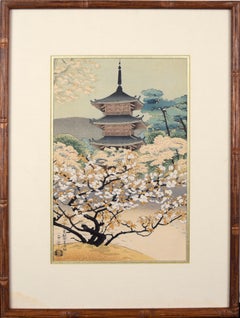
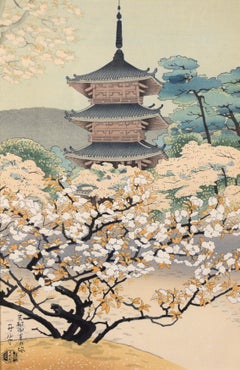
'Cherry Blossoms at Dusk', Japanese color woodblock, Musashino College  of Art

'Cherry Blossoms at Dusk', Japanese color woodblock, Musashino College of Art

Located in Santa Cruz, CA

Signed lower right, 'Morihiro Sato' (Japanese, born 1943), with artist chop mark, and dated 1985; titled, lower left, in English and Kanji 'Cherry Trees (Dusk)' with number and limitation, '3/55'. Paper dimensions: 24.25 x 35.5 inches A fresh and unfaded woodblock print showing a view of cherry tree boughs heavy with glowing blossoms before a vista of rolling hills with stylized Japanese pine beneath a luminous, golden sunset. Morihiro Sato graduated from Musashino College of Fine Art before studying under the printmaker Joichi Hoshi (1913-1979). Sato’s work focuses on the beauty of nature, particularly that of trees. Through the medium of woodblock with inclusion of metallic pigments, his delicately atmospheric prints evoke a sense of gentle sense of wonder. *With thanks to Ronin Gallery

Category

1980s Modern Art by Medium: Woodcut

Materials

Gold Leaf

The energy of the dance floor comes straight back to my ears

The energy of the dance floor comes straight back to my ears

By Thierry Noir

Located in London, GB

Thierry Noir The energy of the dance floor comes straight back to my ears, 2025 Ukiyo-e print in colours on kizuki hosho paper hand made by Ichibei Iwano 27.4 x 27.4 cm 35.7 x 35.7 c...

Category

2010s Street Art Art by Medium: Woodcut

Materials

Woodcut

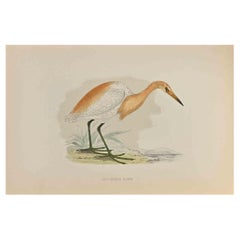
The Bird  -  Woodcut print - early 20th century

The Bird - Woodcut print - early 20th century

Located in Roma, IT

The bird is a woodcut print realized by an unknown artist in the early 20th Century. Very Good conditions. the artwork is depicted through confident strokes.

Category

Early 20th Century Modern Art by Medium: Woodcut

Materials

Woodcut

Japanese Woodcut Print - Original Woodcut Print by Utagawa Hiroshige - 19th Cent

Japanese Woodcut Print - Original Woodcut Print by Utagawa Hiroshige - 19th Cent

By Utagawa Hiroshige

Located in Roma, IT

This is a superb polychrome woodblock print (nishiki-e, ink and color on paper), likely realized by Utagawa Hiroshige (Japanese, 1797-1858) at the middle of 19th century. This plate ...

Category

19th Century Modern Art by Medium: Woodcut

Materials

Woodcut

Toadstool - Woodcut by Maurits Cornelis Escher - 1931

Toadstool - Woodcut by Maurits Cornelis Escher - 1931

Located in Roma, IT

Woodcut print realized by Escher for the series "Emblemata", and published in 1931. On Hollande van Gelder paper. Edition of 300. Unsigned, as issued. Excellent condition, matted....

Category

1930s Modern Art by Medium: Woodcut

Materials

Woodcut

Divided Arc
Divided Arc

Divided Arc

By Robert Mangold

Located in New York, NY

Associated with the Minimalist art movement of the 1960s, Mangold developed a reductive vocabulary based on geometric forms, monochromatic color, and an emphasis on the flatness of t...

Category

2010s Art by Medium: Woodcut

Materials

Woodcut

Byzantine Court - Woodcut Print - 1862

Byzantine Court - Woodcut Print - 1862

Located in Roma, IT

Byzantine Court is an artwork realized from 1856 to 1862 . Black and white woodcut. Published on the book "Usi e costumi di tutti i popoli dell'universo", Milano Borroni and Scotti...

Category

19th Century Modern Art by Medium: Woodcut

Materials

Woodcut

Le berger et le roi, Vingt fables de La fontaine, Jean Carzou

Le berger et le roi, Vingt fables de La fontaine, Jean Carzou

By Jean Carzou

Located in Southampton, NY

Woodcut on vélin d'Arches paper. Inscription: signed in the plate and unnumbered, as issued. Good condition. Notes: from the folio, Vingt fables de La fontaine, 1961. Published by Éd...

Category

1960s Modern Art by Medium: Woodcut

Materials

Woodcut

Clinton Hill, Arroyo, 1962, woodcut, landscape/abstraction

Clinton Hill, Arroyo, 1962, woodcut, landscape/abstraction

By Clinton Hill

Located in New York, NY

Clinton Hill (1922-2003), lived in SoHo, New York, and was a frequent Gallery visitor. Born in Idaho and raised on a working ranch, he joined the US Navy during World War II and beca...

Category

Mid-20th Century Abstract Art by Medium: Woodcut

Materials

Woodcut

Keiji Shinohara, Accelerondo, Ukiyo-e woodcut print landscape, 2005

Keiji Shinohara, Accelerondo, Ukiyo-e woodcut print landscape, 2005

By Keiji Shinohara

Located in New York, NY

Keiji Shinohara was born and raised in Osaka, Japan. After 10 years as an apprentice to the renowned Keiichiro Uesugi in Kyoto, he became a Master Printmaker and moved to the United ...

Category

21st Century and Contemporary Abstract Art by Medium: Woodcut

Materials

Paper, Woodcut

Quartet No. 1
Quartet No. 1

Quartet No. 1

By Eugene Larkin

Located in Kansas City, MO

Eugene Larkin Quartet No. 1 Woodcut in two colors Signed and titled by hand Size: 20 x 29.5 inches COA provided Eugene Larkin (1921-2010) The late Eugene Larkin was an artist who worked in the Twin Cities area for many years and needs little introduction. His works have been shown, collected and appreciated by numerous galleries, museums and collectors throughout the United States. Larkin was influential both as an artist and as a teacher. He taught at the Minneapolis College of Art and Design between 1954 and 1969, where he was head of printmaking and Chairman of the Division of Fine Arts. From 1969-1991 he was a professor in the Design Department at the University of Minnesota. Eugene Larkin, a lithographer, teacher and artist who left behind scores of works, some of them in the permanent collections of the Library of Congress and the Museum of Modern Art. He was considered an early promoter of lithography education, Larkin introduced it into arts programs while teaching at the Minneapolis College of Art and Design and the University of Minnesota. He held a prominent place in the art world through decades of working and teaching in Minneapolis. His work depicted a wide range of subjects, from musicians to nature, including a series of woodcuts based on William Blake's ""Songs of Innocence and Experience." Larkin also wrote a textbook, ""Design: The Search for Unity."" It was his work with lithography, an 18th-century printmaking process, for which he was best known. His last local exhibit was a retrospective at The University of Minnesota Weisman Museum in 2005. ""Sometimes I start the artistic process from a literary source - Adam and Eve, the Egyptian nature gods, or classical Greek themes but sometimes I start from nature. Trees have always been a favorite subject. I see trees as people, as vertical objects...

Category

15th Century and Earlier Modern Art by Medium: Woodcut

Materials

Woodcut

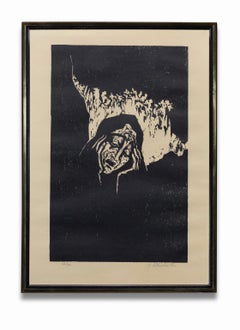
Jewish Rabbi Looking Heavenward German Expressionist Woodcut Israeli "Psalm"

Jewish Rabbi Looking Heavenward German Expressionist Woodcut Israeli "Psalm"

By Jacob Steinhardt

Located in Surfside, FL

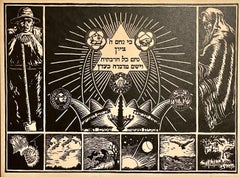
Jacob Steinhardt, 1887-1968 Hand signed in pencil, woodblock print woodcut. Frame: 22.5" x 18" Image: 16.75" X 12.5" "Psalm" 12/30 Jakob Steinhardt, Painter and Woodcut Artist. b. 1887, Yaacov Steinhardt was born in the then remote, largely Polish town of Zerkow in the Posen District of Germany. (poland/german) Immigrated 1933. Studies: 1906 School of Art, 1906 Studied in Berlin Arts and Crafts School. Berlin; 1907 painting with Lovis Corinth and engraving and etching with Hermann Struck; advanced studies, 1908-10 Paris, with Henri Matisse and Steinlen; 1911 Italy. Teaching: Bezalel, Jerusalem, 1953-57 Director. 1910 Participated in the “New Sezession”, Berlin. 1912 together with Ludwig Meidner and Janthur he founded the "Pathetiker" group very early in the German expressionist movement. Running afoul of the Nazis, he fled to Tel-Aviv and then Jerusalem in the early 30s, showing in “Der Sturm” Gallery. 1914 Exhibited with ludwig Meidner at first Expressionist Exhibition in Berlin. Worked mainly in woodcuts depicting biblical and other Jewish subjects. 1955-58 International awards for his woodcuts. receives graphic commissions from Fritz Gurlitt. 1922 Marries Minni Gumpert. Active in organizing Secession exhibits. 1925 Trips to Mark Brandenburg and Holy Land. Turns primarily to painting; stops work on etchings and lithographs. 1933 Emigrates to the Palestine. 1934 Moves to Jerusalem and opens an art school; attempts some etchings. 1948 Closes the art school and becomes Chairman of Graphics Department, Bezalel School for Arts and Crafts. 1954-57 Director of Bezalel School for Arts and Crafts. Taken up by J. B. Neumann who became the agent for his etchings. Exhibited Sturm Gallery, Herbst-salon. 1914 Outbreak of World War I; Steinhardt enlists in German army. 1916-18 First on Eastern Front in Poland and Lithuania, then after short training period in Berlin, sent to Macedonia. 1917 Exhibition of Lithuanian drawings at Berlin Secession in Spring. Elected member of the Secession. He often used wood-cutting techniques that were popular amongst German Expressionists. Steinhardt was driven to express ideas clearly and decisively through art. Amongst the themes found in his work the prophets of the Bible, such as Jonah, are noticeable. Steinhardt identified deeply with Jonah due to his attempt to run from God's call to duty. Additionally, the image of beggars was often found in Steinhardt's works and in his artistic presentation of the less fortunate, the artist's love for his fellow man becomes evident. Moreover, the grotesque was a theme noticeable in Steinhardt's earliest pieces. These were fantastical images; it was unclear whether or not they were human or demon. In the 1950's, Steinhardt returned to these images upon learning of the Holocaust of Europe's Jews. At that time he resided in New York and there, in the shadow of the skyscrapers, Steinhardt's reaction to WWII was expressed through his art. A Collection of Works by Artists of the Land of IsraelThe Bezalel National Museum, Jerusalem 1940 Artists: Shemi, Menahem Rubin...

Category

20th Century Expressionist Art by Medium: Woodcut

Materials

Woodcut

Charles Arnoldi 'Macchu Picchu 4' Limited Edition, Abstract Signed Print

Charles Arnoldi 'Macchu Picchu 4' Limited Edition, Abstract Signed Print

By Charles Arnoldi

Located in San Rafael, CA

Charles Arthur Arnoldi (b. 1946) Macchu Picchu 4, 2019 Woodcut in colors on wove paper Edition: 25/30 Signed, editioned, and dated in pencil along lower edge Printed by Peter Kosowicz, Thumbprint Editions, London Published by Harvey Bayer...

Category

21st Century and Contemporary Abstract Geometric Art by Medium: Woodcut

Materials

Woodcut

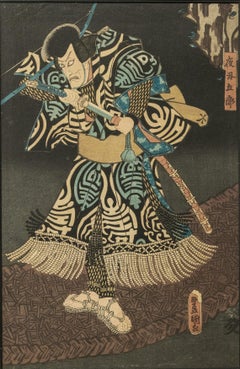
Kumasaka Chōhan to Ushiwakamaru - One of a Diptych Original Woodcut Print

Kumasaka Chōhan to Ushiwakamaru - One of a Diptych Original Woodcut Print

By Utagawa Kunisada (Toyokuni III)

Located in Soquel, CA

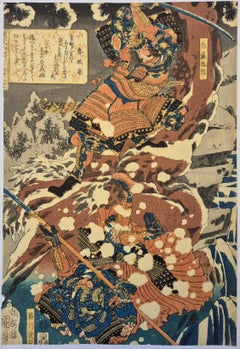
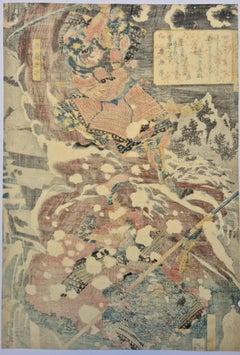
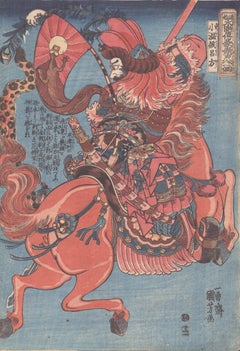
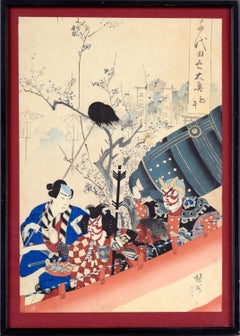
Kumasaka Chōhan to Ushiwakamaru is a Japanese Ukiyo-e print created between 1848 and 1854 by artist Utagawa Kunisada (Japanese, 1786-1864). The print is a Diptych, and is part of the...

Category

1850s Realist Art by Medium: Woodcut

Materials

Printer's Ink, Rice Paper, Woodcut

Children Asleep Under A Tree - Original Illustration for a book by C. Farrère

Children Asleep Under A Tree - Original Illustration for a book by C. Farrère

Located in Roma, IT

Children Asleep Under A Tree is a graceful hand-colored xylograph print, born presumably as an illustration of a book for children, unidentified, written by the French author Claude ...

Category

Mid-20th Century Modern Art by Medium: Woodcut

Materials

Woodcut

"The Engraver" Double Layer Woodblock Print

"The Engraver" Double Layer Woodblock Print

Located in Soquel, CA

Bold woodcut print by M. Sheppard (20th Century). This piece is filled with Neolithic imagery of people and animals. There are two figures that are engaged in hunting and several pre...

Category

1980s Other Art Style Art by Medium: Woodcut

Materials

Paper, Ink, Woodcut

Forest - Woodcut - 1963

Forest - Woodcut - 1963

By Salvador Dalí­

Located in Roma, IT

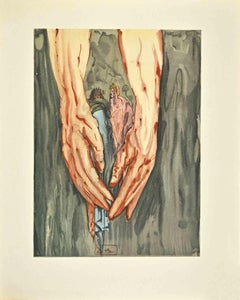
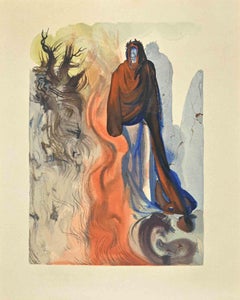
Forest -  "The Divine Comedy" - Song 28 -  Purgatory is a woodcut print realized in 1963 for a series illustrating the Medieval poem of the "Divine Comedy" by Dante Alighieri. Plate ...

Category

1960s Surrealist Art by Medium: Woodcut

Materials

Woodcut

Rooster - Woodcut by Jean Lurçat - 1948

Rooster - Woodcut by Jean Lurçat - 1948

By Jean Lurçat

Located in Roma, IT

Rooster is a vintage woodcut print realized by Jean Lucrat in 1948. Good condition on a cream colored paper. No signature, on the back the title in french language. Jean Lurçat (French: 1 July 1892 – 6 January 1966) was a French artist noted for his role in the revival of contemporary tapestry. In order to fully appreciate and understand the works of Jean Lurçat, one must view them in the context of the history of tapestry, in particular, the downfall of its existence during the rise of the Renaissance. It was during this time that tapestry was somewhat re-invented, where by traditional techniques were misplaced in the likening of tapestry to paintings by artists of the likes of Raphael. Jean Lurçat is largely responsible for its revival in the 20th century when he redefined the importance of designing tapestry in a way that embraced the integrity of authentic tapestry...

Category

Mid-20th Century Modern Art by Medium: Woodcut

Materials

Woodcut

Tropical Palm Block Print

Tropical Palm Block Print

Located in Soquel, CA

Wonderful tropical Woodcut print of Palm Tree on island. Signed "Wessels" with a KW chop in a box above and 2012 lower edge. Presented in speckled pain...

Category

2010s American Impressionist Art by Medium: Woodcut
Materials

Ink, Rice Paper, Woodcut

Letchkov
Letchkov

Martin NoelLetchkov, 1994

$798Sale Price|46% Off

Letchkov

By Martin Noel

Located in Kansas City, MO

Martin Noel "Letchkov" Year: 1994 Color woodcut on handmade paper Size: 27.75 x 22.5 inches (70 x 60 cm) Signed by hand, lower center Publisher: Edition by Griffelkunst-Vereinigung, ...

Category

1990s Abstract Art by Medium: Woodcut

Materials

Woodcut

Three Turns - Surfing Art By Marc Zimmerman

Three Turns - Surfing Art By Marc Zimmerman

By Marc Zimmerman

Located in Carmel, CA

Three Turns - Surfing Art - Figurative - Woodcut Print By Marc Zimmerman Limited Edition 01/04 This masterwork is exhibited in the Zimmerman Gallery, Carmel CA. Immerse yourself i...

Category

2010s Contemporary Art by Medium: Woodcut

Materials

Woodcut

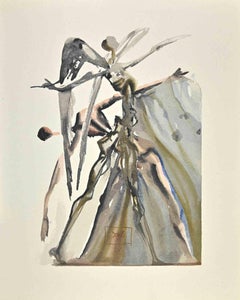
The Song of the Wise Spirits - Woodcut - 1963

The Song of the Wise Spirits - Woodcut - 1963

By Salvador Dalí­

Located in Roma, IT

The Song of the Wise Spirits -  "The Divine Comedy" - Song 3 -  Paradise is a woodcut print realized in 1963 for a series illustrating the Medieval poem of the "Divine Comedy" by Dan...

Category

1960s Surrealist Art by Medium: Woodcut

Materials

Woodcut

John E. Billmyer, Flower Piece, WPA wood engraving

John E. Billmyer, Flower Piece, WPA wood engraving

Located in New York, NY

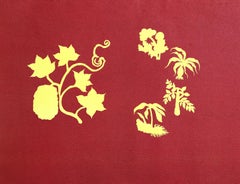
'Flower Piece' shows the artist, John Billmyer, to be a highly accomplished wood engraver. There are endless patterns and created details -- all executed flawlessly. Mostly made up o...

Category

Mid-20th Century American Modern Art by Medium: Woodcut

Materials

Woodcut

Barbican
Barbican

Barbican

By David Everett

Located in Dallas, TX

David Everett was born in Beaumont, Texas, and received both his B.F.A. and M.F.A. from The University of Texas in Austin. In 1978, Everett was awarded a Faculty Travel Grant from So...

Category

21st Century and Contemporary Contemporary Art by Medium: Woodcut

Materials

Paper, Woodcut

House in Kyoto
House in Kyoto

House in Kyoto

By Kiyoshi Saitō

Located in Fairlawn, OH

House in Kyoto Color woodcut, 1963 Signed in white brush bottom left of image, along with the artist's red stamp (see photo) Titled, dated and numbered in pencil bottom margin (see p...

Category

1960s Contemporary Art by Medium: Woodcut

Materials

Woodcut

Chronology of Cacciaguida - Woodcut  - 1963

Chronology of Cacciaguida - Woodcut - 1963

By Salvador Dalí­

Located in Roma, IT

Chronology of Cacciaguida is a woodcut print realized in 1963 for a series illustrating the Medieval poem of the "Divine Comedy" by Dante Alighieri. Not signed, as issued. Plate...

Category

1960s Surrealist Art by Medium: Woodcut

Materials

Woodcut

Nicolas Party, Portrait of a Seahorse Necklace - Original Woodcut, Signed Print

Nicolas Party, Portrait of a Seahorse Necklace - Original Woodcut, Signed Print

By Nicolas Party

Located in Hamburg, DE

Nicolas Party (Swiss, b. 1980) Portrait of a Seahorse Necklace, 2021 Medium: Woodcut on HM-5 gampi-shi Dimensions: 28.3 × 24.1 cm (11 1/10 × 9 ½ in) Edition of 100 + 8 AP: Hand-signe...

Category

21st Century and Contemporary Contemporary Art by Medium: Woodcut

Materials

Woodcut

Touching and Tasting

Touching and Tasting

By Barbara Kuebel

Located in New Orleans, LA

Edition 1/5 BARBARA KUEBEL is a Daphne, AL-based artist who uses oil and pencil for her works on paper and on canvas. She was born and raised in Austria and earned two art degrees f...

Category

21st Century and Contemporary Contemporary Art by Medium: Woodcut

Materials

Paper, Woodcut

"Little Wolf's Last Camp, " Colored Woodblock A/P signed by Carol Summers

"Little Wolf's Last Camp, " Colored Woodblock A/P signed by Carol Summers

By Carol Summers

Located in Milwaukee, WI

"Little Wolf's Last Camp" is a colored woodblock A/P signed by Carol Summers. In the image, a mountain looms over a circle of teat the edge of a lake, a scene likely inspired by the life events of the Northern Cheyenne Chief Little Wolf (c. 1820-1904) and his leadership during the Northern Cheyenne Exodus. The drama of the image is enhanced by Summers' signature printmaking technique, which allows the ink from the woodblock to seep through the paper, blurring the edges of each form. Frame: 37 x 37 in This is an artist's proof from the edition of 100 Carol Summers (1925-2016) has worked as an artist throughout the second half of the 20th century and into the first years of the next, outliving most of his mid-century modernist peers. Initially trained as a painter, Summers was drawn to color woodcuts around 1950 and it became his specialty thereafter. Over the years he has developed a process and style that is both innovative and readily recognizable. His art is known for it’s large scale, saturated fields of bold color, semi-abstract treatment of landscapes from around the world and a luminescent quality achieved through a printmaking process he invented. In a career that has extended over half a century, Summers has hand-pulled approximately 245 woodcuts in editions that have typically run from 25 to 100 in number. His talent was both inherited and learned. Born in 1925 in Kingston, a small town in upstate New York, Summers was raised in nearby Woodstock with his older sister, Mary. His parents were both artists who had met in art school in St. Louis. During the Great Depression, when Carol was growing up, his father supported the family as a medical illustrator until he could return to painting. His mother was a watercolorist and also quite knowledgeable about the different kinds of papers used for various kinds of painting. Many years later, Summers would paint or print on thinly textured paper originally collected by his mother. From 1948 to 1951, Carol Summers trained in the classical fine and studio arts at Bard College and at the Art Students League of New York. He studied painting with Steven Hirsh and printmaking with Louis Schanker. He admired the shapes and colors favored by early modernists Paul Klee (Sw: 1879-1940) and Matt Phillips (Am: b.1927- ). After graduating, Summers quit working as a part-time carpenter and cabinetmaker (which had supported his schooling and living expenses) to focus fulltime on art. That same year, an early abstract, Bridge No. 1 was selected for a Purchase Prize in a competition sponsored by the Brooklyn Museum. In 1952, his work (Cathedral, Construction and Icarus) was shown the first time at the Museum of Modern Art in New York City in an exhibition of American woodcuts. In 1954, Summers received a grant from the Italian government to study for a year in Italy. Woodcuts completed soon after his arrival there were almost all editions of only 8 to 25 prints, small in size, architectural in content and black and white in color. The most well-known are Siennese Landscape and Little Landscape, which depicted the area near where he resided. Summers extended this trip three more years, a decision which would have significant impact on choices of subject matter and color in the coming decade. After returning from Europe, Summers’ images continued to feature historical landmarks and events from Italy as well as from France, Spain and Greece. However, as evidenced in Aetna’s Dream, Worldwind and Arch of Triumph, a new look prevailed. These woodcuts were larger in size and in color. Some incorporated metal leaf in the creation of a collage and Summers even experimented with silkscreening. Editions were now between 20 and 50 prints in number. Most importantly, Summers employed his rubbing technique for the first time in the creation of Fantastic Garden in late 1957. Dark Vision of Xerxes, a benchmark for Summers, was the first woodcut where Summers experimented using mineral spirits as part of his printmaking process. A Fulbright Grant as well as Fellowships from the Louis Comfort Tiffany Foundation and the Guggenheim Foundation followed soon thereafter, as did faculty positions at colleges and universities primarily in New York and Pennsylvania. During this period he married a dancer named Elaine Smithers with whom he had one son, Kyle. Around this same time, along with fellow artist Leonard Baskin, Summers pioneered what is now referred to as the “monumental” woodcut. This term was coined in the early 1960s to denote woodcuts that were dramatically bigger than those previously created in earlier years, ones that were limited in size mostly by the size of small hand-presses. While Baskin chose figurative subject matter, serious in nature and rendered with thick, striated lines, Summers rendered much less somber images preferring to emphasize shape and color; his subject matter approached abstraction but was always firmly rooted in the landscape. In addition to working in this new, larger scale, Summers simultaneously refined a printmaking process which would eventually be called the “Carol Summers Method” or the “ Carol Summers Technique”. Summers produces his woodcuts by hand, usually from one or more blocks of quarter-inch pine, using oil-based printing inks and porous mulberry papers. His woodcuts reveal a sensitivity to wood especially its absorptive qualities and the subtleties of the grain. In several of his woodcuts throughout his career he has used the undulating, grainy patterns of a large wood plank to portray a flowing river or tumbling waterfall. The best examples of this are Dream, done in 1965 and the later Flash Flood Escalante, in 2003. In the majority of his woodcuts, Summers makes the blocks slightly larger than the paper so the image and color will bleed off the edge. Before printing, he centers a dry sheet of paper over the top of the cut wood block or blocks, securing it with giant clips. Then he rolls the ink directly on the front of the sheet of paper and pressing down onto the dry wood block or reassembled group of blocks. Summers is technically very proficient; the inks are thoroughly saturated onto the surface of the paper but they do not run into each other. The precision of the color inking in Constantine’s Dream in 1969 and Rainbow Glacier in 1970 has been referred to in various studio handbooks. Summers refers to his own printing technique as “rubbing”. In traditional woodcut printing, including the Japanese method, the ink is applied directly onto the block. However, by following his own method, Summers has avoided the mirror-reversed image of a conventional print and it has given him the control over the precise amount of ink that he wants on the paper. After the ink is applied to the front of the paper, Summers sprays it with mineral spirits, which act as a thinning agent. The absorptive fibers of the paper draw the thinned ink away from the surface softening the shapes and diffusing and muting the colors. This produces a unique glow that is a hallmark of the Summers printmaking technique. Unlike the works of other color field artists or modernists of the time, this new technique made Summers’ extreme simplification and flat color areas anything but hard-edged or coldly impersonal. By the 1960s, Summers had developed a personal way of coloring and printing and was not afraid of hard work, doing the cutting, inking and pulling himself. In 1964, at the age of 38, Summers’ work was exhibited for a second time at the Museum of Modern Art. This time his work was featured in a one-man show and then as one of MOMA’s two-year traveling exhibitions which toured throughout the United States. In subsequent years, Summers’ works would be exhibited and acquired for the permanent collections of multiple museums throughout the United States, Europe and Asia. Summers’ familiarity with landscapes throughout the world is firsthand. As a navigator-bombardier in the Marines in World War II, he toured the South Pacific and Asia. Following college, travel in Europe and subsequent teaching positions, in 1972, after 47 years on the East Coast, Carol Summers moved permanently to Bonny Doon in the Santa Cruz Mountains in Northern California. There met his second wife, Joan Ward Toth, a textile artist who died in 1998; and it was here his second son, Ethan was born. During the years that followed this relocation, Summers’ choice of subject matter became more diverse although it retained the positive, mostly life-affirming quality that had existed from the beginning. Images now included moons, comets, both sunny and starry skies, hearts and flowers, all of which, in one way or another, remained tied to the landscape. In the 1980s, from his home and studio in the Santa Cruz mountains, Summers continued to work as an artist supplementing his income by conducting classes and workshops at universities in California and Oregon as well as throughout the Mid and Southwest. He also traveled extensively during this period hiking and camping, often for weeks at a time, throughout the western United States and Canada. Throughout the decade it was not unusual for Summers to backpack alone or with a fellow artist into mountains or back country for six weeks or more at a time. Not surprisingly, the artwork created during this period rarely departed from images of the land, sea and sky. Summers rendered these landscapes in a more representational style than before, however he always kept them somewhat abstract by mixing geometric shapes with organic shapes, irregular in outline. Some of his most critically acknowledged work was created during this period including First Rain, 1985 and The Rolling Sea, 1989. Summers received an honorary doctorate from his alma mater, Bard College in 1979 and was selected by the United States Information Agency to spend a year conducting painting and printmaking workshops at universities throughout India. Since that original sabbatical, he has returned every year, spending four to eight weeks traveling throughout that country. In the 1990s, interspersed with these journeys to India have been additional treks to the back roads and high country areas of Mexico, Central America, Nepal, China and Japan. Travel to these exotic and faraway places had a profound influence on Summers’ art. Subject matter became more worldly and nonwestern as with From Humla to Dolpo, 1991 or A Former Life of Budha, 1996, for example. Architectural images, such as The Pillars of Hercules, 1990 or The Raja’s Aviary, 1992 became more common. Still life images made a reappearance with Jungle Bouquet in 1997. This was also a period when Summers began using odd-sized paper to further the impact of an image. The 1996 Night, a view of the earth and horizon as it might be seen by an astronaut, is over six feet long and only slightly more than a foot-and-a-half high. From 1999, Revuelta A Vida (Spanish for “Return to Life”) is pie-shaped and covers nearly 18 cubic feet. It was also at this juncture that Summers began to experiment with a somewhat different palette although he retained his love of saturated colors. The 2003 Far Side of Time is a superb example of the new direction taken by this colorist. At the turn of the millennium in 1999, “Carol Summers Woodcuts...

Category

1970s Contemporary Art by Medium: Woodcut

Materials

Woodcut

Stevan Dohanos, Backyard

Stevan Dohanos, Backyard

By Stevan Dohanos

Located in New York, NY

Stevan Dohanos was an accomplished draftsman who work was widely known through the Saturday Evening Post. This print 'Backyard,' however, leaves aside the illustrative magazine work ...

Category

1930s American Modern Art by Medium: Woodcut

Materials

Woodcut

Harvest #2
Harvest #2

Harvest #2

By Walter Williams

Located in New York, NY

Color woodcut. Signed by the artist in pencil, lower right. Titled "Harvest 2" in pencil, lower center. Numbered "2nd 5/12 Special Edition" in pencil, lower left. Framed dimensi...

Category

1960s Modern Art by Medium: Woodcut

Materials

Woodcut, Color

From the suite La Passion

From the suite La Passion

By Georges Rouault

Located in San Francisco, CA

This artwork from the suite "La Passion" 1932, published 1939 is a wood engraving by French artist Georges Rouault, 1871-1958. (Block engraved by Georges Aubert) It is signed and dat...

Category

Early 20th Century Modern Art by Medium: Woodcut

Materials

Woodcut

La Fille de Minos (Daughter of Minos) - 1978

La Fille de Minos (Daughter of Minos) - 1978

By Salvador Dalí­

Located in Roma, IT

La Fille de Minos (The Daughter of Minos)  is a woodcut print on Arches Paper realized in 1978 to illustrated "L'Art d'Aimer" (The Art of Love) by Ovid. Hand signed and numbered in ...

Category

1970s Surrealist Art by Medium: Woodcut

Materials

Woodcut

In and out simultaneousness, Hand Printed Work, Woodcut

In and out simultaneousness, Hand Printed Work, Woodcut

By Barbara Kuebel

Located in Yardley, PA

Two figures are arranged into one solid piece. The colour red supports the impression of massiveness and therefore I chose it. There is no background needed - the piece should stand ...

Category

21st Century and Contemporary Realist Art by Medium: Woodcut

Materials

Woodcut

The Fisherman (Angling) - Original woodcut - Signed

The Fisherman (Angling) - Original woodcut - Signed

By Raoul Dufy

Located in Paris, IDF

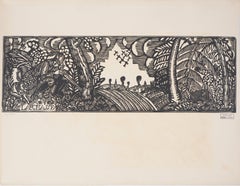
Raoul DUFY The Fisherman (Angling) Original woodcut Signed stamp of the artist's studio Justified Artist Proof (aside the edition numbered on /220) Titled in the board 50.5 x 65.4 c...

Category

Late 20th Century Modern Art by Medium: Woodcut

Materials

Woodcut

Poèmes, Planche XIII

Poèmes, Planche XIII

By Marc Chagall

Located in OPOLE, PL

Marc Chagall (1887-1985) - Poèmes, Planche XIII Woodcut print from 1968. An unnumbered and unsigned copy from a limited edition of 238. Dimensions of sheet: 32.5 x 25 cm Dimensio...

Category

1960s Surrealist Art by Medium: Woodcut

Materials

Woodcut

Still Life - Woodcut - 1936

Still Life - Woodcut - 1936

Located in Roma, IT

Still, Life is a woodcut print on paper, realized by an Anonymous artist in 1936 It is monogrammed and dated on the lower with pencil and numbered, rare edition of 1/20 prints. Goo...

Category

1930s Modern Art by Medium: Woodcut

Materials

Woodcut

Poèmes, Planche VIII

Poèmes, Planche VIII

By Marc Chagall

Located in OPOLE, PL

Marc Chagall (1887-1985) - Poèmes, Planche VIII Woodcut print from 1968. An unnumbered and unsigned copy from a limited edition of 238. Dimensions of sheet: 32.5 x 25 cm Dimensio...

Category

1960s Surrealist Art by Medium: Woodcut

Materials

Woodcut

The Ferry at Sakasai - One Hundred Famous Views of EDO 名所江戸百景

The Ferry at Sakasai - One Hundred Famous Views of EDO 名所江戸百景

By Utagawa Hiroshige (Ando Hiroshige)

Located in BRUCE, ACT

Hiroshige (1797-1858) - One Hundred Famous Views of EDO 名所江戸百景 Artist: 広重 Hiroshige (1797-1858) Series: One Hundred Famous Views of EDO (名所江戸百景) Title: The Ferry at Sakasai (逆井のわたし...

Category

1850s Art by Medium: Woodcut

Materials

Woodcut

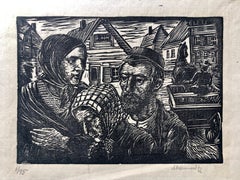
Jewish Shtetl Couple Judaica Woodblock c.1930s WPA Woodcut Print Hand Signed

Jewish Shtetl Couple Judaica Woodblock c.1930s WPA Woodcut Print Hand Signed

By Albert Abramovitz

Located in Surfside, FL

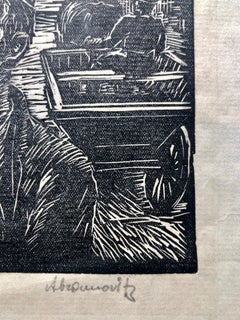
Some of his prints were published by the WPA. it is a wood engraving signed in pencil. From a small edition. Albert Abramovitz (1879-1963), born in Riga, Latvia, on January 24, 187...

Category

1930s American Impressionist Art by Medium: Woodcut
Materials

Woodcut

RAM - PROFILE
RAM - PROFILE

RAM - PROFILE

By Jacques Hnizdovsky

Located in Portland, ME

Hnizdovsky, Jacques. RAM. Tahir 86. Woodcut., 1969. Trial Proof aside from the Edition of 100. Signed, Titled, dated and inscrbed :Trial Proof, all in pencil. 21 x 4 3/4 (image),24 ...

Category

1960s Art by Medium: Woodcut
Materials

Woodcut
Woodcut art for sale on 1stDibs.
Find a wide variety of authentic Woodcut art available on 1stDibs. While artists have worked in this medium across a range of time periods, art made with this material during the 21st Century is especially popular. If you’re looking to add art created with this material to introduce a provocative pop of color and texture to an otherwise neutral space in your home, the works available on 1stDibs include elements of orange, yellow, purple, blue and other colors. There are many well-known artists whose body of work includes ceramic sculptures. Popular artists on 1stDibs associated with pieces like this include Mino Maccari, Utagawa Kunisada (Toyokuni III), Eric Gill, and Utagawa Hiroshige. Frequently made by artists working in the Modern, Contemporary, all of these pieces for sale are unique and many will draw the attention of guests in your home. Not every interior allows for large Woodcut art, so small editions measuring 0.04 inches across are also available