Porcelain Figurative Paintings

29 Results
to
1
26
5
1
Overall Width
to
Overall Height
to
29
3
1
21
3
2
29
25
8
8
6
5
4
4
3
3
3
3
2
2
2
1
1
1
1
1
27,821
46,969
31,195
25,685
24,582
23
1
20
1
30
2
Medium: Porcelain
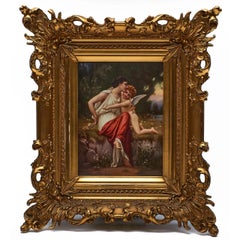
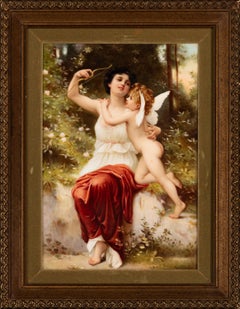
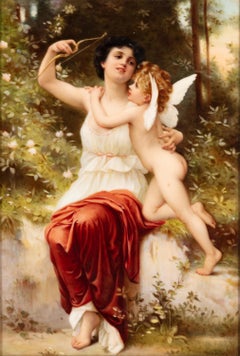
Cupid and Aphrodite: Late 19th Century Porcelain Painting

Cupid and Aphrodite: Late 19th Century Porcelain Painting

Located in Milwaukee, WI

This painting on porcelain depicts the Greek legends Aphrodite and Cupid in radiant light. In this playful scene, Aphrodite holds Cupid's bow just out of his reach. This painting is ...

Category

Late 19th Century Academic Porcelain Figurative Paintings

Materials

Oil, Porcelain

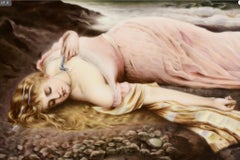
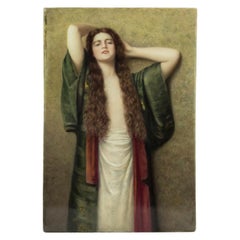
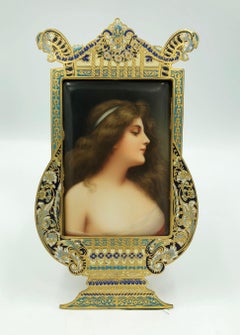
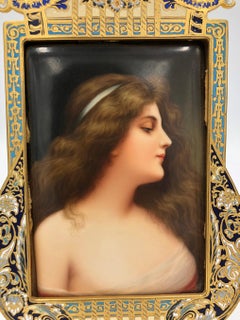
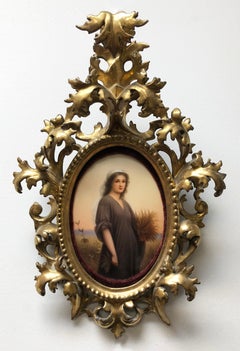
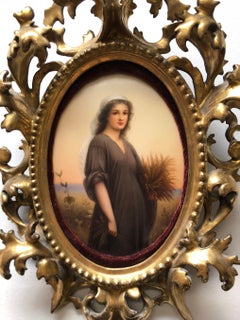
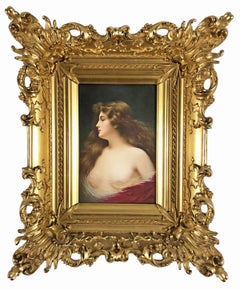
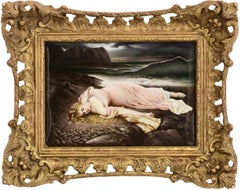
KPM Oil Painting Of An Exotic Maiden Washed Up On A Beach.

KPM Oil Painting Of An Exotic Maiden Washed Up On A Beach.

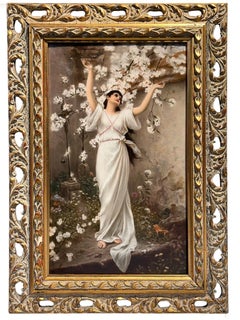
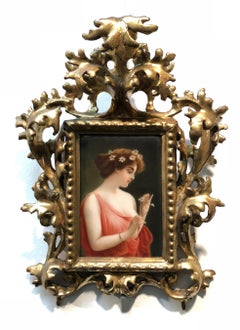
Berlin (K.P.M.) Porcelain Plaque of a Woman Late 19th century. Circa 1896 A very fine and detailed oil painting on porcelain by the Königliche Porzellan-Manufaktur (KPM) depicting a...

Category

1890s Art Nouveau Porcelain Figurative Paintings

Materials

Porcelain, Oil

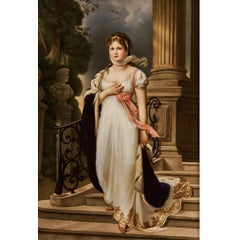
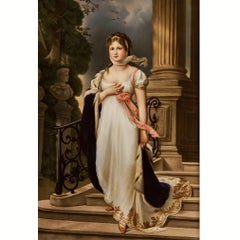
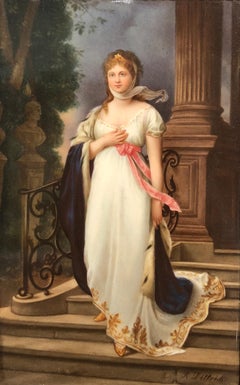
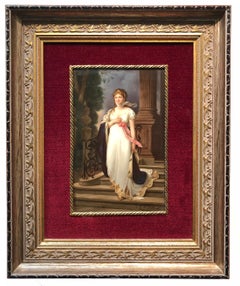
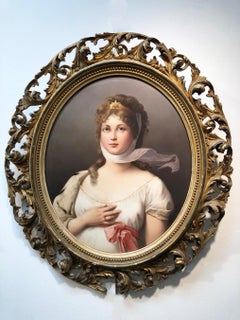
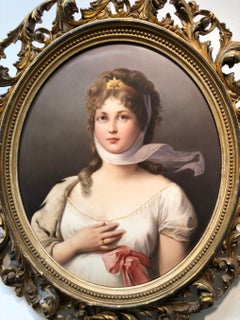
KPM  Porcelain Plaque Of 'Duchess Louise Of Mecklenburg-Strelitz'

KPM Porcelain Plaque Of 'Duchess Louise Of Mecklenburg-Strelitz'

By Königliche Porzellan-Manufaktur (KPM)

Located in New York, NY

KPM Porcelain Plaque of 'Duchess Louise of Mecklenburg-Strelitz' late 19 CENTURY Century After a painting by Gustav Richter (German 1823-1884); verso with an impressed scepter abo...

Category

19th Century Porcelain Figurative Paintings

Materials

Porcelain, Paint, Glaze

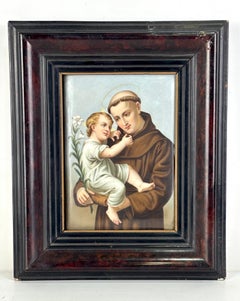
Enamel on Porcelain Depicting Saint Anthony with the Christ Ch

Enamel on Porcelain Depicting Saint Anthony with the Christ Ch

Located in Sant Celoni, ES

Fine 19th Century Enamel on Porcelain Depicting Saint Anthony with the Christ Child Beautiful and finely detailed enamel painting on porcelain representing Saint Anthony of Padua wit...

Category

Mid-19th Century Porcelain Figurative Paintings

Materials

Porcelain, Oil

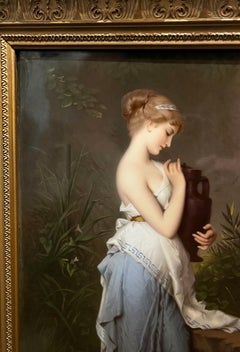
KPM porcelain plaque depicting Psyche holding a Lekythos

KPM porcelain plaque depicting Psyche holding a Lekythos

Located in New York, NY

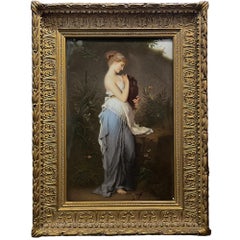
A largeKPM painted porcelain plaque depicting a Psyche holding a Lekythos. The lush and overgrown dark forrest envelops the background of composition, surrounding a bright female fig...

Category

19th Century Porcelain Figurative Paintings

Materials

Porcelain

"Die Falschspieler" [The Cardsharpers] KPM Porcelain Plaque, 19th Century

"Die Falschspieler" [The Cardsharpers] KPM Porcelain Plaque, 19th Century

By Michelangelo Merisi da Caravaggio

Located in Astoria, NY

After Caravaggio "Die Falschspieler" [The Cardsharps] KPM Porcelain Plaque, impressed "K.P.M. / F" marks to reverse, giltwood frame. Image: 11.75" H x 16" W; frame: 20.5" H x 24.5" W...

Category

19th Century Baroque Porcelain Figurative Paintings

Materials

Enamel

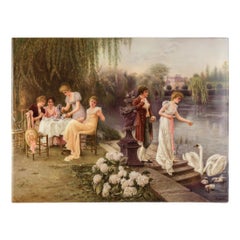
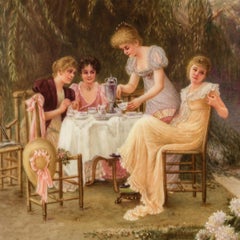
K.P.M. Hand Painted Porcelain Plaque of a Tea Party by Wagner

K.P.M. Hand Painted Porcelain Plaque of a Tea Party by Wagner

By Königliche Porzellan-Manufaktur (KPM)

Located in New York, NY

Depicting young ladies having a tea party by the pond of a country estate, and a young nobleman courting a young lady feeding the swans. Incised "KPM", scepter, "255 / 195" and signe...

Category

19th Century Porcelain Figurative Paintings

Materials

Porcelain

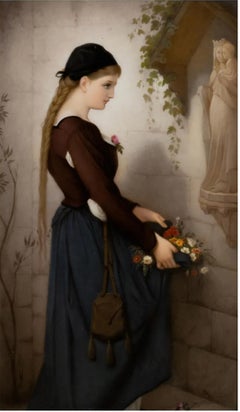
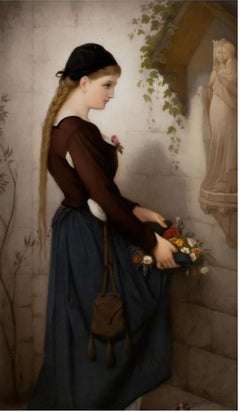
KPM Porcelain Plaque of a young Madonna Worshiper

KPM Porcelain Plaque of a young Madonna Worshiper

By Königliche Porzellan-Manufaktur (KPM)

Located in New York, NY

This plaque depicts a quintessential 19th century Northern European woman with blonde hair, blue eyes and modest European fashions. She holds a bushel of fresh flowers as an offering and to decorate the small stone statue of Mary and a young Jesus before...

Category

19th Century Porcelain Figurative Paintings

Materials

Porcelain

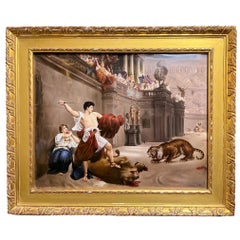
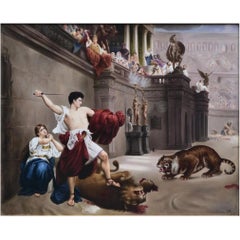
KPM Porcelain Plaque of A Gladiator Battling a Lion and Tiger in the Colosseum

KPM Porcelain Plaque of A Gladiator Battling a Lion and Tiger in the Colosseum

By Königliche Porzellan-Manufaktur (KPM)

Located in New York, NY

Important KPM Plaque of a Gladiator Battling a Lion and Tiger in a Colosseum. A woman in distress cowers behind the gladiator as he surmounts his recently slain lion, readying himsel...

Category

19th Century Porcelain Figurative Paintings

Materials

Porcelain, Glaze

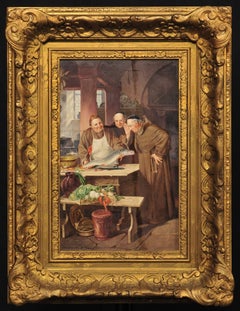
Three Religious Men with Fish

Three Religious Men with Fish

Located in Fort Washington, PA

Medium: Oil on Porcelain Dimensions: 20.00" x 16.00" Signature: Signed Lower Left

Category

20th Century Porcelain Figurative Paintings

Materials

Porcelain, Oil

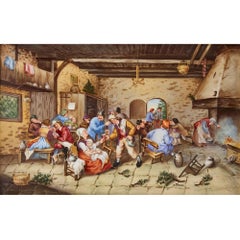
Large German KPM Style Porcelain Plaque of a Tavern Scene

Large German KPM Style Porcelain Plaque of a Tavern Scene

Located in London, GB

Large German KPM style porcelain plaque of a tavern scene German, 20th Century Plaque: Height 26cm, width 40cm Frame: Height 41cm, width 55.5cm, depth 5.5cm This exquisite porcelai...

Category

20th Century Porcelain Figurative Paintings

Materials

Porcelain, Paint

KPM Porcelain Allegorical Plaque Of Admiration  Late 19th Century Plaque

KPM Porcelain Allegorical Plaque Of Admiration Late 19th Century Plaque

Located in New York, NY

Berlin Porcelain Allegorical Plaque of Admiration KPM, Late 19th CENTURY The three-quarter-length portrait depicting a brunette woman with blue eyes in light ecclesiastical robes supporting palms crossed over chest and looking up over right shoulder - in a landscape immersed in powder blue sea holly...

Category

19th Century Porcelain Figurative Paintings

Materials

Porcelain, Paint

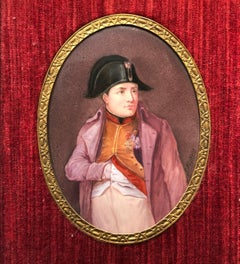
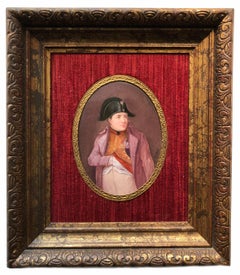
Napoleon
Napoleon

Napoleon

By Manufacture Nationale de Sèvres

Located in Missouri, MO

Sevres 19th C. Original Hand Painted Porcelain Signed "G Poitevin" approx 9 x 5 inches/15 x 12 framed The vast and diverse production of the Sèvres factory in the nineteenth century resists easy characterization, and its history during this period reflects many of the changes affecting French society in the years between 1800 and 1900. Among the remarkable accomplishments of the factory was the ability to stay continuously in the forefront of European ceramic production despite the myriad changes in technology, taste, and patronage that occurred during this tumultuous century. The factory, which had been founded in the town of Vincennes in 1740 and then reestablished in larger quarters at Sèvres in 1756, became the preeminent porcelain manufacturer in Europe in the second half of the eighteenth century. Louis XV had been an early investor in the fledgling ceramic enterprise and became its sole owner in 1759. However, due to the upheavals of the French Revolution, its financial position at the beginning of the nineteenth century was extremely precarious. No longer a royal enterprise, the factory also had lost much of its clientele, and its funding reflected the ruinous state of the French economy. However, the appointment in 1800 of Alexandre Brongniart (1770–1847) as the administrator of the factory marked a profound shift in its fortunes. Trained as both an engineer and a scientist, Brongniart was both brilliant and immensely capable, and he brought all of his prodigious talents to the running of the troubled porcelain factory. He directed the Sèvres factory as administrator until his death in 1847, and during those five decades influenced every aspect of its organization and production. Much of the factory’s old, undecorated stock was immediately sold off, and new forms—largely in the fashionable, more severe Neoclassical style—were designed to replace out-of-date models. The composition for hard-paste porcelain was improved, and the production of soft paste, for which the factory had been famous in the previous century, was abandoned in 1804. New enamels colors were devised, and Brongniart oversaw the development of a new type of kiln that was both more efficient and cost-effective. Much of the factory’s output during Brongniart’s first decade reflected the prevailing Empire taste, which favored extensive gilding, rich border designs, and elaborate figural scenes (56.29.1–.8). Backgrounds simulating marble or a variety of hardstones were employed with greater frequency (1987.224); the new range of enamel colors developed under Brongniart made it easier to achieve these imitation surfaces, and it is thought that his interest in mineralogy provided the impetus for this type of decoration. For objects produced in sets, such as dinner, tea, and coffee services, and even garnitures of vases, Brongniart preferred decorative schemes that linked the objects in terms of subject matter as well as stylistically. Dinner services were given coherence by the use of an overall theme, in addition to shared border patterns and ground colors. One of the best examples of this can be found in the “Service des Départements,” which was conceived by Brongniart in 1824 (2002.57). Each of the plates in the service was decorated with a famous topographical view of the département (administrative unit) of France that it represented, and its border was painted with small cameo portraits of figures from the region, as well as symbols of the major arts, industries, and products of the area. This same type of thematic unity is found on a coffee service produced in 1836 (1986.281.1ab–4). All of the pieces of the service are decorated with scenes depicting the cultivation of cacao, from which chocolate is made, or various stages in the preparation of chocolate as a beverage. The compositions were conceived and executed by Jean Charles Develly, a painter at Sèvres who was responsible for many of the most ambitious dinner services produced at the factory during Brongniart’s tenure. The range of objects produced in the first half of the nineteenth century was enormous, as were the types of decoration that they employed. A recent exhibition catalogue devoted to Brongniart’s years at Sèvres indicates that ninety-two new designs for vases were introduced, as were eighty-nine different cup models, and the types of objects produced by the factory included every sort of form required by a dinner or dessert service, coffee and tea wares, decorative objects such as vases, and functional objects such as water jugs, basins, and toiletry articles. A new form rarely replaced an older one; the range of production simply increased. The same was true with types of decoration, as the factory was working in a wide variety of styles at any given time. From the earliest years of the Sèvres factory, its painters had copied not only contemporary compositions but also prints and paintings from earlier periods. However, under Brongniart, the factory sought to copy famous paintings with the specific intention of recording the “true” appearance of works increasingly perceived to be fragile. Works by a wide variety of artists were copied, but those by Raphael were especially popular. Raphael’s stature is reflected in a vase of 1834 in which a cameo-style portrait of the artist decorates the primary reserve, while on the back an artist’s palette is encircled by the names Titian, Poussin, and Rubens (1978.373). Just as works by earlier artists were copied, so too were decorative techniques of previous centuries. The interlace patterns of so-called Saint-Porchaire ceramic ware of the sixteenth century served as the inspiration for the decoration on a cup of 1837 (2003.153). The form of the cup itself derives from Renaissance silver forms made in Italy and France. However, the palette of vibrant reds, greens, blues, and yellows contrasts markedly with the muted browns and off whites of Saint-Porchaire wares and reflects the reinterpretation of historical styles that was characteristic of so much of nineteenth-century decorative arts. Interest in the Gothic style emerged early in Brongniart’s tenure at Sèvres and remained popular for much of the nineteenth century. Strict adherence to Gothic motifs was rarely observed, however, and the Gothic style was more evoked than faithfully copied. This tendency is reflected in a pair of vases (1992.23.1) for which the model was designated vase gothique Fragonard (named after the vase’s designer, Alexandre Evariste Fragonard [1780–1850]. The Gothic elements lie more in the painted decoration than in the form itself, and the style of the painting reflects a Renaissance technique rather than a medieval one. The palette of grays and whites on a blue ground instantly recalls the enamel-on-copper wares produced in Limoges, France, in the sixteenth century, and its use on these vases indicates the willingness to freely mix artistic styles and techniques of different periods in order to achieve new aesthetic effects. The eclecticism and historicism that characterized so much of the production during Brongniart’s tenure continued after his death in 1847. The factory’s output reflected an ongoing desire for technical innovation as well as a wide embrace of diverse decorative styles that were employed simultaneously. A tea and coffee service of 1855–61 (69.193.1–.11) embodies the selective borrowing of forms and motifs that is found so frequently in Sèvres production of the middle decades of the nineteenth century. The shapes used for the different components of the service evoke both China and the Near East, an obvious allusion to the origins of the two beverages. The openwork decoration refers directly to Chinese ceramics made in this technique, and the decoration employs a variety of Chinese emblems. However, the palette of pink and gold, entirely European in character, serves to neutralize the Asian aspects of the service. Perhaps the only thread that can be said to run through much Sèvres production of the nineteenth century is the proclivity to borrow freely from various historical styles and then to either reinterpret these styles or combine them in unprecedented ways. A standing cup of 1879 (1990.238a,b) draws upon silver cups of the Renaissance for its form, but in this instance the size of the porcelain cup dwarfs any of its metal prototypes. Its style of decoration derives from Limoges painted enamels of the sixteenth century, but the prominent use of gilding throughout reflects its wholly nineteenth-century character. This cup was presented by the French government to one of the first-prize winners at the 1878 Exposition Universelle. It was with the advent of the Art Nouveau style at the very end of the nineteenth century that historicism lost its grip at Sèvres, and indeed throughout the decorative arts, and forms inspired by nature and often characterized by asymmetry become dominant. This reliance upon natural forms is fully evident in a coffee service of 1900–1904 (1988.287.1a,b). The designer, Léon Kann...

Category

Late 19th Century Porcelain Figurative Paintings
Materials

Porcelain, Oil

Related Items
Parisian French Cancan Montmatre Paris Portrait Belle Epoque

Parisian French Cancan Montmatre Paris Portrait Belle Epoque

Located in PARIS, FR

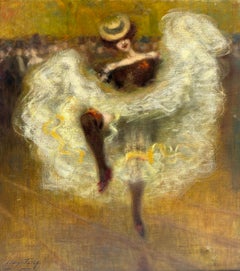
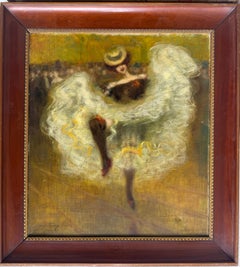
Pierre-André Farcy, known as Andry-Farcy (1882–1950) French Cancan Oil on canvas 61 × 50 cm (24 × 19.7 in.) 71.5 × 66 cm (28.1 × 26 in.) framed Signed lower left Best remembered tod...

Category

Early 20th Century Art Nouveau Porcelain Figurative Paintings

Materials

Cotton Canvas, Oil

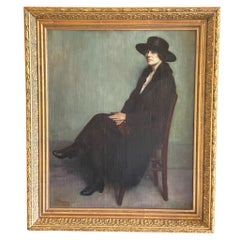
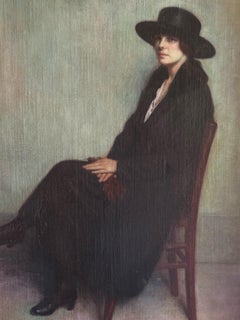
Portrait of a Woman, Lady in Black Coat & Hat, Oil on Canvas, Paris School 1910s

Portrait of a Woman, Lady in Black Coat & Hat, Oil on Canvas, Paris School 1910s

Located in AIGNAN, FR

Early 20th-Century French Portrait of a Seated Woman in a Black Coat & Wide-Brimmed Hat by Louis Pierre Amiel, signed in the lower right and in a vintage gilt frame. A refined e...

Category

Early 20th Century Art Nouveau Porcelain Figurative Paintings

Materials

Canvas, Oil

Gaia, The Primordial Goddess of the Earth, Original Oil on Canvas, Framed

Gaia, The Primordial Goddess of the Earth, Original Oil on Canvas, Framed

By John rush

Located in Chicago, IL

In Greek mythology, Gaia is the primordial goddess of the Earth, the mother of all, and a powerful force who shaped the cosmos and intervened in the affairs of gods and mortals alike...

Category

2010s Art Nouveau Porcelain Figurative Paintings

Materials

Canvas, Oil

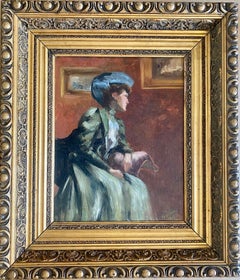
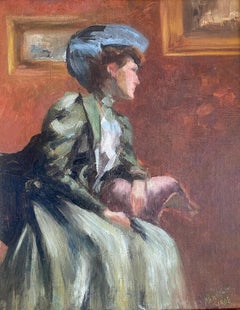
Pensive Salon Beauty Young Woman in an Interior, French Belle Epoque painting

Pensive Salon Beauty Young Woman in an Interior, French Belle Epoque painting

Located in Norwich, GB

A captivating Belle Époque character study attributed to the French painter Tony Tollet (1857–1953), depicting a young woman seated in quiet contemplation. Rather than presenting hi...

Category

Early 1900s Art Nouveau Porcelain Figurative Paintings

Materials

Canvas, Oil

"Dancer's Dream" Large Original Oil Painting by Robert White, Frameless Display

"Dancer's Dream" Large Original Oil Painting by Robert White, Frameless Display

Located in Encino, CA

“Dancer's Dream,” an original oil on canvas by Robert K. White, is a piece for the true collector. White’s careful attention to detail and vivid use of greens, browns, and whites project from the painting, immediately capturing the viewer's attention and highlighting the artist's keen ability to capture emotion and life - all in a brushstroke. White's talent for depicting light and shadow provides the foundation for him to deliver subjects and scenes to the viewer's eye. This masterful work would make a great addition to an art collection and enhance most any home, perfect for those who have an affinity for dancers, the ballet, portraits, and color-rich works of art. In the artist’s own words, “I don’t paint what is inside of me; I paint what I see outside of me. I’m an observer. If I see something and I feel an affinity for it, something just clicks in my head. I’ll make the decision right then and there to paint that particular subject during that particular moment. It’s a perfect moment. Once something has caught my eye and I’ve heard the “perfect” click, it’s like a photograph has been taken in my mind’s eye. I only have a few days of clarity with that image. I have to start the painting quickly or else it will be gone and I will lose that image forever.” Artist: ROBERT KENNETH WHITE...

Category

2010s Realist Porcelain Figurative Paintings

Materials

Oil, Canvas

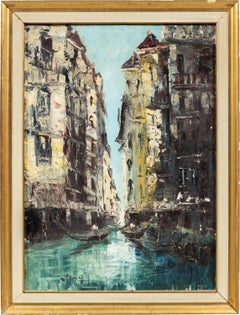
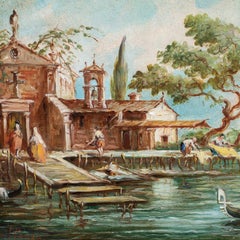
Venetian painter - Early 20th century Venice canal with gondoliers view

Venetian painter - Early 20th century Venice canal with gondoliers view

Located in Varmo, IT

Venetian painter (early 20th century) - View of Venice with Canal and Gondolas. 70 x 50 cm (without frame) - 81 x 61 cm (with frame). Oil on canvas, in gilded wood frame. Si...

Category

Early 20th Century Art Nouveau Porcelain Figurative Paintings

Materials

Canvas, Oil

Gaia, Oil on Canvas Painting, Art Nouveau, Framed, 16x24 in, 2010+

Gaia, Oil on Canvas Painting, Art Nouveau, Framed, 16x24 in, 2010+

By John rush

Located in Chicago, IL

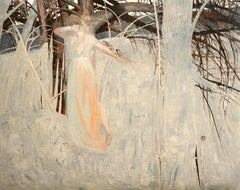
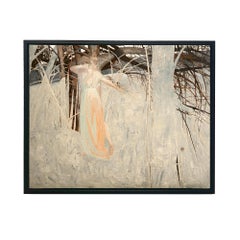
In Penelope Waits, John Rush captures the quiet strength of unwavering devotion. Set within a sparse woodland, the solitary figure appears both present and elusive, her softened form...

Category

2010s Art Nouveau Porcelain Figurative Paintings

Materials

Canvas, Oil

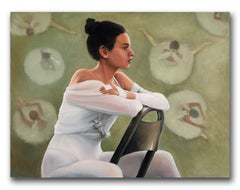
Art Nouveau Ballerina Painting by Mystery European Artist

Art Nouveau Ballerina Painting by Mystery European Artist

Located in New York, NY

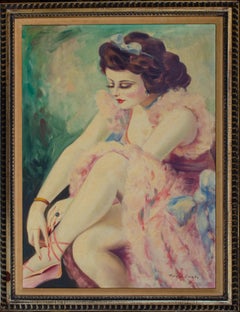
Mystery European Artist Untitled, c. 20th Century Oil on canvas board 31 x 22 3/4 in. Framed: 36 1/4 x 28 x 1 1/2 in. Signed lower right

Category

20th Century Art Nouveau Porcelain Figurative Paintings

Materials

Canvas, Oil, Board

Lucia Ponga - Early 20th century Venetian Capriccio with ruins and boats

Lucia Ponga - Early 20th century Venetian Capriccio with ruins and boats

Located in Varmo, IT

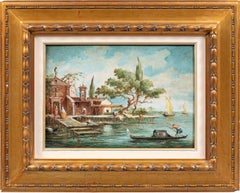
Lucia Ponga degli Ancillo (Venice 1887 - 1966) - Venetian Capriccio with Jetty, Gondola and Staffage Figures. 25 x 35 cm (without frame) - 44.5 x 55 cm (with frame). Oil on panel, ...

Category

Early 20th Century Art Nouveau Porcelain Figurative Paintings

Materials

Panel, Oil

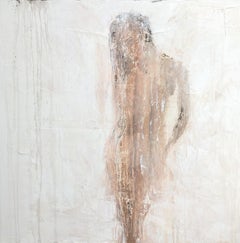
"1397 Innocence" Figurative, Abstract, Painting, 21st Century, Acrylic

"1397 Innocence" Figurative, Abstract, Painting, 21st Century, Acrylic

By Roger König

Located in Dessau-Rosslau, Sachsen Anhalt

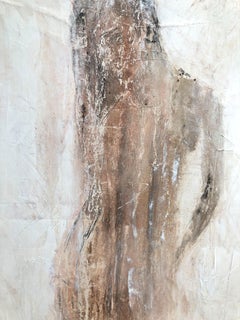
Artist: Roger König b. Dessau, Germany (1968) Master student of Kurt Schönburg, HWK Halle, Germany. The works are developed through a historically informed, proprietary material pra...

Category

2010s Abstract Porcelain Figurative Paintings

Materials

Clay, Acrylic

Dance of the Nymphs
Dance of the Nymphs

Dance of the Nymphs

By Paul Desire Trouillebert

Located in New Orleans, LA

This lyrical landscape entitled Dance of the Nymphs was composed by the French Barbizon painter Paul Désiré Trouillebert. A joyful scene of nymphs dancing the morning fog, the work closely resembles an important work by the great Camille Corot, which is now housed at the Musée d'Orsay (Paris). Renowned for his unique individuality that toed the line between the traditional and modern, Corot and his landscapes helped pave the way for an entire generation of Impressionists who followed him. Trouillebert perfectly captures the poetic atmosphere of Corot’s groundbreaking works, while also imbuing this scene with a freshness and character that is all his own. Trouillebert's oil on canvas is exemplary of the tradition of historical painting. The work perfectly combines a realistic depiction of the natural world with a spirited romanticism as his idealized nymph figures frolic playfully beneath a crisp morning sky. As a whole, it is a lovely composition executed with a level of skill and artistry that proves Trouillebert's exceptional talent in the arts. Born in Paris in 1831, Paul Désiré Trouillebert was a student of the academic painters Ernest Hébert...

Category

19th Century Academic Porcelain Figurative Paintings

Materials

Canvas, Oil

Previously Available Items
The Departure
The Departure

Flore LAUTZThe Departure, 1848

Sold

H 19.49 in W 14.97 in

The Departure

Located in Paris, IDF

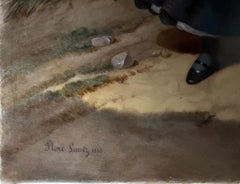
Flore LAUTZ (Active in Paris around 1830-1850) The Departure Painting on porcelain Signed and dated 1848 lower left 49.5 x 38 cm Exhibition: Paris Salon of 1849, under No. 1248 Re...

Category

Mid-19th Century French School Porcelain Figurative Paintings

Materials

Porcelain

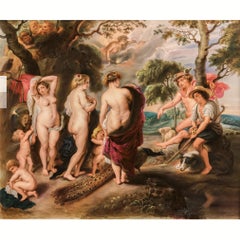
Berlin  KPM Porcelain Mythological Plaque Of 'The Judgment Of Paris'

Berlin KPM Porcelain Mythological Plaque Of 'The Judgment Of Paris'

Located in New York, NY

Berlin Porcelain Mythological Plaque of 'The Judgment of Paris' KPM, Late 19th- Century After a painting by Peter Paul Rubens (Flemish 1577-1640); ve...

Category

19th Century Porcelain Figurative Paintings
Materials

Porcelain, Paint

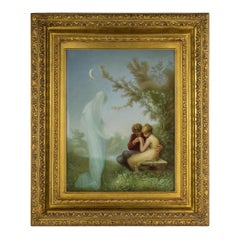
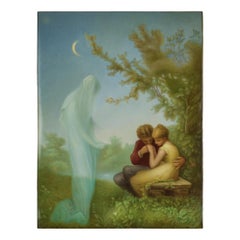
Painted Berlin K.P.M. Porcelain Plaque of Veiled Spirit Gazing Upon Young Lovers

Painted Berlin K.P.M. Porcelain Plaque of Veiled Spirit Gazing Upon Young Lovers

By Königliche Porzellan-Manufaktur (KPM)

Located in New York, NY

With two young lovers seated in a garden before a ghostly figure Maker: K.P.M. Origin: German Date: late 19th century Dimension: 16 1/4 in. x 12 1/4 in.(p...

Category

19th Century Porcelain Figurative Paintings
Materials

Porcelain

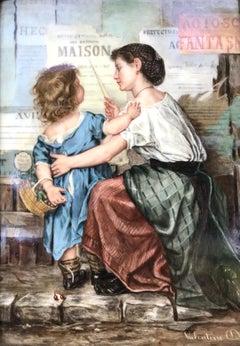
“The French Lesson”
“The French Lesson”

“The French Lesson”

Located in Southampton, NY

Beautifully executed painting on porcelain plaque by the artist J. Valentine. Signed lower right. Circa 1890. Condition: Very good. A very sweet scene of a teacher and her very y...

Category

1880s Academic Porcelain Figurative Paintings

Materials

Porcelain

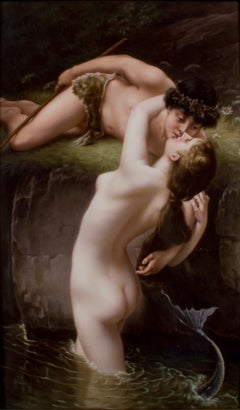
"Kiss, " Nude Figurative Oil Painting on Porcelain produced by K.P.M. Porcelain

"Kiss, " Nude Figurative Oil Painting on Porcelain produced by K.P.M. Porcelain

Located in Milwaukee, WI

"Kiss" is an oil painting on porcelain produced by K.P.M. Porcelain. This painting features two nude or near-nude figures embracing and kissing. A fish or mermaid's tail peeks out of...

Category

20th Century Academic Porcelain Figurative Paintings

Materials

Porcelain, Oil

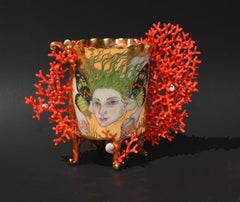
"Butterfly Mermaid Cup", Contemporary, Ceramic, Porcelain, Sculpture, Design

"Butterfly Mermaid Cup", Contemporary, Ceramic, Porcelain, Sculpture, Design

By Irina Zaytceva

Located in St. Louis, MO

Irina Zaytceva was born in Moscow in 1957. As a child, she loved to draw and sculpt and eventually decided to make it her vocation. She graduated from Moscow Art Institute ( Poljgrap...

Category

2010s Contemporary Porcelain Figurative Paintings

Materials

Ceramic, Porcelain, Paint, Mixed Media

Porcelain figurative paintings for sale on 1stDibs.

Find a wide variety of authentic Porcelain figurative paintings available on 1stDibs. While artists have worked in this medium across a range of time periods, art made with this material during the 21st Century is especially popular. There are many well-known artists whose body of work includes ceramic sculptures. Popular artists on 1stDibs associated with pieces like this include Königliche Porzellan-Manufaktur (KPM), (after) Pablo Picasso, Joseph Gascle, and Kate Brett. Frequently made by artists working in the Contemporary, all of these pieces for sale are unique and many will draw the attention of guests in your home. Not every interior allows for large Porcelain figurative paintings, so small editions measuring 0.1 inches across are also available