1730s Figurative Paintings

5 Results
to
2
1
4
Overall Width
to
Overall Height
to
1,068
2,587
14,512
32,698
333
321
572
835
639
826
923
1,255
1,117
1,161
528
2
4
1
5
2
2
2
1
1
1
1
1
4
4
4
4
1
4
1
5
Period: 1730s
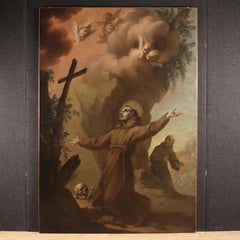
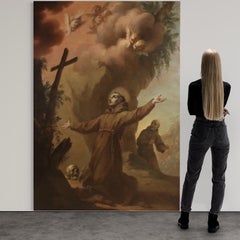
18th Century Oil on Canvas Italian Painting Ecstasy of Saint Francis of Assisi

18th Century Oil on Canvas Italian Painting Ecstasy of Saint Francis of Assisi

Located in Vicoforte, IT

Antique Italian painting from the first half of the 18th century. Oil on canvas artwork depicting an intense scene of mystical ecstasy of Saint Francis of Assisi. A large-scale paint...

Category

1730s Figurative Paintings

Materials

Canvas

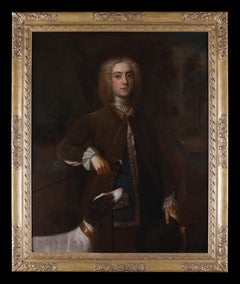
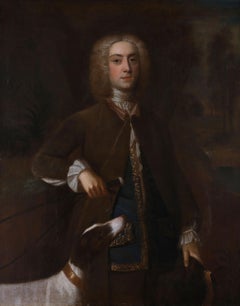
Portrait of a Gentleman with his Dog -  Possibly Abraham Tucker. Oil on Canvas

Portrait of a Gentleman with his Dog - Possibly Abraham Tucker. Oil on Canvas

By Enoch Seeman

Located in St. Albans, GB

Enoch Seeman - 1894 - 1744 Provenance: Christies King Street Canvas Size: 50 x 40" (127 x 102cm) Outside Frame Size: 58 x 48" (147 x 122cm) An excellent example of Seeman's work. ...

Category

Old Masters 1730s Figurative Paintings

Materials

Oil

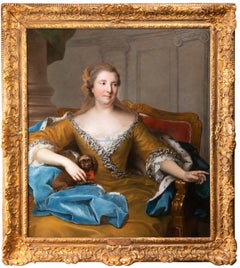
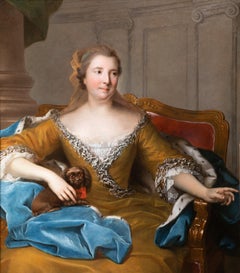
Jean-Marc Nattier (1685 - 1766) - Portrait of Charlotte de Hesse-Rheinfels

Jean-Marc Nattier (1685 - 1766) - Portrait of Charlotte de Hesse-Rheinfels

By Jean-Marc Nattier

Located in PARIS, FR

Jean-Marc Nattier (Paris, 1685 - 1766) and his workshop Portrait of Charlotte de Hesse-Rheinfels Oil on canvas : h. 44.09 in, w. 38.19 in 18th century carved giltwood framed Framed : h. 52.36 in, w. 47.63 in Charlotte de Hesse-Rheinfels (1714-1741), daughter of Landgrave Ernest-Léopold de Hesse-Rheinfels-Rotenburg and Éléonore de Lowenstein-Wertheim and Kazazyan, was Princess of Condé by her marriage in 1728 to Duke Louis-Henri de Bourbon-Condé known as Monsieur le Duc. The princess is portrayed seated on a canopy of gilded wood trimmed with raspberry red velvet, the body positioned facing forward while the face is turned three-quarters to the left. The face with a thoughtful and thoughtful gaze is awakened by its large gray eyes, the translucent skin with painted cheeks accentuates the effect of a melted execution of the model. Her powdered and tied hair is adorned with an orange veil which goes down on her shoulders. The separation fades between the powdered hair and the face. Dressed in a golden yellow satin dress embellished with multiple rows of white and black lace flounces at the bodice and sleeves, the neckline of her dress reveals her bare throat. The ermine coat lined with blue velvet is placed behind his shoulders, the sides of the coat come back to the front and are arranged in angular folds on his knees. With her right hand, arm bent at the elbow, she caresses her little dog, while the left arm resting on the armrest of the armchair is extended and the index finger of her open hand points to the right. The positions of the arms and the head generate an illusion of diagonal movement allowing to break the static character of portrait. This stretching of the arms horizontally is characteristic of Nattier's works, the figure thus grows in size in the painting by occupying a larger place there. This process carried out by highlighting the elegance of refined gestures increases the natural grace of the young woman. The sober architectural background is composed of a column draped with a green curtain and flattened pilasters with Ionian capitals. The light coming from the right partially illuminates the figure, leaving the left part in shadow. Illuminated, the young woman's dress reflects golden reflections in warm orange tones, while the velvet of the coat broken into angular folds reveals its surface through icy white ridges. This opposition only accentuates the volumes and textures of the fabrics. The facial features under a subtle effect of blurred appear more softened while the pearly white complexions seem illuminated with an inner radiance. Related works: Our work is a variant of the painting executed by Jean Marc Nattier...

Category

Old Masters 1730s Figurative Paintings

Materials

Canvas, Oil

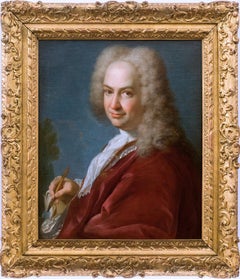
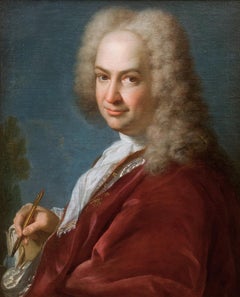
Presumed artist self-portrait

Presumed artist self-portrait

Located in BELEYMAS, FR

Louis-Gabriel BLANCHET (Versailles, 1701 – Rome, 1772) Presumed self-portrait of the artist Oil on canvas H. 73 cm; W. 60 cm Circa 1730 Originally presented in a Restoration period frame with a "Mignard" cartouche, this beautiful painting initially appeared to us as a work from northern Italy. However, it exuded a rather French form of refinement, suggesting that its artist may have assimilated a dual influence from both sides of the Alps. We thank our colleague and friend Philippe Mendès for spontaneously and judiciously "bringing out" the name of Louis-Gabriel Blanchet, a Romanized French portraitist, whose spirit and stylistic characteristics we clearly recognize here. Blanchet's "French" years, before his final departure for Rome in 1728, following his winning of the second Grand Prix for painting after Subleyras in 1727, are extremely poorly documented. His father, Gabriel, was valet to Blouin, himself Louis XIV's first valet at the time. According to Thierry Lefrançois, Blanchet was one of the few students of Nicolas Bertin (1667-1736), whose studio he is said to have joined in the early 1720s. At a baptism on March 24, 1724, where he was godfather, he is mentioned as a painter in the picture store of the Duke of Antin, the director of buildings between 1708 and 1736. At this time, he was probably already married to Jeanne Quément, with whom he had a daughter also named Jeanne, who would marry Nicolas Aviet, the son of a valet in the queen's wardrobe, in Versailles in 1738. When Blanchet arrived in Rome in October 1728, he was accompanied by Subleyras, Trémolières, and Slodtz. He enjoyed the goodwill of Vleughels, the director of the Académie de France, which had been based at the Palazzo Mancini since 1725, even though the latter was not always kind to our resident. From 1732, he was under the protection of the Duke of Saint-Aignan when he took up his post as ambassador to Rome. Along with Slodtz and Subleyras, they formed a trio of friends, joined by Joseph Vernet shortly after his arrival in Rome in 1734. Slodtz and Blanchet, on the occasion of Subleyras's marriage in 1739, were there to attest that their friend was not bound by any marital commitment, and Blanchet was a witness at Vernet's wedding in 1745. It is most likely from these early years in Rome that our portrait of the artist dates, the expression and turn of his face irresistibly reminiscent of a self-portrait. The still relatively youthful features may correspond to Blanchet's thirty-something years, and the fluffy wig was still fashionable at this time. The painting fits well with the depiction of a young painter wanting to display both the beginnings of success and a certain simplicity or restraint. A slight smile expresses a form of assurance in this man with a gentle, sincere gaze and a face radiating a keen sense of wit. We find here the air of intimacy present in almost all of Blanchet's portraits, even those from the 1750s and 1760s, as well as an almost complicity with the viewer. The spirit of the painting is quite close to that of the presumed portrait of Bouchardon (painted around 1730) and the portrait of Pannini, painted in 1736, but it possesses a more natural quality, notably thanks to the absence of decorum. Our work exhibits the characteristics of Blanchet's paintings: elegance, luminosity (especially in the whites), vibrant and refined colors (here, the harmony of the garnet of the garment and the slate blue of the background, whose uniformity is tempered by a very sketched landscape and a grove of greenery), light complexions, rather rosy cheekbones, often full lips, and rather tight framing. According to the Academy's rules, Blanchet's stay should have ended in the spring of 1732, but, for reasons unknown, he remained in the Eternal City until his death, as did his friend Subleyras, with whom he shared accommodation until the late 1730s. The latter regularly called upon him to collaborate on his paintings, such as The Meal at Simon's. Through Saint-Aignan's intervention, Blanchet was employed in the late 1730s by the Stuart princely family, then exiled in Italy. He notably produced copies (now lost) after Liotard of the portraits of Charles Edward and Henry Benedict, the sons of James III Stuart. The latter also commissioned three other portraits (now in the National Portrait Gallery in London), whose more formal character contrasts with the intimate spirit of Blanchet's portraits. Blanchet frequented English painters, such as the landscape painter Richard Wilson, and studied with the Scottish portraitist Katherine Read...

Category

French School 1730s Figurative Paintings
Materials

Oil, Canvas

Related Items
Portrait of Lady Caroline Price

Portrait of Lady Caroline Price

By George Romney

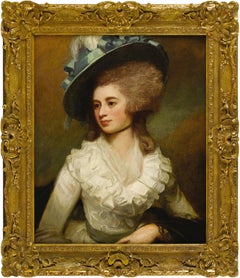
Located in Miami, FL

DESCRIPTION: Perhaps the best Romney in private hands. If Vogue Magazine existed in the late 18th century, this image of Lady Caroline Price would be ...

Category

Old Masters 1730s Figurative Paintings

Materials

Oil, Canvas

Portrait Ferdinando II Sustermans Paint 17th Century Oil on canvas Old master

Portrait Ferdinando II Sustermans Paint 17th Century Oil on canvas Old master

Located in Riva del Garda, IT

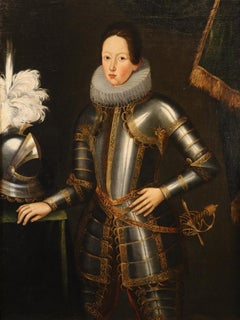
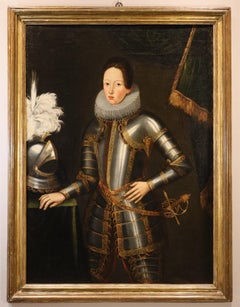
Giusto (or Justus) Sustermans (Antwerp, 1597 – Florence, 1681) Workshop of Portrait of Ferdinando II de' Medici (1610–1670), Grand Duke of Tuscany Oil on canvas 133 x 97 cm Fram...

Category

Old Masters 1730s Figurative Paintings

Materials

Oil

18th Century Oil on Canvas Portrait, Major Alexander Brown in Military Uniform.

18th Century Oil on Canvas Portrait, Major Alexander Brown in Military Uniform.

By Sir David Wilkie

Located in Cotignac, FR

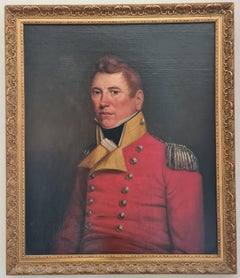
18th Century Military portrait of a young officer in Napoleonic period military dress. The painting is not signed but the subject is Major Alexander Brown. The work is oil on canvas later mounted on board and presented in a fine 'Regence style' carved gilt frame. There are labels to the back referring to the subject, 'Major Brown of Trinity' and a framers trade label from Edinburgh. A magnificent and imposing portrait of a young military officer in the prime of his life. His red uniform adorned with fine buttons, fringed epaulettes and high gilt collar. His ruddy complexion offset by his stylish hair, a quiff and swept forward to the sides as was the fashion at the time. Sir David Wilkie RA (18 November 1785 – 1 June 1841) was a Scottish painter, especially known for his portraits, including formal royal ones, and scenes from his travels to Europe and the Middle East. He painted successfully in a wide variety of genres, including historical scenes. His main base was in London, but he died and was buried at sea, off Gibraltar, returning from his first trip to the Middle East. He was sometimes known as the "people's painter". He was Principal Painter in Ordinary to King William IV and Queen Victoria. Apart from royal portraits, his best-known painting today is probably The Chelsea Pensioners Reading the Waterloo Dispatch of 1822 in Apsley House. Sir David Wilkie was actually admitted in 1799 (despite only being 14) through the influence of the Earl of Leven...

Category

Old Masters 1730s Figurative Paintings

Materials

Canvas, Oil, Board

To the Calvary with Madaleine - Oil on Canvas by Ippolito Borghese - Early 1600

To the Calvary with Madaleine - Oil on Canvas by Ippolito Borghese - Early 1600

By Ippolito Borghese

Located in Roma, IT

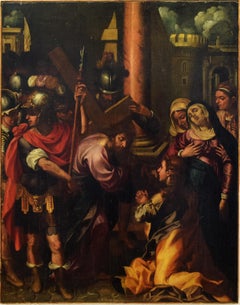
To the Calvary with Maddalena is a superb and impressive original oil painting on canvas, realized by the Italian artist Ippolito Borghese (Sigillo, 1568 - after 1627) Original Title: Andata al Calvario con l'incontro con la Maddalena...

Category

Baroque 1730s Figurative Paintings

Materials

Canvas, Oil

Saint Michael Archangel Reni Paint 17th Centuty Oil on canvas Old master

Saint Michael Archangel Reni Paint 17th Centuty Oil on canvas Old master

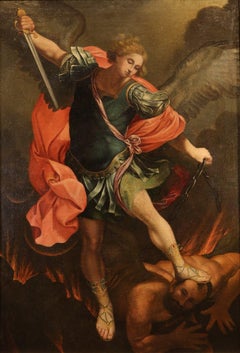
Located in Riva del Garda, IT

Saint Michael the Archangel Workshop of Guido Reni (1575–1642) First half of the 17th century Oil on canvas Dimensions: 132 x 90 cm. With frame: 143 x 102 cm. The Saint...

Category

Old Masters 1730s Figurative Paintings

Materials

Oil

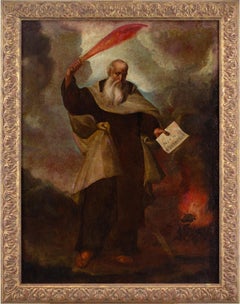
Mid-17th-Century Madrid School, Saint Elijah

Mid-17th-Century Madrid School, Saint Elijah

Located in Cheltenham, GB

This commanding mid-17th-century Spanish Baroque painting depicts Saint Elijah wrapped in a coarse Carmelite habit and raising a flaming sword. Towering within the vertical composit...

Category

Baroque 1730s Figurative Paintings

Materials

Oil, Canvas

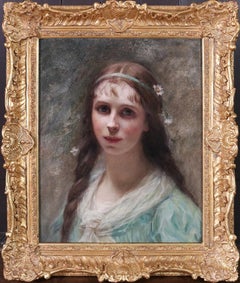
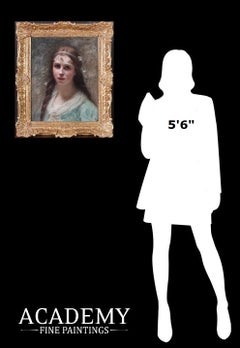
Fine Antique French Belle Epoque Portrait Oil Painting of Paris Flower Girl

Fine Antique French Belle Epoque Portrait Oil Painting of Paris Flower Girl

Located in Gerrards Cross, GB

‘La Couronne de Marguerite’ by Édouard-Louis-Lucien Cabane (1857-1942). The painting – which depicts a young French beauty wearing a crown of daisies – is signed by the artist and ...

Category

French School 1730s Figurative Paintings
Materials

Oil

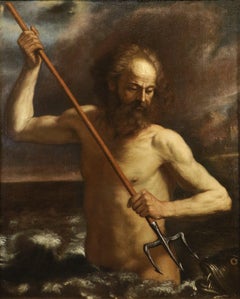
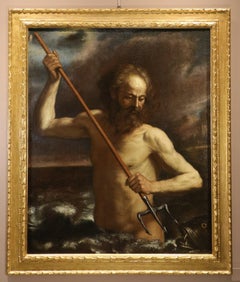
Neptune Poseidon Guercino Paint 17th Century Oil on canvas Old master Italy Art

Neptune Poseidon Guercino Paint 17th Century Oil on canvas Old master Italy Art

Located in Riva del Garda, IT

Neptune on the Waves of the Ocean Workshop of Giovanni Francesco Barbieri, known as Il Guercino (Cento, 1591 – Bologna, 1666) Attributed to Ercole Gennari (Cento, 1597 – Bologna...

Category

Old Masters 1730s Figurative Paintings
Materials

Oil

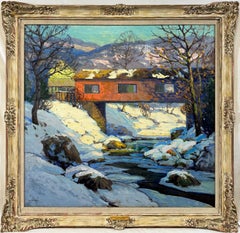
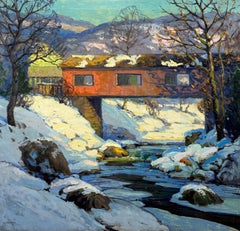
“Covered Bridge, Kingston, NY, 1927” by Walter Koeniger, Snowy Winter Landscape

“Covered Bridge, Kingston, NY, 1927” by Walter Koeniger, Snowy Winter Landscape

By Walter Koeniger

Located in Yardley, PA

Known for his evocative, snow-covered landscapes, Koeniger brings this subject to life with his bold, confident brushwork and keen eye for natural light. The composition centers arou...

Category

American Impressionist 1730s Figurative Paintings
Materials

Canvas, Oil

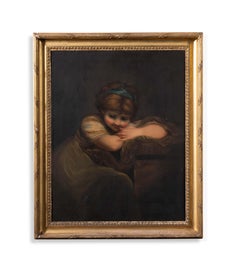
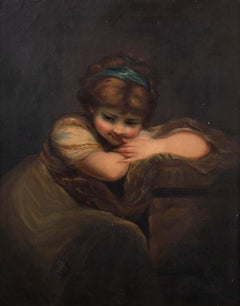
Girl leaning on a pedestal

Girl leaning on a pedestal

By Joshua Reynolds

Located in Stoke, Hampshire

After Joshua Reynolds Girl leaning on a pedestal Oil on canvas Canvas Size - 26 x 33 in Framed Size - 39 x 32 in Sir Joshua Reynolds was the leading portrait painter of 18th-century...

Category

Old Masters 1730s Figurative Paintings
Materials

Oil

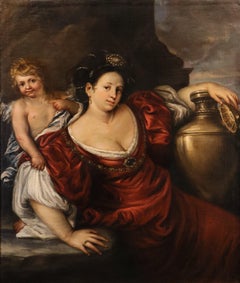
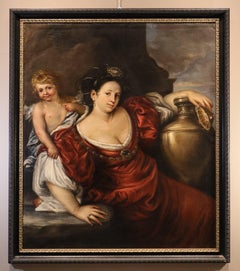
Queen Artemisia Cupid Cairo Paint 17th Century Oil on canvas Old master Italy

Queen Artemisia Cupid Cairo Paint 17th Century Oil on canvas Old master Italy

Located in Riva del Garda, IT

Francesco Cairo (Milan 1607 – 1665), workshop of Queen Artemisia with a Cupid Oil on canvas 129 x 109 cm – Framed 143 x 125 cm. Reference bibliography: Francesco Cairo 1607–1...

Category

Old Masters 1730s Figurative Paintings
Materials

Oil

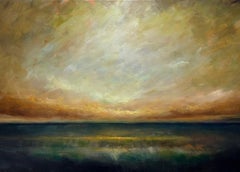
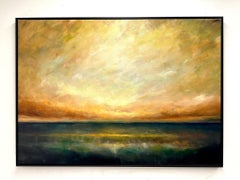
Oostdijk Silence 1 - 21st Century Contemporary seascape painting

Oostdijk Silence 1 - 21st Century Contemporary seascape painting

By Joost Verhagen

Located in Nuenen, Noord Brabant

Joost Verhagen Oostdijk Silence 1 100 x 140 cm Acrylic paint on canvas Shipping on a roll in a tube we can offer, worldwide, for free. Because of the constantly changing prices we ...

Category

Contemporary 1730s Figurative Paintings
Materials

Canvas, Acrylic

Previously Available Items
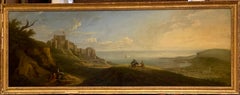
Breathtaking 18th Century Oil Painting Landscape - View of Dover Castle & Bay

Breathtaking 18th Century Oil Painting Landscape - View of Dover Castle & Bay

By George Lambert

Located in London, GB

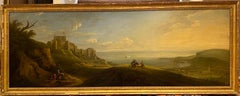
George LAMBERT (1700-1765, English) A View of Dover Castle & Bay 1738 Oil on canvas Signed & dated “G. Lambert, 1738” at lower centre Old paper gallery label on stretcher verso Dimensions H 19 x W 53 inches Framed in a giltwood frame H 22.5 x 56 inches Provenance: Sotheby’s London, November 8 1995, British Paintings, Lot 78. In this panoramic view of Dover Castle and Bay, the castle dominates the left of the composition and the town of Dover can be seen to the right. This is one of six versions of this view, painted by the theatre scene and landscape painter George Lambert between 1735 and 1751. The distant ships and figures may have been added by Samuel Scott (c.1702-1772), with whom Lambert sometimes collaborated. George Lambert divided his career equally between the theatre scene painting and landscape painting professions. For most of his life he lived in Covent Garden, Lonon. His early style of the 1720s is similar to that of John Wootton. However, his later classical landscapes earned him the accolade ‘the father of English Landscape’ and ‘the English Poussin’. Lambert painted the landscape backgrounds for William Hogarth’s paintings ‘The Pool of Bethesda...

Category

Old Masters 1730s Figurative Paintings
Materials

Oil