By Jordi Curos
Located in Sitges, Barcelona
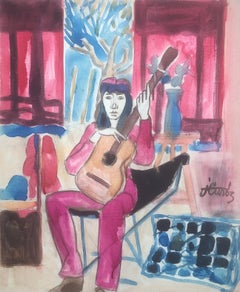
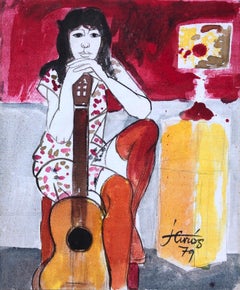
Spanish Modernist Portrait of a Woman with Guitar, Catalan Fauvist Interior
Artist: Jordi Curós Ventura (Spanish, 1930–2017)
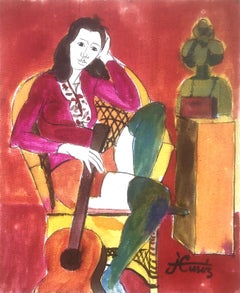
Title: Woman with Guitar
Date: 1980
Medium: Oil on panel
Dimensions: 46 × 38 cm (18.11 × 14.96 in)
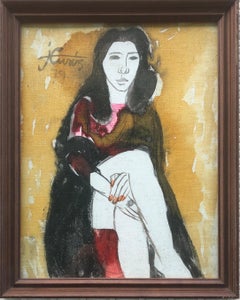
Framed dimensions: 64 × 56 cm (25.20 × 22.05 in)
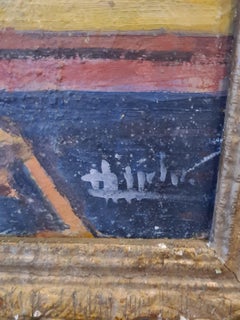
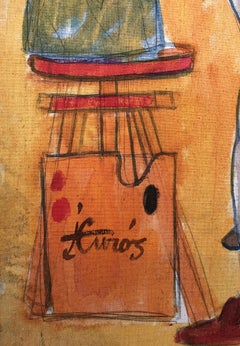
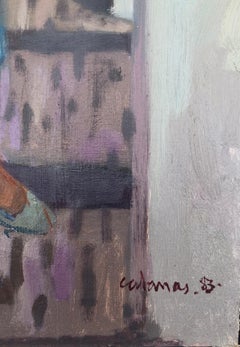
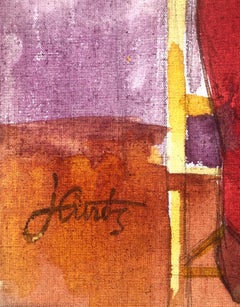
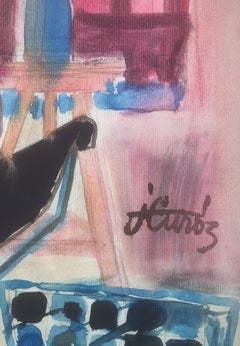
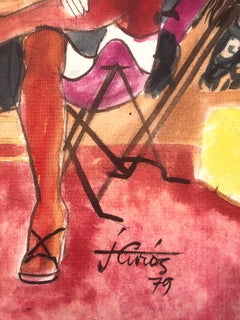
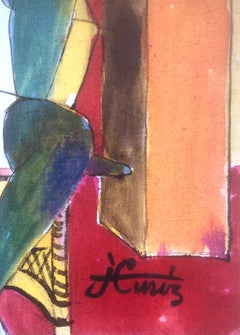
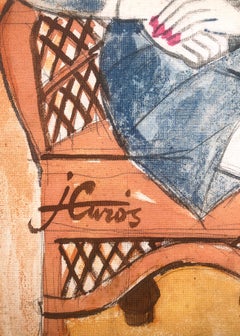
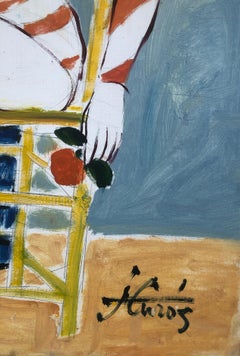
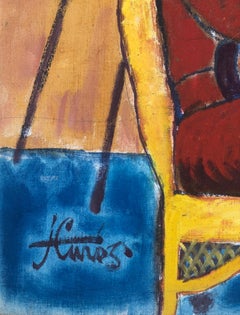
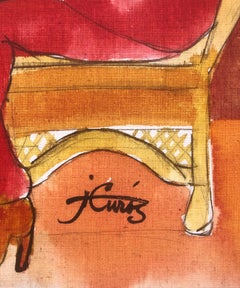
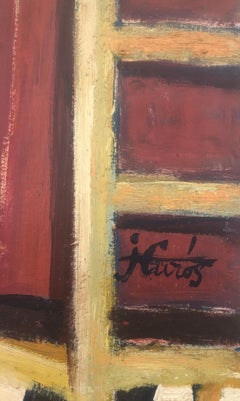
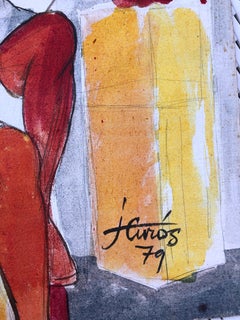
Signature: Signed and dated lower right
Period: Late 20th century
Style: Spanish Modernism, Catalan Modern Art, Figurative Expressionism, Fauvist influence
Subject: Female portrait, woman, guitar, interior, flowers
Condition: Good vintage condition, consistent with age
Frame: Framed
Description
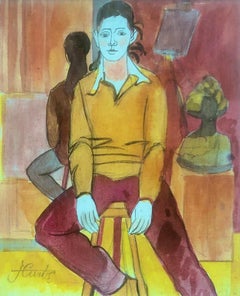
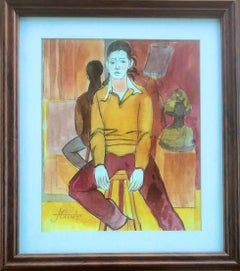
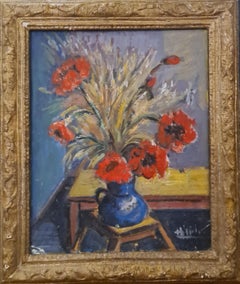
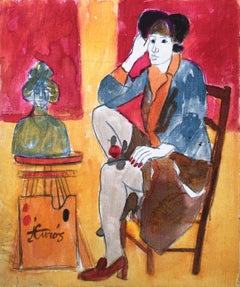
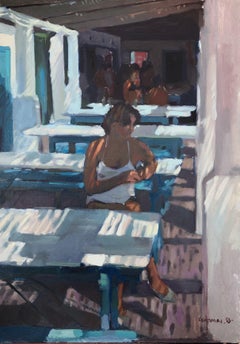
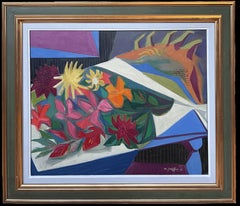
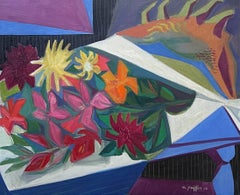
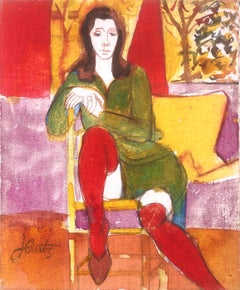
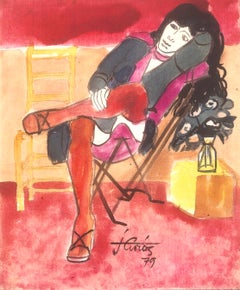
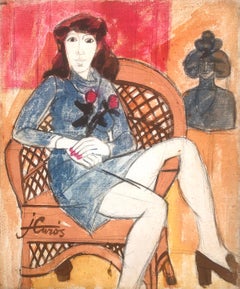
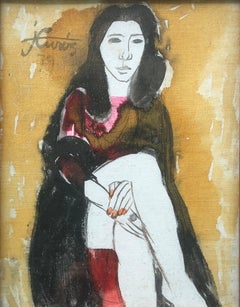
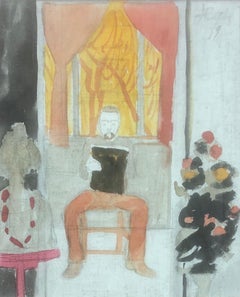
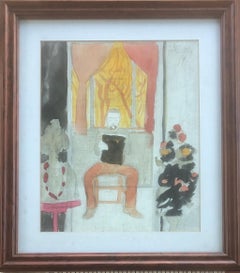
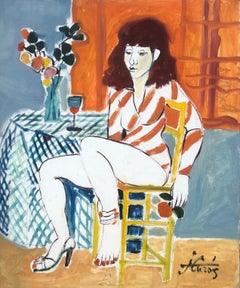
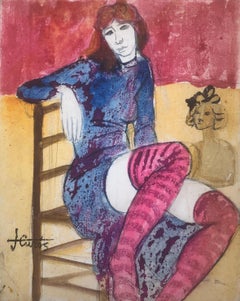
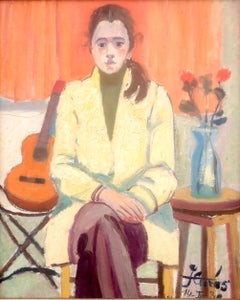
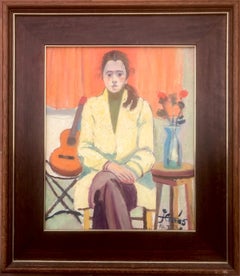
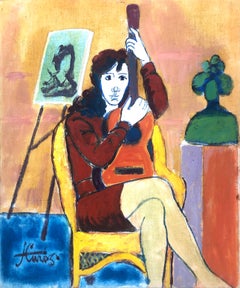
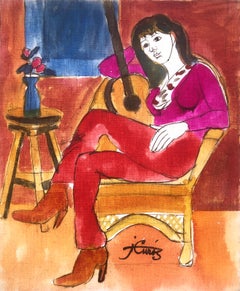
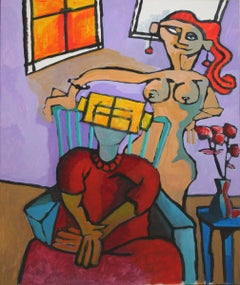
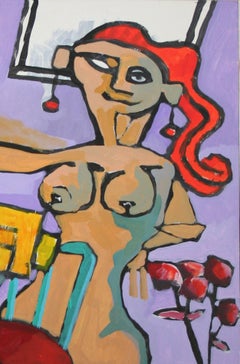
A striking 1980 oil painting by Catalan artist Jordi Curós Ventura, depicting a seated young woman in an intimate interior accompanied by a Spanish guitar and a vase of red flowers.
The composition is constructed through large areas of warm, expressive color. The intense coral-orange background establishes an immediate chromatic presence, while the woman's pale yellow jacket, dark violet trousers, blue-green vase and orange guitar create a carefully balanced yet deliberately unconventional palette. Curós simplifies forms without abandoning figuration, giving the painting the visual immediacy associated with postwar European modernism and the coloristic freedom of Fauvism.
The sitter occupies the center of the composition, frontal and still, her crossed legs and folded hands producing an almost sculptural stability. Behind her, the guitar introduces an unmistakably Mediterranean and Spanish note, while the vase and small table transform the portrait into an intimate domestic scene.
Rather than functioning merely as accessories, these objects divide the composition into chromatic zones and establish a rhythmic dialogue between figure, still life and interior.
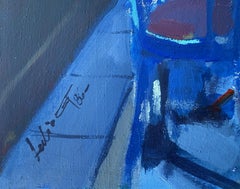
The painting is signed and dated lower right and retains its substantial period frame.
Biography
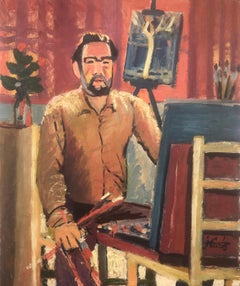
Jordi Curós Ventura (Olot, Girona, 1930–2017) was an important Catalan painter associated with the renewal of Spanish figurative painting during the second half of the 20th century.
He trained at the Escola d'Arts i Oficis of Olot, a city with one of Catalonia's most distinguished landscape-painting traditions. His first solo exhibition took place at Galerías Jardín in Barcelona in 1950, and from 1951 he participated in the influential Salons d'Octubre, which played an important role in introducing new artistic languages into postwar Catalan art.
Curós exhibited at prominent Barcelona galleries including Sala Caralt, Galerías Layetanas, Galería Syra and Sala Vayreda. His Madrid debut took place at Galerías Biosca in 1953, and he also exhibited internationally.
In 1952 he was selected by the influential Catalan intellectual and critic Eugeni d'Ors for the X Salón de los Once. The following year he participated in the II Bienal Hispanoamericana de Arte in Havana.
Curós received scholarships that enabled him to work in Paris, first from the Institut Français de Barcelona in 1954 and later from Barcelona City Council in 1958. Contact with the Parisian art world contributed to the development of the increasingly experimental language that characterized his work during the following years.
Between approximately 1958 and 1963, his painting moved toward abstraction and Informalism, with strongly textured surfaces, arabesques and enamel-like areas of color. He later returned to figuration, developing a highly personal style characterized by luminous color, simplified forms and an interest in capturing the immediacy of everyday life.
From 1965 to 1989 he exhibited repeatedly at Barcelona's historic Sala Parés, one of Spain's oldest and most prestigious commercial galleries.
His career also included participation in major exhibitions of contemporary Spanish art in Havana, Rio de Janeiro, Montevideo, Lisbon, Porto and Brussels. The Museu d'Art Modern de Barcelona acquired one of his paintings as early as 1953.
Today Curós is regarded as a distinctive representative of postwar Catalan painting, occupying a fascinating territory between Mediterranean figuration, Expressionism, abstraction and the legacy of French modernism.
Artistic Inspiration and Context
This painting belongs to Curós's mature return to figuration after his experiments with abstraction and Informalism.
Its saturated palette and simplified construction recall the great colorist tradition of 20th-century European painting, particularly Henri Matisse, Kees van Dongen and Raoul Dufy, while its psychological directness and deliberately economical drawing place it firmly within Spanish and Catalan postwar figurative art.
There is also a subtle connection with the intimate interiors of the School of Paris: a solitary figure, ordinary domestic objects and an apparently simple setting transformed through color into something psychologically charged.
The guitar is especially significant. Beyond its decorative function, it introduces a distinctly Spanish cultural symbol into an otherwise cosmopolitan modernist composition. Together with the flowers and intensely colored background, it gives the work a warm Mediterranean character highly characteristic of Curós's mature figurative vocabulary.
The result is both portrait and interior, combining Spanish identity, Catalan postwar modernism and the chromatic freedom inherited from Fauvism.
Jordi Curós Ventura
Spanish Modern Art
Catalan Modern Art
Catalan Painting
Spanish Figurative Painting
Spanish Expressionism
Fauvist Painting
Fauvism
Postwar European Art
Postwar Spanish Art
Mid-Century European Art
20th Century Spanish Painting
Modernist Portrait
Female Portrait
Woman Portrait Painting
Woman with Guitar
Guitar Painting
Spanish Guitar Art...
Category
1980s Fauvist Interior Paintings