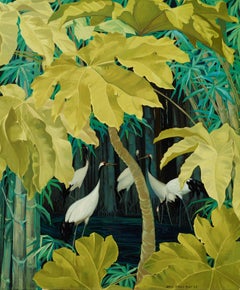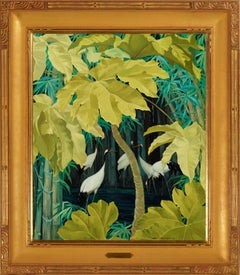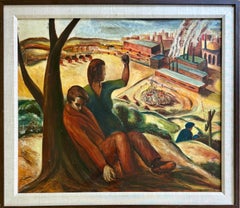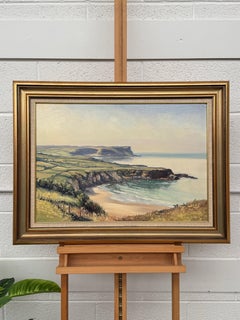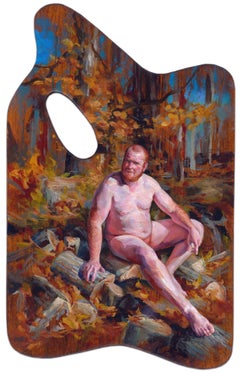
Le Source 2
Located in Denver, CO
Le Source 2, 2016
21st Century and Contemporary Maple Landscape Paintings
Oil, Maple
Le Source 2
Located in Denver, CO
Le Source 2, 2016
Oil, Maple
"Birch, " Oil Paint on Olive Board
By Bruno Surdo
Located in Chicago, IL
Chicago-based fine art painter Bruno A. Surdo is classically trained in drawing and oil painting in the tradition of Renaissance masters. With strong command of the human form, Surdo creates dynamic compositions of people and places that communicate a rich commentary on the world around him. Depicting trees from personal encounters, Surdo’s latest body of work entitled “Tree Spirits” takes us on a foray into the forest, where leaves, branches and burls express something deeply personal. Applying his mastery of figurative realism to the natural world, he experiments with form and texture to uncover the intangible spirits of trees. Entitled “Birch,” this small-scale oil painting depicts a young birch sapling against an olive wood board. Restricting the composition to only a portion of the trunk, Surdo focuses on qualities that make the tree memorable - its narrow trunk...
Oil, Wood
$1,792
H 16.93 in W 13 in D 1.58 in
20th Century Italian Signed Landscape Painting
By Filiberto Petiti
Located in Roma, IT
20th Century Italian Signed Landscape Beautiful and important painting by the great artist born in Turin, but of the Roman school, Filiberto Petiti (Turin, 14 November 1845 - Rome,...
Oil, Wood
$10,992Sale Price|20% Off
H 31.5 in W 28.35 in
The Rape of Europa, signed Peter Sion (1624-1695), Antwerp, 17th century
Located in PARIS, FR
The Rape of Europa By Peter Sion (Antwerp, 1624-1695) Signed in the lower right corner P. Sion 17th century Antwerp School Oil on copper, dim. h. 53 cm, w. 45 cm Moulded and ebonized...
Oak, Oil, Wood Panel
$17,921
H 12.41 in W 14.18 in
Landscape with Gentleman on Horseback and Peasant Woman Receiving Alms
By Philips Wouwerman
Located in Stockholm, SE
Workshop / Circle of Philips Wouwerman (1619-1668) Landscape with Gentleman on Horseback and Peasant Woman Receiving Alms oil on oak panel 12.40 x 14.17 inches (31.5 x 36 cm) wit...
Oil, Oak, Wood Panel
$13,000
H 20 in W 24 in
Along Central Park. New York City Street Scene Original Oil Painting.
Located in Marco Island, FL
New York City scene of two women walking down a sidewalk with a park in the background, in the foreground a man is walking a small dog. American life is captured in this Clyde Sing...
Masonite, Oil
$1,433Sale Price|20% Off
H 11.82 in W 13.78 in D 1.58 in
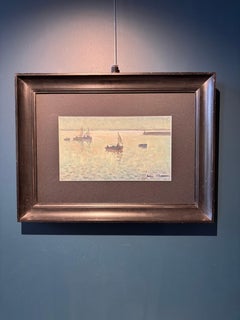
Modern French Painting Signed Marine Landscape
By Moya Dyring
Located in Roma, IT
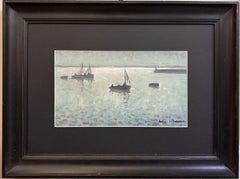
Beautiful and evocative oil painting by the great French school modern artist Moya Dyring specializing in marinas. It depicts a harbor with boats probably from the French Riviera painted with great intensity but giving, at the same time, a sweet sense of serenity. Moya Claire Dyring was born in Coburg, Victoria in 1909. She produced drawings, oil paintings and pastels. She was one of the first women artists to embrace Modernism and exhibit cubist paintings in Melbourne. For several years she was a member of the modern art community known as the Heide Circle, named after the home of art collectors John and Sunday Reed, and now the Heide Museum of Modern Art. Every item of our Gallery, upon request, is accompanied by a certificate of authenticity issued by Sabrina Egidi official Expert in Italian furniture for the Chamber of Commerce of Rome and for the Rome Civil Courts. Dyring then travelled to the USA and France, where she lived most her life. Her work is held in the Heide Museum as well as the National Gallery of Australia. One of her earliest works in cubist in style, Melanctha, 1934, was acquired by Sunday Reed. In 1934 Dyring also painted Portrait of Sunday Reed which went into the Reed's collection, along with a cubist style Portrait of a Woman from the same year. While her early works were figurative or cubist, in France she turned to landscape as she travelled to various towns throughout France. In her later years, unable to travel freely, she painted children against the backdrop of Paris. As time passed, she was largely glossed over and not included in major exhibitions of artists, especially women artists, of the 30s, 40, and 50s. In 2002, at the University of Melbourne, Gaynor Patricia Cuthbert delved into her life and work for a doctoral thesis, helping to bring back attention to her work. Collection The Heide Museum of Modern Art holds many paintings and drawings, some acquired through the John and Sydney Reed collection. The National Gallery of Australia, Canberra includes one drawing. The Art Gallery of New South Wales holds multiple works. Third child of Carl Peter Wilhelm Dyring, medical practitioner, and his second wife Dagmar Alexandra Esther, née Cohn, both Victorian born. Moya was educated (1917-27) at Firbank Church of England Girls' Grammar School, Brighton. After visiting Paris in 1928, she studied (1929-32) at the National Gallery schools, Melbourne, and shared fellow student Sam Atyeo's interest in artistic innovation. Classical modernism engaged her attention in the early 1930s. She painted at the George Bell school and studied under Rah Fizelle in Sydney; Mary Alice Evatt and Cynthia Reed were her colleagues. For several months in 1937 she took charge of Heide, the home and garden of John and Sunday Reed, at Bulleen, Melbourne. The Reeds were pivotal both to her sympathy for modernism and her belief in congenial fellowship. She enjoyed something of the intense relationship with Sunday Reed that the latter would subsequently extend to Joy Hester. In June Dyring held an exhibition, opened by H. V. Evatt, at the Riddell Gallery, Melbourne. Less enthusiastic than the Reeds and the Evatts about her art, Basil Burdett wrote of her 'somewhat incoherent interpretation of modern ideas', although he did acknowledge that her work had 'audacity of colour and a certain monumental feeling for form . . . qualities rare enough in Australian painting'. In August Dyring embarked for Panama whence she travelled by bus to New York, breaking her journey to view major galleries. She had intended to paint in the United States of America, but disliked the work of contemporary American artists and sailed for France. In 1938 she was based in Paris, taking advantage of Atyeo's contacts within the avant-garde. She studied at the Académie Colarossi, the Académie de la Grande Chaumière and with Andre Lhote, although by October she denounced him as a 'racketeer'. In 1939 Dyring and Atyeo settled on a farm at Vence, France; inspired by memories of Heide, they grew fruit and flowers. Sam accepted a commission to decorate a house in Dominica, West Indies, leaving Moya at Vence. Evacuated to Australia via South Africa, where she painted and searched for tribal art, she then journeyed to Dominica and married Atyeo. They were not happy, neither painted and Dyring was ill. Evatt offered Atyeo work and Dyring accompanied him to the U.S.A. She viewed art, painted occasionally and claimed to have exhibited in Washington in 1943. After World War II Evatt found Sam various postings, while Moya returned to Paris to pursue a full-time career in art. They were to be divorced in 1950. From about 1946 Dyring's art was more personal than innovative. She gained a considerable reputation among French regionalist and nationalist artists for her sympathetic appreciation of provincial scenes and life. Bernard Smith placed her in the French tradition of intimiste painters. In 1948 she leased and renovated an apartment on the Ile St Louis, which, as Chez Moya, became a centre for Australians who enjoyed her hospitality, cooking and practical assistance. She revisited Australia and exhibited in various cities in 1950, 1953, 1956, 1960 and 1963; the press carried her reports of Parisian cultural life. Dyring held a solo exhibition in London in December 1949 and was in close contact with expatriate Australians, among them Loudon Sainthill...
Wood, Oil
A Haitian Country Scene
Located in San Francisco, CA
Haitian artist Jacksin Mésidor painted this from his Caribbean coastal hometown of Cap-Haitien in the north of his native land. As Haitian folk art, the painting delivers an archityp...
Masonite, Oil
Winter Light on a Frozen Lake
Located in Stockholm, SE
In this evocative winter landscape, painted in 1941, Swedish artist Olof Walfrid Nilsson captures the serenity and quiet grandeur of a frozen lake bathed in gentle afternoon light. E...
Masonite, Oil
$5,257
H 15.35 in W 18.5 in
Landscape with figures, workshop of Paul Bril, Italian school 17th Century
By Paul Bril
Located in PARIS, FR
Idyllic landscape with myhological story of Cephalus and Procris Early 17th century Italian school Workshop Of Paul Bril (Antwerp, 1554 - Roma, 1626) Oil on poplar panel: H. 28 cm (1...
Poplar, Oil
$18,877
H 22.05 in W 26.97 in
Rest on the Flight into Egypt - Attributed to Pieter Van Avont - 17th c. Flemish
Located in PARIS, FR
Rest during the Flight into Egypt - The Virgin and Child with St. John the Baptist and the angels in a Landscape. Attributed to Pieter Van Avont (1600-1652) 17th century Antwerp School, circa 1630 Oil on oak panel, Dimensions: h. 38 cm, w. 50 cm (14.96 in x 19.68 in) Flemish style frame in ebonized and moulded wood Framed: h. 56 cm, w. 68.5 cm (22.04 in. x 26.97 in.) This artwork is sold with a certificate of authenticity guaranteeing its origin, date of execution, and attribution to the artist. In the heart of a lush wooded landscape, the Virgin with Jesus rests in a green clearing accompanied by Saint John the Baptist and the cherubs. Seated to the left of the composition, the Virgin Mary holds the Child on her lap; the little Saint John the Baptist wearing the camel-skin tunic (his attribute) stands before Jesus to exchange a few caresses. On the right, the couple of cherubs are playing with the lamb of Saint John the Baptist, bringing a jovial character to the scene. A pair of gardening putti on the left pick flowers to bring bouquets to the Virgin and Jesus. Spring flowers such as tulips, daffodils and anemones that grow abundantly around them and enrich the composition with their shimmering colors. A lush rose bush blooms to the left of the figures offering delicate roses. (The rose is the flower associated with the Virgin Mary, who is the "mystical rose," the one that does not bear the "thorn of sin") At the feet of the Virgin are bunches of grapes (symbol of the future passion of Christ) as well as apples (symbol of the original fall of Man but also of the Redemption in Christ) In the foreground we find a wicker basket filled in profusion with beautiful flowers and guinea pigs nibbling on the blades of grass. In a cleverly arranged disorder, these elements of the still life with their strong symbolic power accentuate the religious theme, but are also an opportunity for the artist to demonstrate his know-how in the still life genre that is gaining momentum in Antwerp. The landscape behind the figures consists of a large tree with a twisted trunk and a luminous opening to the horizon placed on the right. We see Saint Joseph arriving with a donkey, a small reminder from the artist that the composition is associated with the episode of Rest during the flight into Egypt. The calm expanse of this bucolic forest opening onto the luminous distance, with its profusion of symbolic flowers and fruits, is particularly suited to this sacred scene. The theme of Jesus' sacrifice and his tragic fate is mitigated by cherubs who play with innocence and carelessness in the face of the fragility of life symbolized by cut flowers. The great mastery of the painter is manifested by the finesse of the drawing enhanced by the delicacy in the application of the brushstrokes bringing a multitude of details. The richness of the whole is exacerbated thanks to the choice of colours, this varied palette is an undeniable asset of our work. The virtuosity of our artist lies in his versatility, as much concerned with the success of the landscape and flowers as with the modelling of his figures. The cherubs with their naked bodies are gracefully illuminated by warm colours with subtle shadows, while the still life is rendered with astonishing realism, both in the precision of the drawing and in the countless shades of the flowers. There are several compositions similar to ours, of which below are the closest versions: • Sale, Jean-Claude Anaf et Associés, Lyon, 08/02/1998, attributed to Pieter Van Avont, oil on panel, h. 48 cm, l. 71 cm (recorded on RKD n° 31451). Comment: identical composition, only St Joseph with the donkey is different) • Christie's New York sale, 29/01/1998, Pieter Van Avont, oil on copper, h. 23.8 cm, w. 24.8 cm • Dorotheum sale, Vienna, 25/04/2017, Pieter Van Avont and Jan Breughel II, oil on copper, h .26 cm, w. 39 cm • Hermitage Museum, Saint Petersburg, Russia, Pieter Van Avont, oil on panel, h. 50.5 cm, w. 71.7 cm Peter van Avont, Flemish painter (Mechelen, 1600 - Antwerp. 1652) Born in Mechelen, he is mentioned in 1620 as a member of the painters' guild of his hometown. He left in 1 622 for Antwerp, where he was also a member of the guild. He collaborated with many painters, including Jan Brueguel the Younger, David Vinckboons, Lucas van Uden...
Oak, Oil
$2,000
H 26.78 in W 22.05 in D 1.78 in
Alfred SALVIGNOL, Port of Villefranche-sur-Mer, Oil on panel, Beg. 20th C.
Located in Saint Amans des cots, FR
Oil on panel by Alfred SAVIGNOL (1877-), Beginning of the 20th century, France. Port of Villefranche-sur-Mer (between Nice and Monaco). With frame: 68x 56 cm - 26.8x22 inches ; with...
Wood, Oil
La Mujer Isla Surrealist Painting
By Enrique Chavarría
Located in Lake Worth Beach, FL
The Island Woman (La Mujer Isla) Artist signed and titled. Enrique Chavarría (1927-1998) was a Mexican painter and neo-surrealist, whose fantastic imagery carries forward the work of the Mexican Surrealists. He created hundreds of easel-sized oil paintings on masonite and numerous smaller works. For four decades his principal patron was Bryna Prensky, an American gallery owner from Florida who moved to Mexico City in 1954. She bought most of Chavarría’s known works for her gallery and her own collection. Prensky said she often found Chavarría in his pajamas at mid-day. He read widely and painted dreamlike images that reflect his wide-ranging scholarly interests. Much of his work is thought to have been inspired by poetry, especially the writings of André Breton, Paul Éluard, Arthur Rimbaud, and Paul Valéry; by the classic surrealism of Salvador Dalí; and by the paintings of Mexican neo-surrealist artists Remedios Varo...
Masonite, Oil