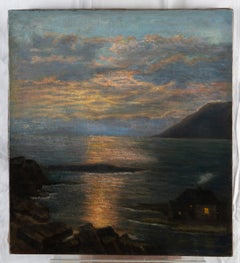
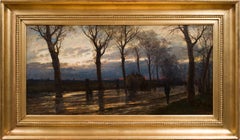
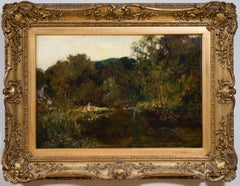
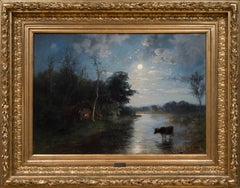
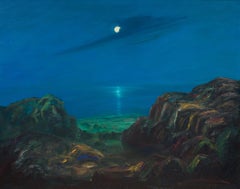
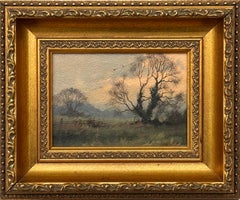
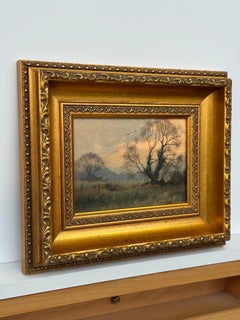
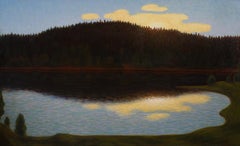
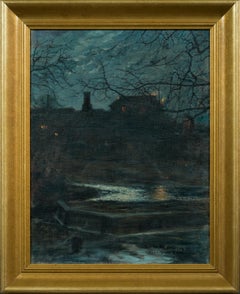
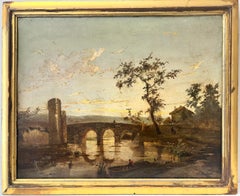
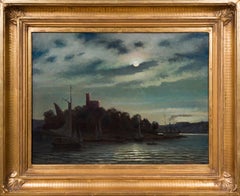
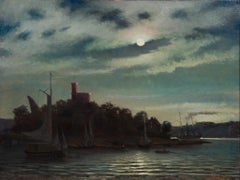
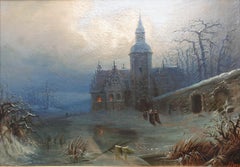
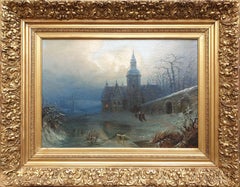
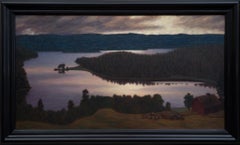
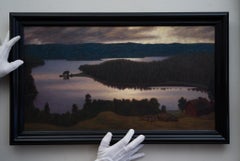
This atmospheric moonlit landscape from 1888 represents a mature and characteristic work by Amalia von Schwerin, a Swedish aristocrat and professional painter whose artistic career was closely connected to the Düsseldorf and Munich schools of nineteenth century landscape painting. Executed late in her career, the painting demonstrates her assured handling of nocturnal light, pastoral motif, and animal staffage, elements that recur throughout her oeuvre.
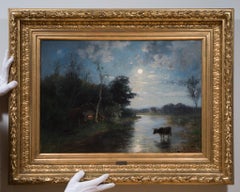
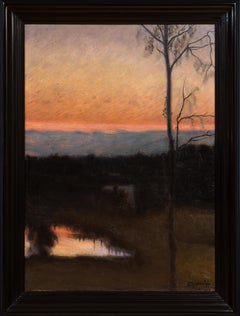
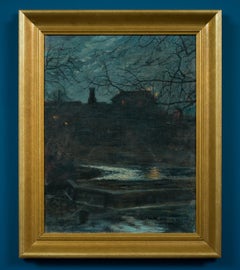
The composition depicts a tranquil rural scene illuminated by moonlight. A calm body of water reflects the pale glow of the moon, which hangs high in a softly clouded night sky. On the left, a modest cottage is partially concealed by trees, its warmly lit window suggesting human presence and domestic shelter within the surrounding darkness. To the right, a solitary cow stands quietly in the shallow water, its reflection subtly merging with the rippling surface. In the distance, faintly lit buildings and tree silhouettes dissolve into the night, reinforcing the depth and stillness of the scene.
Von Schwerin’s treatment of light is central to the painting’s expressive power. The cool silvery tones of the moonlight contrast gently with the warmer hues emanating from the cottage window, creating a balance between natural and human illumination. The reflections in the water are rendered with sensitivity and restraint, enhancing the sense of calm and quietude that permeates the scene. The landscape is not dramatic but contemplative, inviting prolonged viewing rather than immediate narrative engagement.
Amalia von Schwerin received her early artistic education at various art schools in Düsseldorf, where her husband owned property, before continuing her studies under Friedrich Voltz in Munich. These environments exposed her to the dominant landscape traditions of the period, particularly the emphasis on tonal unity, careful observation of natural light, and the integration of animal figures within expansive settings. Her work reflects these influences while maintaining a personal sensitivity to mood and atmosphere.
Although based for long periods in Germany, von Schwerin remained closely connected to the Swedish art world. She participated extensively in group exhibitions in Sweden during the 1860s and 1870s, including exhibitions at the Royal Swedish Academy of Fine Arts, as well as shows organised by regional art associations across the country. She was also represented at the Paris World Exhibition in 1878. Her home in Düsseldorf became a social and artistic gathering place for younger Scandinavian artists, a role that reflects both her social position and her significance within the artistic community.
Von Schwerin’s artistic production consists almost exclusively of landscape paintings with...
Category
1880s Romantic Landscape Paintings