Masonite Paintings

to
245
218
253
229
137
163
Overall Width
to
Overall Height
to
10
796
194
3
3
9
37
71
113
127
85
64
32
209
165
163
91
38
29
26
20
12
3
1
1
521
394
79
330
177
143
119
111
110
89
49
42
39
35
34
33
25
22
20
19
18
18
17
1,358
156,426
95,144
72,640
68,818
43
36
25
19
19
563
46
875
117
Medium: Masonite
"Symbiosis" Oil Painting

"Symbiosis" Oil Painting

By Kierstin Young

Located in Denver, CO

Kierstin Young's (US based) "Symbiosis" is an oil painting that depicts branches and foliage emerging from a female figures nude back and hands with a bright pink background Artist ...

Category

2010s Realist Masonite Paintings

Materials

Masonite, Oil

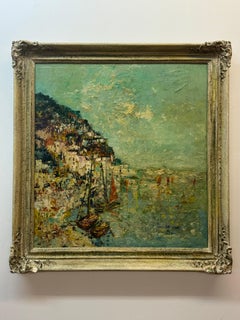
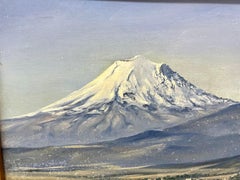
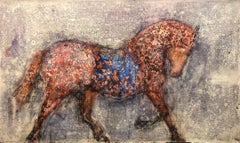
'Naples with a View of Mount Vesuvius', Golfo di Napoli

'Naples with a View of Mount Vesuvius', Golfo di Napoli

Located in Santa Cruz, CA

Signed lower left, 'G. Giardiello' for Giuseppe Giardiello (Italian, 1877-1920) and painted circa 1900. A skilled late 19th century Italian landscape painter, little is known about ...
Category

Early 1900s Masonite Paintings

Materials

Canvas, Masonite, Oil

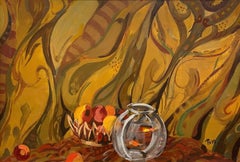
Autumn Landscape
Autumn Landscape

Autumn Landscape

By Robert Vickrey

Located in Los Angeles, CA

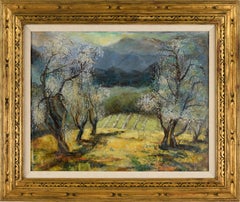
Autumn Landscape, by 1958, tempera on Masonite, 24 x 36 inches, signed lower left, exhibited: 1) 133rd Annual Exhibition of the National Academy of Design, New York, NY, February 20 – March 16, 1958 (Henry Ward Ranger Purchase Prize); and 2) Henry Ward Ranger Centennial Exhibition, National Academy of Design, New York, NY, September 25 - October 12, 1958, #133 (see Levin, Meyer, Illustrative Paintings Gathered for Ranger Show at National Academy, St. Petersburg Times, October 13, 1958 (“There’s a warm, low-keyed picture of golden fields, with distant structures, called “Autumn Landscape,” by Robert Vickrey, whose magic realism is felt in so “regular” a subject.”), literature: 1) Watson, Ernest William, Composition in Landscape and Still Life, Watson-Guptill Publications, New York, 1959, pp. 24, 155 and 157 (illustrated); and 2) Vickrey, Robert and Cochrane, Diane, New Techniques in Egg Tempera, Watson-Guptill Publications, New York, 1973, p. 111 (illustrated); ex collection National Academy of Design Reflecting on his art, Robert Vickery...
Category

1950s American Realist Masonite Paintings

Materials

Masonite, Egg Tempera

Untitled
Untitled

Untitled

By Richard Pousette-Dart

Located in Miami, FL

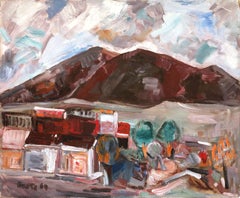
Acrylic on masonite. This is a pivotal work in deep and radiant cobalt blue from 1950. It dipicts calligraphic and hieroglyph structures over a grid and pyramidal base by the first generation abstract expressionist. Provenance: Skinner: November 13, 1992 [Lot 00219}, The entry in the Skinner catalog indicates that the painting came directly from the artist to the family of the consignor to Skinner. Kaminsky Auctions. There is an unbroken paper trail that traces the ownership of the painting from the current owner, through two auction houses to the artist. Perfect unbroken provenance. Pousette-Dart was among the most inventive of the Abstract Expressionist generation, His uncanny talent was to expand the nature of abstraction and still make each mark each element very much his own; a reflection of what he called   "the concealed power of the spirit," he said, “not of the brute physical form."   His was not aiming for a singular, realized aesthetic formula but to expand the possibilities of painting; the transcendental in painting. Typical of such invention and exploration is this  painting  Untitled 1950 when the artist was only 34 years old and represented by one of the champions of the new American painting, Betty Parsons.  
A banner year for Pousette-Dart, the Museum of Modern Art acquired their first painting by the Minnesota born artist.  He worked on easel size works such as this painting an oil on masonite. At the same time Pousette-Dart was also working on larger scale works such as Path of the Hero, running over ten feet in length now in the collection of the Metropolitan Museum of Art.  Both contain fields of color articulated by a highly sophisticated white hieroglyphic vocabulary. Rather than demonstrate an expressionist sensibility, Pousette-Dart harnesses his more cerebral ideas transforming thick areas of paint into a more refined composition of geometric forms akin to the pattern and forms of say a stained glass window. In a way he is looking back at Fugue, 1940 a black and white composition which makes use of a similar format of painting albeit smaller. Color and form are minimal, but what Pousette-Dart has maximized is the rhythmic and syncopated character of painting casting his ideas into purely symbolic terms that one might link to the pictograms of Adolph Gottlieb. Nonetheless, nature is always at the core of Pousette-Dart’s thinking and dreaming. Here he has transformed the local Ramapo Mountains—where he will eventually move with his family to live and work— into a complex series of articulated fragments linked by style, scale and color.  The painting’s imagery built on two large triangles and reduced to just two colors, cobalt blue and white all outlined in black.  Pousette-Dart symbols stacked in horizontal and vertical rows:  blue is ground, white is language, symbolic of light, consciousness and awareness . The painting maintains a mystical character images compounded that formulate a secret code and linked to the series of white paintings Pousette-Dart authored in the first half of the 1950s. Get up close to the picture and you discover images within images a kind of picture puzzle...

Category

1950s Abstract Expressionist Masonite Paintings

Materials

Masonite, Acrylic

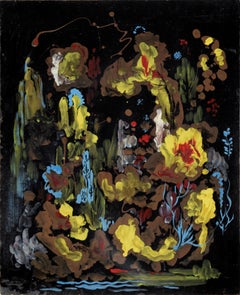
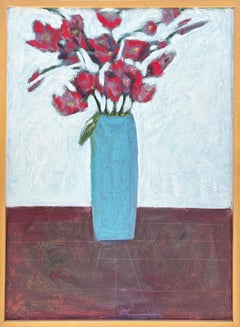
Colorful Modernist Still Life with Impasto Flowers Style of Emily Sillman

Colorful Modernist Still Life with Impasto Flowers Style of Emily Sillman

Located in Soquel, CA

Colorful Modernist Still Life with Impasto Flowers by Ellis Hopkins (American, b. 1952). This bold still life features an array of flowers as its central focus. The painting is ren...

Category

Late 20th Century Abstract Expressionist Masonite Paintings

Materials

Oil, Board, Masonite

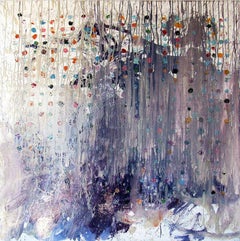
Shimmering Pond in the Woods - Surrealist Abstract 1960s

Shimmering Pond in the Woods - Surrealist Abstract 1960s

By Rose Herzog

Located in Soquel, CA

Shimmering Pond in the Woods - Surrealist Abstract 1960s Highly textured abstract composition by Rose Herzog (American, mid-20th Century). A multicolored pond is shown in the middle...

Category

1960s American Modern Masonite Paintings

Materials

Cotton, Masonite, Mixed Media, Oil, Tissue Paper

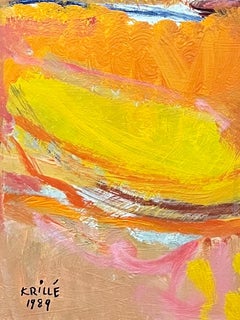
Landscape 128 by Jean Krille - Oil on masonite 70x50.5 cm

Landscape 128 by Jean Krille - Oil on masonite 70x50.5 cm

By Jean Krille

Located in Geneva, CH

Jean Krillé’s paintings are known for their expressive use of color and dynamic, abstract forms, blending realism with abstraction in his depictions of nature. His landscapes often f...

Category

Late 20th Century Abstract Masonite Paintings

Materials

Masonite, Oil

Rock Candy Mountain  (unique, signed Abstract Expressionist painting) framed 70s

Rock Candy Mountain (unique, signed Abstract Expressionist painting) framed 70s

By Ben Wilson

Located in New York, NY

Ben Wilson Rock Candy Mountain, ca. 1970 Oil on masonite board (Hand Signed, titled and dated) Hand signed, titled and dated by Ben Wilson on the back Frame Included: held in artist'...

Category

1970s Abstract Expressionist Masonite Paintings

Materials

Masonite, Oil, Permanent Marker

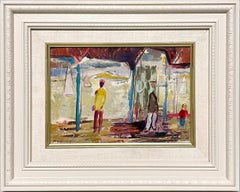
Modernist Oil Painting George Schwacha Brooklyn Street Scene Fruit Market WPA

Modernist Oil Painting George Schwacha Brooklyn Street Scene Fruit Market WPA

By George Schwacha Jr

Located in Surfside, FL

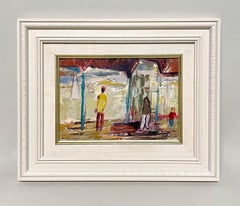
Hand signed lower left corner Oil on masonite Dimensions: Frame H 18.25" x W 22.25". Sight H 11.25" x W 15.25 This is a great scene, vintage Americana. Possibly Crown Heights in Brooklyn New York City. Done in a mid century modern style with great vibrant colors and loose, adept, brushwork. Fruit vendor with ladies shopping. George Schwacha, Jr. (1908 - 1986) New Jersey artist. Known for Landscape painting and snow scenes. He studied Arthur W. Woelfle; John Grabach; Edward Dufner and A. Schweider. George Schwacha was president of the American Artists Professional League and a past president of the Audubon Artists and Art Center of New Jersey. He belongs to the American Watercolor Society, The National Society of Painters in Casein, and the Philadelphia Watercolor Club. His paintings have been shown throughout the country at museums such as the Pennsylvania Academy, the Corcoran Gallery in Washington, DC and the Birmingham Art Museum, The Butler Art Institute in Youngstown, Ohio the Connecticut Academy of Fine Arts, as well as in leading New Jersey and New York exhibitions, including the American Society of Arts and Letters. He is listed in Who's Who in American Art and International Directory of Arts. His work is represented nationally in over 30 museums and public collections including the Newark Museum, Montclair Museum, Birmingham Art Museum, the Isaac Delgado Museum in New Orleans, and the Butler Art Institute. Worldwide he is also represented in collections in the following countries: Austria, Belgium, Canada, Egypt, England, France, Germany, Greece, Holland, Hong Kong, Israel, Scotland and Switzerland. Seymour Zayon, Bertram Hartman, Hugh Campbell, Frank Herbst, Joseph Newman, Theodore Valenkamph, Robert John McClelland, Nicolai Cikovsky, Ben Benn, George Howell Gay, Robert Brackman, Vernon Wood...

Category

Mid-20th Century American Modern Masonite Paintings

Materials

Masonite, Oil

Paper Bags

Paper Bags

By Marina Stern

Located in Los Angeles, CA

This work is part of our exhibition Marina Stern Luminary, the first retrospective of the artist since 2007. Marina Stern was a multifaceted New York-based artist whose works ranged from Expressionism and Pop Art to the Neo Immaculate paintings and pastels for which she is best known. A native of Venice, Stern and her family fled in 1939 to escape Italy’s repressive racial laws. After living in England for several years, the family arrived in the United States in 1941. A bright and capable student, Stern graduated from New York’s Julia Richman High School at age 15 and soon enrolled in the Pratt Institute to pursue an interdisciplinary education in the arts. Despite majoring in advertising design, Stern favored her fine art courses. She graduated from Pratt in 1946 at age 18 and began working for advertising agencies. After a brief marriage which ended in divorce, Stern married her second husband, who encouraged the artist to study at the Art Students League of New York, under the renowned Japanese American modernist, Yasuo Kuniyoshi. In Fall 1953, Stern gave birth to her first child, Michael, as she continued to study at the Arts Students League. Later in the Spring of 1957, Stern gave birth to her daughter Nina, as she continued to balance motherhood with her fine art practice and commercial art and design work. Stern’s first significant exhibitions were in 1962 at the Waverly Gallery and the Osgood Gallery, both in New York, followed by inclusion of her work in the Bertha Schaefer Traveling Collage Show from 1963 to 1964. Stern made a splash in the avant-garde art world in 1964 when Time magazine reviewed a show at Amel Gallery which featured three of her audio-visual paintings. Time’s critic noted that Stern created the “cleverest noisemakers” in the exhibition. Time dubbed this work “Talkie Pop,” a label which Stern rejected. Following this recognition, Stern was selected for inclusion in The New American Realism at the Worcester Art Museum—a major showcase of leading artists, including Andy Warhol, Robert Indiana, Roy Lichtenstein, and Jasper Johns. After the Worcester exhibition, Stern began to shift away from her “talking” Pop paintings to mysterious, interior scenes with orange, blue or black walls with windows or doors rising above black and white floors, often depopulated, but sometimes with figures. One of these works, Seven Minus Twenty-One Equals Seven, entered the permanent collection of New York’s Museum of Modern Art in 1966. By 1969, Stern began to incorporate industrial images into these scenes, and in the early 1970s, Stern created her first Neo-Immaculate works of rural, and urban landscapes, which she described as her most satisfying work. Stern often depicted locations that she held close -- New York, New Jersey, Iowa (where her son attended college), Sharon, Connecticut (where her family spent weekends and vacations) and her native Venice, Italy. Stern’s success as a Neo Immaculate painter led to consistent New York gallery representation for over two decades, first with Lee Ault & Co and James Yu Gallery, and then Forum Gallery, where she had six solo shows. Stern completed a Neo-Immaculate mural commission for the Port Authority of New York, George Washington Bridge #1 and #2, followed by another commission from the NY Cityarts Public Art Program in 1976 for a mural on Mulberry Street. Stern also enjoyed solo exhibitions in Boston (Eleanor Rigelhaupt Gallery), Connecticut (Silo Gallery, the Hotchkiss School, J. Rosenthal Fine Arts Gallery, Tremaine Gallery, and Staib Gallery), Chicago (Michael Rosenfeld Gallery), and Santa Fe (Santa Fe East Gallery). Her work was included in group shows at over a dozen public institutions, including The National Academy of Design, The Staten Island Museum, Worcester Art Museum, the Oklahoma Art Center, and the Arkansas Art Center. The Southern Alleghenies Museum of Art hosted a retrospective of four decades of Stern’s work from January 19 to April 22, 2007, entitled Perception and the Cultural Environment: The Paintings of Marina...

Category

Early 2000s American Modern Masonite Paintings

Materials

Masonite, Oil

Landscape 144 by Jean Krille - Oil on Masonite 100x100 cm

Landscape 144 by Jean Krille - Oil on Masonite 100x100 cm

By Jean Krille

Located in Geneva, CH

Jean Krillé’s paintings are known for their expressive use of color and dynamic, abstract forms, blending realism with abstraction in his depictions of nature. His landscapes often f...

Category

Late 20th Century Neo-Expressionist Masonite Paintings

Materials

Masonite, Oil

Out of the Blue, Miniature Red & Blue Abstract

Out of the Blue, Miniature Red & Blue Abstract

By Tom Hamil

Located in Soquel, CA

Bright, small abstract expressionist painting of red, white and blue hues by California artist Tom Hamil (American, b. 1928). Signed upper left corner "Hamil". Condition: Excellent. Presented in rustic wooden shadow box frame. Image size: 2.75"H x 6.75"W. Tom Hamil, was born in New York in 1928 and raised primarily in California. After attending the US Naval Academy in Annapolis, he returned to California to begin his formal art training at the California School of Fine Arts in San Francisco (now known as the San Francisco Art Institute). He completed his education at the University of Washington with a Master’s Degrees and Doctorate in Fine Arts and Education. His first solo exhibition was held in 1956. Since then, he has participated in numerous one man shows, group shows, and has been represented in galleries in the US and Mexico. In addition to his painting, Hamil has authored and illustrated a number of books. While at the Naval Academy, he received recognition for his paintings, drawings, and illustrations. Listed among Hamil’s many awards and honors are a Ford Foundation Fellowship and an Award of Excellence from the American Graphics Society. Currently, he lives in Zirahuen, Michoacan, Mexico and Truth or Consequences, New Mexico. Hamil’s statement: “I am a man...

Category

Mid-20th Century Abstract Expressionist Masonite Paintings

Materials

Masonite, Oil

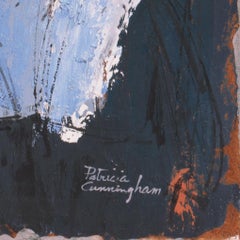
'Nuns at Notre-Dame', Paris, Munich, Woman Modernist, AIC, Smithsonian, Carmel

'Nuns at Notre-Dame', Paris, Munich, Woman Modernist, AIC, Smithsonian, Carmel

By Patricia Stanley Cunningham

Located in Santa Cruz, CA

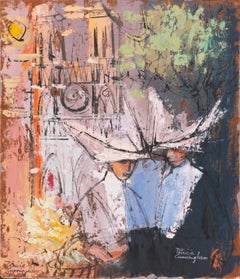
Signed lower left, and lower right, 'Patricia Cunningham' for Patricia Stanley Cunningham (American, 1907-1984) and painted circa 1965. A vibrant, Post-Impressionistic oil showing a...

Category

1980s Modern Masonite Paintings

Materials

Masonite, Oil

Autumn Gift - Seasonal Harvest Still Life with Flowers

Autumn Gift - Seasonal Harvest Still Life with Flowers

Located in Soquel, CA

Autumn Gift - Seasonal Harvest Still Life with Flowers by Albin Kern. This still life by Austrian-American painter Albin Kern (b. 1884, d. 1975) depicts a seasonal spread of gourds...

Category

1950s Photorealist Masonite Paintings

Materials

Oil, Masonite

Landscape with Orange Sky

Landscape with Orange Sky

Located in Wilton Manors, FL

James Earl Ray (1928-1998). Landscape with Orange Sky. ca. 1975. Oil on masonite panel measures 6.5 x 8.5 inches, 10.5 x 12.5 inches framed. Signed lowe...

Category

Mid-20th Century Abstract Masonite Paintings

Materials

Masonite, Oil

Etude III (abstract expressionist painting)

Etude III (abstract expressionist painting)

By Fredric Karoly

Located in Wilton Manors, FL

Fredric Karoly (1898-1987). Etude III, 1950. Oil on masonite panel measures 18 x 24 inches. Unframed. Signed, titled, dated on reverse. Good condition with minor paint loss at edges. Biography: An abstract painter, Karoly was born in Hungary and studied painting in Paris, architectural eingineering in Berlin, and emigrated to the U.S. in 1926. He began a successful career as a fashion and fabric designer. In 1948 he was working as a fashion director for Simplicity Patters, when he had a solo exhibition of of his oil paintings, wire montages, dry-pen drawings and abstract photography. Solo Exhibitions: Hugo Gallery (Alexandre Iolas) New York 1948; Gallery Mai. Paris 1949; New Gallery (Eugene Thaw) New York 1950; Museu de Arte, Sao Paulo, Brazil 1951; Miami Museum of Modern Art, Miami, Florida 1959; Loft Gallery, New York City, 1966.Group Exhibitions: Hugo Gallery, New York 1947; Salon des Realities Nouvelles, Paris 1949-1953; Whitney Museum of American Art, New York (Annual) 1951-1953, 1963; Biennale of Sao Paulo, Brazil, 1951; International Independent Exhibition, Tokyo, 1951; Martha Jackson Gallery, New York, 1959; The Butler Institute of Art, Youngstown, Ohio, 1960; Stuttman Gallery, New York, 1960; The Art Institute of Chicago (Annual), 1960; International Watercolor Exhibition, Brookyln Museum, 1961; Westchester Art Museum, White Plains, NY, 1963; Whitney Museum, Annual, NY 1963; Cleveland Art Festival, Park Synagogue, Cleveland, 1963; Whitney Museum, Sculpture Annual, NY, 1964.Works in Institutional Collections: Museu de Arte, San Paulo, Brazil; Museu de Bellas Artes, Buenos Aires, Argentina; New York University, New York; Washington University, St. Louis, Missouri; Finch College, NY; Barnard College, NY; Metropolitan Museum, Whitney Museum and Guggenheim Museum, New York; Museum of Fine Arts, St. Petersburg, FL. Awards: National Council Arts Awards, 1968. Frederic Karoly died on December 15, 1987 at the Inter-Continental Hotel in Manhattan, where he had made his home for many years. Fredric Karoly was born in Budapest in 1893. According to Karoly’s own vitae, his exhibition history began in New York in 1947, when at the age of 54 he took part in a four-person group show at Hugo Gallery. His involvement with visual art however was apparently life long. In a brief introduction to his solo show at Galerie Mai in Paris in June of 1949, Jen Luc de Rudder, reports that Karoly began painting at the age of 12 in Budapest. After several years of studying, then working in London, Paris and Berlin, Karoly emigrated to the United States in 1925 or 1926 (he probably first came to the US on a work visa in 1925). In New York, Karoly worked in women’s fashion as a designer. In 1948 Karoly worked in a manner than was clearly influenced by the work of such European surrealists as Max Ernst, creating spiked automatic bi-chromatic paintings. His style progressed into a progressively more biomorphic vein, similar to explorations by Theodore Stamos, Daphnis, Milton Avery and Mark Rothko around the same period. He was supported with patronage during this period by Mrs. Mimi Baliff, who apparently supported the “Industrial Design Workshop” that she helped open to feature Karoly’s designs in 1948. By the early 1950’s (1951) Karoly started experimenting with the drip and splatter process as well. Drip paintings dominated his process until the late 50’s-early 60’s, when linear compositional elements began to reemerge. By the late 50’s multi-layered drip grid motifs asserted a masque of spatial organization over looser washed fields and splatters of paint that Karoly worked off of. This development was consistent with concurrent explorations into the grid by artist Agnes Martin and others. By the mid-50’s Karoly’s style began another transition into a more surface concerned “Color Field” style of painting. There are elements still reminding one of Abstract Expressionist concerns as such painters as Clifford Still. But the works that began to emerge from Karoly’s studio in 1958 presaged the Morris Lewis fan motifs and Friedl Dzubas’s epic and romantic color spewing expanses of canvas. In 1959 Karoly began experiments using washes of turpentine diluted oil paint directly onto raw linen, and all of these subsequently suffered the consequences of oil oxidation and acidity upon the surfaces. However, many of Karoly’s washes in color field happily occurred on lightly prepared primed canvas surfaces as well. By 1960 Karoly began reintroducing imagistic references to his visual content. There were also various references to Japanese and Zen influences. He experimented with a variety of processes that included mixed media and marbleized surfaces achieved by the intermixture of oil and water mediums. A calligraphic element also enter Karoly’s work in the early 60’s. Then in 1961 glued and assembled objects begin to show up in Karoly’s work in earnest. The influence of early POP artists, particularly Jasper Johns, and Robert Rauschenberg, become apparent. From 1961-63, a series of the assemblage works transition from canvas to the sculptural to pieces obviously intended for full scale installation. Many of these pieces were among the most fragile of his works primarily due to their reliance upon the of gluing of objects such as plastic or paper cups on flexible surfaces of stretched linen or canvas. In the mid-60’s Karoly apparently produced a number of photo-silk screened series of Picasso, De Kooning and other significant artists of his generation. These were executed in a style somewhere between Rauschenberg’s and Roy Lichtenstein’s, primarily because of their reliance upon half tones and Ben-Day dot effects. Then Karoly began a series of paintings conflating his drip and grid styles with super imposed and painted over string. In the late 60’s Karoly embarked upon a series of multi-paneled stretched linen constructions often with slits and fiber optic back-lit elements that were prescient of the work of Dan Flavin and others. It was this body of work that was shown at Hofstra University’s Emily Lowe Gallery, and it was these works that suffered perhaps the most irreparable damage from a steam/water infiltration in a space where they were being stored. The late professional start that Karoly had into the art world was balanced by his long life span and early immersion into the design issues of modernism as it emerged in turn of the century Europe and later evolved in America. He was clearly an artist who subscribed to the ethos of the new in abstraction and was obviously impressionable and in some instances prescient with regard to various trends in abstraction. Several noteworthy and influential collectors and institutions during his 40 years of professional engagement acquired his work. The Whitney Museum of American Art had and may still own a large Karoly canvas from 1960, but this is doubtful as the artist failed to list it on the vitae he filed with MoMA in 1965. His work was recognized and honored by the Whitney with its inclusion in four of their annual survey shows (1951,1953, 1963 and 1964). The artist’s surrealist influenced paintings from 1948-1950 were the focus of a solo exhibition held of his work by the Museo de Art in Sao Paulo and eight years later a ten year survey of his work was the focus of a solo show at the Miami Museum of Modern art. The Sao Paulo Museum in Brazil, and the Museo de Bellas Artes in Buenos Aires, Argentina each acquired Karoly paintings for their collections in the 1950’s. One of Karoly’s surrealist pieces was apparently purchased by Christian Zervos, Picasso’s designated chronicler, who apparently also wrote a piece on Karoly in Cahiers D’Art in 1949. A 60’s piece of Karoly art that is in the New York University’s permanent collection is included in the MoMA Library’s catalog...

Category

Mid-20th Century Abstract Expressionist Masonite Paintings

Materials

Oil, Masonite

[Bruce Sargeant (1898-1938)] Single Rower

[Bruce Sargeant (1898-1938)] Single Rower

By Mark Beard

Located in New York, NY

[Bruce Sargeant (1898-1938)] Single Rower n.d. Signed in red, u.r. Oil on canvas mounted to Masonite 37.25 x 71.5 inches (94.6 x 181.6 cm) $8,500 + $800 framing This work is off...

Category

Early 2000s Contemporary Masonite Paintings

Materials

Canvas, Masonite, Oil

Abstract Composition N°3 by Vivaldo Martini - Oil on masonite 53x106 cm

Abstract Composition N°3 by Vivaldo Martini - Oil on masonite 53x106 cm

By Vivaldo Martini

Located in Geneva, CH

His first name sounds like a concerto. Vivacious, its name is reminiscent of an aperitif or a cyclist. The addition of the two evokes the Italianate. Indomitable and unavoidable. Mor...

Category

Mid-20th Century Post-War Masonite Paintings

Materials

Oil, Masonite

Mid Century Winter Stream Oil Paint Landscape

Mid Century Winter Stream Oil Paint Landscape

By Lorenz E. Griffith

Located in Soquel, CA

Peaceful winter landscape of a calm stream winding through a snowy forest by Lorenz Griffith (American, 1889-1968). Signed "Lorenz Griffith" lower left. Titled "A Winter Stream - Virginia" and dated 1960 on verso. Presented in a giltwood frame. Image size: 23.25"H x 29"W. Lorenz E. Griffith was born in Indiana; he was active/lived in North Carolina, Florida, Indiana and many places across the United States. Lorenz Griffith is known for luminist landscapes and portraits. He was painted in the style of the Florida Highwaymen...

Category

1960s American Impressionist Masonite Paintings

Materials

Masonite, Oil

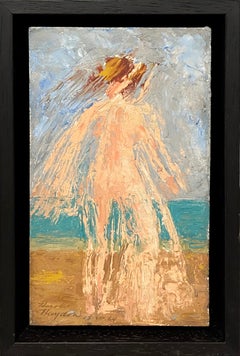
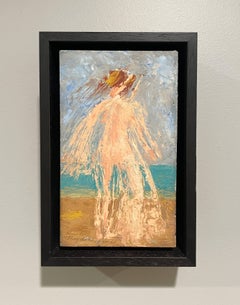
A Striking 1950s Mid-Century Modern Painting of a Male Bather, Vermont Landscape

A Striking 1950s Mid-Century Modern Painting of a Male Bather, Vermont Landscape

By Harold Haydon

Located in Chicago, IL

A Striking, 1950s Mid-Century Modern Oil Painting of a Nude Male Bather Kneeling in a Vermont Summer Landscape by Notable Chicago Artist, Harold Haydon (Am. 1909-1994). Painted in A...

Category

Mid-20th Century American Modern Masonite Paintings

Materials

Masonite, Oil

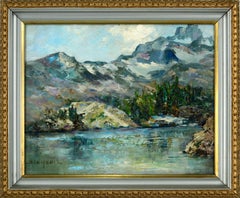
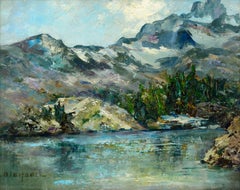
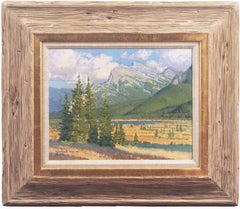
Mid Century Landscape California Mountain Lakeside

Mid Century Landscape California Mountain Lakeside

Located in Soquel, CA

Idyllic landscape of a scenic lake view with an evergreen forest and picturesque purple mountains in the background by an unknown artist. Unsigned. Displayed in a period rustic wood ...

Category

1950s American Impressionist Masonite Paintings

Materials

Masonite, Oil

Etude (abstract expressionist painting)

Etude (abstract expressionist painting)

By Fredric Karoly

Located in Wilton Manors, FL

Fredric Karoly (1898-1987). Etude, 1950. Oil on masonite panel measures 18 x 24 inches. Unframed. Signed, titled, dated on reverse. Good condition with minor paint loss at edges. Biography: An abstract painter, Karoly was born in Hungary and studied painting in Paris, architectural eingineering in Berlin, and emigrated to the U.S. in 1926. He began a successful career as a fashion and fabric designer. In 1948 he was working as a fashion director for Simplicity Patters, when he had a solo exhibition of of his oil paintings, wire montages, dry-pen drawings and abstract photography. Solo Exhibitions: Hugo Gallery (Alexandre Iolas) New York 1948; Gallery Mai. Paris 1949; New Gallery (Eugene Thaw) New York 1950; Museu de Arte, Sao Paulo, Brazil 1951; Miami Museum of Modern Art, Miami, Florida 1959; Loft Gallery, New York City, 1966.Group Exhibitions: Hugo Gallery, New York 1947; Salon des Realities Nouvelles, Paris 1949-1953; Whitney Museum of American Art, New York (Annual) 1951-1953, 1963; Biennale of Sao Paulo, Brazil, 1951; International Independent Exhibition, Tokyo, 1951; Martha Jackson Gallery, New York, 1959; The Butler Institute of Art, Youngstown, Ohio, 1960; Stuttman Gallery, New York, 1960; The Art Institute of Chicago (Annual), 1960; International Watercolor Exhibition, Brookyln Museum, 1961; Westchester Art Museum, White Plains, NY, 1963; Whitney Museum, Annual, NY 1963; Cleveland Art Festival, Park Synagogue, Cleveland, 1963; Whitney Museum, Sculpture Annual, NY, 1964.Works in Institutional Collections: Museu de Arte, San Paulo, Brazil; Museu de Bellas Artes, Buenos Aires, Argentina; New York University, New York; Washington University, St. Louis, Missouri; Finch College, NY; Barnard College, NY; Metropolitan Museum, Whitney Museum and Guggenheim Museum, New York; Museum of Fine Arts, St. Petersburg, FL. Awards: National Council Arts Awards, 1968. Frederic Karoly died on December 15, 1987 at the Inter-Continental Hotel in Manhattan, where he had made his home for many years. Fredric Karoly was born in Budapest in 1893. According to Karoly’s own vitae, his exhibition history began in New York in 1947, when at the age of 54 he took part in a four-person group show at Hugo Gallery. His involvement with visual art however was apparently life long. In a brief introduction to his solo show at Galerie Mai in Paris in June of 1949, Jen Luc de Rudder, reports that Karoly began painting at the age of 12 in Budapest. After several years of studying, then working in London, Paris and Berlin, Karoly emigrated to the United States in 1925 or 1926 (he probably first came to the US on a work visa in 1925). In New York, Karoly worked in women’s fashion as a designer. In 1948 Karoly worked in a manner than was clearly influenced by the work of such European surrealists as Max Ernst, creating spiked automatic bi-chromatic paintings. His style progressed into a progressively more biomorphic vein, similar to explorations by Theodore Stamos, Daphnis, Milton Avery and Mark Rothko around the same period. He was supported with patronage during this period by Mrs. Mimi Baliff, who apparently supported the “Industrial Design Workshop” that she helped open to feature Karoly’s designs in 1948. By the early 1950’s (1951) Karoly started experimenting with the drip and splatter process as well. Drip paintings dominated his process until the late 50’s-early 60’s, when linear compositional elements began to reemerge. By the late 50’s multi-layered drip grid motifs asserted a masque of spatial organization over looser washed fields and splatters of paint that Karoly worked off of. This development was consistent with concurrent explorations into the grid by artist Agnes Martin and others. By the mid-50’s Karoly’s style began another transition into a more surface concerned “Color Field” style of painting. There are elements still reminding one of Abstract Expressionist concerns as such painters as Clifford Still. But the works that began to emerge from Karoly’s studio in 1958 presaged the Morris Lewis fan motifs and Friedl Dzubas’s epic and romantic color spewing expanses of canvas. In 1959 Karoly began experiments using washes of turpentine diluted oil paint directly onto raw linen, and all of these subsequently suffered the consequences of oil oxidation and acidity upon the surfaces. However, many of Karoly’s washes in color field happily occurred on lightly prepared primed canvas surfaces as well. By 1960 Karoly began reintroducing imagistic references to his visual content. There were also various references to Japanese and Zen influences. He experimented with a variety of processes that included mixed media and marbleized surfaces achieved by the intermixture of oil and water mediums. A calligraphic element also enter Karoly’s work in the early 60’s. Then in 1961 glued and assembled objects begin to show up in Karoly’s work in earnest. The influence of early POP artists, particularly Jasper Johns, and Robert Rauschenberg, become apparent. From 1961-63, a series of the assemblage works transition from canvas to the sculptural to pieces obviously intended for full scale installation. Many of these pieces were among the most fragile of his works primarily due to their reliance upon the of gluing of objects such as plastic or paper cups on flexible surfaces of stretched linen or canvas. In the mid-60’s Karoly apparently produced a number of photo-silk screened series of Picasso, De Kooning and other significant artists of his generation. These were executed in a style somewhere between Rauschenberg’s and Roy Lichtenstein’s, primarily because of their reliance upon half tones and Ben-Day dot effects. Then Karoly began a series of paintings conflating his drip and grid styles with super imposed and painted over string. In the late 60’s Karoly embarked upon a series of multi-paneled stretched linen constructions often with slits and fiber optic back-lit elements that were prescient of the work of Dan Flavin and others. It was this body of work that was shown at Hofstra University’s Emily Lowe Gallery, and it was these works that suffered perhaps the most irreparable damage from a steam/water infiltration in a space where they were being stored. The late professional start that Karoly had into the art world was balanced by his long life span and early immersion into the design issues of modernism as it emerged in turn of the century Europe and later evolved in America. He was clearly an artist who subscribed to the ethos of the new in abstraction and was obviously impressionable and in some instances prescient with regard to various trends in abstraction. Several noteworthy and influential collectors and institutions during his 40 years of professional engagement acquired his work. The Whitney Museum of American Art had and may still own a large Karoly canvas from 1960, but this is doubtful as the artist failed to list it on the vitae he filed with MoMA in 1965. His work was recognized and honored by the Whitney with its inclusion in four of their annual survey shows (1951,1953, 1963 and 1964). The artist’s surrealist influenced paintings from 1948-1950 were the focus of a solo exhibition held of his work by the Museo de Art in Sao Paulo and eight years later a ten year survey of his work was the focus of a solo show at the Miami Museum of Modern art. The Sao Paulo Museum in Brazil, and the Museo de Bellas Artes in Buenos Aires, Argentina each acquired Karoly paintings for their collections in the 1950’s. One of Karoly’s surrealist pieces was apparently purchased by Christian Zervos, Picasso’s designated chronicler, who apparently also wrote a piece on Karoly in Cahiers D’Art in 1949. A 60’s piece of Karoly art that is in the New York University’s permanent collection is included in the MoMA Library’s catalog...

Category

Mid-20th Century Abstract Expressionist Masonite Paintings

Materials

Masonite, Oil

Northern California Coastal Santa Cruz County Ocean Waves 1950 Plein Air

Northern California Coastal Santa Cruz County Ocean Waves 1950 Plein Air

Located in Soquel, CA

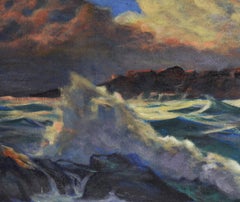
Northern California Coastal Santa Cruz County Ocean Waves 1950 Plein Air Santa Cruz Sandstone Cliffs and crashing waves near Natural Bridges circa 1950 by an unknown California artis...

Category

1950s American Impressionist Masonite Paintings

Materials

Masonite, Oil

Mid 19th Century Interior of Stable with Horses, Dogs, and Stable Hand

Mid 19th Century Interior of Stable with Horses, Dogs, and Stable Hand

Located in Soquel, CA

Wonderful mid 19th Century painting of a stable's interior with two horses, stable hand, two spaniels, a rooster and ducks from a follower of John Frederick Herring, Sr. (British, 17...

Category

19th Century English School Masonite Paintings

Materials

Masonite, Oil, Linen

White Landscape, Abstract Expressionist Collage by Keith Morrow Martin 1959

White Landscape, Abstract Expressionist Collage by Keith Morrow Martin 1959

Located in Long Island City, NY

An abstract collage on wood by Kenneth Morrow Martin, American (1911-1983). Exhibited: 1st Knoxville Art Center National Exhibtion, 1961 White Landscape by Keith Morrow Martin...

Category

1950s Abstract Expressionist Masonite Paintings

Materials

Masonite, Varnish, Magazine Paper

California School - Desert Ranch Road Landscape Oil on Canvas

California School - Desert Ranch Road Landscape Oil on Canvas

Located in Soquel, CA

California School - Ranch Road Landscape Oil on Canvas Imapsto oil painting of the California landscape by an unknown California artist working in the style of Sam Hyde Harris, anna Althea Hills...

Category

1950s American Impressionist Masonite Paintings

Materials

Canvas, Masonite, Oil

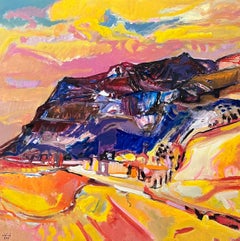
Landscape 136 by Jean Krille - Oil on Masonite 39x60.5 cm

Landscape 136 by Jean Krille - Oil on Masonite 39x60.5 cm

By Jean Krille

Located in Geneva, CH

Jean Krillé’s paintings are known for their expressive use of color and dynamic, abstract forms, blending realism with abstraction in his depictions of nature. His landscapes often f...

Category

Late 20th Century Neo-Expressionist Masonite Paintings

Materials

Masonite, Oil

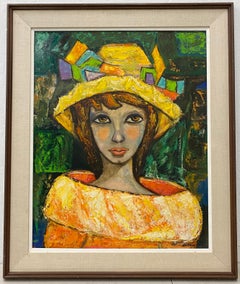
Girl With Hat
Girl With Hat

Donald Roy PurdyGirl With Hat, 1999

$6,375Sale Price|25% Off

Girl With Hat

By Donald Roy Purdy

Located in New York, NY

Signed: Purdy lower left and dated verso Panel size: 24 x 30 inches Painted in an expressive manner, the amount of color and freshness to this painting is refreshing. There is a sen...

Category

1990s American Impressionist Masonite Paintings

Materials

Masonite, Oil

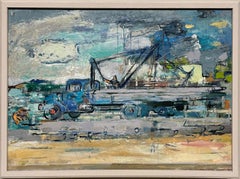
Mid Century Abstract Expressionist Cityscape

Mid Century Abstract Expressionist Cityscape

Located in Soquel, CA

Wonderful mid century abstract expressionist landscape of bridge over water cityscape, circa 1960. Illegible signature lower left ("Aioli"?). Conditi...

Category

1960s Abstract Expressionist Masonite Paintings

Materials

Masonite, Oil

Mid Century Autumn Reflections Oil Paint Landscape

Mid Century Autumn Reflections Oil Paint Landscape

By Lorenz E. Griffith

Located in Soquel, CA

Peaceful landscape of a calm stream winding through an autumnal forest by Lorenz Griffith (American, 1889-1968). Signed "Lorenz Griffith" lower left. Titled "Autumn Reflections - Virginia" and dated 1958 on verso. Unframed. Image size: 24"H x 35.5"W. Lorenz E. Griffith was born in Indiana; he was active/lived in North Carolina, Florida, Indiana and many places across the United States. Lorenz Griffith is known for luminist landscapes and portraits. He painted in the style of the Florida Highwaymen...

Category

1950s American Impressionist Masonite Paintings

Materials

Masonite, Oil

[Bruce Sargeant (1898-1938)] Two Cyclists and One Runner

[Bruce Sargeant (1898-1938)] Two Cyclists and One Runner

By Mark Beard

Located in New York, NY

[Bruce Sargeant (1898-1938)] Two Cyclists and One Runner n.d. Signed in red, u.l. Oil on canvas mounted to Masonite 35.75 x 58 inches This work is offered by ClampArt in New York...

Category

2010s Contemporary Masonite Paintings

Materials

Canvas, Masonite, Oil

“Belgian Quay”
“Belgian Quay”

“Belgian Quay”

Located in Southampton, NY

Original oil on masonite painting of a Belgian Quay by the artist Flory Roland. Signed lower right by the artist. Circa 1955. Condition is very good. The painting is housed in a p...

Category

1950s Post-Modern Masonite Paintings

Materials

Masonite, Oil

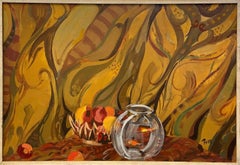
Trompe l'Oeil Still Life and Landscape in Acrylic on Masonite

Trompe l'Oeil Still Life and Landscape in Acrylic on Masonite

Located in Soquel, CA

Trompe l'Oeil Still Life and Landscape in Acrylic on Masonite Still life in the trompe l'oeil style by Richard M. Bacon (American, 20th Century). A still life with a bottle, fishbow...

Category

Early 2000s American Modern Masonite Paintings

Materials

Masonite, Acrylic

"Countryside Landscape Hills Scene with Path" Expressionistic Style Oil Painting

"Countryside Landscape Hills Scene with Path" Expressionistic Style Oil Painting

By Michael Baxte

Located in New York, NY

A strong modernist oil painting depicted in the Mid Century by Russian painter Michael Baxte. Mostly known for his abstracted figures on canvas or street scenes, this piece is a wonderful representation of his landscapes with expressive use of color, shape, and form. Later in his career, Baxte explores Expressionism, infusing both European and North American stylistic trends. Art measures 15 x 18 inches Michael Posner Baxte was born in 1890 in the small town of Staroselje Belarus, Russia. For the first half of the 19th century, it was a center of the Chabad movement of Hasidic Jews, but this group was gone by the middle of the 19th century. By the time the Baxte family immigrated to the United States at the beginning of the 20th century, the Jewish population numbered only on the hundreds. The native language of the Baxte family was Yiddish. It is likely that the death of Michael Baxte’s father triggered the family’s immigration. Three older brothers arrived in New York between 1903 and 1905. Michael and his mother, Rebecca, arrived in 1907. By 1910 Michael, his mother, and brother, Joseph, were living in New Orleans and may have spent some time on a Louisiana plantation. Around 1912, Michael Baxte returned to Europe to study the violin. In 1914 he, his mother, and Joseph moved to New York City. Meanwhile, in Algeria, a talented young woman painter, Violette Mege, was making history. For the first time, a woman won the prestigious Beaux Art competition in Algeria. At first, the awards committee denied her the prize but, with French government intervention, Mege eventually prevailed. She won again 3 years later and, in 1916, used the scholarship to visit the United States of America. When Violette came to New York, she met Baxte, who was, by then, an accomplished violinist, teacher, and composer. Baxte’s compositions were performed at the Tokyo Imperial Theater, and in 1922 he was listed in the American Jewish Yearbook as one of the prominent members of the American Jewish community. As a music teacher, he encouraged individual expression. Baxte stated, “No pupil should ever be forced into the imitation of the teacher. Art is a personal experience, and the teacher’s truest aim must be to awaken this light of personality through the patient's light of science.” By 1920 Michael Baxte and Violette Mege were living together in Manhattan. Although they claimed to be living as husband and wife, it seems that their marriage did not become official until 1928. On their “unofficial” honeymoon around 1917, in Algiers, Baxte confided to her his ambition to paint. There and later in New Mexico where the wonderful steeped sunlight approximates the coloring of Algiers, she taught him his heart’s desire. He never had any other teacher. She never had any other pupil. For ten years she devoted all her time, energy, and ambition to teaching, encouraging, inspiring him. Then in 1928, their mutual strivings were rewarded, as his works were being chosen as one of the two winners in the Dudensing National Competition for American Painters. Out of 150 artists from across the country participated in the Dudensing, and Michael Posner Baxte and, Robert Fawcett...

Category

Mid-20th Century Expressionist Masonite Paintings

Materials

Oil, Masonite

Masonite paintings for sale on 1stDibs.

Find a wide variety of authentic Masonite paintings available on 1stDibs. While artists have worked in this medium across a range of time periods, art made with this material during the 21st Century is especially popular. If you’re looking to add paintings created with this material to introduce a provocative pop of color and texture to an otherwise neutral space in your home, the works available on 1stDibs include elements of blue, green, pink, purple and other colors. There are many well-known artists whose body of work includes ceramic sculptures. Popular artists on 1stDibs associated with pieces like this include Enzio Wenk, Mark Beard, Michael Baxte, and Helen Enoch Gleiforst. Frequently made by artists working in the Impressionist, Abstract, all of these pieces for sale are unique and many will draw the attention of guests in your home. Not every interior allows for large Masonite paintings, so small editions measuring 0.1 inches across are also available