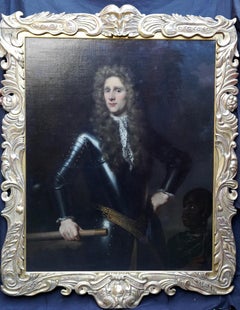
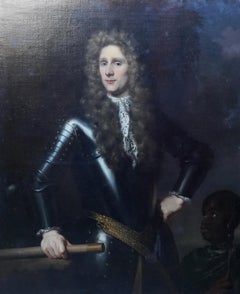
This magnificent large-scale portrait, presented by Titan Fine Art, depicts Tufton Wray, later Lady Montagu, seated in a wooded area, resting her arm on a plinth next to a fountain, a warm evening sky in the background. Lady Wray was a paragon of the wealthy and privileged society that she belonged to – and her status is evident in the choice of her final resting place - the great Canterbury Cathedral. The portrait was painted circa 1685, when the sitter was around eighteen years old. Much of the attractiveness of this elegant large-scale portrait resides in the graceful composition and the beauty of the youthful sitter.
Lady Wray is wearing a white satin dress with a pearl clasp on the sleeve, and her body is enveloped in a voluptuous wrap. While the dress is loose, it nonetheless follows the “tight bodied” style via an invisible corset – such images exude a sense of status and Augustan decorum, and were highly influential in transmitting these values into the first half of the eighteenth century. An inscription on the portrait identifies the sitter: 'Tufton Daughter of Sr Wm. Wray/ Married to Ld Chief Baron Montagu' and on the reverse is a handwritten label: ‘Sir Godfrey Kneller 1648-1723. Portrait of Tufton Wray cir 1683. Collection: Homedown, Hambledon No. 24’.
Tufton Wray was a daughter of English politician, Sir William Wray, 1st Baronet, of Ashby (c.1625-1669) - the Wray’s were a family of judges and politicians for many generations. She had three brothers: Sir Christopher (c.1652-1679), Sir William (died c.1686), and Sir Edward (all died without issue), and four sisters. On the 6th October 1694 she married Sir James Montagu (1666-1723) in London. Sir James was an English lawyer, Whig politician, a judge, and also as Solicitor General and Attorney General under Queen Anne. The couple had one son, Charles (1695-1759), and one daughter, Elizabeth (d. 9th March 1746).
Charles was a politician and he succeeded the estates of his father in 1723. He married Ann Colladon (died 1780) in 1725, daughter of Sir Theodore Colladon of Chelsea, and sub-governess to the Princesses. The couple had a daughter and two sons, their son Frederick (1733-1800) succeeded his father’s estate, and around 1787 he built Papplewick Hall which became the family seats for much of the 18th century. Robin Hood is, of course, said to have haunted the district, and a cave, called Robin Hood’s Stable, is close to the hall. Frederick died childless and the Papplewick estate passed to his sister’s grandson Richard Fountayne-Wilson (1783-1847) together with the surname of Montagu. In 1826 he gave it by Royal Licence to his eldest son, Andrew, who was 10-year-old at the time. Andrew Montagu took charge of the 1,758-acre estate during 1840 and moved into Papplewick Hall from his home at Normanton, Rutland. He never married and on his death in 1895, the Papplewick Estate was left in trust, for his brother's youngest son, James Fountayne Montagu. James inherited the estate on his 25th birthday in December 1912, and he developed it as a horse breeding centre however the business failed and Papplewick was sold in April 1919 to Alderman Albert Ball.
Elizabeth married Sir Clement Wearg (1686–1726), an English lawyer and politician, and solicitor-general from 1724. Elizabeth and Clement were interred in the same grave, under a plain raised tomb, in Temple Church (London), with accordance of Clement’s will.
The sitter died 6th September 1712 and her tomb in Canterbury Cathedral in Kent has a Latin inscription which translates to English as:
Under this Marble lies...
Category
Old Masters 1680s Paintings