1840s Art

1,129 Results
to
37
666
377
62
17
19
Overall Width
to
Overall Height
to
7,667
21,546
166,487
236,785
2,163
2,346
4,739
6,579
6,011
15,889
21,224
26,531
19,336
14,163
5,480
752
17
7
1
1
1
675
457
3
785
335
300
239
148
137
97
95
95
89
66
56
47
47
45
39
35
28
27
26
822
135
126
108
74
134
50
26
17
12
124
831
944
189
Period: 1840s
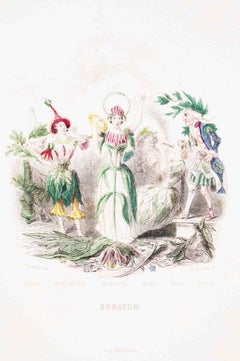
Frontispiece - Les Fleurs Animées Vol.II - Lithograph by J.J. Grandville - 1847

Frontispiece - Les Fleurs Animées Vol.II - Lithograph by J.J. Grandville - 1847

By J. J. Grandville

Located in Roma, IT

Image dimensions: 24.3 x 17.5 cm. Single sheet with passepartout. "At a crossing in the forest, where four roads unite, a number of flowers happened to meet - among which were seen the Cactus, the Peach-blossom, the Dahlia, the Sensitive-plant, the Fuchsia, the Periwinkle, and the Sweet-scented Pea." T. Delord. Les Fleurs animées...

Category

Modern 1840s Art

Materials

Lithograph

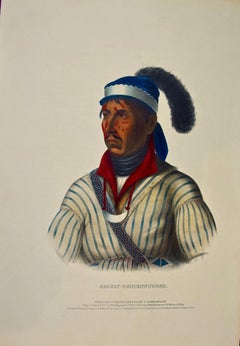
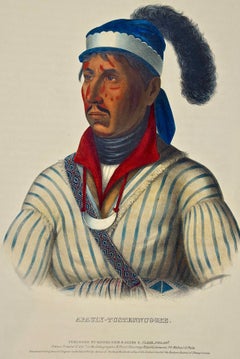
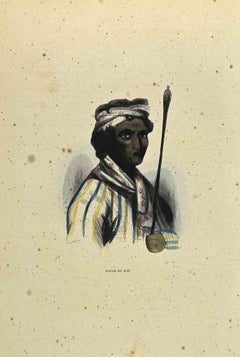
Apauly-Tustennuggee: 19th C. Hand-colored McKenney & Hall Folio-sized Lithograph

Apauly-Tustennuggee: 19th C. Hand-colored McKenney & Hall Folio-sized Lithograph

By McKenney & Hall

Located in Alamo, CA

This is an original 19th century hand-colored folio size McKenney and Hall engraving of a Native American entitled "Apauly-Tustennuggee, A Creek Chief" after a painting by Charles Bird King from McKenney and Hall's "History of the Indian Tribes of North America", published in Philadelphia by Daniel Rice and James G. Clark in 1843. McKenney described him as “a chief and a warrior...a firm, brave man - and of good sense.” This original McKenney and Hall large hand-colored folio-size engraving measures 20" high and 14" wide. The print is in excellent condition. Col. Thomas J. McKenney was Superintendant of The Bureau of Indian Affairs from 1816 until 1830. He was one of a very few government officials to defend American Indian interests and attempt to preserve their culture. He travelled to Indian lands meeting the Native American leaders. He brought with him an accomplished artist, James Otto Lewis...

Category

Naturalistic 1840s Art

Materials

Engraving

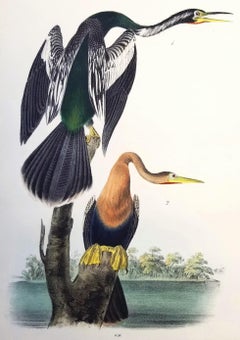
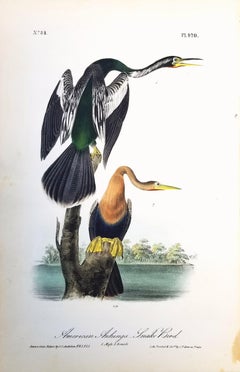
American Anhinga - Snake Bird /// John James Audubon Ornithology Natural History

American Anhinga - Snake Bird /// John James Audubon Ornithology Natural History

By John James Audubon

Located in Saint Augustine, FL

Artist: John James Audubon (American, 1785-1851) Title: "American Anhinga - Snake Bird" (Plate 420, No. 84) Portfolio: The Birds of America (First Royal Octavo Edition) Year: 1840-1844 Medium: Original Hand-Colored Lithograph on wove paper Limited edition: approx. 1,200 Printer: John T. Bowen, Philadelphia, PA Publisher: John James Audubon and J.B. Chevalier, New York, NY and Philadelphia, PA Sheet size: 10" x 6.69" Image size: 6.63" x 4.63" Reference: Ayer/Zimmer page 22; Bennett page 5; McGill/Wood page 208; Nissen No. IVB 51; Reese No. 34; Sabin No. 2364; Tyler App. I Condition: Minor toning to sheet and some faint discoloration in margins. Old glue staining along right binding edge as normal. It is otherwise in very good condition with strong colors Notes: Provenance: private collection - Cleveland, OH. Lithography and hand-coloring by American artist John T. Bowen (1801-c.1856). Comes from Audubon's famous seven volume portfolio "The Birds of America", (First Royal Octavo Edition) (1840-1844), which consists of 500 hand-colored lithographs. The preceding 1836 Havell edition of this work has a different title: "Black-bellied Darter", (Plate: CCCXVI - 396, No. 64). Based on a drawing inscribed "New Orleans 1822 - redrawn ... 1836". This conspicuous bird had various names including "water turkey" and "Bec à Lancette". The Anhinga, sometimes called snakebird, darter, American darter, or water turkey, is a water bird of the warmer parts of the Americas. The word anhinga comes from a'ñinga in the Brazilian Tupi language and means "devil bird" or "snake bird". To make 'The Birds of America' more affordable and widely available, in 1839 John James Audubon began the first octavo edition, a smaller version of the folio which was printed and hand-colored by J. T. Bowen in Philadelphia. Employing a new invention, the camera lucida, the images were reduced in size, rendered in intermediate drawings by John James Audubon and his son John Woodhouse, and then drawn onto lithographic stones. These miniatures exhibit a remarkable amount of attention to quality and detail, as well as a meticulous fidelity to the larger works. Some compositional changes were made in order to accommodate the smaller format. Like the Havell edition, John James Audubon’s first...

Category

Victorian 1840s Art

Materials

Watercolor, Lithograph

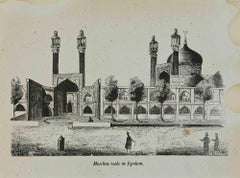
Royal Mosque in Isfahan - Lithograph - 1862

Royal Mosque in Isfahan - Lithograph - 1862

Located in Roma, IT

Royal Mosque in Isfahan is a  lithograph realized in 1864. Good conditions. The artwork belongs to the Suite Uses and customs of all the peoples of the universe, or History of the ...

Category

Modern 1840s Art

Materials

Lithograph

"View Towards the Pyramids": David Roberts' 19th Century Hand Colored Lithograph

"View Towards the Pyramids": David Roberts' 19th Century Hand Colored Lithograph

By David Roberts

Located in Alamo, CA

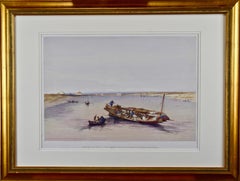
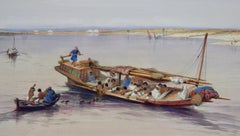
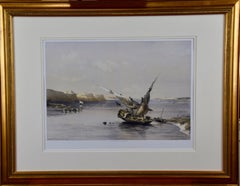
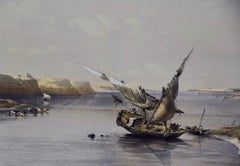
"View Towards the Pyramids" is a 19th century full folio sized hand-colored lithograph by David Roberts from his monumental publication "The Holy Land, Syria, Idumea, Arabia, Egypt, and Nubia", published in London in 1846. It depicts a scene of a boat on the Nile, along with several smaller boats. Saccara (Saqqara), near Memphis, the original capital of Egypt, can be seen in the background with its ancient Step Pyramid of Pharoah Djoser. This was the first Egyptian pyramid, designed by the physician and architect Imhotep. Pharoah Snofru’s (Sneferu) failed design Bent Pyramid and the subsequent replacement Red Pyramid can be seen in Dashour (Dashur). These structures preceded the more famous pyramids in Giza. This lithograph is professionally framed in a gold-colored wood frame, double cream-colored mats and it is glazed with museum quality archival material. The print is in excellent condition. There are four additional listings of David Roberts engravings of Egypt...

Category

Realist 1840s Art

Materials

Lithograph

Persian Woman - Original Lithograph - 1848 ca.

Persian Woman - Original Lithograph - 1848 ca.

Located in Roma, IT

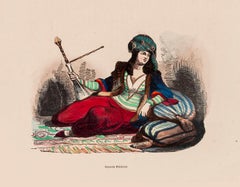
Persian Woman is an original hand-colored lithograph on paper realized in 1848 ca. by an Anonymous artist of the mid XIX century. Titled on the lower center in Italian "Signora Pers...

Category

1840s Art

Materials

Lithograph

Bonaparte’s Flycatching-Warbler (Great Magnolia) /// Ornithology Bird Audubon

Bonaparte’s Flycatching-Warbler (Great Magnolia) /// Ornithology Bird Audubon

By John James Audubon

Located in Saint Augustine, FL

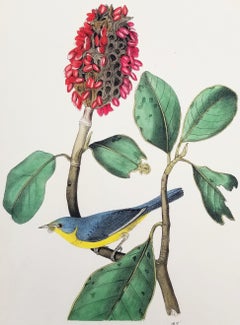
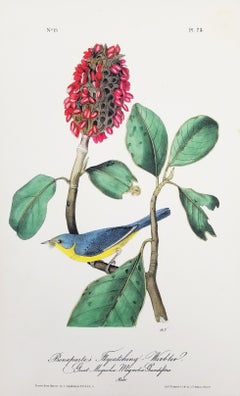
Artist: John James Audubon (American, 1785-1851) Title: "Bonaparte’s Flycatching-Warbler (Great Magnolia)" (Plate 73, No. 15) Portfolio: The Birds of America (First Royal Octavo Edition) Year: 1840-1844 Medium: Original Hand-Colored Lithograph on wove paper Limited edition: approx. 1,200 Printer: John T. Bowen, Philadelphia, PA Publisher: John James Audubon and J.B. Chevalier, New York, NY and Philadelphia, PA Sheet size: 10.5" x 6.5" Image size: 7.5" x 5.63" Reference: Ayer/Zimmer page 22; Bennett page 5; McGill/Wood page 208; Nissen No. IVB 51; Reese No. 34; Sabin No. 2364; Tyler App. I Condition: Minor area of discoloration upper right corner. In excellent condition with strong colors Notes: Lithography and hand-coloring by American artist John T. Bowen (1801-c.1856). Comes from Audubon's famous seven volume portfolio "The Birds of America", (First Royal Octavo Edition) (1840-1844), which consists of 500 hand-colored lithographs. Based on a composition painted on August 13, 1821. The Canada warbler is a small boreal songbird of the New World warbler family. It summers in Canada and northeastern United States and winters in northern South America. To make 'The Birds of America' more affordable and widely available, in 1839 John James Audubon began the first octavo edition, a smaller version of the folio which was printed and hand-colored by J. T. Bowen in Philadelphia. Employing a new invention, the camera lucida, the images were reduced in size, rendered in intermediate drawings by John James Audubon and his son John Woodhouse, and then drawn onto lithographic stones. These miniatures exhibit a remarkable amount of attention to quality and detail, as well as a meticulous fidelity to the larger works. Some compositional changes were made in order to accommodate the smaller format. Like the Havell edition, John James Audubon’s first...

Category

Victorian 1840s Art

Materials

Watercolor, Lithograph

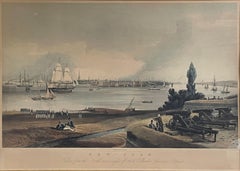
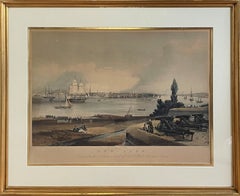
"New York - Taken from the Northwest angle of Fort Columbus, Governor's Island"

"New York - Taken from the Northwest angle of Fort Columbus, Governor's Island"

Located in New York, NY

New York - Taken from the north west angle of Fort Columbus Governor's Island, 1846 Engraved by Henry Papprill after a sketch by F. Catherwood, published by Henry J. Megarey Hand-colored engraving on paper Image 16 x 26 1/2 inches Henry A. Papprill (1816–1903) was a British engraver. Noted as an aquatint engraver from 1840. His plates were published from 1840 till 1883 mainly by Ackermann of the Strand. Papprill was born in Holborn, London. Lived for much of his life at Wharton Street, Lloyd Square, London. Papprill is thought to have been based in New York City for brief period in the mid-1840s. His work in the USA appears to classify him as an American engraver but he was based and gained his reputation and bulk of his work in England. He produced a series of works for Ackermann & Co from 1840 beginning with four plates called "The Jolly Squire", with verses, after James Pollard. In the following years Papprill engraved a number of military plates for Ackermann as well a series of engravings of New York (1846-9) for H.I.Megarey (published in New York). The most notable of these are: "The North West Angle of Fort Columbus, Governor's Island" (the Catherwood-Papprill view) and New York from the Steeple of St. Paul's Church, Looking East, South & West." (The Hill-Papprill view) listed in the American Historical Prints - Early Views of American Cities, etc: I.N.Phelps Stokes & Daniel C. Haskell. New York Public Library 1932. Papprill also produced for Ackermann a series of sporting prints after G. H. Laporte between 1860 and 1865. These were entitled: Racing, Hunting and Coursing. He also produced a series of shipping prints...

Category

1840s Art

Materials

Paper, Engraving, Aquatint

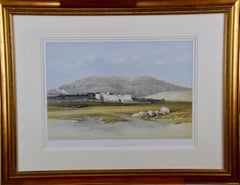
David Roberts' 19th Century Hand Colored Lithograph, "Fortress of Ibrim, Nubia"

David Roberts' 19th Century Hand Colored Lithograph, "Fortress of Ibrim, Nubia"

By David Roberts

Located in Alamo, CA

"Approach to the Fortress of Ibrim, Nubia" is a 19th century folio sized hand-colored lithograph from the Egypt and Nubia volume of David Roberts’ large folio edition, published in London by F. G. Moon in 1847. The lithographs were prepared by Louis Haghe (1806-1885) from drawings and paintings by Roberts. The resultant large folio editions of 'The Holy Land' and 'Egypt & Nubia' are considered the greatest lithographically illustrated works issued in the 19th century. The print is presented in a gold-colored wood frame with a decorative inner trim, with a cream-colored double mat. It is in excellent condition. The lithograph depicts the Fortress of Ibrim in Nubia in the background, which had been a Roman and an Egyptian fortification for centuries due to its strategic elevation, allowing a view of large portions of the surrounding desert. Men are securing the boat in the foreground for the night, taking down its sails. A herd of cattle drinks and cools themselves in the water on the left. There are four additional listings of David Roberts engravings of Egypt...

Category

Realist 1840s Art

Materials

Lithograph

The Jolly Flat Boat Men

The Jolly Flat Boat Men

By George Caleb Bingham

Located in Missouri, MO

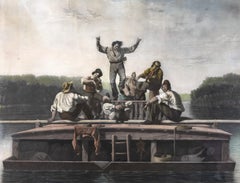
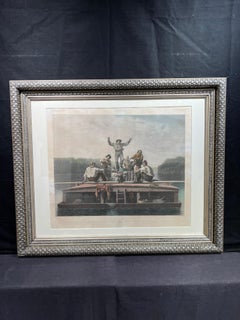
The Jolly Flat Boat Men, 1847 After George Caleb Bingham (American, 1811-1879) Engraved by Thomas Doney (French, active New York 1844-1849) Engraving with Hand-Coloring Published by The American Art-Union, New York (1838-1851) Printed by Powell and Co. 18 x 24 inches 32 x 38 inches with frame In 1847, the American Art-Union purchased Bingham’s painting "The Jolly Flat Boat Men" (1846; National Gallery of Art) directly from the artist. The subscription-based organization, founded in 1838 as the Apollo Association, boasted nearly ten-thousand members at this date. For an annual fee of five dollars, each received a large reproductive engraving and was entered in a lottery to win original artworks exhibited at the Art-Union’s Free Gallery. Aimed at educating the public about contemporary American art, the organization developed an impressive distribution network that reached members in every state. The broad circulation of the Art-Union's print helped to establish Bingham's reputation and made his river scene famous. Born in Augusta County, Virginia in the Shenandoah River Valley, George Caleb Bingham became known for classically rendered western genre, especially Missouri and Mississippi River scenes of boatmen bringing cargo to the American West and politicians seeking to influence frontier life. One of his most famous river genre paintings was The Jolly Flatboatmen completed in several versions in 1846. This first version of this painting is in the Manoogian Collection at the National Gallery of Art. Fame resulted for this work when it was exhibited in New York at the American Art Union whose organizers made an engraving of 10,000 copies and distributed it to all of their members. Paintings such as Country Politician (1849) and County Election (1852) and Stump Speaking (1854) reflected Bingham's political interests. In 1819, as an eight-year old, he moved to Boon's Lick, Missouri with his parents and grandfather who had been farmers and inn keepers in the Shenandoah Valley near Rockingham, Virginia. Reportedly as a child there, he took every opportunity to escape supervision to travel the River and watch the marine activity. His father died in 1827, when his son was sixteen years old. His mother had encouraged his art talent, but art lessons were not easily obtainable. In order to earn money, he apprenticed to a cabinet maker but determined to become an artist. By 1835, he had a modest reputation as a frontier painter and successfully charged twenty dollars per portrait in St. Louis. "His portraits had become standard decorations in prosperous Missouri homes." (Samuels 46). In 1836, he moved to Natchez, Mississippi and there had the same kind of career, only was able to charge forty dollars per portrait. He remained largely self taught until 1837, when he, age 26 and using the proceeds from his portraiture, studied several months at the Pennsylvania Academy of the Fine Arts. He later said that he learned much of his atmospheric style and classically balanced composition by copying paintings in collections in St. Louis and Philadelphia and that among his most admired painters were Thomas Cole, John Vanderlyn, and William Sidney Mount. Between 1856 and 1859, Bingham traveled back and forth to Dusseldorf, Germany, where he studied the work of genre painters. Some critics think these influences were negative on his work because during that time period, he abandoned his luminist style that had brought him so much public affirmation. Bingham credited Chester Harding (1792-1866) as being the earliest and one of the most lasting influences on his work. Harding,a leading portraitists when Bingham was a young man, had a studio in Franklin, near Bingham's home town. In 1822, when Bingham was ten years old, he watched Harding finish a portrait of Daniel Boone. Bingham recalled that watching Harding with the Boone portrait was a lasting inspiration and that it was the first time he had ever seen a painting in progress. Harding suggested to Bingham that he begin doing portraiture by finding subjects in the river men, which, of course, opened the subject matter that established fame and financial success for Bingham. Harding also encouraged Bingham to copy with paint engravings. He later painted two portraits of Boone but, contrary to the assertions of some scholars, he did not do Boone portraits in the company of Harding. Bingham's portraits of Boone are not located, but one of them, a wood signboard for a hotel in Boonville circa 1828 to 1830, showed a likeness of Boone in buckskin dress...

Category

Hudson River School 1840s Art
Materials

Engraving

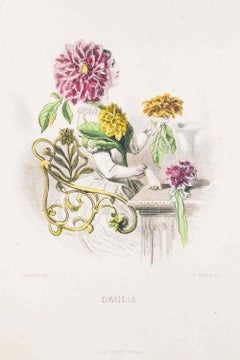
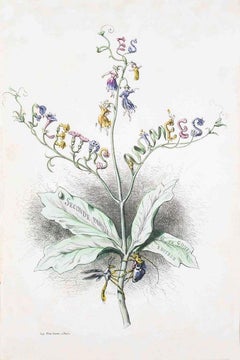
Dahlia - Les Fleurs Animées Vol.II - Lithograph by J.J. Grandville - 1847

Dahlia - Les Fleurs Animées Vol.II - Lithograph by J.J. Grandville - 1847

By J. J. Grandville

Located in Roma, IT

Image dimensions: 24.3 x 17.5 cm. Single sheet with passepartout. "...weary of being followed round by old bachelors, who clasp me by the waist, and call me Flora's priestess, I have resolved to flee from mankind, and to return to my old condition - that of a simple flower." T. Delord. Les Fleurs...

Category

Modern 1840s Art
Materials

Lithograph

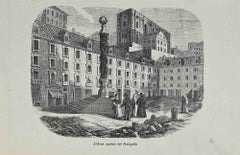
Lisbon Capital of Portugal - Lithograph - 1862

Lisbon Capital of Portugal - Lithograph - 1862

Located in Roma, IT

Lisbon Capital of Portugal is a  lithograph realized in 1862. Good conditions. The artwork belongs to the Suite Uses and customs of all the peoples of the universe, or History of t...

Category

Modern 1840s Art
Materials

Lithograph

The Soldier's Ballad - Lithograph by Max Ernst - 1972

The Soldier's Ballad - Lithograph by Max Ernst - 1972

By Max Ernst

Located in Roma, IT

The Soldier's Ballad is a contemporary artwork realized by Max Ernst in 1972. Mixed colored lithograph on Arches Paper. Edited by Manus Presse, Stuttgart 1972. Not signed and not ...

Category

Surrealist 1840s Art
Materials

Lithograph

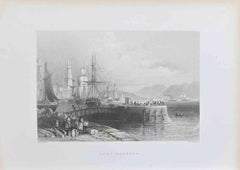
Port Glasgow - Etching by W. H.Bartlett - 1845

Port Glasgow - Etching by W. H.Bartlett - 1845

Located in Roma, IT

Port Glasgow is an etching realized in 1845 by W. H. Bartlett. Signed on the plate. Titled on the lower center, from the series of "Ports of Great Britain". Good conditions with...

Category

Modern 1840s Art
Materials

Etching

Beaumaris - Etching by J.C.Armytage - 1845

Beaumaris - Etching by J.C.Armytage - 1845

Located in Roma, IT

Beaumaris is an etching realized in 1845 by J.C.Armytage. Signed in plate. The artwork is realized in a well-balanced composition.

Category

Modern 1840s Art
Materials

Etching

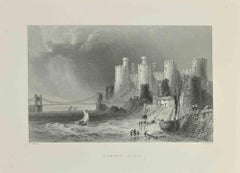
Conway Quay - Etching by J.C.Armytage - 1845

Conway Quay - Etching by J.C.Armytage - 1845

Located in Roma, IT

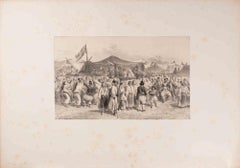
Conway Quay is an etching realized in 1845 by J.C. Armytage. Signed in plate. The artwork is realized in a well-balanced composition.

Category

Modern 1840s Art
Materials

Etching

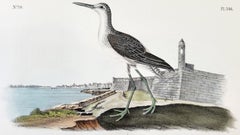
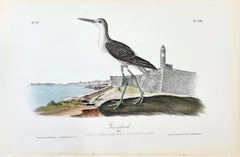
Greenshank (View of St. Augustine & Spanish Fort East Florida) /// Audubon Birds

Greenshank (View of St. Augustine & Spanish Fort East Florida) /// Audubon Birds

By John James Audubon

Located in Saint Augustine, FL

Artist: John James Audubon (American, 1785-1851) Title: "Greenshank (View of St. Augustine & Spanish Fort East Florida)" (Plate 346, No. 70) Portfolio: The Birds of America (First Royal Octavo Edition) Year: 1840-1844 Medium: Original Hand-Colored Lithograph on wove paper Limited edition: approx. 1,200 Printer: John T. Bowen, Philadelphia, PA Publisher: John James Audubon and J.B. Chevalier, New York, NY and Philadelphia, PA Sheet size: 6.75" x 10.19" Image size: 4.25" x 7.75" Reference: Ayer/Zimmer page 22; Bennett page 5; McGill/Wood page 208; Nissen No. IVB 51; Reese No. 34; Sabin No. 2364; Tyler App. I Condition: Minor mat stain around edges and faint offsetting to sheet. One small foxmark above bird's head. It is otherwise in good condition with strong colors Notes: Provenance: private collection - St. Augustine, FL. Lithography and hand-coloring by American artist John T. Bowen (1801-c.1856). Comes from Audubon's famous seven volume portfolio "The Birds of America", (First Royal Octavo Edition) (1840-1844), which consists of 500 hand-colored lithographs. Comes with its original accompanying text pages. Gold gilded edges as issued. The composition was probably painted in England in 1835, using a preserved specimen. Since no other than Audubon has ever claimed to have seen this European species in America, it is considered possible that he confused it with the greater yellow-legs. The common greenshank is a wader in the large family Scolopacidae, the typical waders. The genus name Tringa is the New Latin name given to the green sandpiper by Aldrovandus in 1599 based on Ancient Greek trungas, a thrush-sized, white-rumped, tail-bobbing wading...

Category

Victorian 1840s Art

Materials

Watercolor, Lithograph

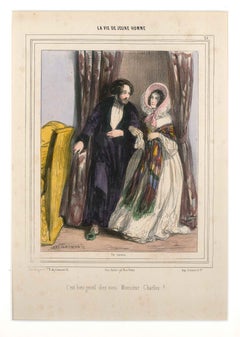
La Vie de Jeune Homme - Original Lithograph by Paul Gavarni - First Half of 1800

La Vie de Jeune Homme - Original Lithograph by Paul Gavarni - First Half of 1800

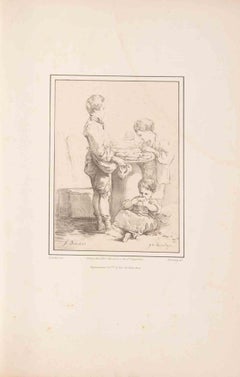
Colored lithograph with pouchoir details. Beautiful satiric illustration by the French draftsman Paul Gavarni (alias Guillaume Sulpice Chevalier Gavarni, 1804-1866). Plate 25, from...

Category

Modern 1840s Art
Materials

Lithograph

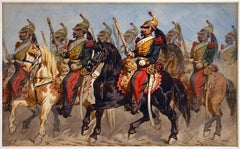
Battle, Knights on Horses - China Ink and Watercolor by T. Fort - 1840s
Battle, Knights on Horses - China Ink and Watercolor by T. Fort - 1840s

By Theodore Fort

Located in Roma, IT

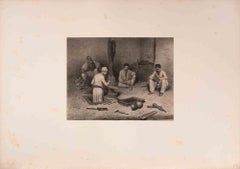
Typical battle scene by T. Fort, in very good conditions and signed by the artist. A very interesting artwork for a connoisseur of the militaria genre! Theodore Géricaul Fort (1810 - 1896), Simeone Fort's son, belonged to the French school of the XIX century; Théodore Fort...

Category

Old Masters 1840s Art
Materials

Watercolor, Ink