Engraving Black and White Photography

to
3
Overall Width
to
Overall Height
to
3
3
2
1
2
2
2
2
2
1
1
1
1
1
1
1
4,932
9,703
9,386
8,583
6,383
3
Medium: Engraving
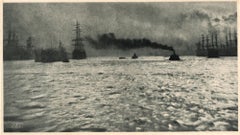
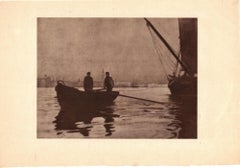
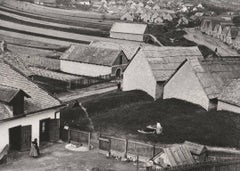
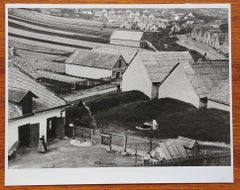
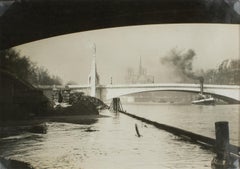
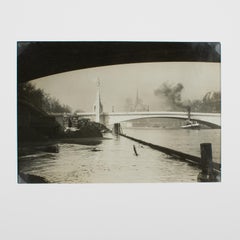
Harbour of Hamburg; From the journal Camera Work

Harbour of Hamburg; From the journal Camera Work

By Heinrich Kuhn

Located in Middletown, NY

New York: Alfred Stieglitz, 1911. Halftone engraving from a gum bichromate print, 4 11/16 × 8 9/16 inches (119 × 218 mm), tipped onto a mounting sheet 8 x 11 3/4 inches. Signature o...

Category

Early 20th Century Modern Engraving Black and White Photography

Materials

Engraving, Photogravure

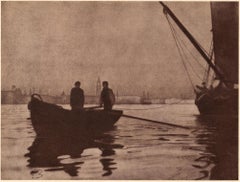
Venice; From the journal Camera Work

Venice; From the journal Camera Work

By Heinrich Kuhn

Located in Middletown, NY

New York: Alfred Stieglitz, 1911. Halftone engraving from a gum bichromate print, 5 9/16 x 7 11/16 inches (148 x 196 mm), tipped onto a mounting sheet 8 x 11 3/4 inches. A muted an...

Category

Early 20th Century Modern Engraving Black and White Photography

Materials

Engraving, Photogravure

Sailing Boats; From the journal Camera Work

Sailing Boats; From the journal Camera Work

By Heinrich Kuhn

Located in Middletown, NY

New York: Alfred Stieglitz, 1911. Halftone engraving from a gum bichromate print; 8 x 5 5/8 inches (203 x 142 mm), tipped onto a mounting sheet 8 x 11 3/4 in. 2 mm tear on lower rig...

Category

Early 20th Century Modern Engraving Black and White Photography

Materials

Engraving, Photogravure

Related Items
Flights , Scotland , 2015

Flights , Scotland , 2015

By Benjamin Heller

Located in Hudson, NY

In his latest show, Benjamin Heller invites us to enter a poetic space of echo and convergence. As a photographer, sculptor, and performer, movement is key in this body of work, that is punctuated by self portraits selected from the series "The Long Walk: Analog Narratives". This series features pieces collected over an extended period of time spent traveling. It is a window to the interior landscapes he seeks to find reflected in the world, to contain a sense of this intimate vastness. All of the images can be viewed as variations on a self-portrait. The places of intimacy and sense of vastness contained in the photographs can convey a sense of transport that enhances the viewer's visual experience. The "echoes" we find in the show reside in multiplicities of human and physical forms, rolling natural curves, and animals in flight; all intended to provide a resonance with the contours of earth, water, and wind. The result is an array of images captivating in themselves, but also given new meaning in the context of Robin Rice's skillful curatorial arrangement. Her intuitive placement creates a graphic narrative for the viewer to follow and decipher, encouraged by the convergence of the poetic titles of the works. Traces of poetry, sculpture, the lines of the body, lived experience are also evoked in Heller's photographs, in movement and action. He also finds inspiration in photographer Duane Michals' framing of expressive narratives, and in Sally Mann's felt sense of powerful physical presence. Photographer Miranda Penn Turin, in reviewing the exhibition, said "I can almost hear a soundtrack, and it's the sound of wind". The invitational image is entitled "Fall," a graceful figure, suspended in a glowing arc, light streaming upwards, eyes closed in rapture. This light sits in contrast to the infinite shadow of the black background, conjuring a certain atmosphere. Heller believes that it is shadows that allow the viewer to reside in the experience – this image does just that. These imagined environments speak to our converging lives and the echoed moments we experience, embodying for each viewer, just what Benjamin Heller connects with while photographing. Another view of self portraiture at the front sign in desk, is an image reading, "and the soul wanted to move," between the keys of a typewriter. This show is a mirror of a desire to move. The black & white images capture simultaneously this movement and stillness, asking us to pause between the natural forces that rise and fall. Heller employs multiple-exposure and a fixed 4x5...

Category

2010s Modern Engraving Black and White Photography

Materials

Photographic Paper

Hollywood Freeway, January 2007

Hollywood Freeway, January 2007

Located in Hudson, NY

Each year, Robin Rice celebrates a Salon style exhibition to showcase her gallery artists and invite new ones. With Robin’s extensive experience as a gallery curator, all Robin Rice...

Category

Early 2000s Modern Engraving Black and White Photography

Materials

Archival Pigment

Rapids Below Vernal Fall, Yosemite, CA

Rapids Below Vernal Fall, Yosemite, CA

By Ansel Adams

Located in Pacific Grove, CA

This vintage silver gelatin contact print is signed in pencil on the front of the mount, with Portfolio One stamp and numbering in red crayon on the back of the mount. This print com...

Category

1940s Modern Engraving Black and White Photography

Materials

Silver Gelatin

Fern Spring, Dusk, Yosemite

Fern Spring, Dusk, Yosemite

By Ansel Adams

Located in Pacific Grove, CA

This silver gelatin print with exemplary provenance is unsigned but bears several stamps from the artist's family on the back of the mount, including the authentication stamp of Adam...

Category

1960s Modern Engraving Black and White Photography

Materials

Silver Gelatin

Margaret Bourke-White Precisionist Steel Mill, Otis Steel Company, 1928

Margaret Bourke-White Precisionist Steel Mill, Otis Steel Company, 1928

By Margaret Bourke-White

Located in Camden, ME

This commanding industrial photograph dates from 1928, a pivotal year in the early career of Margaret Bourke-White, and belongs to the body of work that established her as one of the...

Category

1920s American Modern Engraving Black and White Photography

Materials

Silver

Rock Covers Paper #9, Big Sur

Rock Covers Paper #9, Big Sur

By Bob Kolbrener

Located in Pacific Grove, CA

Hand-crafted by world-renowned large format film photographer Bob Kolbrener. This image is available in the following sizes: 10x20 ($2,500) - 15x30 ($3,200) - 20x40 ($6,500). Please ...

Category

1990s Modern Engraving Black and White Photography

Materials

Silver Gelatin

Whitworth - A little horse in the distance - Black + White Landscape Small Print

Whitworth - A little horse in the distance - Black + White Landscape Small Print

Located in London, GB

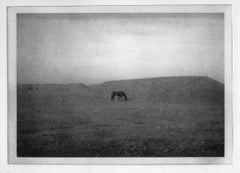
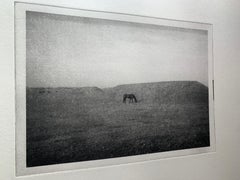
"Although looking like the mid-west, this horse is grazing in front of an industrial spoil tip." - David George A solitary horse stands against a vast, barren backdrop, embodying loneliness and introspection... This minimalistic scene capturing the endless spoil tip horizon with a lone horse grazing quietly... Print info:Photogravure; Charbonnel Ink on Archival Somerset Satin Paper Photogravure; 14.85 x 21 cm (image size) on 28.5 x 37.5 cm / 11.22 x 14.76 inches paper From Edition of 5 only Signed and numbered "When all the words are put to one side I hope the project will instigate a new curiosity for the people who live and work around the River Tees and rekindle a pride in this remarkable asset that has served them so well over hundreds, even thousands, of years." - David George David George's interest in British landscape began under the tutelage of John Blakemore at Derby University and continues to be a major part of his practice, now mainly concerned with ideas of classical and romantic visual semantics in the contemporary British landscape. His work looks at the decline of traditional industries, incorporating his interest in 19th century European landscape painting. David George (b.1957, Cheltenham and brought up in County Durham) lives and works in east London and in 2009 he co- founded the Uncertain States project which championed contemporary thinking and practice in UK photography...

Category

2010s Romantic Engraving Black and White Photography

Materials

Archival Ink, Black and White, Photogravure

Moth and Stump, Interglacial Forest, Glacier Bay National Monument, Alaska

Moth and Stump, Interglacial Forest, Glacier Bay National Monument, Alaska

By Ansel Adams

Located in Pacific Grove, CA

This vintage silver gelatin print is signed in pencil on the front of the mount, with image number "6" in the lower left corner. Portfolio Two stamp with print #6 and set #A in red c...

Category

1940s Modern Engraving Black and White Photography

Materials

Silver Gelatin

Cedar Fence, Pojoaque, New Mexico

Cedar Fence, Pojoaque, New Mexico

By Ansel Adams

Located in Pacific Grove, CA

This silver gelatin print is signed in pencil on the front of the mount. Post-BMFA 11 studio stamp with title in ink on the front of the mount. An inscription by Adams' assistant "Pr...

Category

1950s Modern Engraving Black and White Photography

Materials

Silver Gelatin

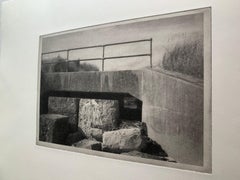
Druridge Bay - Small Black and White Photogravure Print of Concrete Bridge

Druridge Bay - Small Black and White Photogravure Print of Concrete Bridge

Located in London, GB

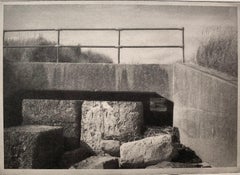
An urban landscape where manmade structure meets nature, evoking a sense of quiet introspection... Silent and steadfast, the weathered bridge stands against time, blending with nature's embrace... This is a study in geometry, shadows, and time, this piece captures the quiet strength of a forgotten underpass. "David George has been exploring photographic representations of the contemporary British landscapes for forty years and has incorporated themes prevalent in nineteenth century painting practice and aesthetic, to aid this exploration. He has appropriated the sublime, melancholy, the romantic, the pastoral and the uncanny to create something that not only represents the contemporary landscape in a pictorial way, but also making work that can be still viewed as documenting the landscape." David George's interest in British landscape began under the tutelage of John Blakemore at Derby University and continues to be a major part of his practice, now mainly concerned with ideas of classical and romantic visual semantics in the contemporary British landscape. His work looks at the decline of traditional industries, incorporating his interest in 19th century European landscape painting. David George (b.1957, Cheltenham and brought up in County Durham) lives and works in east London and in 2009 he co- founded the Uncertain States project which championed contemporary thinking and practice in UK photography...

Category

2010s Contemporary Engraving Black and White Photography

Materials

Archival Paper, Archival Ink, Photographic Paper, Black and White, Photo...

Tree and Rock Wall, Glen Canyon

Tree and Rock Wall, Glen Canyon

By Brett Weston

Located in Pacific Grove, CA

This vintage silver gelatin print is signed and dated in pencil on the front of the mount, and again on the back of the mount. Printed in 1961 for inclusion in "Fifteen Photographs" ...

Category

1950s Modern Engraving Black and White Photography

Materials

Silver Gelatin

Garrapata Beach
Garrapata Beach

Brett WestonGarrapata Beach, 1952

$7,500

H 7.625 in W 9.625 in

Garrapata Beach

By Brett Weston

Located in Pacific Grove, CA

This silver gelatin print is signed and dated in pencil on the front of the mount. Accompanied by a sheet that's titled and dated in pencil by Robert K. Byers, a long time friend and...

Category

1950s Modern Engraving Black and White Photography

Materials

Silver Gelatin

Previously Available Items
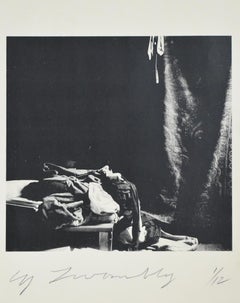
CY TWOMBLY BLACK & WHITE PHOTO PHOTOGRAPHY MID CENTURY 1 OF 12

CY TWOMBLY BLACK & WHITE PHOTO PHOTOGRAPHY MID CENTURY 1 OF 12

By Cy Twombly

Located in San Antonio, TX

Cy Twombly (1928-2011) Virginia/ New York / Italy Image Size: 16 x 11 Visible inside matboard is 12 x 11 Frame Size: 21.5 x 19 Medium: Photograph Edition 1/12 Signed with the edition number "Black and White" 1954 This is an original. The same photo in the Twombly book is a dry point on cardboard but is unsigned by hand. Cy Twombly (1928-2011) Following is the obituary of the artist by Randy Kennedy, The New York Times, July 5, 2011 Cy Twombly, whose spare, childlike scribbles and poetic engagement with antiquity left him stubbornly out of step with the movements of postwar American art even as he became one of the era's most important painters, died on Tuesday in Rome. He was 83. His death was announced by the Gagosian Gallery, which represents his work. Mr. Twombly had battled cancer for several years. In a career that slyly subverted Abstract Expressionism, toyed briefly with Minimalism, seemed barely to acknowledge Pop art and anticipated some of the concerns of Conceptualism, Mr. Twombly was a divisive artist almost from the start. The curator Kirk Varnedoe, on the occasion of a 1994 retrospective at the Museum of Modern Art, wrote that his work was "influential among artists, discomfiting to many critics and truculently difficult not just for a broad public, but for sophisticated initiates of postwar art as well." The critic Robert Hughes called him "the Third Man, a shadowy figure, beside that vivid duumvirate of his friends Jasper Johns and Robert Rauschenberg." Mr. Twombly's decision to settle permanently in southern Italy in 1957 as the art world shifted decisively in the other direction, from Europe to New York, was only the most symbolic of his idiosyncrasies. He avoided publicity throughout his life and mostly ignored his critics, who questioned constantly whether his work deserved a place at the forefront of 20th century abstraction, though he lived long enough to see it arrive there. It didn't help that his paintings, because of their surface complexity and whirlwinds of tiny detail — scratches, erasures, drips, penciled fragments of Italian and classical verse amid scrawled phalluses and buttocks — lost much of their power in reproduction. But Mr. Twombly, a tall, rangy Virginian who once practiced drawing in the dark to make his lines less purposeful, steadfastly followed his own program and looked to his own muses — often literary ones, like Catullus, Rumi, Pound and Rilke. He seemed to welcome the privacy that came with unpopularity. "I had my freedom and that was nice," he said in a rare interview, with Nicholas Serota, the director of the Tate, before a 2008 survey of his career at the Tate Modern. The critical low point probably came after a widely panned 1964 exhibition at the Leo Castelli Gallery in New York. The artist and writer Donald Judd, who was hostile toward painting in general, was especially damning, calling the show a fiasco. "There are a few drips and splatters and an occasional pencil line," he wrote in a review. "There isn't anything to these paintings." But by the 1980s, with the rise of neo-Expressionism, a generation of younger artists like Jean-Michel Basquiat found inspiration in Mr. Twombly's skittery bathroom-graffiti scrawl. Coupled with rising interest in European artists whose work shared unexpected ground with Twombly's, like Joseph Beuys, the newfound attention brought him a kind of critical favor he had never enjoyed before. And by the next decade, he was highly sought after not only by European museums and collectors, who had discovered his work early on, but also by those back in his homeland who had not known what to make of him two decades before. In 1989, the Philadelphia Museum of Art opened permanent rooms dedicated to his monumental 10-painting cycle, Fifty Days at Iliam, based on Alexander Pope's translation of The Iliad. (Mr. Twombly said that he purposely misspelled Ilium, a Latin name for Troy, with an "a," to refer to Achilles.) That same year, Mr. Twombly's work passed the million dollar mark at auction. In 1995, the Menil Collection in Houston opened a new gallery dedicated to his work, designed by Renzo Piano after a plan by Mr. Twombly himself. Despite this growing acceptance, Mr. Varnedoe still felt it necessary to include an essay in the Modern's newsletter at the time of the retrospective, titled "Your Kid Could Not Do This, and Other Reflections on Cy Twombly." In the only written statement Mr. Twombly ever made about his work, a short essay in an Italian art journal in 1957, he tried to make clear that his intentions were not subversive but elementally human. Each line he made, he said, was "the actual experience" of making the line, adding: "It does not illustrate. It is the sensation of its own realization." Years later, he described this more plainly. "It's more like I'm having an experience than making a picture," he said. The process stood in stark contrast to the detached, effete image that often clung to Mr. Twombly. After completing a work, in a kind of ecstatic state, it was as if the painting existed but he himself barely did anymore: "I usually have to go to bed for a couple of days," he said. Edwin Parker Twombly Jr., was born in Lexington, Va., on April 25, 1928, to parents who had moved to the South from New England. His father, a talented athlete who pitched a summer for the Chicago White Sox and went on to become a revered college swimming coach, was nicknamed Cy, after Cy Young, the Hall of Fame pitcher. The younger Mr. Twombly (pronounced TWAHM-blee) inherited the name, though he was much more bookish than athletic as a child, with stooped shoulders and a high ponderous forehead. He read avidly and, discovering his calling early, he worked from art kits he ordered from the Sears Roebuck catalog. As a teenager, he studied with the Spanish painter Pierre Daura, who had left Europe after the Spanish Civil War and settled in Lexington. Daura's wife, Louise Blair, studied cave paintings and may have sparked Mr. Twombly's early interest in Paleolithic art. In 1947 he attended the Boston Museum School, where German Expressionism was the rage, but Mr. Twombly gravitated to his own interests, like Dada and Kurt Schwitters and particularly to Jean Dubuffet and Alberto Giacometti, two important early influences. He moved back to Lexington in 1949 and studied art at Washington and Lee University, where his talent impressed teachers. By 1950, he was in New York, the recipient of a scholarship to the Art Students League. Later in his life, he cited visiting Willem de Kooning's studio and seeing an Arshile Gorky retrospective at the Whitney Museum of American Art as important moments in his young painting life. But he also came to New York at the heyday of the New York School and was exposed to the work of almost all its giants in the city's galleries. He turned down an offer for a solo show of his paintings at the Art Students League in 1950, saying that he felt it was too early for him. He met Rauschenberg, a fellow student at the league, during his second semester, and Rauschenberg later persuaded Mr. Twombly to enroll at Black Mountain College in North Carolina, which had become a crucible for the American avant-garde, with John Cage, Merce Cunningham, Ray Johnson, Dorothea Rockburne and John Chamberlain among its faculty and students. Mr. Twombly, who studied with Ben Shahn, stayed at the college only briefly and was a bit of an outsider even then. As he told Mr. Serota: "I was always doing my own thing. I always wondered why there are books with photographs of all the artists of that period and I was only in one! I thought: 'Where was I?' " In the summer of 1952, after receiving a grant from the Virginia Museum of Fine Arts, Mr. Twombly traveled to Europe for the first time and met up with Rauschenberg. The two wandered through Italy, North Africa and Spain, an experience that later yielded some of the first paintings to be considered a part of Mr. Twombly's mature work. "Tiznit," made with white enamel house paint and pencil and crayon, with gouges and scratches in the surface, was named for a town in Morocco that he had visited, and the painting's primitivist shapes were inspired by tribal pieces he saw at the ethnographic museum in Rome, as well as by artists like Dubuffet, de Kooning and Franz Kline. The painting, along with another based on tribal motifs, was exhibited in 1953 at Eleanor Ward's Stable Gallery on West 58th Street along with monochromatic paintings by Rauschenberg. The show was generally savaged. (Early this year, the Museum of Modern Art acquired "Tiznit," along with another early work, which Mr. Twombly had kept in his personal collection.) Mr. Twombly was drafted and spent more than a year in the Army, where he was assigned to cryptography work in Washington. On weekends and leaves, he continued to paint and draw, sometimes at night with the lights out to try to lose techniques he had learned in art classes and to express himself more instinctively. After receiving a medical discharge and teaching for a time in Virginia, Mr. Twombly returned to New York and worked in a studio on William Street, near both Rauschenberg and Johns, who helped choose titles for his paintings during this period. Mr. Twombly tried without success for several months to get a grant to go back to Europe and in 1957, with Ward's help, he spent several months in Italy, where he met Tatiana Franchetti...

Category

1950s Modern Engraving Black and White Photography
Materials

Drypoint

Engraving black and white photography for sale on 1stDibs.

Find a wide variety of authentic Engraving black and white photography available on 1stDibs. While artists have worked in this medium across a range of time periods, art made with this material during the 20th Century is especially popular. There are many well-known artists whose body of work includes ceramic sculptures. Frequently made by artists working in the Modern, all of these pieces for sale are unique and many will draw the attention of guests in your home. Not every interior allows for large Engraving black and white photography, so small editions measuring 0.63 inches across are also available

Read More

Robert Doisneau’s Camera Followed Human Connections on the Streets of Paris

The French photographer transformed everyday encounters into enduring images of shared experience.

Welcome to the Surreal and Sensual World of Mona Kuhn

The photographer made her name shooting luminous nudes. Her latest works reframe what an image can hold.

Some of the Best Beatles Photos Were Taken by Paul McCartney

A trove of recently unearthed personal photos adds another dimension to the abundance of press images of the Fab Four.

This Photo of Big Sur Reveals the Awesomeness and Intimacy of Nature

When a beachcomber accidentally stepped in front of Jeffrey Conley’s camera, a perfect moment was captured.

Queen Elizabeth’s Life in Photos

She was one of the most photographed women in history, but the world’s longest-reigning queen remained something of a mystery throughout her decades on the throne.

Photographer to Know: William Klein

The noted lensman brought a bold sense of irony to fashion photography in the 1950s and '60s, transforming the industry. But his work in street photography, documentary filmmaking and abstract art is just as striking.

David Yarrow Tells Us the Tales behind His Wild, Wild Photography
To capture many of the cinematic images in his new show, the famed photographer traveled to the still-rugged parts of Alaska and the Rocky Mountains, shooting supermodels and carnivores alike.

Lori Grinker’s Artful Photographs of a Young Mike Tyson Are a Knockout!

The New York photographer tells us how an encounter with the then-13-year-old boxer led to a decade-long project that saw them both go pro.