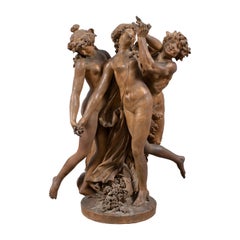
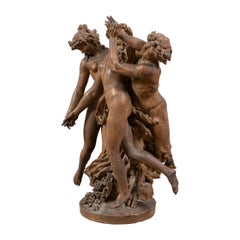
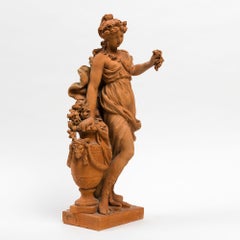
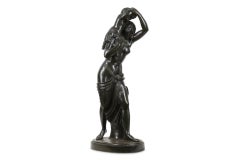
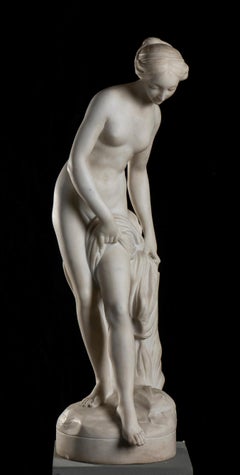
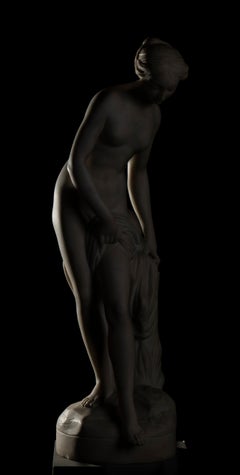
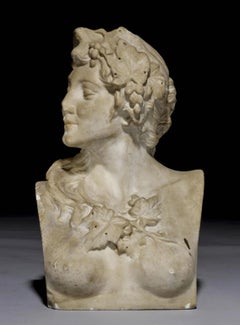
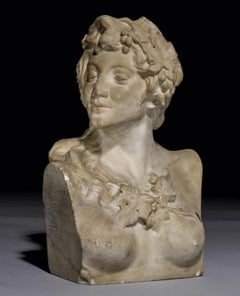
The sculptor has portrayed the moment just before the young girl's bath, as she puts her foot tentatively forward to test the temperature of the water. This graceful gesture was inspired by the Bather, painted in 1725 by François Lemoyne (author of large decorative works such as the ceiling of the Hercules Salon at Versailles), and made popular by engravings. Falconet captures the moment when a young girl becomes a woman, thereby defining a new feminine aesthetic - long, slender body, narrow hips, sloping shoulders, and small breasts - which was to impregnate his future work and influence his contemporaries. The girl's head is small and her oval face forms a triangle. Her hairstyle was inspired by antiquity: smooth on top, with a central parting. It appealed to Mme du Barry, mistress of Louis XV, who wears the same style in the portrait sculpted by Augustin Pajou in 1772.
The bather is entirely naked, but not immodest. The purity of line, the reserved pose (leaning slightly forward to extend her foot), the graceful position of the arms, and the candid face with lowered eyelids, avoid all vulgarity and keep the spectator at a certain distance.
Yet the statuette is neither cold nor inert. The slightly jutting hip counterbalances the sideways swing of the arms in a dancing movement. And above all, Falconet imparted an impression of living flesh to his sculpture, with the soft shine of the marble suggesting the grain and shiver of the skin.
Étienne Maurice Falconet (1 December 1716 – 24 January 1791) was a French baroque, rococo and neoclassical sculptor, best-known for his equestrian statue of Peter the Great, the Bronze Horseman (1782), in St. Petersburg, Russia, and for the small statues he produced in series for the Royal Sévres Porcelain Manufactory. Falconet was born to a poor family in Paris. He was at first apprenticed to a carpenter, but some of his clay figures, with the making of which he occupied his leisure hours, attracted the notice of the sculptor Jean-Baptiste Lemoyne, who made him his pupil. One of his most successful early sculptures was of Milo of Croton...
Category
18th Century Rococo Sculptures