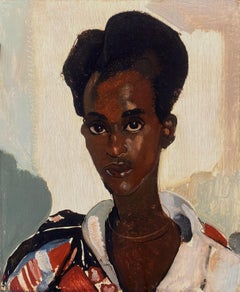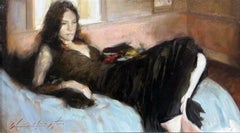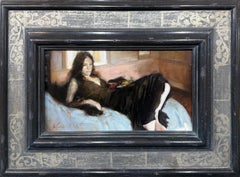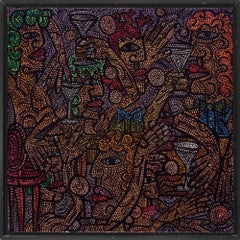
Howard Logan Hildebrandt, 1872-1958
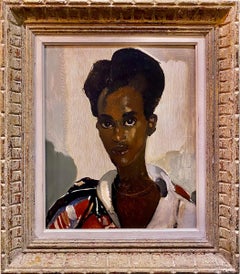
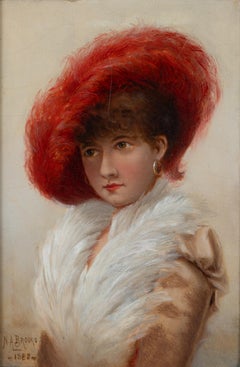
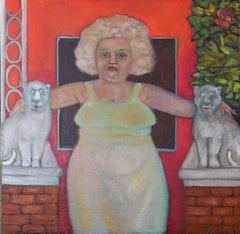
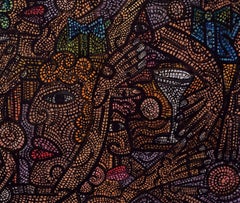
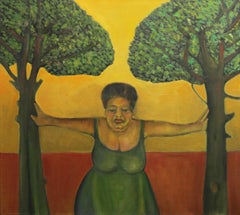
Femme Avec Le Chapeau Plumé, n.d.
Oil on canvas
26 ½ x 21 ½ inches
Signed (lower right): H L Hildebrandt
Provenance
Private collection, Detroit
A native of Allegheny, Pennsylvania, which later merged with Pittsburgh, Howard Logan Hildebrandt achieved prominence in the art world for his portraiture, and counted esteemed doctors, businessmen, musicians and his own artist-colleagues among his numerous sitters.
Born in 1872, his life followed a trajectory similar to other young men in an industrial Pennsylvania town when he went to work at a local stained-glass factory during his teenage years. In 1890, Hildebrandt decided to enroll in the National Academy of Design in New York and although his instruction there was brief, lasting only one season, he took classes in both antique and life drawing and must have felt prepared enough to continue his education abroad in the ateliers of Paris. He studied with Jean-Joseph Benjamin-Constant and Jean-Paul Laurens at the Académie Julian, and also trained at the École des Beaux-Arts, before eventually returning to the United States in the late 1890s to launch his career.
Hildebrandt initially settled in Pittsburgh before relocating to New York by 1899, where he briefly kept a studio at the famed Tenth Street Studios and later moved to Carnegie Hall. With the artist’s star rising steadily, Marian A. White, editor of the Fine Arts Journal, praised for his talents in a commentary published in a Pittsburgh weekly: [Hildebrandt] is but thirty-three years of age, yet, through perseverance and industry and an indomitable will, has taken an enviable position among American portrait painters as well as of painters of fisher-folk….Mr. Hildebrandt is an ideal American artist, enthusiastic, energetic, and reveling in painting subjects that are of American type.
Beginning in 1905, Hildebrandt was fortunate to gain admittance into newly-constructed buildings being designed specifically for artists rising along New York’s West 67th Street, including the Sixty-Seventh Street Studios, where Henry Ward Ranger and Childe Hassam had spaces, and later the Colonial Studios building, which was commissioned by Robert and Bessie Potter Vonnoh.
Counting such luminaries among his neighbors and keeping to an active exhibition schedule,
Hildebrandt continued to advance his career. Between 1898 and the mid-1920s, he participated in the annuals of the Pennsylvania Academy of the Fine Arts and the Art Institute of Chicago. Concurrently, he exhibited with the National Academy from the 1890s through the late 1940s, and the titles of paintings shown at these venues suggest the artist was drawn to a variety of themes, from the fishermen and wharves of Gloucester, Massachusetts, to landscape, still life and figural subjects, and finally portraiture, at which he excelled. One of his early portraits, titled Portrait: Miss C and shown at the National Academy in 1902, is thought to be of Cornelia Ellis, a talented miniature painter whom Hildebrandt married that same year. The artist eventually earned the esteemed moniker of National Academician in 1932. In addition to the venues previously mentioned, he showed with the National Arts Club, the Salmagundi Club, the American Watercolor Society and the Allied Artists of America, earning prizes from all four groups.
Around 1913, the Hildebrandts began spending summers away from the city in New Canaan, Connecticut, and a few years later built a home on Huckleberry Hill Road near the Silvermine River. Drawn to the idyllic countryside and to the region’s burgeoning artists’ colony founded by sculptor Solon Borglum...
Category
1890s Portrait Paintings