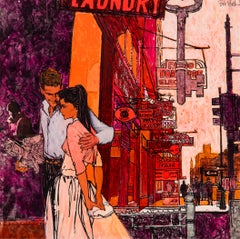
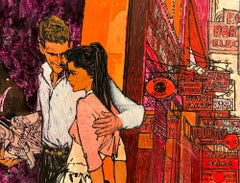
Bob Peak for sale on 1stDibs
Bob Peak - Robert M. Peak (May 30, 1927 – August 1, 1992) was an American llustrator. Known for his developments in the design of the modern film poster His artwork has been on the cover of Time magazine, TV Guide, and Sports Illustrated. He also illustrated advertisements
Bob Peak was born in Denver, and grew up in Wichita. From an early age that he wanted to be a commercial illustrator. After serving in the military during the Korean War, Peak transferred to the Art Center College of Design. In 1953, Peak moved to NYC and went on to appear in major advertising and national magazines.
Peak in 1961 to design the poster images for the film West Side Story. My Fair Lady and Camelot. Peak's style would become familiar to fans of science fiction films when he created the poster art for the futuristic film Rollerball (1975), which was followed by the first five Star Trek films, Superman (1978), Excalibur (1981), Derek Flint films, Apocalypse Now (1979), The Spy Who Loved Me and other James Bond concepts.[3] By the 1980s, only the film poster artist Drew Struzan was in as much demand by film directors
In 2011, the Academy of Motion Picture Arts and Sciences presented the "Bob Peak: Creating the Modern Movie Poster" Peak taught in his own college and later at Art Students League of New York, Pratt Institute and Famous Artists School.
Illustrations
Fate of a Man, movie poster 1959 West Side Story, movie poster , 1961 The Leopard, movie poster 1963 My Fair Lady, movie poster 1964 The Cincinnati Kid, movie poster 1965 The Liquidator, movie poster 1965 Lord Jim, movie poster 1965 Kaleidoscope, movie poster 1966 Modesty Blaise, movie poster 1966 Our Man Flint, movie poster 1966 Camelot, movie poster 1967 In Like Flint, movie poster 1967 Thoroughly Modern Millie, movie poster 1967 The Wanderer, movie poster 1967 For Love of Ivy, movie poster 1968 A Dream of Kings, movie poster 1969 Funny Girl, movie poster 1969 Lions Love (... and Lies), movie poster1969 The Secret of Santa Vittoria, movie poster , 1969 There Was a Crooked Man..., movie poster 1970 Cesar & Rosalie, movie poster 1972 The Great Waltz, movie poster , 1972 Mame, movie poster 1974 The Voyage, movie poster 1974 The Yakuza, movie poster 1974 Rollerball, movie poster 1975 That's Entertainment, Part II, movie poster 1975 The Missouri Breaks, movie poster 1976 Equus, movie poster 1977 Islands in the Stream, movie poster 1977 The Spy Who Loved Me, movie poster 1977 Every Which Way But Loose, movie poster 1978 Superman, movie poster 1978 The Wiz, movie poster 1978 Hair, movie poster 1979 Apocalypse Now, movie poster 1979
In 1961, Peak was named Artist of the Year by the Graphic Artists Guild New York chapter. He won eight Awards of Excellence and four gold medals from Society of Illustrators. In 1977, the Society of Illustrators inducted him to its Hall of Fame. The Hollywood Reporter presented him the 1992 Key Art Award, now known as the Clio Entertainment Awards.
Finding the Right Figurative-paintings for You
Figurative art, as opposed to abstract art, retains features from the observable world in its representational depictions of subject matter. Most commonly, figurative paintings reference and explore the human body, but they can also include landscapes, architecture, plants and animals — all portrayed with realism.
While the oldest figurative art dates back tens of thousands of years to cave wall paintings, figurative works made from observation became especially prominent in the early Renaissance. Artists like Michelangelo, Leonardo da Vinci and other Renaissance masters created naturalistic representations of their subjects.
Pablo Picasso is lauded for laying the foundation for modern figurative art in the 1920s. Although abstracted, this work held a strong connection to representing people and other subjects. Other famous figurative artists include Francis Bacon and Lucian Freud. Figurative art in the 20th century would span such diverse genres as Expressionism, Pop art and Surrealism.
Today, a number of figural artists — such as Sedrick Huckaby, Daisy Patton and Eileen Cooper — are making art that uses the human body as its subject.
Because figurative art represents subjects from the real world, natural colors are common in these paintings. A piece of figurative art can be an exciting starting point for setting a tone and creating a color palette in a room.
Browse an extensive collection of figurative paintings on 1stDibs.