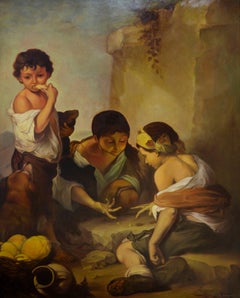
Dice Oil On

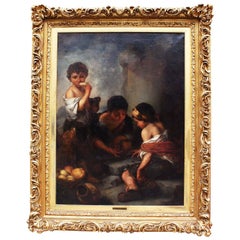
Boys Playing Dice - Mid Century Figurative in Oil on Masonite

Boys Playing Dice - Mid Century Figurative in Oil on Masonite

By R. Hauslar

Located in Soquel, CA

Exceptional detail in this painting of boys playing dice by R. Hauslar (German, 20th Century). A Hausler interpretation of a work by the famous Bartolome Esteban Murillo (1617-1650) ...

Category

1950s Romantic Figurative Paintings

Materials

Masonite, Oil

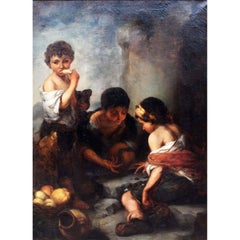
A Game of Dice, Modern Oil Painting on Canvas by Fred Aris

A Game of Dice, Modern Oil Painting on Canvas by Fred Aris

Located in Long Island City, NY

Fred Aris (British, 1932 - 1995) - A Game of Dice, Year: 1973, Medium: Oil on Canvas, signed, Size: 21 x 25 in. (53.34 x 63.5 cm), Frame Size: 23 X 27 inches

Category

1970s Modern Figurative Paintings

Materials

Oil

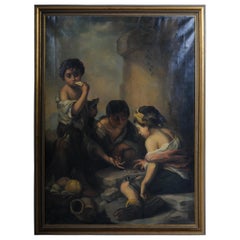
Large Oil on Canvas "Beggar Boys Playing Dice" After Bartolomé Esteban Murrillo

Large Oil on Canvas "Beggar Boys Playing Dice" After Bartolomé Esteban Murrillo

By Bartolomé Esteban Murillo

Located in Los Angeles, CA

A fine and large 19th century oil on canvas after Bartolomé Esteban Murrillo's (Spanish, 1617-1682) Masterpiece "Beggar Boys Playing Dice" (The original work by Murillo was painted ...

Category

Antique Late 19th Century German Baroque Paintings

Materials

Gesso, Canvas, Wood

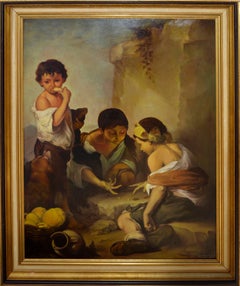
Boys Playing Dice After Esteban Murillo Oil of Canvas

Boys Playing Dice After Esteban Murillo Oil of Canvas

Located in Berlin, DE

After Bartolome Esteban Murillo Boys Playing Dice Copy oil painting on canvas Unsigned The picture shows two about ten-year-old street boys eating fruit.

Category

20th Century European Paintings

Materials

Canvas

Recent Sales

19th Century Painting after Bartolomé Esteban Murillo, Young Boys Playing Dice

19th Century Painting after Bartolomé Esteban Murillo, Young Boys Playing Dice

By Bartolomé Esteban Murillo

Located in Miami, FL

After Bartolomé Esteban Murillo, Spanish, 1617-1682, young boys playing dice, oil on canvas, gilt gesso and wood exhibition frame.

Category

Antique 19th Century Spanish Baroque Paintings

Dice or No Dice
Dice or No Dice

Emily RoyerDice or No Dice, 2020

Unavailable

H 24 in W 18 in D 0.01 in

Dice or No Dice

Located in Philadelphia, PA

Dice or No Dice is an oil painting on unstretched canvas paper, measuring 24 x 18 x .01 inches.

Category

2010s Contemporary Figurative Paintings

Materials

Paper, Oil

"Slice And Dice", Painting, Oil on Canvas

"Slice And Dice", Painting, Oil on Canvas

By Preston M. Smith

Located in Yardley, PA

This is a completely unique and original abstract oil painting on canvas. This painting epitomizes a technique and aesthetic I have been working to perfect over the years. The colors...

Category

2010s Abstract Abstract Paintings

Materials

Oil

Soldiers Playing Dice, Oil on Panel, France, 19th Century

Soldiers Playing Dice, Oil on Panel, France, 19th Century

Located in Paris, FR

Soldiers playing dice, oil on panel, France, 19th century.

Category

Antique 1870s French Renaissance Revival Paintings

Materials

Wood

Playing Dice, 1970 African American Scene Painting

Playing Dice, 1970 African American Scene Painting

Located in Treasure Island, CA

Hipster kids shooting dice circa 1970 oil on fiberboard 45 x 37 inches

Category

Vintage 1970s American Paintings

Materials

Board

Get Updated with New Arrivals
Save "Dice Oil On", and we’ll notify you when there are new listings in this category.

Dice Oil On For Sale on 1stDibs

With a vast inventory of beautiful furniture at 1stDibs, we’ve got just the dice oil on you’re looking for. A dice oil on — often made from canvas, fabric and paper — can elevate any home. There are many kinds of the dice oil on you’re looking for, from those produced as long ago as the 18th Century to those made as recently as the 20th Century. When you’re browsing for the right dice oil on, those designed in Baroque, Art Deco and mid-century modern styles are of considerable interest. A well-made dice oil on has long been a part of the offerings for many furniture designers and manufacturers, but those produced by Paul Klee are consistently popular.

How Much is a Dice Oil On?

The average selling price for a dice oil on at 1stDibs is $8,750, while they’re typically $450 on the low end and $38,954 for the highest priced.

Questions About Dice Oil On

  • Lilac Gallery Ltd.March 17, 2021
    An abstract oil painting and an artwork that is made with oil paint on a medium like canvas, wood board, or other panels like canvas board. And the 'abstract' term refers to the Movement & Style of the piece. As abstraction indicates a departure from reality in the depiction of imagery in art, the artist creates a painting where the subject, shape, form, color, and line, is created with no particular references of the world but as a composition that may exist with a degree of independence from its vision.
  • 1stDibs ExpertApril 5, 2022
    To tell if an emerald has been oiled, look for white or yellow branch patterns along the surface of the gem. If you see them, the gem is likely oiled. Also, examine it under a magnifying glass for any signs of trapped bubbles. These also indicate an oiled gemstone. Consulting a licensed jewelry appraiser is the best way to accurately identify oiled emeralds. You'll find a collection of expertly vetted emerald gemstone jewelry on 1stDibs.
  • 1stDibs ExpertMarch 22, 2024
    To maintain oil paintings that you purchased for your home, experts suggest that you keep them out of direct sunlight. Prolonged exposure to the sunlight coming in from a window can fade the colors in your painting. Do not hang your oil painting near a heat source or where it can get wet (bathrooms and kitchens are not safe for your oil painting).

    You may wish to dust your oil painting so that layers of dust don’t begin to gather on its surface. This should only be considered to remove loose dust. Never spray any chemical substance on your oil painting. Do not use a damp cloth to dust your oil painting. (Again, your painting should not be exposed to moisture.)

    To remove loose dust, use a soft brush that measures approximately one to two inches wide with natural-hair bristles. Do not use a dust cloth or a feather duster, as those items may catch or leave threads or feathers behind. Do not apply pressure or dust your painting for an extended period of time.

    If you think that your oil painting is considerably dirty or believe that other issues may be at work, experts strongly suggest that you consult with a professional conservator.

    Read about how to arrange your wall art and find oil paintings for sale on 1stDibs.
  • 1stDibs ExpertSeptember 25, 2019

    Clean an oil painting by dusting it with a natural-hair artists’ brush.

  • 1stDibs ExpertNovember 20, 2024
    Opinions vary on who is the most realistic oil painter. Among contemporary artists, Leng Jun, Richard Estes and John Baeder are all acclaimed for the incredibly lifelike works they produce. Other artists who could be contenders for the title include Frédéric Bazille, George Bellows, Rosa Bonheur, Gustave Caillebotte, Gustave Courbet, Honoré Daumier, Thomas Eakins and Jules Bastien-Lepage. Shop a wide range of oil paintings on 1stDibs.
  • 1stDibs ExpertApril 5, 2022
    Yes, natural emeralds need to be oiled. Natural emeralds will have cracks and fissures before treatment, and oils will help give the emerald a high sheen and attractive finish. Browse a wide selection of emerald jewelry pieces from some of the world’s top sellers on 1stDibs.
  • 1stDibs ExpertFebruary 13, 2024
    To identify an oil painting, look closely at its surface. Compared to other paintings, pieces produced in oils usually show off a variety of textures across the canvas, and the paint will appear layered on. If you're looking to determine the name, age or creator of a work, try snapping a photo with your smartphone’s camera and conducting a reverse image search online. Shop a diverse assortment of oil paintings on 1stDibs.
  • 1stDibs ExpertMay 3, 2024
    Jan van Eyck is widely considered by art historians to be the father of oil painting. While the usage of oil paints dates back to 7th-century China, the Flemish painter popularized the material, using oils to produce highly detailed works such as The Arnolfini Portrait. The Northern Renaissance master also influenced many other artists, such as Hugo van der Goes and Gerard David. Shop an assortment of fine art on 1stDibs.
  • 1stDibs ExpertOctober 12, 2021
    A whale oil lamp is a lamp that uses whale oil for fuel. Whale oil lamps were largely made from the 16th to the 19th centuries. Antique whale oil lamps are collectibles today and an older specimen will be a striking addition to your mantel or display cabinet. Find a collection of antique and vintage whale oil lamps on 1stDibs today.
  • 1stDibs ExpertApril 5, 2022
    A no oil emerald is an emerald that has not been treated with oil. Generally, emeralds are oiled to fill in fractures and enhance clarity. A no oil emerald is considered rare and more valuable than standard emeralds. Shop a collection of no oil emerald jewelry on 1stDibs.
  • 1stDibs ExpertFebruary 27, 2024
    Oil paint was invented during the 7th century A.D. The earliest examples of oil paintings have been traced to Afghanistan and depict scenes related to the Buddhist religion. Records dating back to the 12th century indicate that early Christian monks in Europe used oil paints to decorate furniture, and a century later, some artists began finishing tempera paintings with touches of oil paint. It wasn't until the 15th century that oil paints became a common medium for European painters, when Flemish artists like Jan van Eyck began favoring them over tempera. Explore a variety of oil paintings on 1stDibs.
  • 1stDibs ExpertJanuary 27, 2025
    The famous Belgian painter who developed oil painting by mixing linseed oil and oil from nuts with diverse colors is Jan van Eyck. Because his innovative paints were richly pigmented and able to dry quickly, they allowed van Eyck to produce highly detailed, incredibly lifelike paintings. Today, van Eyck is considered one of the most important figures of the Northern Renaissance. Among his most famous works are the Arnolfini Portrait, the Ghent Altarpiece and Portrait of a Man. Explore a diverse assortment of oil paintings on 1stDibs.
  • 1stDibs ExpertMay 3, 2024
    A few things make an oil painting valuable. Age has a major impact on price, with pieces made over a century ago tending to fetch the highest prices. Who created the painting also matters. The more famous the artist, the higher the selling price for a painting is likely to be. Finally, the condition of the work and whether it is in its original frame will also impact how much it is worth. Find a diverse assortment of oil paintings on 1stDibs.
  • 1stDibs ExpertFebruary 1, 2024
    What oil you should use on wicker furniture varies. For best results, consult the care instructions that accompanied your piece for specific instructions and product recommendations. Depending on the properties of your piece, linseed oil, lemon oil or another natural plant oil may be the best option. Find a diverse assortment of wicker furniture on 1stDibs.
  • 1stDibs ExpertAugust 20, 2024
    The difference between a lithograph and an oil painting comes down to uniqueness and technique. To produce an oil painting, an artist applies oil-based paints to a canvas or another surface using a brush. The process results in a single work of art. Lithography is a form of printmaking that begins by drawing on or painting on a stone surface with an oil-based substance, such as a greasy crayon or tusche, an oily wash. The stone is then covered with water, which is repelled by the oily areas. Oil-based ink is then applied to the wet stone, adhering only to the oily image. Through lithography, an artist can produce dozens, or even thousands, of copies of a single image. On 1stDibs, shop a large selection of lithographs and oil paintings.
  • 1stDibs ExpertSeptember 25, 2019

    Butcher blocks should be oiled whenever the wood begins to look dry or chalky.

  • 1stDibs ExpertMarch 22, 2024
    Yes, sunlight affects oil paintings. Keep your oil paintings away from direct sunlight.

    To maintain oil paintings that you purchased for your home, experts suggest that you keep them out of sunlight. Prolonged exposure to the sunlight coming in from a window can fade the colors in your painting. Do not hang your oil painting near a heat source or where it can get wet (bathrooms and kitchens are not safe for your oil painting).

    You may wish to dust your oil painting so that layers of dust don’t begin to gather on its surface. This should only be considered to remove loose dust. Never spray any chemical substance on your oil painting. Do not use a damp cloth to dust your oil painting. (Again, your painting should not be exposed to moisture.)

    To remove loose dust, use a soft brush that measures approximately one to two inches wide with natural-hair bristles. Do not use a dust cloth or a feather duster, as those items may catch or leave threads or feathers behind. Do not apply pressure or dust your painting for an extended period of time.

    If you think that your oil painting is considerably dirty or believe that other issues may be at work, experts strongly suggest that you consult with a professional conservator.

    Read about how to arrange your wall art and find oil paintings for sale on 1stDibs.
  • 1stDibs ExpertApril 5, 2022
    To tell if your oil painting is authentic, first check the signature of the artist to start your research. Use a magnifying glass to check the texture of the painting, and finally check the back for the painting’s original stretchers. Shop a selection of expertly vetted artwork from some of the world’s top art dealers on 1stDibs.
  • 1stDibs ExpertApril 5, 2022
    There are a few key things to look for to identify an antique oil lamp. First check for a patent number anywhere on your lamp. Use a black light to inspect whether your lamp’s hardware is secured with glue, which fluoresces and would indicate a contemporary lamp. Antique lamps use plaster to attach hardware and fill gaps. An antique oil lamp may have hand-blown glass. Shop a range of professionally authenticated antique oil lamps on 1stDibs.
  • 1stDibs ExpertFebruary 13, 2023
    Because the value of an oil painting can vary greatly based on the artist, the subject and the condition of the piece, it's generally best to work with a certified appraiser. A knowledgeable professional can evaluate the piece and estimate its value. Shop a variety of authentic oil paintings from some of the world’s top galleries on 1stDibs.