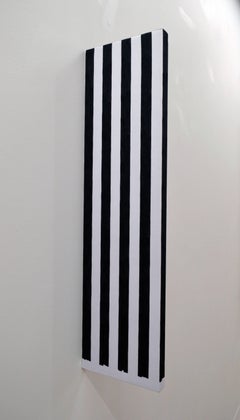
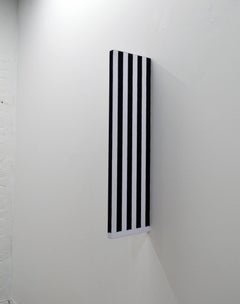
Stripes 2
By Lyn Carter
Located in Buffalo, NY
An original conceptual wall sculpture by contemporary Canadian female artist Lyn Carter. Lyn
Category
2010s Conceptual Abstract Sculptures
Materials
Fabric, Wood, Digital
Stripes 2
By Lyn Carter
Located in Buffalo, NY
An original conceptual wall sculpture by contemporary Canadian female artist Lyn Carter. Lyn
Fabric, Wood, Digital
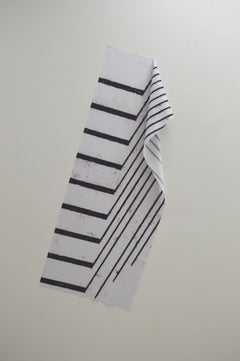
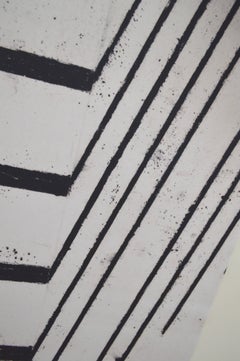
Turn
By Lyn Carter
Located in Buffalo, NY
An original conceptual wall sculpture by contemporary Canadian female artist Lyn Carter. "Turn
Fabric, Digital
In 1967, artist Sol LeWitt wrote that in “Conceptual art the idea or concept is the most important aspect of the work.” He was giving a name to an art movement that had emerged in the 1960s in which artists were less focused on their medium being something traditionally “artistic” and instead engaged in using any object, movement, form, action or place to express an idea.
LeWitt’s work was featured alongside an assemblage of notes, drawings and outlines by other artists in “Working Drawings and Other Visible Things on Paper Not Necessarily Meant to Be Viewed as Art,” a groundbreaking show at New York City’s School of Visual Arts curated by Mel Bochner, another leading exponent of Conceptualism. Building on radical 20th-century statements, like Fountain (1917) by French artist Marcel Duchamp, Conceptual artists around Europe and North and South America were not interested in the commercial art scene and rather directly challenged its systems and values.
Stretching into the 1970s, this movement has also been called Post-Object art and Dematerialized art. Conceptual art reflected a larger era of social and political upheaval. Pieces associated with the style range from Roelof Louw’s Soul City (Pyramid of Oranges) (1967) — a work of installation art that sees fresh oranges stacked into a pyramid from which visitors are allowed to take one orange away — to On Kawara’s “Today” series, which saw the Japanese artist carefully painting a date in white acrylic on canvases consisting of a single color from 1966 to his death in 2014. Artists such as Ed Ruscha, who created the Twentysix Gasoline Stations book — a collection of photos of gas stations that is widely said to be the first modern artists’ book — made photography a major platform for Conceptual art, as did Bruce Nauman, who burned one of Ruscha's books and then photographed it for his own.
Conceptual art’s legacy of questioning artistic authorship, ownership and how to work with complex ideas of space and time had a significant influence on the decades of culture that followed, and it continues to inform art today.
The collection of Conceptual photography, paintings and sculptures on 1stDibs includes artworks by John Baldessari, Jenny Holzer, Lawrence Weiner, Joseph Kosuth and others.
If you’re thinking about decorating your space with abstract sculpture, there are a couple of things to keep in mind.
You don’t have to look for a piece that demands attention. Find a work of abstract sculpture that speaks to you. As is the case with any abstract art, whether it’s sculpture, an abstract painting or a grouping of prints, you can select a work for your living room or dining room, for example, that will either casually fade into the background or serve as a focal point. When you’re thinking about how to arrange your furniture and decor, consider color, texture and what kind of energy you’d like a specific room or corner to evoke. Abstract sculpture can go a long way in elevating a home, and its history is interesting if you’re shopping for a new piece today.
As a pioneer in naturalistic forms and figures that vividly express emotion, Auguste Rodin is often called the father of modern sculpture. His work in the 19th and early 20th century broke with artistic conventions and inspired modernism, leading to a new period of avant-garde abstraction.
Among the first artists to push abstract sculpture into the mainstream were Pablo Picasso and Georges Braque. They helped define the movement of Cubism, which focused on deconstructing the world abstractly.
Later in the 20th century, the artistic movements of Italian Futurism, Dadaism, Neo-Dadaism, Surrealism, Abstract Expressionism and minimalism all contributed to the advancement of new and more abstract sculpture designs. Italian Futurism, for example, celebrated movement, dynamics and technology in abstract sculpture. These movements passed down ideas that continue to inform abstract sculpture today.
Browse a range of modern abstract sculptures, postmodern abstract sculptures and other kinds of sculpture on 1stDibs.