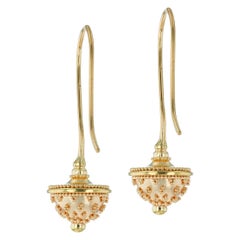
Each piece of Kent Raible jewelry showcases the master goldsmith's love for the craft. The Washington state-based designer uses ancient techniques to create exquisite 18-karat gold cocktail rings, dangle earrings and pendant necklaces.
Raible’s contemporary accessories are set with the finest colored gemstones and feature layers of incredibly detailed granulation, a method of ornamentation common in Byzantine jewelry (and employed in Etruria as well) that sees a piece’s surface decorated with granular spheres of precious metal. Together with his wife, Lynn, Raible has grown his passion project into a thriving and recognizable brand.
Raible's first exposure to metalwork was in a high school jewelry class in the early 1970s. It sparked his interest in the material, and he would go on to spend years studying goldsmithing and design. Though Raible is largely self-taught and never apprenticed under a master goldsmith, he did seek out knowledgeable teachers to help hone his skill and traveled to Germany to study during the 1980s.
Since then, alongside establishing his studio, Raible has become a teacher himself, leading workshops at the Revere Academy of Jewelry Arts in San Francisco and the Penland School of Craft in South Carolina. He also offers self-guided online courses and in-person workshops.
Raible's work has garnered acclaim and recognition over the years. One of his masterpieces, the Floating City necklace, is part of the permanent collection at the Renwick Gallery of the Smithsonian American Art Museum. Finished in 1996 — and partly inspired by the legend of Atlantis — the accessory took two years to make and features diamonds, tourmaline, sapphires, chalcedony and amethysts. A sculpture of Raible’s was included in “The Art of Gold” exhibition organized by the Society of North American Goldsmiths. That same sculpture won the 2015 Saul Bell Design Award competition in the Hollowware/Art Object category.
Raible continues to offer workshops and make covetable jewelry. He is also inspiring a new generation of jewelry artists, such as Southern California-based designer Loren Nicole, who studied under Raible to learn more about gold granulation.
On 1stDibs, find Kent Raible rings, earrings, necklaces and more.
Earrings have a rich, diverse history, and while there are many types of this accessory to choose from, the dangle style is one of the most enduring designs. Today antique and vintage dangle earrings are timeless adornments that can make any outfit instantly more glamorous.
One of the oldest known pairs of dangle earrings was made of jade between 7,500 and 8,200 years ago in Inner Mongolia. Hoop earrings — of which there have been countless variations — are as old as Ancient Mesopotamia, and Ancient Egyptians wore dangle earrings that had sacred symbolism as part of their jewelry practices. In ancient Rome, dangle earrings with pearls and other precious materials were popular.
Dangle earrings vary in length, but they are all designed to cascade off the ears. Some dangle earrings barely fall past the bottom of the earlobe while others fall low enough to graze the shoulders or even fall past them. During the Renaissance period, women wore up-do hairstyles so they could show off their dangle earrings. Even noblemen joined the trend, donning a sole dangle earring adorned with a pearl.
Georgian women preferred heavy girandole earrings that featured candelabra-like arrangements of precious metal and stones. Dangle earrings in the 19th century were simpler, often featuring a single suspended gemstone in a drop-earring style. Going into the 20th century, screw-back earrings and clip-ons became popular, leading to more minimal stud designs. However, dangle earrings have always come back into fashion.
Whether they are made with diamonds, beads or feathers, dangle earrings are statement pieces reflecting the shifting styles over the years. Find the perfect antique and vintage dangle earrings for any occasion on 1stDibs.