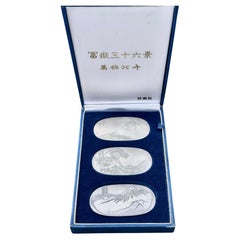
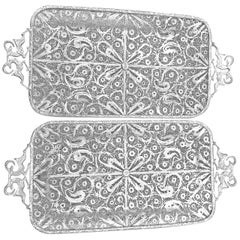
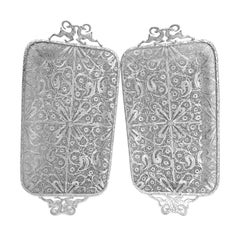
You are likely to find exactly the piece of pure silver flatware you’re looking for on 1stDibs, as there is a broad range for sale. Every item for sale was constructed with extraordinary care, often using
Silver and
Sterling Silver. In our selection of items, you can find a vintage example as well as a contemporary version. Finding the perfect item from our selection of pure silver flatware may mean sifting through those created during different time periods — you can find an early version that dates to the 20th Century and a newer variation that were made as recently as the 21st Century. If you’re browsing our inventory for a choice in our collection of pure silver flatware, you’ll find that many are available today for
women, but there are still pieces to choose from for unisex and
men.
While early utensils were often shaped from clay, wood or bone, silversmiths later crafted flatware from precious metal. In the 19th century, mass production of electroplated flatware made silver utensils accessible to the middle class. Now, antique and vintage silver, flatware and silver-plate objects for dining and the home are heritage pieces reflecting this history of design.
Silver spoons were so prized in 15th-century England that people would travel with the valuable utensils. Forks in the 17th century were frequently made with steel and likewise only available to the upper class. Silver flatware continued to be produced in small workshops in the 18th century and was a luxury reserved for the elite. When George I came to the throne in 1714, the silver dining service — including plates, dishes, soup tureens, chargers and sauceboats — became all-important.
Innovative manufacturing techniques such as the electroplating process in the 19th century would transform silversmithing with industrialization. Sheffield plate was used from 1750 to 1880 and involved a fusion method to fabricate everything from knife handles to serveware. French industrial chemist Henri de Ruolz discovered a gilding and silver-plating process for metals in 1841, with the silver-like results so celebrated that Napoleon III ordered a 3,000-piece flatware set. The expansion of table service in the Victorian era also led to an increasing number of flatware and serving pieces in a canteen, or cutlery chest, all with specific uses, from toast forks to butter picks.
While affordable metal flatware is widely available today, historic brands including Gorham Manufacturing Company — whose legendary contribution to the history of silver making started in 1831 — and Christofle continue the tradition of silver and silver-plate flatware.
Browse 1stDibs for both antique and contemporary silver, flatware and silver-plate objects in a range of elegant designs to enhance your dining table.