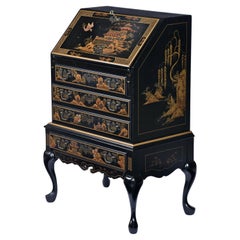
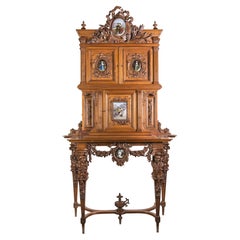
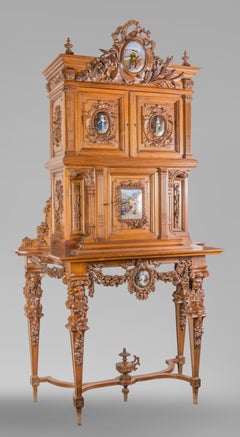
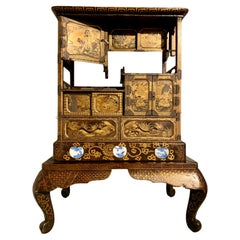
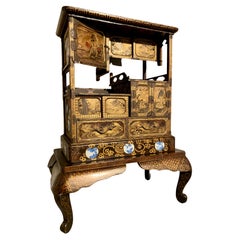
A spectacular Japanese lacquer and porcelain inlaid display cabinet on stand, kazaridana, Edo Period, mid 19th century, Japan.
The sumptuous kazaridana of traditional display cabinet form, with several shelves and enclosed spaces for display and storage. The cabinet decorated all over in beautiful maki-e lacquer against a dense nashiji ground and inset with blue and white Arita porcelain plaques.
The front of the cabinet of asymmetric design, with two open display shelves at staggered heights, and several doors enclosing storage areas of various shapes and sizes, including one hinged corner door, two pairs of sliding doors, and one pair of hinged doors opening to reveal a rounded inset corner shelf. A pair of drawers below complete the cabinet. All supported on a separate tall fitted stand.
The corner door decorated with a bold scene of a samurai warrior fighting a demon. This most likely depicts the warrior Watanabe no Tsuna battling the demon Ibaraki-doji at Rashomon gate, in which Watanabe no Tsuna attempts to help a young girl return home, carrying her on his back, only for the girl to turn into a demon, which he then must fight.
The top pair of sliding doors with a scene of a man playing the sho, a Japanese mouth organ, along the banks of a river with a waterfall in the background.
The bottom pair of sliding doors with a waterfall scene on one side, while a scholar lounges with his attendants on the other.
The pair of hinged doors finely decorated with a pair of fully armored samurai.
The two drawers wonderfully decorated in the kodaiji style with a stream of rushing water and various plants and grasses.
The cabinet is decorated in the round, with the top, sides, and base of the cabinet decorated with various scenes of flowers and birds, and inset with blue and white Arita porcelain plaques in the form of traditional fan. The fans painted...
Category
Mid-19th Century Japanese Edo Antique Porcelain Furniture
MaterialsPorcelain, Softwood, Lacquer