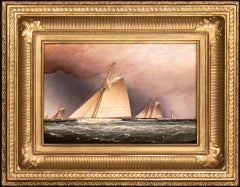
Born in 1817 in Middlesex County, Great Britain, James Edward Buttersworth was the son of important English sea painter Thomas Buttersworth. Settling in New York in 1845, he soon established himself as one of America's leading marine artists. For the most part he signed his works J.E. Buttersworth.
During the next period of his life, many of his works were chosen by Currier & Ives as subjects for lithographs. His images were also used in magazines and newspapers that reported the yachting events of the day. New York Harbor and the surrounding areas became a favorite background for his vessels which he portrayed faithfully with an eye for precise detail. His reputation sprang from his accurate representations of the great sailing yachts of his time.
In order to accent the speed and grace of these vessels, he would often elongate the hulls and sails to create a feeling of motion portrayed along a low horizon line. With dramatic skies, churning seas and accurate detail, he ennobled and romanticized sailing ships with what have become historically important paintings that are both beautiful and refined.
Painting is an art form that has spanned innumerable cultures, with artists using the medium to tell stories, explore and communicate ideas and express themselves. To bring abstract paintings, landscape paintings, still-life paintings and other original paintings into your home is to celebrate and share in the long tradition of this discipline.
When we look at paintings, particularly those that originated in the past, we learn about history, other cultures and countries of the world. Like every other work of art, paintings — whether they are contemporary creations or works that were made during the 19th century — can often help us clearly see and understand the world around us in a meaningful and interesting way.
Cave walls were the canvases for what were arguably the world’s first landscape paintings, which depict natural scenery through art. Portrait paintings and drawings, which, along with sculpture, were how someone’s appearance was recorded prior to the advent of photography, are at least as old as Ancient Egypt. In the Netherlands, landscapes were a major theme for painters as early as the 1500s. Later, artists in Greece, Rome and elsewhere created vast wall paintings to decorate stately homes, churches and tombs.
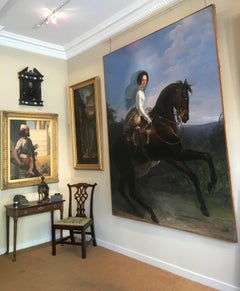
Today, creating a wall of art is a wonderful way to enhance your space, showcase beautiful pieces and tie an interior design together.
No matter your preference, whether you favor Post-Impressionist paintings, animal paintings, Surrealism, Pop art or another movement or specific period, arranging art on a blank wall allows you to evoke emotions in a room while also showing off your tastes and interests. A symmetrical wall arrangement may comprise a grid of four to six pieces or, for an odd number of works, a horizontal row. Asymmetrical arrangements, which may be small clusters of art or large, salon-style gallery walls, have a more collected and eclectic feel.
Download the 1stDibs app, which includes a handy “View on Wall” feature that allows you to see how a particular artwork will look on a particular wall, and read about how to arrange wall art. And if you’re searching for the perfect palette for your interior design project, what better place to turn than to the art world’s masters of color?
On 1stDibs, you’ll find an expansive collection of paintings and other fine art for your home or office. Browse abstract paintings, portrait paintings, paintings by emerging artists and more today.