Japanese Buddha Vase

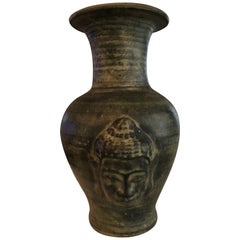
Vintage Stone Buddha Face/Head Urn/Vase

Vintage Stone Buddha Face/Head Urn/Vase

$784Sale Price|20% Off

H 17.5 in Dm 14 in

Vintage Stone Buddha Face/Head Urn/Vase

Located in Los Angeles, CA

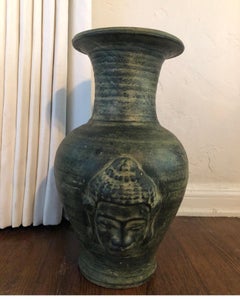
Buddhist urn/vase. Green patina with face on both sides of urn. Measures: Height 17.5 x 14” x 8.5

Category

20th Century Anglo-Japanese Urns

Materials

Stone

Get Updated with New Arrivals
Save "Japanese Buddha Vase", and we’ll notify you when there are new listings in this category.

Japanese Buddha Vase For Sale on 1stDibs

Find many varieties of an authentic Japanese buddha vase available at 1stDibs. Frequently made of ceramic, metal and earthenware, every Japanese buddha vase was constructed with great care. If you’re shopping for a Japanese buddha vase, we have 8 options in-stock, while there are 2 modern editions to choose from as well. Whether you’re looking for an older or newer Japanese buddha vase, there are earlier versions available from the 19th Century and newer variations made as recently as the 21st Century. You’ll likely find more than one Japanese buddha vase that is appealing in its simplicity, but Satsuma produced versions that are worth a look.

How Much is a Japanese Buddha Vase?

The average selling price for a Japanese buddha vase at 1stDibs is $1,750, while they’re typically $700 on the low end and $17,500 for the highest priced.

Finding the Right Urns for You

Decorative vases and antique and vintage urns are statement objects for the home that can date back centuries. Ranging from pieces with intricate, hand-painted details to more minimal forms with abstract shapes, decorative vases and urns come in a range of styles and sizes.

An urn is a type of vase that typically has a cover, a narrow neck and a round body, sometimes with a footed pedestal. However, when a vessel is called an urn, this often denotes its purpose rather than its origin or shape. One of the urn’s most crucial roles was and remains to be to hold the ashes of people for funerary rites. Another type of urn is adorned with figures that tell a story or show a scene.

Some of the earliest vases were formed from clay or metal-like bronze. Mesopotamians used them not only for decoration but also for storage. In ancient Greece, vases and urns frequently depicted stories from mythology, showing images of the gods and heroes. In ancient Egypt, vases such as the amphora had ceremonial purposes.

Over time, vases grew in popularity among artists as a different kind of canvas for expression. Unlike many of the ancient examples, these vases were not always functional but instead made for a striking addition to one’s decor. Even a plain, solid-colored vase can add color or style to a room. Metal urns are elegant additions to your living room or foyer rather than outside, unless you’re partial to the alluring weathered patina that is expected to characterize an antique cast-iron garden urn.

Every interior designer will tell you that decorative objects are what make a house a home. Decorative objects trumpet the homeowner’s personality while bringing a room to life. For designers, they present an opportunity to express their creative vision.

When looking for a decorative vase, it’s important to note the design and also the size and shape. Decorative vases vary from those with a wide base to those with long slender necks. Browse decorative vases and an extensive ceramic urn collection on 1stDibs.

Questions About Japanese Buddha Vase
  • 1stDibs ExpertFebruary 22, 2021
    The Buddha's origins are Chinese, but Buddhism has since made its way to Japan and, later, Korea.
    Lotus Gallery
    Lotus GalleryMarch 17, 2021
    Gautama Buddha was an Indian prince born in modern day Nepal. The first images of the Buddha were created almost simultaneously in Mathura, India, and the Greco-Buddhist kingdom of Gandhara (modern day Pakistan and Afghanistan). From there, images fo the Buddha spread out along trade routes into East and Southeast Asia.
  • 1stDibs ExpertOctober 12, 2021
    A type of Japanese pottery originated from Satsuma province in Japan is termed as Satsuma ware. A vase of this kind is known as a Satsuma vase. An interesting fact about Satsuma ware is that they feature a "makers mark" or marking as a key to help collectors unlock the value, age and authenticity of the piece. Shop a range of antique and vintage Japanese vases on 1stDibs.
  • 1stDibs ExpertFebruary 1, 2024
    Yes, some Japanese vases are valuable. Some of the most highly sought-after types of Japanese vases include Satsuma, Kutani, Arita and Imari pieces. There is also a demand for select cloisonné and bronze vases made by Japanese artisans. The size, style, condition and rarity of a Japanese vase will contribute to its value. A certified appraiser or knowledgeable dealer can give you an estimate of how much a particular vase is worth. On 1stDibs, shop a diverse assortment of Japanese vases.