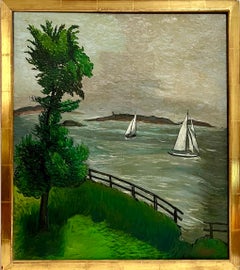
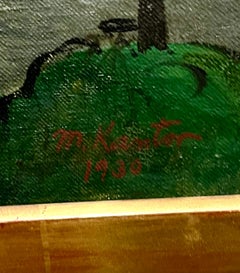
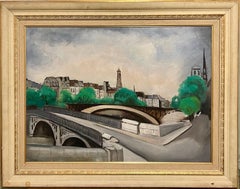
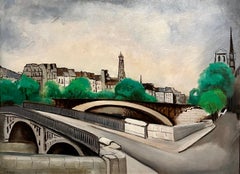
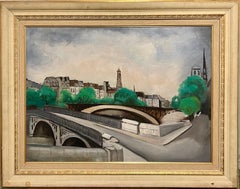
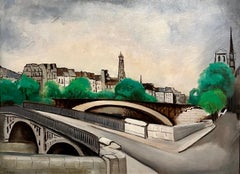
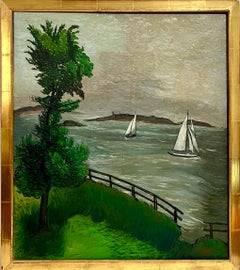
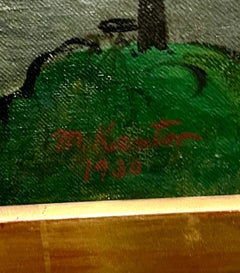
Morris Kantor was born in Minsk, Russia in 1896, and moved to New York in 1906. Early in his career he experimented with Futurism and Cubism. In 1916 he studied landscape painting with Homer Boss (1882-1956). In 1928, after returning to New York City from a year in Paris, Kantor developed a style in which he combined Realism with Fantasy, often taking the streets of New York as his subject matter. By 1940, he was focusing on figural studies.
Today Kantor's work can be found in such institutions as: Whitney Museum of American Art, NY; Metropolitan Museum of Art, NY; Museum of Modern Art, NY; Art Institute of Chicago; Pennsylvania Academy of the Fine Arts.
Source: Peter Falk, Who Was Who in American Art
Figurative art, as opposed to abstract art, retains features from the observable world in its representational depictions of subject matter. Most commonly, figurative paintings reference and explore the human body, but they can also include landscapes, architecture, plants and animals — all portrayed with realism.
While the oldest figurative art dates back tens of thousands of years to cave wall paintings, figurative works made from observation became especially prominent in the early Renaissance. Artists like Michelangelo, Leonardo da Vinci and other Renaissance masters created naturalistic representations of their subjects.
Pablo Picasso is lauded for laying the foundation for modern figurative art in the 1920s. Although abstracted, this work held a strong connection to representing people and other subjects. Other famous figurative artists include Francis Bacon and Lucian Freud. Figurative art in the 20th century would span such diverse genres as Expressionism, Pop art and Surrealism.
Today, a number of figural artists — such as Sedrick Huckaby, Daisy Patton and Eileen Cooper — are making art that uses the human body as its subject.
Because figurative art represents subjects from the real world, natural colors are common in these paintings. A piece of figurative art can be an exciting starting point for setting a tone and creating a color palette in a room.
Browse an extensive collection of figurative paintings on 1stDibs.