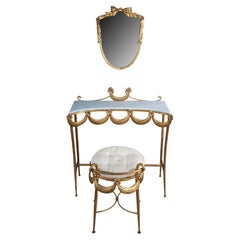
Neoclassical design emerged in Europe in the 1750s, as the Age of Enlightenment reached full flower. Neoclassical furniture took its cues from the styles of ancient Rome and Athens: symmetrical, ordered, dignified forms with such details as tapered and fluted chair and table legs, backrest finials and scrolled arms.
Over a period of some 20 years, first in France and later in Britain, neoclassical design — also known as Louis XVI, or Louis Seize — would supersede the lithe and curvaceous Rococo or Louis XV style.
The first half of the 18th century had seen a rebirth of interest in classical antiquity. The "Grand Tour" of Europe, codified as a part of the proper education of a patrician gentleman, included an extended visit to Rome. Some ventured further, to sketch the ruins of ancient Greece. These drawings and others — particularly those derived from the surprising and rich archaeological discoveries in the 1730s and ’40s at the sites of the Roman cities of Pompeii and Herculaneum — caused great excitement among intellectuals and aesthetes alike.
Neoclassical furniture is meant to reflect both grace and power. The overall appearance of neoclassical chairs, tables and cabinetry is strong and rectilinear. These pieces are, in effect, classical architecture in miniature: chair and table legs are shaped like columns; cabinets are constructed with elements that mirror friezes and pediments.
Yet neoclassicism is enlivened by gilt and silver leaf, marquetry, and carved and applied ornamental motifs based on Greek and Roman sculpture: acanthus leaves, garlands, laurel wreaths, sheaves of arrow, medallions and chair splats are carved in the shapes of lyres and urns. Ormolu — or elaborate bronze gilding — was essential to French design in the 18th and 19th centuries as a cornerstone of the neoclassical and Empire styles.
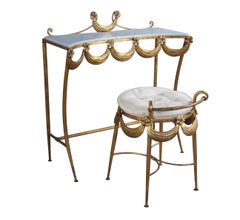
As you can see from the furniture on these pages, there is a bit of whimsy in such stately pieces — a touch of lightness that will always keep neoclassicism fresh.
Find antique neoclassical furniture today on 1stDibs.
Vintage, new and antique vanity tables have forever felt like personal, intimate sanctuaries of sorts, designed to introduce a level of serenity that feels rare and welcome in our otherwise frenetic days. They’ve been variously known as dressing tables or makeup tables over the years, but no matter what we call them — and whether it's a sophisticated contemporary piece or an iconic vintage Luigi Massoni vanity — vanities have offered a special place for us to get ready for work, an early-morning appointment or lunch date or whatever lies ahead.
“Beauty routines, taking the time to protect what you have, a moment to accessorize, a moment to pause and slow down — these are all so important now as an antidote to our fast and hectic lives,” says Oona Bannon, creative director of Pinch Design in Clapham, South London. “Just thinking about a dressing table makes me feel calm.”
When decorative boxes would no longer suffice as repositories for cosmetics, fragrant oils and perfumes, dressing tables originated in France and England during the 17th century. Men who called the latter home used “shaving tables” — a proto-dressing table — for their grooming routines while women found in dressing tables an oasis for applying makeup, particularly as improvements upon vanity tables equipped them with mirrors and lighting. In the United States, as vanity tables became a seamless component of bedroom furniture, furniture makers working in Chippendale, Rococo and other styles were regularly commissioned to produce these popular items.
Vanity tables have evolved over the years, and while there is lots to love about the ornate carving and pronounced curvilinear forms of Victorian vanities, the clean lines that characterize mid-century modern vanities and the decorative flourishes associated with Art Deco vanities, the main elements of this furnishing are the same. All vanities are about as tall as a standard table with room for seating furniture, which tends to be a small bench, a stool or an armless chair. Many also have special organization features for makeup. Without a chair and a mirror, a vanity would resemble a dresser.
Nowadays, vanities are more than a place to do hair and makeup. They’re a platform to display beauty products and store makeup collections. Vanities are standard in bedrooms, particularly if you’re not lucky enough to have a spacious dressing room or walk-in closet for your dressing table. The better the lighting is in your bedroom or wherever you’ve positioned your vanity table — even if you’ve opted for a moody setting versus a bright one — the more you will benefit from having this personal place of respite to prepare for the day ahead.
Find your antique, new or vintage vanity table today on 1stDibs.