Adrien Barrère Art

to
2
1
1
Overall Width
to
Overall Height
to
4
2
1
3
3
1
2
1
1
1
1
1
2
1
1
4
11,586
2,878
2,492
1,574
3
1
Artist: Adrien Barrère
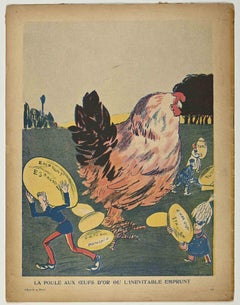
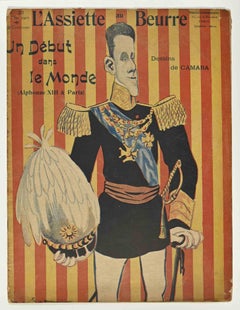
L' Assiette au Beurre - Magazine by Adrien Barrère - 1905

L' Assiette au Beurre - Magazine by Adrien Barrère - 1905

By Adrien Barrère 1

Located in Roma, IT

L'Assiette au Beurre is a Comic Magazine published in 1905, reproducing drawings by Leal da Camara (1876-1948). Good condition on a yellowed paper, except for some torn paper on the...

Category

Early 1900s Modern Adrien Barrère Art

Materials

Paper

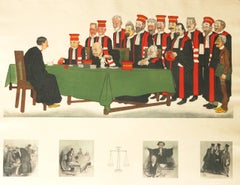
Passing the Bar

Passing the Bar

By Adrien Barrère 1

Located in Paonia, CO

artist: Adrien Barrere (1877-1931) title: Passing the Bar medium: Lithograph paper size: 19.75 x 25.50 image size: 18 x 24.25 French caricaturist...

Category

1930s Adrien Barrère Art

Materials

Lithograph

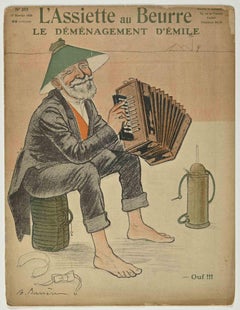
L' Assiette au Beurre - Magazine by Adrien Barrère - 1906

L' Assiette au Beurre - Magazine by Adrien Barrère - 1906

By Adrien Barrère 1

Located in Roma, IT

L'Assiette au Beurre is a Comic Magazine published in 1906, reproducing drawings by Adrien Barrère (1874–1931). Good condition on a yellowed paper, except for some torn paper on the...

Category

Early 1900s Modern Adrien Barrère Art

Materials

Paper

Related Items
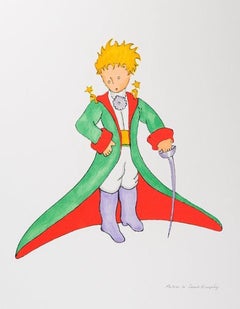
Le Petit Prince En Grand Manteau - Antoine De Saint-Exupéry

Le Petit Prince En Grand Manteau - Antoine De Saint-Exupéry

Located in Sint-Truiden, BE

Color lithograph after the watercolor illustrations by Antoine de Saint-Exupéry from his beloved masterpiece "The Little Prince". This lithograph was printed and published in 2009 ...

Category

Early 2000s Adrien Barrère Art

Materials

Lithograph

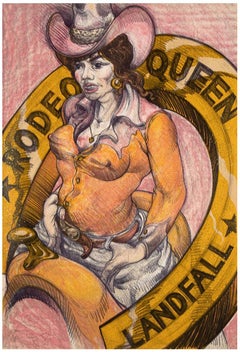
Rodeo Queen by Luis Jimenez

Rodeo Queen by Luis Jimenez

By Luis Alfonso Jimenez

Located in Phoenix, AZ

Rodeo Queen, 1981 Edition 36/50 Signed lower left, Inscribed: for the "Rose" 82. Provenance: Print was a gift to Rozanne Charington, companion and model for "Rodeo Queen", "Rose Tattoo" and "Jimenez at Adeliza's Candy Store". Lithograph on paper 42 ½ × 29 in. (107.3 × 73.7 cm) Luis Alfonso Jimenez Born, 1940, El Paso, Texas, died 2006, Hondo, New Mexico. Statement: Luis Jimenez, in his work, celebrates the vitality of life. . . . Jimenez es un hijo de la frontera; he knows its people and the landscape. It is the transformation of these people into art that is his most important contribution to the art of this vast region which stretches between Mexico and the United States. His subject matter utilizes the popular images of the cultura del norte, and a large part of it is depicted and transformed in the rough and tumble world of la frontera. He is also a son of el norte, and so he uses its materials and explores its emerging, popular myths. The tension and attraction of Jimnez’s work is that he always creates within the space of his two worlds, the Mexicano and the Americano. He constantly shows us the irony of the two forces which repel, while showing us glimpses of the synthesis he seeks. What a gift it has been to us for this talented artist to reflect on the soul of our region. He gives meaning to our existence and history. Rudolfo Anaya (passage chosen by the artist), A View from La Frontera, Man on Fire: Luis Jimenez, pp. 1, 3, 6Biography: Luis Jimenez was born in Texas to parents who had emigrated from Mexico to the United States; he would later dedicate his 1989 sculpture Border Crossing to his father, who had entered the country illegally. The elder Jimenez was a neon sign designer in El Paso, and Luis worked with him as a youth. His experience working in the neon shop and his fascination with U.S. car culture would both become major influences on his art career. Jimenez studied architecture at the University of Texas, Austin (UTA), and also took art courses in which he first created sculptures with wood, steel, and fiberglass, choosing the latter because of its association with U.S. popular culture. He subsequently became one of the artists who made fiberglass an acceptable medium in the 1960s. In 1964 Jimenez received his B.S. in art from UTA, and he continued his studies at the Universidad Nacional Autonoma de Mexico in Mexico City. In 1966 he moved to New York City and worked as an assistant to sculptor Seymour Lipton. Jimenez began to exhibit his art while in New York and in 1972 moved to New Mexico to focus on creating public sculptures, even as he maintained his diverse output of drawings, prints, and lithographs. Drawing on his early experiences, Jimenez creates works that come from a border perspective, one that draws upon the hybridity bred by culture clashes. Often socially and politically informed, his works speak not only in regional terms, those germane to the southwestern United States, but to broader, more global issues as well. They exhibit a profoundly Chicano aesthetic and sensibility, one that is informed by Mexican and Mexican American traditions, North American popular culture, Chicano cultural icons, and images and themes unique to the Southwest. Death, sexuality, and the struggle of the common people are frequent themes. Inspired by authors who write in an autobiographical style, Jimenez creates works that function as personal narrative yet are also able to make statements about culture in more global terms. His use of bold colors and lines, a legacy from his fathers work as a neon sign maker, lends a dynamic sensuality to his work, one that is particularly evident in his monumental fiberglass and acrylic urethane sculptural works Many of Jimenez's works correspond to scholar Toms Ybarra-Fraustos definition of the Chicano aesthetic of rasquachismo, a lowbrow sensibility that appeals to the working class in that it applies to objects that subvert expressions of the mainstream or dominant culture. Creating art that speaks to the people, Jimenez is able to transform regional and culturally specific myths and symbols into globally recognized and relevant icons. Exhibitions: In addition to his personal work, Jimenez has been commissioned for numerous public art projects. In 1999 his sculpture Southwest Piet was designated a National Treasure by First Lady Hillary Clinton. The many exhibitions featuring his work have included Human Concern/Personal Torment (Whitney Museum of American Art, New York, 1969). The First International Motorcycle Art Show (Phoenix Art Museum, Phoenix, AZ, 1973). Three Texas Artists (Centre Cultural Americaine, USIS, Paris, 1977), Recent Trends in Collecting (Smithsonian Institution, Washington, DC, 1982). Committed to Print (Museum of Modern Art, New York, 1989) Printmaking in Texas: The 1980s (Modern Art Museum, Fort Worth, TX. Laguna Gloria Art Museum, Austin, 1990. The Whitney Biennial (Whitney Museum of American Art, New York, 1991) Man On Fire: Luis Jimnez (Albuquerque Museum of Art, NM, 1994-95). 47th Annual Purchase Exhibition (American Academy of Arts and Letters, New York, 1995). Traveling solo exhibition, Working Class Heroes: Images from the Popular Culture (1997-2000). Jiménez Collier Gallery has been in continuous operation for over 40 years. Originally located just off Main Street in downtown Scottsdale, Arizona, we have moved to Phoenix to accommodate and showcase our large inventory including: • Original works by Maynard Dixon, Lon Megargee, Ed Mell, Fritz Scholder, Bill Schenck, Bill Lesch, Luis Jimenez, Greg Singley, Dan Budnik, and other 20th century Western, WPA and Contemporary Southwestern artists. • The Fine Art Estate of Lon Megargee • Vintage rodeo...

Category

1980s Contemporary Adrien Barrère Art
Materials

Lithograph

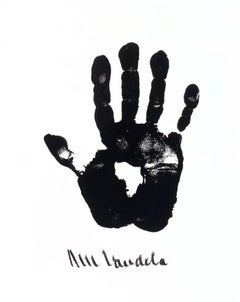
Hand of Africa - Mandela, Former South African President, Signed Artwork, Hand

Hand of Africa - Mandela, Former South African President, Signed Artwork, Hand

By Nelson Mandela

Located in Knowle Lane, Cranleigh

Nelson Mandela, Hand of Africa, Signed Limited Edition Lithograph Many people are unaware that Nelson Mandela turned his hand to art in his 80's as a way of leaving a legacy for his ...

Category

Early 2000s Contemporary Adrien Barrère Art
Materials

Lithograph

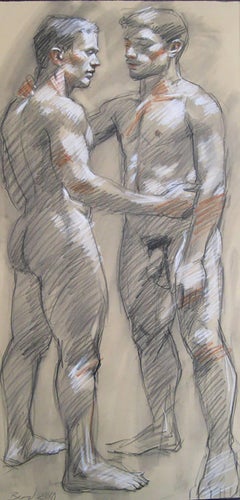
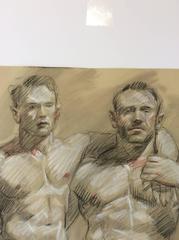
Mark Beard 054 (Figurative Charcoal Drawing of Two Male Nudes on Arches Paper)

Mark Beard 054 (Figurative Charcoal Drawing of Two Male Nudes on Arches Paper)

By Mark Beard

Located in Hudson, NY

Figurative drawing of two male nudes made with graphite, charcoal, and conte crayon on Arches paper 30 x 14 inches, unframed This unique life study drawing of two standing nude m...

Category

2010s Modern Adrien Barrère Art
Materials

Charcoal, Graphite, Paper

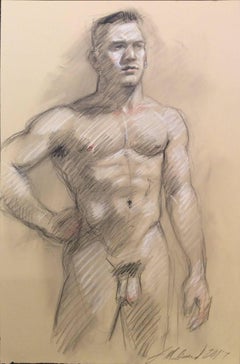
MB 001 (Modern, Academic Style Figurative Life Drawing of Muscular Male Nude )

MB 001 (Modern, Academic Style Figurative Life Drawing of Muscular Male Nude )

By Mark Beard

Located in Hudson, NY

Figurative male nude drawing on Arches paper by Mark Beard graphite, conte crayon and charcoal on Arches paper 22 x 15 inches unframed Contemporary figurative life study drawing of ...

Category

2010s Modern Adrien Barrère Art
Materials

Conté, Graphite

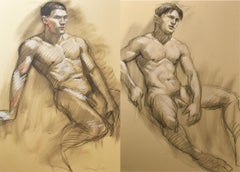
MB 076 A&B (Double Sided Figurative Charcoal Drawing of Male Nudes)

MB 076 A&B (Double Sided Figurative Charcoal Drawing of Male Nudes)

By Mark Beard

Located in Hudson, NY

Figurative drawing of male nudes made with graphite, charcoal, and conte crayon on Arches paper 30 x 22 inches, unframed One piece of 30 x 22 inch Arches. Two drawings, one on either...

Category

Early 2000s Modern Adrien Barrère Art
Materials

Charcoal, Archival Paper, Graphite

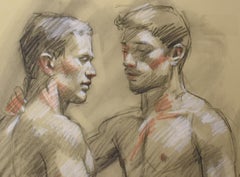
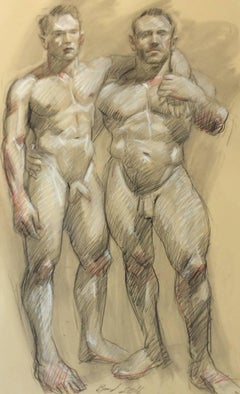
MB 807 (Figurative Charcoal Drawing on Arches Paper of Two Male Nude Models)

MB 807 (Figurative Charcoal Drawing on Arches Paper of Two Male Nude Models)

By Mark Beard

Located in Hudson, NY

Figurative drawing of two male nudes made with graphite, conte crayon and charcoal on Arches paper 30 x 18.5 inches, unframed This unique life study drawing of two standing male n...

Category

2010s Modern Adrien Barrère Art
Materials

Archival Paper, Charcoal, Graphite

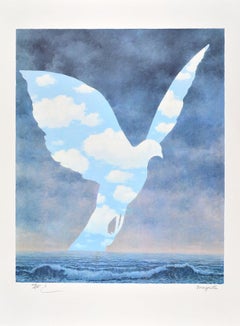
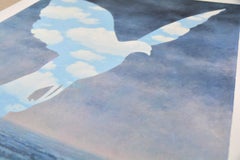
RENÉ MAGRITTE LA GRANDE FAMILLE, 1963 Limited edition Lithograph - Surrealism

RENÉ MAGRITTE LA GRANDE FAMILLE, 1963 Limited edition Lithograph - Surrealism

By (after) René Magritte

Located in Madrid, Madrid

LA GRANDE FAMILLE, 1963 (THE LARGE FAMILY) Date of creation: 2010 Medium: Lithograph on BFK Rives Paper Edition: 275 Size: 60 x 45 cm Observations: Lithograph on BFK Rives paper plat...

Category

Mid-20th Century Surrealist Adrien Barrère Art
Materials

Lithograph

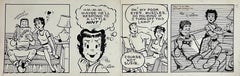
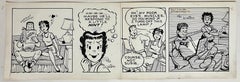
Rare 1950s Original Syndicated Ink Drawing Cartoon Strip Susie Q Smith Comic Art

Rare 1950s Original Syndicated Ink Drawing Cartoon Strip Susie Q Smith Comic Art

By Jerry Walter & Linda Walter

Located in Surfside, FL

SUSIE Q. SMITH Medium: Newspaper comics Distributed by: King Features Syndicate First Appeared: 1945 Creators: Linda and Jerry Walter 6 X 18.25 Like her contemporaries, Aggie Mack,...

Category

1950s American Modern Adrien Barrère Art
Materials

Paper, Ink

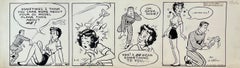
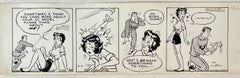
Rare 1950s Vintage Syndicated Ink Drawing Cartoon Strip Susie Q Smith Comic Art

Rare 1950s Vintage Syndicated Ink Drawing Cartoon Strip Susie Q Smith Comic Art

By Jerry Walter & Linda Walter

Located in Surfside, FL

SUSIE Q. SMITH Medium: Newspaper comics Distributed by: King Features Syndicate First Appeared: 1945 Creators: Linda and Jerry Walter 5.5 X 19.5 Dated August 13, 1954 in top right corner. Like her contemporaries, Aggie Mack, Candy and Patsy Walker (before her conversion to a superhero), Susie Q. Smith was a female Archie-type — not exactly an imitator, because Archie, who had started only four years earlier, hadn't yet become popular enough to spawn imitators, but part of his genre. She attended high school, where her teachers often seemed unreasonable to her, interacted with the opposite gender in a typically adolescent way, and her parents didn't completely understand her. And she was cute and perky as only a teenage girl can be. Susie was the star of a comic strip distributed by King Features, the biggest of the comic strip syndicates, whose other offerings have ranged from Jackys Diary to Prince Valiant. King launched the strip in both daily and Sunday form in 1945. Daily, she was only in a panel at first, but it expanded into a full, multi-panel strip on February 7, 1953. In a very odd turn of events, in 1953 the Walters chose to leave King Features behind and hitch their wagon at the McNaught Syndicate. The creators were Harold "Jerry" Walter and his wife, Linda. Jerry was also responsible for Jellybean Jones, who has nothing to do with Jughead Jones's young sister, a modern-day addition to the Archie cast of characters. Together, they did The Lively Ones during the 1960s. Though each was capable of doing both major jobs in comic strip production, their usual working method was for Jerry to dream up the ideas and write the dialog, while Linda did the artwork. The Walters also collaborated on a series of Susie Q. Smith comic books for Dell Comics. Instead of reprinting newspaper strips, these ran new stories by the Walters. Between 1951 and '54, four issues were published as part of the Four Color Comics series, where many minor comic strips, including Dotty Dripple, Timmy and Rusty Riley had found a home. It had no other media spin-offs. Susie Q. Smith had a respectable run in the newspapers, but it ended in 1959. Jerry Walter (1915 - 2007) was an abstract expressionist artist whose output of energetic and colorful paintings were the products of the rich artistic milieu of post-war New York City. He was born Harold Frank Walter in Mount Pleasant, Iowa on November 25, 1915. After graduating from Colgate University in 1937, Walter moved to New York City, where he studied drawing and painting at the New School and the Art Students’ League. Before concentrating seriously on his art, he spent several years as a successful copywriter and idea man for the advertising agencies of J. Walter Thompson, McCann Ericson, and BBDO. During this time, he also worked as a syndicated cartoonist. Collaborating with his wife, Linda, his best-known series was Susie Q. Smith, which first appeared in 1945 and described as a “female Archie type.” Very popular, the cartoon was later the subject of a series of comic books published from 1951 to 1954. After serving in the United States Army for three years during World War II, Walter began to paint seriously. He ascribed his earliest artistic influence to Joan Miró, whose Dog Barking at the Moon (1926) he viewed when he was twelve, the year he published his first cartoon. Walter later wrote that jazz, “the first native expression of so-called modernism” was a strong influence on his work. During the later 1940s, Walters spent time at the Research Studio in Maitland, Florida. Founded in 1937 by artist and architect J. André Smith and supported by the philanthropist Mary Curtis Bok, the Research Studio was a lively colony that hosted prominent artists, including Milton Avery, Ralston Crawford, and Doris Lee. While at the Studio, Walter’s work was purchased by Frank Crowninshield. A founding trustee of the Museum of Modern Art and editor of Vanity Fair, Crowinshield was a noted collector; his collection included important works by Pablo Picasso, Marc Chagall, Henri Matisse, Edgar Degas, George Bellows, and Pierre Bonnard. Returning to New York after his time at the Studio, Walter became an active member of the New York school of the abstract expressionist movement, and in the summer of 1956, Walter exhibited 13 paintings and a selection of drawings at New York’s Chase Gallery. The adroit manipulation of both color and composition evident in his work shows the influence of Abstract Expressionism, particularly Willem de Kooning, Arshile Gorky, and Hans Hofmann. illustrator and female cartoonist Linda Walter was the talented female mind behind the beloved "Susie Q. Smith" comic strip. She played an instrumental role in shaping the cultural landscape through her vibrant illustrations. Known for the timeless charm of the "Susie Q. Smith" comic strip, Linda's artistry brought joy and laughter to countless readers during the 1950s and continues to resonate with fans across generations. She was part of the Woodstock artists community. from Women in Comics: Linda Walter was the artist of newspaper strip Susie Q. Smith, which was written by her husband, Jerry. It was syndicated by King Features Syndicate and ran from 1945 to 1959. The Walters also contributed original Susie Q. Smith stories to Dell's Four Color comic books from 1951 to 1954. From 1964-1965, they created a singled panel comic called The Lively Ones. Vintage Golden Age of Comics era. The Golden Age of Comic Books describes an era in the history of American comic books from 1938 to 1956. During this time, modern comic books were first published and rapidly increased in popularity. The superhero archetype was created. Between 1939 and 1941 Detective Comics (DC) and its sister company, All-American Publications, introduced popular superheroes such as Batman and Robin, Wonder Woman, the Flash, Green Lantern, Doctor Fate, the Atom, Hawkman, Green Arrow and Aquaman. Timely Comics, the 1940s predecessor of Marvel Comics, had million-selling titles featuring the Human Torch, the Sub-Mariner, and Captain America. Another notable series was The Spirit by Will Eisner. Dell Comics' non-superhero characters (particularly the licensed Walt Disney animated-character comics) outsold the superhero comics of the day. The publisher featured licensed movie and literary characters such as Mickey Mouse, Donald Duck, Roy Rogers and Tarzan. Additionally, MLJ's introduction of Archie Andrews in Pep Comics #22 (December 1941) gave rise to teen humor comics, with the Archie Comics...

Category

1950s American Modern Adrien Barrère Art
Materials

Paper, Ink

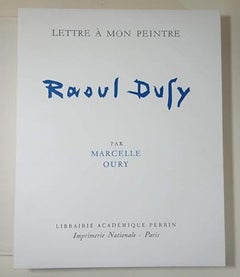
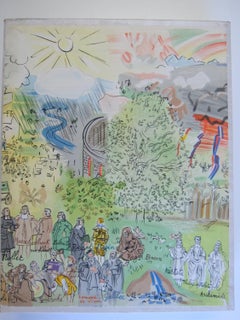
Lettre a Mon Peintre Raoul Dufy Marcelle Oury limited edition

Lettre a Mon Peintre Raoul Dufy Marcelle Oury limited edition

By (after) Raoul Dufy

Located in Pasadena, CA

First edition, limited and numbered (2278). 25 lithographs by Dufy, Villon, Braque, Chagall, Gromaire, Buffet, Segonzac, Lapicque, Marchand and Lurcat--eight of which are double-page...

Category

Late 20th Century Modern Adrien Barrère Art
Materials

Vellum

Adrien Barrère art for sale on 1stDibs.

Find a wide variety of authentic Adrien Barrère art available for sale on 1stDibs. You can also browse by medium to find art by Adrien Barrère in lithograph, pencil and more. Much of the original work by this artist or collective was created during the 20th century and is mostly associated with the modern style. Not every interior allows for large Adrien Barrère art, so small editions measuring 13 inches across are available. Customers who are interested in this artist might also find the work of Charles Joseph Traviès, Chas Laborde, and Philibert-Louis Debucourt. Adrien Barrère art prices can differ depending upon medium, time period and other attributes. On 1stDibs, the price for these items starts at $198 and tops out at $295, while the average work can sell for $246.

Artists Similar to Adrien Barrère