By Bernard Picart
Located in Fairlawn, OH
Bernard Picart (French, 1673–1733)
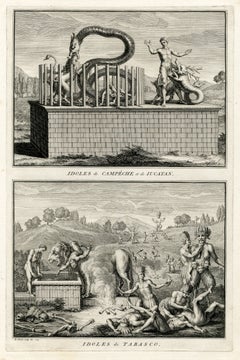
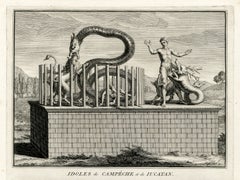
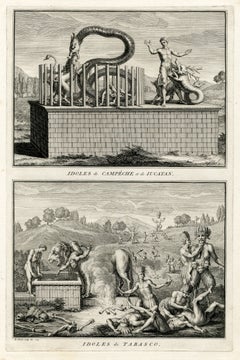
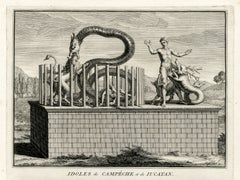
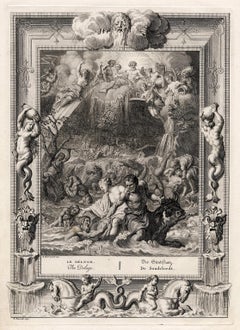
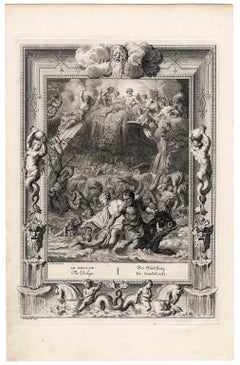
Idoles de Campêche et de Iucatan / Idoles de Tabasco
1723
Engraving on fine laid paper
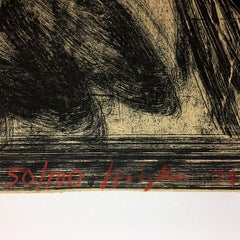
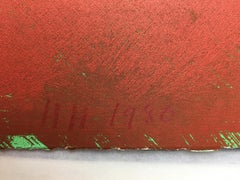
Signed and dated in the plate, lower left: “B. Picart sculp. dir. 1723” (see photo)
Published by Jean-Frédéric Bernard, Amsterdam
From Cérémonies et coutumes religieuses de tous les peuples du monde
Image dimensions: 13 1/16 x 8 5/8 inches
Catalogue entry
Divided into two registers, this engraving purports to illustrate religious images and sacrificial practices among the Indigenous peoples of Campeche, Yucatán, and Tabasco in southeastern Mexico. It appeared in the first volume of Jean-Frédéric Bernard and Bernard Picart’s monumental Cérémonies et coutumes religieuses de tous les peuples du monde, published in Amsterdam beginning in 1723. In the original French edition, the plate was positioned immediately before page 165.
The upper register, captioned Idoles de Campêche et de Iucatan, presents a group of fantastic composite deities enclosed by a circular palisade. A huge dragon or serpent rises above the enclosure, while a smaller serpentine creature, a horned quadruped, and other monstrous beings crowd the interior. At right, a nude male figure stands on an animal-like pedestal beside a hybrid creature with antlers, claws, and a coiling tail. Picart organizes this imaginary pantheon as though it were an antiquarian display: the figures are isolated, clearly outlined, and placed on a raised masonry platform for the viewer’s inspection.
The lower register, Idoles de Tabasco, depicts a considerably more violent ritual. At left, a human victim is apparently placed within or against an enormous leonine idol; blood flows toward a rectangular reservoir. A priest kneels beside a fire while holding an object identified in the accompanying text as the victim’s heart. Dismembered bodies, severed heads, clubs, and bones occupy the foreground, while additional idols and ritual participants appear across the distant landscape.
The Denver Art Museum explains that this lower composition was adapted from an engraving in Arnoldus Montanus’s De Nieuwe en Onbekende Weereld of 1671. The imagery combines geographically and culturally unrelated European conventions: Tabasco’s Olmec and Maya history is represented through feathered headdresses associated with European depictions of Aztec culture, while the deity’s goat-like legs derive from European fantasies about Huitzilopochtli.
Interpretation and cultural significance
The engraving should not be treated as a reliable eyewitness representation of Maya or other Indigenous religious practices. Picart never visited the Americas. His composition belongs to a chain of European textual and visual transmission in which colonial chronicles, earlier engravings, classical models, and inherited ideas about “idolatry” were repeatedly combined and embellished.
The figures consequently reveal as much about eighteenth-century Europe as about pre-Hispanic Mexico. The reptilian monsters resemble creatures from European emblem books and mythological prints...
Category
1720s Old Masters Bernard Picart Art