By Hiroshi Yoshida
Located in Myrtle Beach, SC
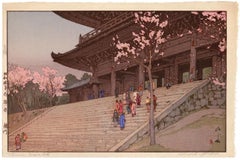
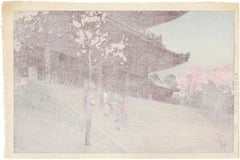
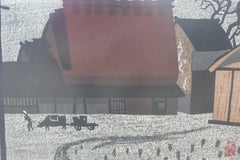
Hiroshi Yoshida, 'Chion-in Temple Gate (Sunset)' from the series 'Eight Scenes of Cherry Blossoms (Sakura hachi dai: Sakura mon)', color woodblock print, 1935. Signed in brush 'Yoshida' and in pencil 'Hiroshi Yoshida'. A superb, early impression, with fresh colors; the full sheet with margins, on cream Japan paper; an area of slight toning in the top right sheet corner, not affecting the image, otherwise in excellent condition. Marked with a jizuri (self-printed) seal, upper left margin. Self-published by the artist.
Image size 9 5/8 x 14 3/4 inches (444 x 375 mm); sheet size 10 7/8 x 16 inches (276 x 406 mm). Archivally sleeved, unmatted.
Provenance: M. Nakazawa, Tokyo.
Literature: Tadao Ogura, 'Yoshida Hiroshi zenhangashu (The Complete Woodblock Prints of Hiroshi Yoshida)', 1987, p. 140, no. 194
Amy Reigle Stephens, gen. ed., 'The New Wave: Twentieth-Century Japanese Prints from the Robert O. Muller Collection', 1993, p. 121, no. 111
Ogura Tadao, 'Yoshida Hiroshi ten: shizen-e no manazashi, tokubetsuten, botosugo 50 shunen kinen (Yoshida Hiroshi Exhibition)', MOA Museum of Art, 2000, p. 96, cat. no. 127
Amanda T. Zehnder, 'Modern Japanese Prints: The Twentieth Century', Carnegie Museum of Art, 2009, p. 189
Yoshida Hiroshi: A Retrospective, Chiba City Museum of Art, 2016, p. 211, cat. no. 5-27
Collections: Carnegie Museum of Art, Crocker Art Museum, Honolulu Museum of Art, Museum of Fine Arts Boston, Seattle Art Museum, Toledo Museum of Art.
ABOUT THE IMAGE
Located in Kyoto, Chionin is the main temple of the Jodo sect of Japanese Buddhism, one of the most popular Buddhist sects in Japan, having millions of followers. The Sanmon Gate, Chionin's entrance gate, standing 24 meters tall and 50 meters wide, it is the largest wooden temple gate in Japan and dates back to the early 1600s. Behind the gate, a broad set of stairs leads to the main temple grounds.
ABOUT THE ARTIST
Painter and printmaker Yoshida Hiroshi (1876-1950) is regarded as one of the greatest artists of the Japanese 'shin hanga' (New Print) movement.
Yoshida was born as the second son of Ueda Tsukane in Kurume, Fukuoka Prefecture, a schoolteacher from an old samurai family. In 1891 he was adopted by his art teacher Yoshida Kasaburo in Fukuoka and took his surname. In 1893 he went to Kyoto to study painting, and the following year to Tokyo to join Koyama Shotaro's Fudosha private school; he also became a member of the Meiji Fine Arts Society. These institutions taught and advocated Western-style painting, greatly influencing Yoshida’s artistic development.
In 1899 Yoshida had his first American exhibition at Detroit Museum of Art (now Detroit Institute of Art), making the first of many visits to the US and Europe. In 1902 he helped reorganize the Meiji Fine Arts Society, renaming it the Taiheiyo-Gakai (Pacific Painting...
Category
1930s Showa Carlo Mazzoni Art