Charles Wilson Knapp Art

American, 1823-1900
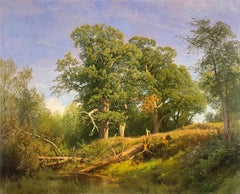
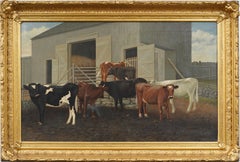
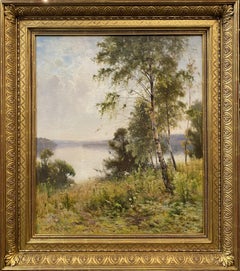
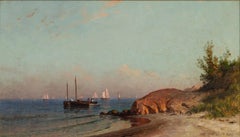
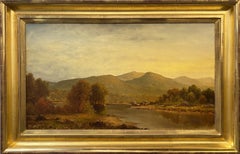
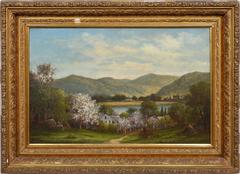
harles Knapp (1823-1900) Charles W. Knapp is well known for his quintessential depictions of farm life along the rivers and shorelines of America from New Hampshire to upper state New York. "View of the Susquehanna River" was painted between 1860-1870 in Pennsylvania farm country, where cattle drank along rivers and farmers piled hay on wagons to feed animals. This canvas is a major example painted during the peak of the Hudson River School tradition. Knapp was born in Philadelphia in 1823 and he died in that city in 1900. He first exhibited at the National Academy of Design in New York City in 1859, at which time his address is listed as New York City. In 1878 he exhibited two New Hampshire views at the Massachusetts Charitable Mechanics Association in Boston, many views at the Pennsylvania Academy of Fine Arts (1877-1887) and most recently his canvases of Ellsworth Brook in West Campton, NH, the Entrance to Franconia Knotch, Silver Lake near Mount Chocorua, the Peabody River in Mount Washington, Saco and Kearsarge and the White Mountains from Androscoggin Valley were listed in New Hampshire Scenery (C.H. Campbell, NH Historical Society, Phoenix Publishing1985). His paintings are in many relevant private collections and at the New Hampshire Historical Society, Dartmouth College Art Galleries and elsewhere. He is considered a leading White Mountains painter, but he spent many years in and around Philadelphia and the Susquehanna River painting landscapes from life. He also painted Narragansett Bay (RI), the Pocanos, the Catskills, the Delaware Water Gap and along the New Jersey Shore.
to
1
1
1
Overall Width
to
Overall Height
to
2
1
1
1
1
2
2
2
2
2
11,084
2,853
2,494
1,433
2
2
Artist: Charles Wilson Knapp
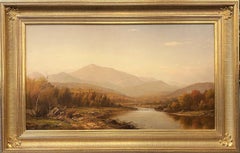
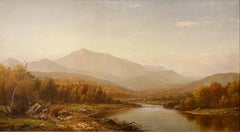
“Summer”
“Summer”

“Summer”

By Charles Wilson Knapp

Located in Southampton, NY

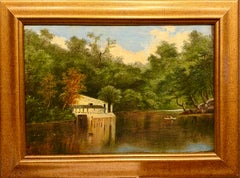
Here for your consideration is a wonderful large panoramic original oil painting by the well known American artist, Charles Wilson Knapp. Signed lower right. Circa 1880. Condition...

Category

1880s Academic Charles Wilson Knapp Art

Materials

Canvas, Oil

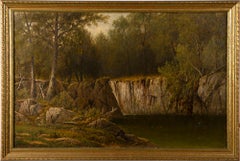
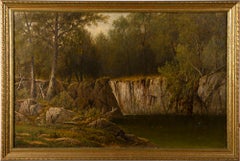
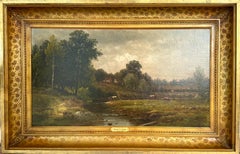
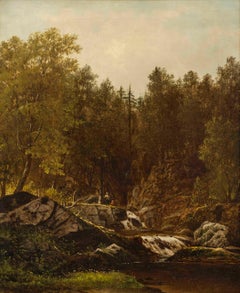
Fishermen by a Brook by Charles Wilson Knapp (American, 1823-1900)

Fishermen by a Brook by Charles Wilson Knapp (American, 1823-1900)

By Charles Wilson Knapp

Located in New York, NY

Hudson River School artist Charles Wilson Knapp's (1823-1900) "Fisherman by a Brook" is oil on canvas and measures 24 x 20 inches. The work is signed by Knapp at the lower left. The ...

Category

19th Century Hudson River School Charles Wilson Knapp Art
Materials

Canvas, Oil

Related Items
Luminous Hudson River School Landscape Cows Grazing Wide Gold Frame Oil Painting

Luminous Hudson River School Landscape Cows Grazing Wide Gold Frame Oil Painting

Located in Buffalo, NY

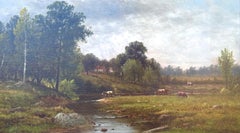
A finely rendered 19th century Hudson River School landscape depicting cattle grazing within an expansive open field, set beneath a softly illuminated sky. The composition is anchore...

Category

1860s Hudson River School Charles Wilson Knapp Art
Materials

Canvas, Oil

"Landscape with Sheep" by Daniel Folger Bigelow (1823-1910), Oil on Canvas

"Landscape with Sheep" by Daniel Folger Bigelow (1823-1910), Oil on Canvas

By Daniel Folger Bigelow

Located in Portland, OR

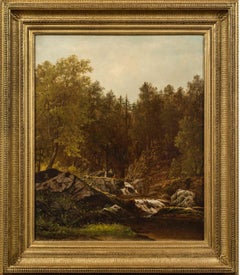
"Landscape with Sheep" by Daniel Folger Bigelow (July 22, 1823 - July 14, 1910), Oil on Canvas, signed D. F. Bigelow lower right corner. An American painter active in New England an...

Category

1890s Hudson River School Charles Wilson Knapp Art
Materials

Canvas, Oil

Large landscape oil painting of the Deer Park at Vaynol country estate, Wales

Large landscape oil painting of the Deer Park at Vaynol country estate, Wales

By George Earl

Located in Petworth, West Sussex

George Earl (British, 1824 -1908) Rivals at Dawn, Vaynol The Deer Park at Vaynol is a country estate in Gwynedd, Wales Oil on canvas Signed and dated ‘George Earl. Pinxt 1882’ (lower...

Category

19th Century Academic Charles Wilson Knapp Art

Materials

Canvas, Oil

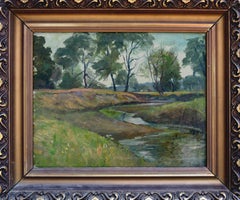
Antique American School Framed Signed Serene Lake Landscape Original Painting

Antique American School Framed Signed Serene Lake Landscape Original Painting

Located in Buffalo, NY

Antique American school landscape oil painting. Oil on canvas. Signed. Framed. Measuring: 24 by 33 inches overall, and 20 by 29 painting alone. Nice period frame. Excellent condit...

Category

1890s Hudson River School Charles Wilson Knapp Art
Materials

Oil, Canvas

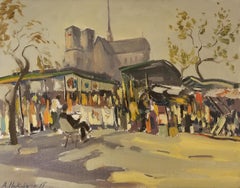
"Barcelone", City Square with Church and Dome, 19th century Oil Painting

"Barcelone", City Square with Church and Dome, 19th century Oil Painting

By August von Siegen

Located in Genève, GE

Dimensions with frame: 30 x 40,3 x 4 cm. Signed "Aug Siegen" in the lower left corner. A richly atmospheric view of a Barcelona city square centered on an elegant church façade and ...

Category

Late 19th Century Academic Charles Wilson Knapp Art

Materials

Canvas, Oil

Sheep in Pasture
Sheep in Pasture

George RieckeSheep in Pasture

$6,750

H 26 in W 46 in D 3 in

Sheep in Pasture

Located in Saratoga Springs, NY

George Riecke (1848–1930) Pastoral Landscape with Sheep Oil on canvas, 26 × 46 inches (32 × 52 inches framed) Signed lower right George Riecke’s pastora...

Category

1890s Hudson River School Charles Wilson Knapp Art
Materials

Canvas, Oil

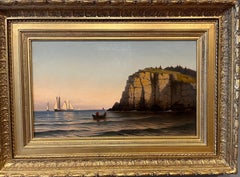
Racing Yacht Comet Off New York, Oil on Canvas, Framed, 1879

Racing Yacht Comet Off New York, Oil on Canvas, Framed, 1879

Located in Bryn Mawr, PA

Racing Yacht "Comet" Off New York, 1879 Oil on canvas 14 x 24 inches (35.6 x 61 cm) Framed dimensions: 24 1/2 x 34 1/2 inches Signed lower left: A. Cary Smith 79 Provenance Private...

Category

1870s Hudson River School Charles Wilson Knapp Art
Materials

Canvas, Oil

Mount Washington,  New Hampshire

Mount Washington, New Hampshire

By Edmund Darch Lewis

Located in Saratoga Springs, NY

Edmund Darch Lewis (1835-1910) Mount Washington, New Hampshire 50 x 58 inches, signed & dated 1859 Description The area near Mount Washington in New Hampshire was visited by m...

Category

1850s Hudson River School Charles Wilson Knapp Art
Materials

Canvas, Oil

Water Lilies
Water Lilies

Water Lilies

By George Henry Hall

Located in Bryn Mawr, PA

Water Lilies, 1881 Oil on canvas, 7 1/2 x 12 inches (19.1 x 30.5 cm) Framed dimensions: 16 1/8 x 21 1/8 inches Signed and dated lower left: Geo. Henry Hall '81 George Henry Hall was...

Category

1880s Hudson River School Charles Wilson Knapp Art
Materials

Canvas, Oil

“Woodland Study”
“Woodland Study”

James M. Hart“Woodland Study”, 1869

$3,850

H 25 in W 15 in D 2 in

“Woodland Study”

Located in San Francisco, CA

Remarkably, this painting tells its own story on the verso. To save your eyesight, here's what it reveals: James McDougal Hart (1828-1901) Landscape, animal, and portrait painter. A ...

Category

1860s Hudson River School Charles Wilson Knapp Art
Materials

Canvas, Linen, Oil

"Building the Allegheny Railroad, Pennsylvania" Alfred Wall, Scalp Level School

"Building the Allegheny Railroad, Pennsylvania" Alfred Wall, Scalp Level School

Located in New York, NY

Alfred S. Wall (American, 1825-1896) Untitled (Building the Railroad), 1859 Oil on canvas 14 1/2 x 18 1/2 inches Signed and dated lower left For Christmas, 2008, the Pittsburgh Post-Gazette featured Alfred Wall's painting, Old Saw Mill from the collection of the Westmoreland Museum of American Art in Greensburg, PA. It was painted in 1851 in the town of Lilly, Pennsylvania in the Allegheny Mountains. The newspaper description stated that "though the saw mill is long gone, it still conveys all the warmth and coziness of this time of year. The article, written by Patricia Lowry, continued: At first glance, Alfred S. Wall's painting of a saw mill in snowy woods triggers nostalgia for the coziness of a log cabin, the smell of a wood-burning fire and the warming of chilled hands and feet beside it. But as sentimental as it seems on the surface, Mr. Wall's painting has a deeper and unexpected context. This is more than a painting about sled-riding children and early industry planted in the middle of virgin forest. Intended or not, this is a painting about conquering the great divide of the Allegheny Mountains. For the third consecutive year, the Post-Gazette features a winter-scene painting on the cover of the Christmas Day newspaper. This year's painting, Old Saw Mill, was selected by co-publisher and editor-in-chief John Robinson Block and executive editor David Shribman during a visit to the Westmoreland Museum of American Art in Greensburg. Mr. Wall, listed as a portrait painter in the 1850 census, was about 26 when he painted Old Saw Mill in 1851. The self-taught artist was born in Mount Pleasant, Westmoreland County, to William and Lucy Wall, who'd emigrated from England around 1820. An artistic sensibility ran in the family: William was a sculptor who carved ornate tombstones here; Alfred's children, A. Bryan and Bessie, were landscape painters, as was Alfred's older brother, William Coventry Wall. For more than a century the Walls formed a prominent art dynasty in Pittsburgh, and Alfred, eventually a partner in the city's most prestigious art gallery, was well known as a painter, dealer and restorer. In Old Saw Mill, two wood cutters, each holding an axe, meet outside the mill; one points in the direction of the forest. On the other side of the stream, one child pulls another down the hillside on a sled. Just behind the hill's slope, the roof of a building appears, perhaps the home of the sawyer. The luminous, late afternoon light comes from the northwest, casting lengthening shadows on the snow under a darkening sky. The saw mill in "Old Saw Mill" likely would have been impossible to track down had Mr. Wall, presumably, not written on the back of the painting: "old saw mill near Jct. 4, Portage RR, Pa." "There was no Junction 4," said Mike Garcia, park ranger at the Allegheny Portage Railroad National Historic Site, about 90 miles east of Pittsburgh near Gallitzen, Cambria County. "But there was an Inclined Plane No. 4 at Lilly, and there was a saw mill there." In fact, there were at least six saw mills at Lilly over the years, said longtime resident Jim Salony, president of the Lilly-Washington Historical Society. But when he saw an image of the painting, Mr. Salony had no trouble coming up with a location. While there are no known photographs of the saw mill, he believes it stood near the intersection of Portage and Washington streets, next to Bear Rock Run. Mr. Salony, retired academic dean at Mount Aloysius College, didn't know exactly when the mill was torn down, but it's been gone since at least the late 1800s. He was pleased to learn of the painting, even though that knowledge came too late for inclusion in a new book about Lilly, The Spirit of a Community, for which he served as primary author and editor. It runs to more than 700 pages. For a little town -- population 869 last year -- Lilly has a lot of history. Nestled in a bowl on the western slope of the Allegheny Mountains about 3 miles south of Cresson, Lilly was first settled in 1806 by Joseph Meyer and his family, who named their 332-acre land patent Dundee. Although the Meyers had left by 1811, other settlers followed, but the community didn't flourish until the 1830s, when the Allegheny Portage Railroad began its 23-year-run through the town. For 200 years the Alleghenies had stood as an impediment to trade and travel between Pittsburgh and the east. A canal from Philadelphia to Pittsburgh would change that and compete with New York's Erie Canal. But a portage railroad would have to be built, on which teams of horses would lead the canal boats over the mountains. Engineer Sylvester Welch began his surveying from the small settlement at Lilly. The railroad would require 10 inclined planes, some quite steep, between Hollidaysburg and Johnstown. To build it, trees had to be cut along a 120-foot-wide right-of-way for 36 miles, along which track and engine houses had to be built. William Brown, who owned the saw mill on Bear Rock Run, built at least one of the engine houses at Inclined Plane No. 4; an 1834 contract also included fencing the dwelling lots at the head and foot of the plane. Lilly is located at what was the foot of Inclined Plane No. 4., giving the community one of its early informal names, Foot of Four. Named in 1883 for Richard Lilly, who'd completed the grist mill there, Lilly had another early name: Hemlock, so dubbed by a Portage Railroad traveler who smelled the bark stripped from the trees at the saw mill. Because there isn't another Allegheny Portage Railroad location like it, where a cut in the mountains opens into a bowl, Mr. Salony thinks it was Lilly that Charles Dickens wrote about following his trip from Harrisburg to Pittsburgh on the Pennsylvania Canal in late March 1842, describing what he saw after emerging from "the bottom of the cut": "It was very pretty while traveling, to look down into a valley full of light and softness, catching glimpses through the tree-tops of scattered cabins; children running to the doors; dogs bursting out to bark, who we could see without hearing; terrified pigs scampering homeward; families sitting out in their rude gardens; cows gazing upward with a stupid indifference; men in their shirt-sleeves looking on at their unfinished houses, planning out to-morrow's work; and we riding onward, high above them, like a whirlwind." To get to Lilly, Mr. Wall may have taken the Pennsylvania Canal from his home in Allegheny City, now the North Side. He'd married young, at 21, to Sarah Carr in 1846, the same year he began his career as an artist. By 1880 they were living in a brick townhouse at 104 (later 814) Arch St., now demolished. Across the river in Pittsburgh he shared a studio at 67 Fourth Ave. with his brother William; they later moved to Burke's Building, today the city's oldest office building at 209-211 Fourth. But often they worked outdoors, sometimes as part of the colony of artists that grew up around painter George Hetzel beginning in the late 1860s at Scalp Level...

Category

1850s Hudson River School Charles Wilson Knapp Art
Materials

Canvas, Oil

Previously Available Items
View of the Pemigewasset, New Hampshire

View of the Pemigewasset, New Hampshire

By Charles Wilson Knapp

Located in Milford, NH

A wonderful New Hampshire landscape by American artist Charles Wilson Knapp (1823-1900). Knapp was born in Philadelphia, Pennsylvania, and his work was first exhibited at the Nationa...

Category

1870s Hudson River School Charles Wilson Knapp Art
Materials

Canvas, Oil

Valley River
Valley River

Charles Wilson KnappValley River

Sold

H 39.75 in W 61.75 in D 3 in

Valley River

By Charles Wilson Knapp

Located in Milford, NH

A fine valley river landscape with cows in the style of the Hudson River School by American artist Charles Wilson Knapp (1823-1900). Knapp was bor...

Category

Late 19th Century Hudson River School Charles Wilson Knapp Art
Materials

Canvas, Oil

Charles Wilson Knapp art for sale on 1stDibs.

Find a wide variety of authentic Charles Wilson Knapp art available for sale on 1stDibs. You can also browse by medium to find art by Charles Wilson Knapp in canvas, fabric, oil paint and more. Not every interior allows for large Charles Wilson Knapp art, so small editions measuring 20 inches across are available. Customers who are interested in this artist might also find the work of Samuel Colman, Jane Bloodgood-Abrams, and John Frederick Kensett. Charles Wilson Knapp art prices can differ depending upon medium, time period and other attributes. On 1stDibs, the price for these items starts at $16,000 and tops out at $16,000, while the average work can sell for $16,000.

Artists Similar to Charles Wilson Knapp