David Young Cameron Art

British, 1865-1945
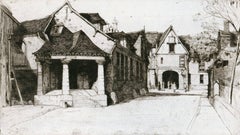
Scottish painter, etcher, and draughtsman, born in Glasgow, the son of a clergyman. He abandoned brief unhappy careers in commerce and law to study at *Glasgow School of Art and the Royal Scottish Academy in Edinburgh. Most of his work consisted of landscapes (especially scenes of mountains) and architectural views, and he is best known for his etchings of buildings, including Gothic churches on the Continent, ”rich and sombre" works with which he established a reputation as one of the outstanding printmakers of the day.
to
3
1
Overall Width
to
Overall Height
to
3
1
1
4
1
1
1
1
1
4
1
1
1
1
4
11,770
2,886
2,541
1,621
1
4
Artist: David Young Cameron
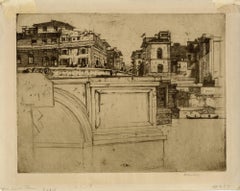
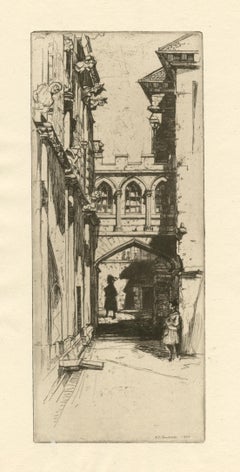
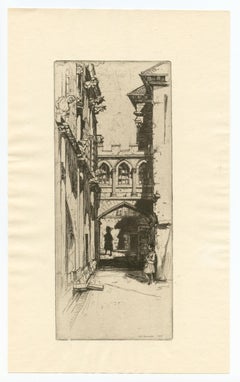
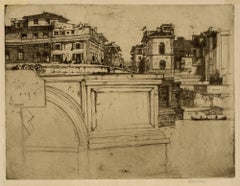
Ponte della Trinità, Florence

Ponte della Trinità, Florence

By David Young Cameron

Located in Middletown, NY

Etching and drypoint on tissue-thin cream laid paper, 6 5/8 x 8 1/8 inches (167 x 205 mm), full margins. Signed in pencil in the lower right margin, and inscribed "Ponte Trinità, Florence" in pencil the lower left margin. Non-archival paper tape tabs at the top right and left corners on the verso, with minor associated discoloration which presents on the recto. Minor, light mat tone, and some very small losses at the extreme corners, well outside of image area. The numerals "325" written in pencil in the lower right margin, in reference to the Rinder catalog number. A beautiful, silvery, early-state impression. Rinder 325 [Rinder 325 iii/vii]. The son of a clergyman, Sir David Young Cameron was born in Glasgow in 1865. After a brief and unhappy dalliance in the fields of business and law, Cameron began attending the prestigious Glasgow School of the Arts in 1881, and later the Edinburgh School of the Arts. At first associated with the Glasgow Boys (John Lavery, Joseph Crawhall...

Category

Early 20th Century Modern David Young Cameron Art

Materials

Laid Paper, Drypoint, Etching

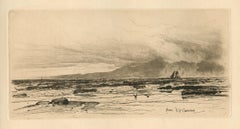
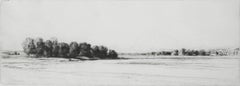
"Arran" original etching

"Arran" original etching

By David Young Cameron

Located in Henderson, NV

Medium: original etching and drypoint. This impression on on cream wove paper was printed in 1889. Plate size: 5 x 9 3/4 inches (125 x 250 mm). Signed and titled in the plate (not ha...

Category

1880s David Young Cameron Art

Materials

Etching

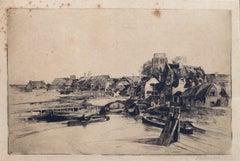
DY Cameron 19th c. European Village Etching

DY Cameron 19th c. European Village Etching

By David Young Cameron

Located in New York, NY

D.Y. (David Young) Cameron (Scottish, 1865-1945) The Border Tower, c. 1893 Etching Sight: 9 x 13 1/4 in. Framed: 15 1/4 x 19 1/2 x 1/2 in. Signed in pencil lower right Cameron trained at the Glasgow and Edinburgh Schools of Art in the early 1880s and was at first associated with the Glasgow Boys. He became a leader in the Scottish etching...

Category

1890s Academic David Young Cameron Art

Materials

Etching

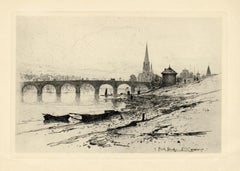
"Perth Bridge" original etching

"Perth Bridge" original etching

By David Young Cameron

Located in Henderson, NV

Medium: original etching. Catalogue reference: Rinder 28. Executed in 1889; this is a fine, dark impression on wove paper from "The Portfolio" edition, published in London by Seeley,...

Category

1880s David Young Cameron Art

Materials

Etching

Related Items
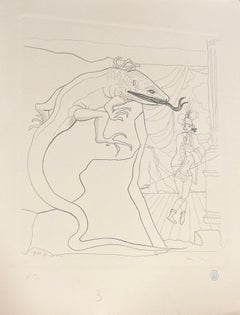
French Modern Art by Jean Cocteau - Le Lézard et Le Page

French Modern Art by Jean Cocteau - Le Lézard et Le Page

By Jean Cocteau

Located in Paris, IDF

Etching or eau-forte on archival paper with H.C. in pencil at lower left, indicating a Hors Commerce (Artist's/Publisher's Proof) including pencil signature that appears to read Jean...

Category

1930s Symbolist David Young Cameron Art

Materials

Archival Paper, Etching

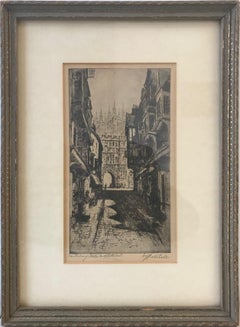
Canterbury Gate Cathedral

Canterbury Gate Cathedral

By Preston Cribb

Located in New York, NY

Preston Cribb (English, 1876-1937) "Canterbury Gate Cathedral", Etching titled and signed in Pencil, 13.63 x 9.50 Framed (Image: 9.50 x 5.25), Early to Mid 20th Century Colors: Bla...

Category

Mid-20th Century Academic David Young Cameron Art

Materials

Etching

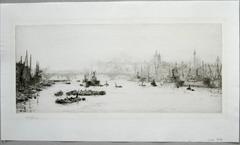
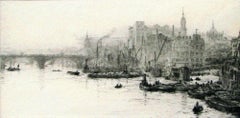
London Bridge.
London Bridge.

William Lionel WyllieLondon Bridge., 1924

$975Sale Price|22% Off

H 13.13 in W 20 in D 0.5 in

London Bridge.

By William Lionel Wyllie

Located in Plano, TX

London Bridge, London. 1924. Etching and drypoint. 6 3/8 x 14 3/4 (sheet 9 7/8 x 17 1/4). Mat line; otherwise fine condition. A rich impression with dryp...

Category

1920s Modern David Young Cameron Art

Materials

Drypoint, Etching

Five Locations

Ross BlecknerFive Locations, 2007

$4,000

H 39.5 in W 30 in

Five Locations

By Ross Bleckner

Located in Berkeley, CA

Color spitbite aquatint with chine colle. Edition of 50

Category

21st Century and Contemporary Contemporary David Young Cameron Art

Materials

Etching

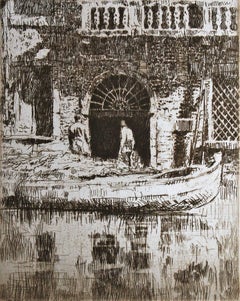
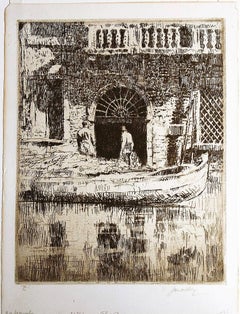
The Doorway.
The Doorway.

James McBeyThe Doorway., 1925

$1,450

H 20 in W 16 in

The Doorway.

By James McBey

Located in Plano, TX

Hardie/Carter 244. 8 1/16 x 6 3/8 (sheet 10 1/4 x 8 1/4). Edition 80, #52. Illustrated: Guichard, British Etchers, 1850-1940; ; Eric Denker, Reflections & Undercurrents: Ernest Roth ...

Category

Early 20th Century Modern David Young Cameron Art

Materials

Drypoint, Etching

Early Banana Peel Sunrise Print, Contemporary Etching, 2010s, Framing Available

Early Banana Peel Sunrise Print, Contemporary Etching, 2010s, Framing Available

By David Onri Anderson

Located in Columbus, OH

“I had been eating bananas every day for several years when I finally got the idea to start paying homage to this source of energy and inspiration in my life. I love how banana peels...

Category

2010s Contemporary David Young Cameron Art

Materials

Etching, Archival Ink

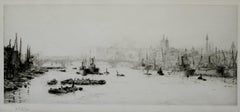
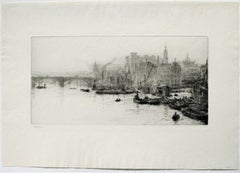
The Pool  of London.

William Lionel WyllieThe Pool of London., c. 1915

$1,500Sale Price|23% Off

H 20 in W 23.5 in D 0.5 in

The Pool of London.

By William Lionel Wyllie

Located in Plano, TX

The Pool of London. c. 1915. Etching and drypoint. 7 7/8 x 15 7/8 (sheet 11 x 14 7/8 x 21 1/4). A rich impression with drypoint burr printed on the full sheet of simili-Japan paper. ...

Category

1910s Modern David Young Cameron Art

Materials

Drypoint, Etching

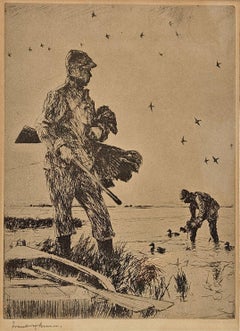
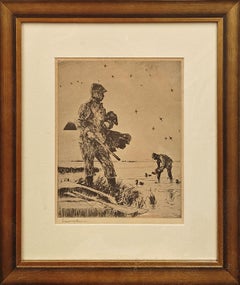
"Winter Wildfowling" Frank Weston Benson, Hunting Scene, Outdoors, Marshes

"Winter Wildfowling" Frank Weston Benson, Hunting Scene, Outdoors, Marshes

By Frank Weston Benson

Located in New York, NY

Frank Weston Benson Winter Wildfowling, 1927 Signed lower left Etching on paper Image 8 1/2 x 7 inches Born in Salem, Massachusetts, a descendant of a long line of sea captains, Benson first studied art at Boston’s Museum School where he became editor of the student magazine. In 1883, Benson enrolled at the Académie Julian in Paris where artists such as Bouguereau, Lefebvre, Constant, Doucet and Boulanger taught students from all over Europe and America. It was Boulanger who gave Benson his highest commendation. “Young man,” he said, “Your career is in your hands . . . you will do very well.” Benson’s parents gave him a present of one thousand dollars a twenty-first birthday and told him to return home when it ran out. The money lasted long enough to provide Benson with two years of schooling in Paris, a summer at the seaside village of Concarneau in Brittany and travel in England. Upon returning to America, Benson opened a studio on Salem’s Chestnut Street and began painting portraits of family and friends. An oil of his wife, Ellen Perry Peirson, dressed in her wedding gown is representative of this period. It demonstrates not only the academic techniques he learned at the Academie Julian but also his own growing emphasis on the effects of light. And yet, despite all the technical mastery displayed in the work, the painting exudes the warmth that existed between model and artist. More than a likeness, it is a study in serenity. Perhaps it was of a work such as this that Benson was thinking when he said, “The more a painter knows about his subject, the more he studies and understands it, the more the true nature of it is perceived by whoever looks at it, even though it is extremely subtle and not easy to see or understand. A painter must search deeply into the aspects of a subject, must know and understand it thoroughly before he can represent it well.” Following a brief stint as an instructor at the Portland, Maine, Society of Art, Benson was appointed as instructor of antique drawing at the Museum School in Boston in the spring of l889. Benson’s long association with the school was particularly fruitful. Under the leadership of Edmund Tarbell and Benson the Museum School became a national and internationally recognized institution. The students won numerous prizes, enrollment tripled, a new school building was erected and visiting delegations from other schools sought the secret of their success. Benson cherished his role as teacher and was held in high esteem by his students, many of whom called him “Cher Maitre.” Reminiscing about his long career with the school Benson once said, “I may have taught many students, but it was I who learned the most.” In 1890, Benson won the Hallgarten Prize at the National Academy in New York. It was the first of a long series of awards, that earning for him the sobriquet “America’s Most Medalled Painter.” In the early years of his career, Benson’s studio works were mostly portraits or paintings of figures set in richly appointed interiors. Young women in white stretch their hands out towards the glow of an unseen fire; girls converse on an antique settee in a room full of objets d’arts; his first daughter, Eleanor, poses with her cat. Works of this sort, together with a steady influx of portrait commissions, earned Benson both renown and financial rewards, yet it was in his outdoor works that gave Benson his greatest pleasure. In the latter half of the 1890s, Benson summered in Newcastle, on New Hampshire’s short stretch of seacoast. It was here, in 1899, that Benson made his first foray into impressionism with Children in the Woods and The Sisters, the latter a sun-dappled study of his two youngest daughters, Sylvia and Elisabeth. This painting was one of the first works that Benson hung at an exhibition with nine friends. The resignation of these ten illustrious artists rocked the American art establishment but, the catalogue for their first exhibition was titled, simply, “Ten American Painters.” When, in 1898, the three Bostonians and seven New Yorkers began to exhibit their best work in exquisitely arranged small shows, the group (dubbed by newspapers, “The Ten” ) quickly became known as the American Impressionists, a bow to the style of their French predecessors. The Ten’s annual shows soon became an eagerly awaited part of the annual exhibition calendar and were always well reviewed. Held annually in New York City, the group’s yearly exhibitions usually traveled to Boston and were occasionally seen in other cities. Benson’s association with other members of the group such as Childe Hassam, Thomas Dewing, William Merrit Chase and J. Alden Weir, only reinforced his growing emphasis on the tenets of Impressionism. As he later said to his daughter Eleanor, “I follow the light, where it comes from, where it goes.” The principles of Impressionism began to dominate Benson’s work by 1901, the year that the Bensons first summered on the island of North Haven in Maine’s Penobscot Bay. His summer home “Wooster Farm,” which they rented and finally bought in 1906, became the setting for some of Benson’s best known work and there, it seemed, he found endless inspiration. Benson’s sparkling plein-air paintings of his children–Eleanor, George, Elisabeth and Sylvia–capture the very essence of summer and have been widely reproduced: In The Hilltop, George and Eleanor watch the sailboat races from the headland near their house. As a boy, Benson dreamed of being an ornithological illustrator. In mid-life, he returned to the wildfowl and sporting subjects that had remained his lifelong passion. Using etching and lithography, watercolor, oil and wash, Benson portrayed the birds observed since childhood and captured scenes of his hunting and fishing expeditions. Together with his two brothers-in-law, Benson bought a small hunting retreat on a hill overlooking Cape Cod’s Nauset Marsh. Here, in the late 1890s, he began experimenting with black and white wash drawings. These paintings became so popular that Benson was not able to keep up with the demand. He turned to an art publishing company to have several made into it intaglio prints; twelve wash drawings are known to have been reproduced in this manner. At least two of them were given as gifts to associate members of the Boston Guild of artists, of which Benson was a founding member. Benson was also an avid fisherman and his salmon fishing expeditions to Canada’s Gaspé Peninsula where one of the high points of his summer. There, in 1921, he began the first in a series of watercolors that would eventually over 500 works. Benson’s watercolors conveyed the joy and beauty of a sportsman’s life whether in a painting of a hunter setting out decoys, a flock of ducks coming in for a landing or a grouse flushed from cover. The critics favorably compared Benson’s watercolors to those of Homer. “The love of the almost primitive wilderness which appears in many of Homer’s landscapes and the swift, sure touch with which he suggests rather than describes–these also characterize Benson’s work,” one critic wrote. “The solitude of the northern woods is very much like Homer’s.” Like the wash drawings before them, Benson’s watercolors proved...

Category

1920s Academic David Young Cameron Art
Materials

Paper, Etching

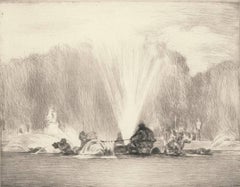
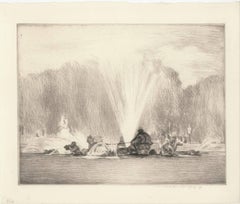
Bassin d'Apollon, Versailles (Fountain of Appollo, Versailles).

Bassin d'Apollon, Versailles (Fountain of Appollo, Versailles).

By Mortimer Menpes

Located in Plano, TX

Bassin d'Apollon, Versailles (Fountain of Appollo, Versailles). Drypoint. Menpes 364. 7 1/8 x 9 1/8 (sheet 8 13/16 x 10 7/8). A very rich impression with drypoint burr and plate tone...

Category

Early 20th Century Modern David Young Cameron Art

Materials

Drypoint, Etching

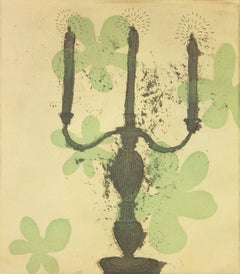
Light

Squeak CarnwathLight, 2011

$1,000

H 15 in W 12 in

Light

By Squeak Carnwath

Located in Berkeley, CA

Color aquatint etching on Rives light weight cream paper

Category

2010s Contemporary David Young Cameron Art

Materials

Etching, Aquatint

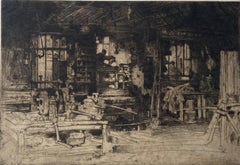
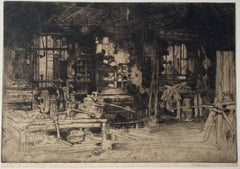
The Workshop (Stirling)

Sir David Young Cameron, R.A.The Workshop (Stirling), 1895

$1,000Sale Price|50% Off

H 8.19 in W 12 in D 0.5 in

The Workshop (Stirling)

By Sir David Young Cameron, R.A.

Located in Plano, TX

The Workshop (Stirling). 1905. Etching and drypoint. Rinder 369 state .ii/iv.Image: 8 3/16 x 12 (sheet 8 5/16 x 12). No published edition. A rich impression with drypoint burr printe...

Category

Early 20th Century Modern David Young Cameron Art

Materials

Etching, Drypoint

Fisherman Boats on the Scheldt - Original Etching

Fisherman Boats on the Scheldt - Original Etching

Located in Paris, IDF

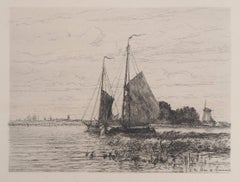
Carel Nicolaas STORM VAN'S GRAVENSANDE Fisherman Boats on the Scheldt Original etching Printed signature in the plate On laid paper, 26,5 x 38 cm (c. 10,4 x 14,9 inch) Excellent co...

Category

19th Century Academic David Young Cameron Art

Materials

Etching

Previously Available Items
"In Stirling Castle" original etching

"In Stirling Castle" original etching

By David Young Cameron

Located in Henderson, NV

Medium: original etching and drypoint. Executed in 1899. This impression is printed on cream laid paper. Plate size: 7 7/8 x 3 3/8 inches (200 x 85 mm). Signed in the plate (not hand...

Category

1890s David Young Cameron Art

Materials

Etching

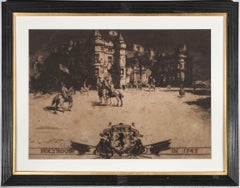
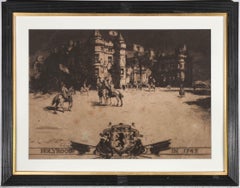
David Young Cameron - 1896 Etching, Culloden, Holyrood in 1745

David Young Cameron - 1896 Etching, Culloden, Holyrood in 1745

By David Young Cameron

Located in Corsham, GB

This striking etching depicts Jacobite troupes gathering in the courtyard of Holyrood House ahead of the Battle of Culloden in 1745. The palace played a significant part in Bonnie prince Charlie's attempt to restore his family's line to the British throne...

Category

Late 19th Century David Young Cameron Art

Materials

Etching

Loch Chon - Academic Oil, Lake in Scottish Landscape - Sir David Young Cameron

Loch Chon - Academic Oil, Lake in Scottish Landscape - Sir David Young Cameron

By David Young Cameron

Located in Marlow, Buckinghamshire

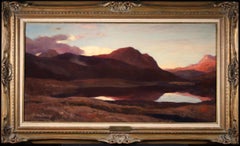
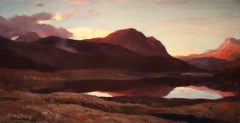
A magnificent large oil on canvas circa 1915 by Scottish academic painter Sir David Young Cameron RA. The work depicts a view if Loch Chon in the Trossachs, Scotland. The vast hills in the landscape reflect in the still water below as the sun sets with light bouncing off the clouds in the blue sky. Signature: Signed lower right Dimensions: Framed: 28"x46" Unframed: 19"x37" Provenance: William Scott & Sons - Montreal, Canada (original labels verso) David Cameron was the son of a Protestant minister. He studied at evening classes in Glasgow and at the Royal Institution in Edinburgh in 1885. Cameron began engraving at the age of 18. He first exhibited in Glasgow and achieved success at a young age. He exhibited at the 'Secession' exhibition in Berlin and in Munich. In 1893 he was awarded medals in Antwerp and Chicago, in 1895 a silver medal in Brussels, in 1897 a gold medal in Dresden, in 1900 a gold medal at the Paris Exposition Universelle and in 1905 a gold medal in Munich. In 1919 he taught at the British School in Rome. Cameron was knighted in 1924. He became an associate member of the Royal Scottish Academy and a member of the Society of Watercolourists of England and of Scotland. He contributed to several publications and magazines and also illustrated literary works including An Elegy by Robert Louis Stevenson in 1896 and the Story of the Tweed by H. Maxwell in 1905. Cameron became one of the most influential artists of the Glasgow School, who, like their French counterparts, promoted the custom of open-air painting. His paintings and engravings were preceded by numerous preparatory drawings. By 1890, Cameron was at his best and proved this in two etchings entitled Kitchen in the Highlands; Greenock. He drew, painted and engraved subjects that he encountered on his travels and was particularly attracted by architectural landscapes. In 1892 Cameron published Views of Holland, which includes the well-known plate Stormy Sunset. It was the following series of views that made his reputation: the 1896 Views of North Italy and the 1900 Views of London which includes the plates The Admiralty, The Customs and Newgate acclaimed by the art critic Frederick Wedmore who drew up the catalogue of Cameron's work in 1903 when the artist was still only 38 years old. After the publication of the catalogue other works followed: the 1907 Views of Belgium and the 1909 Views of Paris. Cameron is often compared with Meryon and considered to be his successor in the engraving of Romantic architecture, often depicted under dramatic lighting effects such as storms and sunsets. He is also seen as revealing a Post-Impressionist style which allies him to Whistler. In Cameron's landscape paintings the Post-Impressionist influence is even more marked. He was directly inspired by Gauguin and worked in flat tints of clear colour in the manner of the Nabis. Museum and Gallery Holdings Dundee (University Fine Art Collection): Lunan Bay...

Category

1910s Academic David Young Cameron Art
Materials

Canvas, Oil

Old Museum, Beauvais

Old Museum, Beauvais

By David Young Cameron

Located in Plano, TX

Rinder catalog 467 state .iii. 6 7/8 x 12 1/4 (sheet 8 3/16 x 13 1/16). Edition about 6. Of these, 36 were sent to New York, the gross proceeds being a gift from the artist to the A...

Category

1910s Modern David Young Cameron Art
Materials

Drypoint, Etching

Kincardine (Scotland)

Kincardine (Scotland)

By David Young Cameron

Located in Plano, TX

Kincardine. 1914. Etching. Rinder catalog 454 state vii. 6 7/8 x 12 1/2 (sheet 6 9/16 x 13 7/8). Edition about 60. Exhibited: Society of Twelve, 1916, No. 90; Victoria and Albert Mus...

Category

1910s Old Masters David Young Cameron Art
Materials

Etching

David Young Cameron art for sale on 1stDibs.

Find a wide variety of authentic David Young Cameron art available for sale on 1stDibs. You can also browse by medium to find art by David Young Cameron in etching, drypoint, engraving and more. Much of the original work by this artist or collective was created during the 20th century and is mostly associated with the modern style. Not every interior allows for large David Young Cameron art, so small editions measuring 9 inches across are available. Customers who are interested in this artist might also find the work of Oliver Hall, R.A., R.E., R.S.W., Sir David Young Cameron, R.A., and Robin Tanner. David Young Cameron art prices can differ depending upon medium, time period and other attributes. On 1stDibs, the price for these items starts at $150 and tops out at $2,250, while the average work can sell for $509.