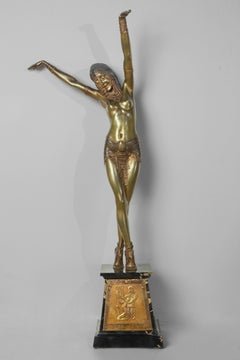
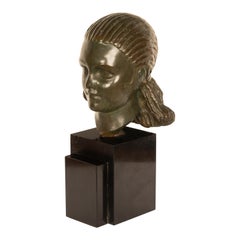
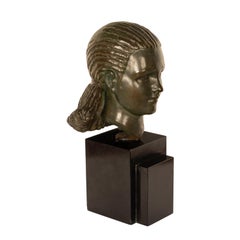
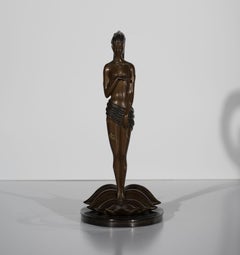
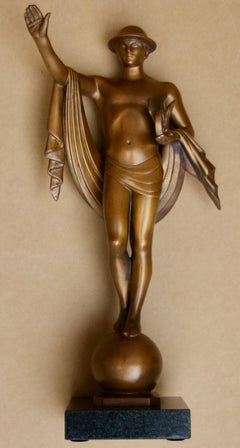
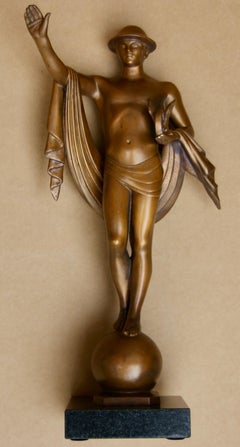
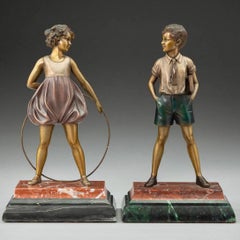
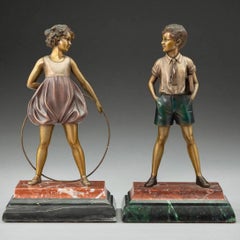
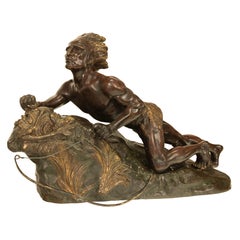
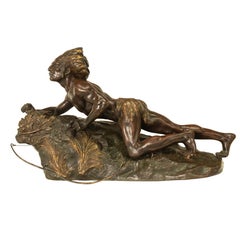
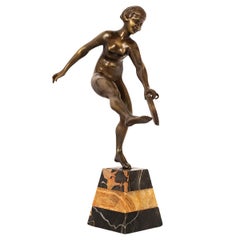
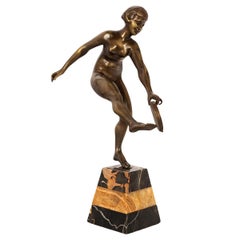
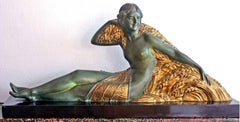
Demetre Chiparus Egyptian Dancer
By Demetre Chiparus
Located in Miami, FL
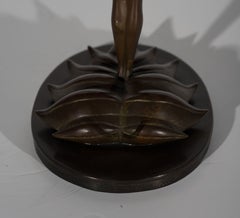
Demetre Chiparus Egyptian Dancer, ca. 1920 Bronze, enamel, gilt metal, and marble 29 in Signed to base 'Chiparus'
1920s Art Deco Demetre Chiparus Sculptures
Bronze
Romanian sculptor Demetre Chiparus — who is sometimes referred to as Dumitru Chiparus or Dimitri Chiparus — was a renowned Art Deco-era artist most often associated with realism. He initially created sculptures that featured small children. As his work began to mature, he continued to create figurative sculptures but shifted his focus, and his output was marked by an appreciation for the lithe female form — a popular subject during the 1920s. Chiparus was later known for his animal sculptures, too.
Chiparus lived comfortably as an artist owing in part to his family fortune. At the age of 23, he moved to Italy and began his formal art and sculpting studies under Italian sculptor Raffaello Romanelli. Following his time in Italy, he moved to Paris where he attended L'École des Beaux-Arts. He studied under sculptors Antonin Mercie and Jean Boucher. He was inspired by the Russian Ballet, French theater and early motion pictures.
Though he wouldn’t sell many of his pieces during his lifetime, Chiparus was well known for his bright and colorful busts and sculptures featuring dancing ladies. He was equally inspired by the discovery of King Tut’s tomb — a common influence for designers and artists of the Art Deco era — which is obvious in his references to Egyptian themes in his decorative objects and other realist works.
Chiparus worked with a combination of ivory and bronze to create chryselephantine sculptures, a method and type of sculpture that was particularly popular during the Archaic period. The bases of his pieces were typically made of marble or onyx and he adorned his life-like subjects with vibrant enamel that lent a touch of whimsicality to his art.
Chiparus exhibited his works at the Salon of 1914 and lived in Paris until his death. A range of his sculptures is held in the permanent collection of the Museo Art Nouveau and Art Deco in Spain.
Find original Demetre Chiparus decorative objects, sculptures and other works on 1stDibs.
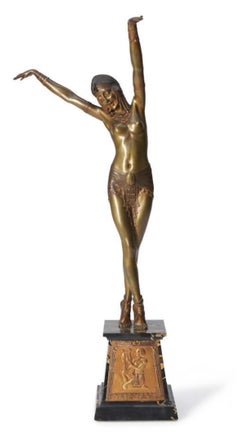
Demetre Chiparus Egyptian Dancer
By Demetre Chiparus
Located in Miami, FL
Demetre Chiparus Egyptian Dancer, ca. 1920 Bronze, enamel, gilt metal, and marble 29 in Signed to base 'Chiparus'
Bronze
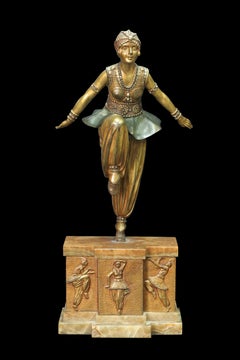
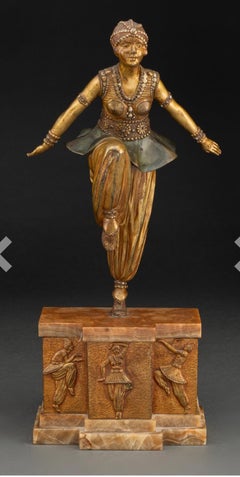
Oriental Dancer
By Demetre Chiparus
Located in Miami, FL
Oriental Dancer Cold-painted Bronze Figure, circa 1925 on a shaped marble plinth inset with bronze medallions 15 in high, signed to base 'Chiparus' Demetre Chiparus was a Romanian s...
Bronze
$12,936
H 37.01 in W 41.74 in D 17.72 in
Pair Bronze Greyhounds Dogs Art Deco France 20th Century
Located in Riva del Garda, IT
Pair of greyhounds French sculptor Art Deco style - 20th century Bronze, lost wax casting Dimensions (cm): male height 94 cm/length 106 cm/width 45 cm female: height 89 cm/len...
Bronze
Triumph, Signed and Numbered Art Deco Bronze Sculpture by Erté
By Erté
Located in Long Island City, NY
Erté's Triumph celebrates victory and achievement through Art Deco sculptural design with elegant bronze craftsmanship. This striking metal sculpture features the artist’s signature...
Bronze
Art Deco Silver-coated Bronze Falcon Sculpture
Located in Long Island City, NY
Artist: Prince Title: Falcon Year: 2006 Medium: Silver-coated Bronze Sculpture Size: 22 in. x 5 in. x 5 in. (55.88 cm x 12.7 cm x 12.7 cm)
Bronze
An Evening in 1922, Erté
By Erté
Located in Fairfield, CT
Artist: Erte, Romain de Tirtoff (1892-1990) Title: An Evening in 1922 Year: 1982 Medium: Bronze Edition: 61/250 Numbered, 12 AP, 9 HC Size: 17 inches Condition: Excellent Inscription...
Bronze
Golden Fleece
By Erté
Located in Greenwich, CT
Erté designed Golden Fleece for a Folies-Bergére scene entirtled "The Golden Fleece" and a 1926 George White's Scandals scene entitled "La Toison d'or." Erté, whose artistic style was influenced in part by a childhood admiration of classic Greek art, was always drawn to a good story with a sense of drama – typified by Greek tragedy. Catalogue - Erté: The Last Works (Dutton, pgs. 115, 207). From the total edition of 462; numbered 207/375 (there were also 50 Roman and 37 AP). Referring to the legend of Jason and the Argonauts, the Golden Fleece sculpture depicts an elegant woman in a classic Greek garment. The curled horns of the ram style her headdress, elegant in appearance and yet fierce in battle. Descending from these horns is the golden fleece itself, its curly mane covering the woman to her toes. Her gown, a gracefully draped toga, is designed to leave one breast bared, in the folkloric tradition of the Amazon tribe of women warriors...
Bronze
Art Deco Bronze Nude Girl with Fawn, Amazon with Fawn
By Pierre Traverse
Located in Miami, FL
Signed on base. This was exhibited at the Goldscheider Pavilion at the 1925 Paris Exhibition Marble base has loss to right edge and very small lose to center edge. , Bronze is in ve...
Bronze
Mermaid
By Erté
Located in Greenwich, CT
Whether in the draping of a silk gown worn by an opera diva, or in the sparkle of an intricately beaded headdress worn by a woman of society, Erté had an exceptionally acute visual memory of every detail of his early design creations. It was no wonder then that his fashion designs were so adeptly applied to the sculpture format. In Mermaid, we have a fine example of how Erté carried the technical possibilities of the sculpture medium to a new level. This attention to detail added to his legend as one of the Twentieth Century’s foremost artist-designers, with work represented in the collections of the Metropolitan Museum of Art, New York, the Museum of Modern Art, New York, the Paris Opera House, the Smithsonian Institution and the Victoria and Albert Museum, London. Through Mermaid, Erté takes us beyond the female form by choosing the intriguing legendary sea creature whose upper body is that of a woman, and whose lower body is that of an aquatic creature. In quintessential Erté style...
Bronze
Two goudou antelopes
By Rembrandt Bugatti
Located in PARIS, FR
Two goudou antelopes « Two friends » by Rembrandt BUGATTI (1884-1916) Group in bronze with a nuanced brownish black patina Signed on the base "R.Bugatti" A lost wax cast by "A.A. Hé...
Bronze
$8,191
H 15.75 in W 18.12 in D 9.45 in
Bronze Sculpture Winged Buffalo Bronze 1921
By Badeau Georges Laurent
Located in Saint-Ouen, FR
Bronze Sculpture with Black Patina dated 1929 Signed G.L.BADEAU and dated 1929 on the corner of the base Seal of the founder BISCEGLIA on the base Put on an independent marble Pedest...
Bronze
Cornucopia
By Erté
Located in Greenwich, CT
Cornucopia pays homage to the great goddesses of abundance and fortune, with a modern twist – rather than showing the bounty of the earth overflowing from the horn, this Cornucopia o...
Bronze
$70,000
H 78 in W 20 in D 20 in
Woman, Black, Abstract, Twist, Dance, Gown, Art Deco, Garden, By Commission
By David Hostetler
Located in Nantucket, MA
Summertime Lady can be commissioned. You can have it with the black finish or painted Ferrari Red. I've cast it in a pale green patina for a pool in Bermuda. Outstanding focal point ...
Bronze
Coty Award
Located in Los Angeles, CA
Created C. 1943, award presented in 1965 to Gertrude Seperack for her design work in the fashion induustry. The bronze portion measures 14 x 8.5 inches. The Coty American Fashion Cri...
Bronze
Portrait of Julienne Lullier
By Demetre Chiparus
Located in Los Angeles, CA
Portrait of the artist’s wife. Demetre Haralamb Chiparus (also known as Dumitru Chiparus) (16 September 1886 in Dorohoi, Romania - 22 January 1947 in Paris, France) was a Romanian Art Deco* era sculptor who lived and worked in Paris. He was born in Romania, the son of Haralamb and Saveta. In 1909 he went to Italy, where he attended the classes of Italian sculptor Raffaello Romanelli. In 1912 he traveled to Paris to attend the Ecole des Beaux Arts* to pursue his art at the classes of Antonin Mercie and Jean Boucher. Demetre Chiparus died in 1947 and was buried in Bagneux cemetery, just south of Paris. The first sculptures of Chiparus were created in the realistic style and were exhibited at the Salon of 1914. He employed the combination of bronze and ivory, called chryselephantine*, to great effect. Most of his renowned works were made between 1914 and 1933. The first series of sculptures manufactured by Chiparus were the series of the children. The mature style of Chiparus took shape beginning in the 1920s. His sculptures are remarkable for their bright and outstanding decorative effect. Dancers of the Russian Ballet, French theatre, and early motion pictures were among his more notable subjects and were typified by a long, slender, stylized appearance. His work was influenced by an interest in Egypt, after Pharaoh Tutankhamen's tomb was excavated. He worked primarily with the Edmond Etling and Cie Foundry in Paris administrated by Julien Dreyfus. Les Neveux de J. Lehmann was the second foundry which constantly worked with Chiparus and produced the sculptures of his models. Chiparus rarely exhibited at the Salon. In 1923 he showed his Javelin Thrower, and in 1928 exhibited his Ta-Keo dancer. During the period of Nazi persecution and the World War II, the foundries discontinued production of work by Chiparus. The economic situation of that time was not favorable to the development of decorative arts and circumstances for many sculptors worsened. Since the early 1940s almost no works of Chiparus were sold, but he continued sculpting for his own pleasure, depicting animals in the Art Deco style. At the 1942 Paris Salon, the plaster sculptures Polar Bear...
Bronze
Sold
H 9.5 in W 14.75 in D 3 in
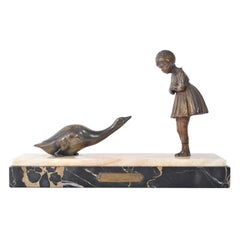
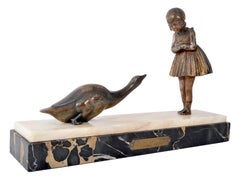
Antique French Art Deco Bronze Figural Group/Statue 1930's D. H. Chiparus
By Demetre Chiparus
Located in Portland, OR
Antique French Art Deco Bronze Figural Group/Statue, Demetre Haralamb Chiparus (1886-1947), 1930s. The bronze showing a whimsical scene of a ...
Marble, Bronze
ART DECO NUDE
By Demetre Chiparus
Located in Los Angeles, CA
DEMETRE CHIPARUS BRONZE, SIGNED WITH PSEUDONYM DARCLES FRANCE, C.1930 11.5 X 30.75 INCHES Demetre Chiparus created many of his sculptures in plasterline and sold them to the foundaries who then paid him commissions for how many they sold, therefore many sculptures are unsigned or signed differently as in the case with this model signed Darcles. Other known pseudonym for Chiparus are Darcourt and Audin. Demetre Chiparus 1888-1950 Demetre Haralamb Chiparus (also known as Dumitru Chiparus) (16 September 1886 in Dorohoi, Romania - 22 January 1947 in Paris, France) was a Romanian Art Deco* era sculptor who lived and worked in Paris. He was born in Romania, the son of Haralamb and Saveta. In 1909 he went to Italy, where he attended the classes of Italian sculptor Raffaello Romanelli. In 1912 he traveled to Paris to attend the Ecole des Beaux Arts to pursue his art at the classes of Antonin Mercie and Jean Boucher. Demetre Chiparus died in 1947 and was buried in Bagneux cemetery, just south of Paris. The first sculptures of Chiparus were created in the realistic style and were exhibited at the Salon of 1914. He employed the combination of bronze and ivory, called chryselephantine, to great effect. Most of his renowned works were made between 1914 and 1933. The first series of sculptures manufactured by Chiparus were the series of the children. The mature style of Chiparus took shape beginning in the 1920s. His sculptures are remarkable for their bright and outstanding decorative effect. Dancers of the Russian Ballet, French theatre, and early motion pictures were among his more notable subjects and were typified by a long, slender, stylized appearance. His work was influenced by an interest in Egypt, after Pharaoh Tutankhamen's tomb was excavated. He worked primarily with the Edmond Etling and Cie Foundry in Paris administrated by Julien Dreyfus. Les Neveux de J. Lehmann was the second foundry which constantly worked with Chiparus and produced the sculptures of his models. Chiparus rarely exhibited at the Salon. In 1923 he showed his Javelin Thrower, and in 1928 exhibited his Ta-Keo dancer. During the period of Nazi persecution and the World War II, the foundries discontinued production of work by Chiparus. The economic situation of that time was not favorable to the development of decorative arts and circumstances for many sculptors worsened. Since the early 1940s almost no works of Chiparus were sold, but he continued sculpting for his own pleasure, depicting animals in the Art Deco style. At the 1942 Paris Salon, the plaster sculptures Polar Bear and American Bison were exhibited, and in 1943 he showed a marble Polar Bear and plaster Pelican. Sculptures of Dimitri Chiparus...
Bronze
woman
By Demetre Chiparus
Located in Nice, FR
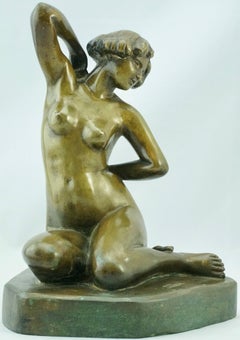
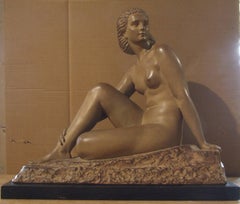
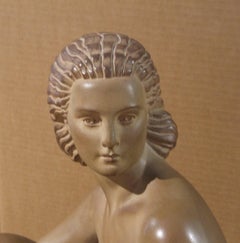
A rare sculpture made of clay by Demeter Chiparus, representing a sit nude woman. Signed on the sculpture. On a wood basement. Demétre Haralamb Chiparus...
Clay
Wheat Art Deco by Demetre Chiparus
By Demetre Chiparus
Located in Miami, FL
Beautiful large work and it's very heavy. Bronze with green and gold patina. It is very heavy
Bronze