Ebenezer Challis Art

to
1
Overall Width
to
Overall Height
to
1
1
1
1
1
1
1
1
1
10,339
2,808
2,500
1,410
1
Artist: Ebenezer Challis
Related Items
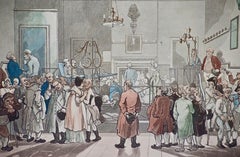
Bow Street Office: Rowlandson Hand-colored Engraving from Microcosm of London

Bow Street Office: Rowlandson Hand-colored Engraving from Microcosm of London

By Thomas Rowlandson

Located in Alamo, CA

An early 19th century print entitled "Bow Street Office", an illustration (Plate 11) from "The Microcosm of London", published in London in 1808 by R. Acker...

Category

Early 1800s Other Art Style Ebenezer Challis Art

Materials

Aquatint, Etching

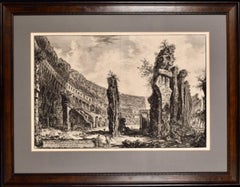
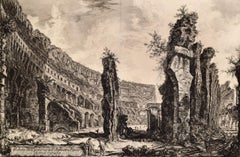
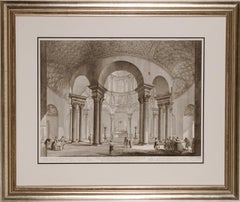
The Roman Colosseum: A Framed 18th Century Etching of the Interior by Piranesi

The Roman Colosseum: A Framed 18th Century Etching of the Interior by Piranesi

By Giovanni Battista Piranesi

Located in Alamo, CA

This large framed 18th century etching by Giovanni Battista Piranesi entitled "Veduta dell'interno dell'Anfiteatro Flavio detto il Colosseo" (View of the interior of the Flavian Amph...

Category

1760s Old Masters Ebenezer Challis Art

Materials

Etching

William Hogarth's "Analysis of Beauty": A Set of Two Framed 18th C. Engravings

William Hogarth's "Analysis of Beauty": A Set of Two Framed 18th C. Engravings

By William Hogarth

Located in Alamo, CA

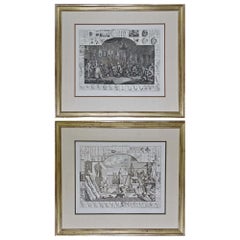
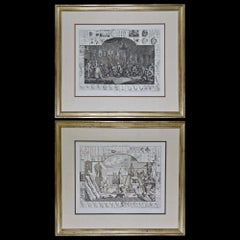
The two plates in this set were created utilizing both engraving and etching techniques by William Hogarth in 1753, originally as illustrations of his book on aesthetics, entitled "Analysis of Beauty". Due to their popularity, these plates were later published separately. The publication line in the lower right reads: "Designed, Engraved, and Publish'd by Wm. Hogarth, March 5th 1753, according to Act of Parliament." Hogarth's original copper plates were refurbished where needed by James Heath and engravings were republished in London in 1822 by Braddock, Cradock & Joy. This was the last time Hogarth's copper plates were used for printing. Most were melted during World War I for the construction of bombs. These large folio sized "Analysis of Beauty" engravings are presented in antiqued gold-colored frames with double mats; the outer silk mats are light brown-colored and the inner mats are dark brown. Each frame measures 27.38" x 31.25" x 1.13". There is one tiny spot in the right margin of plate 1 and another in the lower margin; the latter could be from the printing process. The prints are otherwise in excellent condition. The "Analysis of Beauty" series is in the collection of many major museums, including: The British Museum, The Metropolitan Museum of Art, The Tate Museum, The Chicago Art Institute and The Fine Arts Museums of San Francisco. The first engraving (Plate 1) depicts a courtyard of statues which is filled with some of the most famous works of classical sculpture. The most important sculptures are surrounded by less impressive works. The Medicean Venus (#13) is in the center with a statue of Julius Caesar (#19) to the right, elevated on a pulley with a short, overdressed Brutus stands over the falling Caesar. The Apollo Belvedere (#12) is next. A judge stands to the right with his foot on a cherub (#16). Another crying cherub holds a gallows and wipes his tears with the judge's robe. A sphinx (#21) and the drunken Silenus (#107) are below the Venus. Michaelangelo's torso (#54) and a statue of Antonius (#6) are seen in the foreground. The Farnese Hercules (#3) and a bust of another Hercules (#4) under two statuettes of Isis are also included in the scene. The key to these objects is included in the form of a serpentine line winding around a cone (#26), Hogarth's "Line of Beauty". For Hogarth the winding line is an essential element of beauty in art. Hogarth's theory of beauty is communicated in this plate. Plate 2 is thought to represent the Wanstead Assembly, with the Earl of Tynley and his household. It is an adaptation of a scene in the Happy Marriage series, which complements Hogarth's Marriage à la Mode...

Category

Mid-18th Century Old Masters Ebenezer Challis Art

Materials

Engraving, Etching

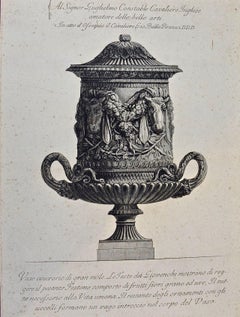
Ancient Roman Marble Vase: 18th C. Piranesi Etching Vaso Cinerario di Gran Mole

Ancient Roman Marble Vase: 18th C. Piranesi Etching Vaso Cinerario di Gran Mole

By Giovanni Battista Piranesi

Located in Alamo, CA

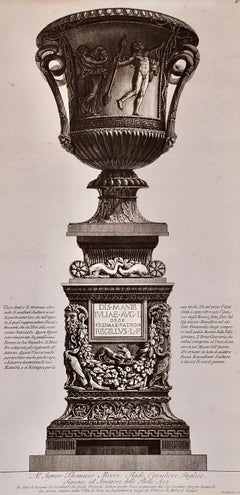
"Vaso Cinerario di Gran Mole. Le Teste dei Giovenchi mostrano di reggere it pesante Festone composto di Frutti Fiori Grans ed use. Il tuto Necefsario all Vita Umana. Il Restante degl...

Category

1760s Old Masters Ebenezer Challis Art

Materials

Etching

Interiors VII: The Train from Munich

Interiors VII: The Train from Munich

By Peter Milton

Located in Middletown, NY

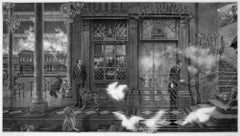
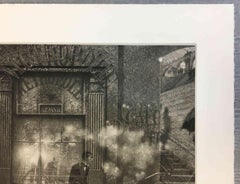
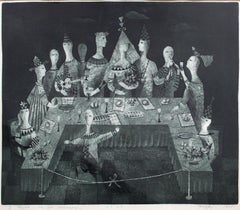
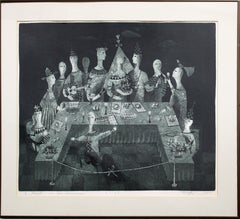
Interiors VII: The Train from Munich Robert E. Townsend, 1991. Resist ground etching and engraving with hand refinement in charcoal, pencil, stabilo, and eraser on BFK Rives white wove paper, 20 x 36 inches (507 x 914 mm), full margins. Signed, titled, dated and numbered 51/175 by the artist in pencil, lower margin. A brilliant, inky impression with luminous light and gradient tones. In excellent condition with one extremely minor and superficial spot of light tan adhesive residue on the verso, unobtrusive and not visible on the recto, with no other visible defects. With the blind stamp of the printer, Robert E. Townsend in the lower left margin. An especially fine impression in superb condition. [Milton 113]. When asked about this work in particular, Milton expressed that his favorite images were his darkest images, in theme, mood, and in ink. Milton, who has said that his work is infused with a postmodern awareness of the past, has focused here in a deeply personal way on a segment of history that continues to haunt us all. The work, published in 1991, evokes one of the darkest periods of European history, the eroding and erasing of European culture under fascism, and the eventual total loss of humanity. The Train from Munich is an especially relevant and emotional work for Milton, who created the piece for his wife, Edith, who escaped Munich in 1939 as a child on the fabled Kinderstransport. The Kinderstransport was a desperate rescue effort on the part of the British government to save as many Jewish children as possible by railway before borders closed on the precipice of the Second World War. Children left their parents behind, and boarded the trains alone, leaving the impending doom of Nazi Germany, they arrived in Great Britain as refugees. More than 10,000 children escaped the holocaust via the Kinderstransport. In Train from Munich, the image itself holds an almost immeasurable amount of symbolism; each inch of the matrix is a successful effort to confront this history in a way that is poignant through a series of motifs. We see the Café disappearing into a ghostlike memory of the past, an allegory to the disintegration of culture, while through the windows we can see a rampant, snarling dog; a portrait of Hitler's shepherd, Blondi. Blondi isn't the only notable figure in the composition. Milton has pointed out that the fading figure of the doorman at the Hotel Metropole is modeled after the artist and intellectual Marcel Duchamp, and the face of the young girl peering...

Category

1990s American Modern Ebenezer Challis Art

Materials

Charcoal, ABS, Engraving, Etching
London Dandies-or- Monstrosities of 1816, Scene, Hyde Park, from Monstrosities

London Dandies-or- Monstrosities of 1816, Scene, Hyde Park, from Monstrosities

By George Cruikshank

Located in Middletown, NY

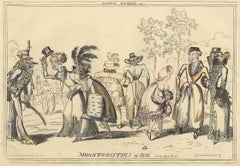
London: Thomas McLean, 1818. Third Edition. Etching with hand coloring in watercolor on cream wove paper (published August 1st, 1835), 9 7/8 x 14 inches ...

Category

Early 19th Century Victorian Ebenezer Challis Art

Materials

Watercolor, Etching

A Framed 18th C. Piranesi Etching of an Ancient Marble Vase from Hadrian's Villa

A Framed 18th C. Piranesi Etching of an Ancient Marble Vase from Hadrian's Villa

By Giovanni Battista Piranesi

Located in Alamo, CA

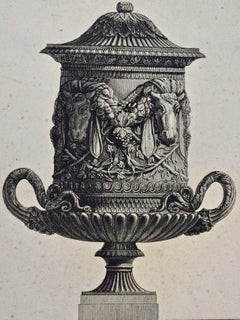
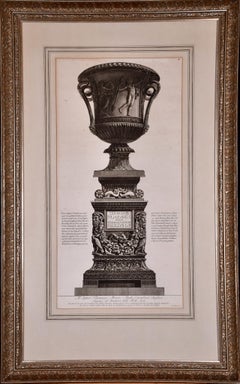
This large framed 18th century etching by Giovanni Battista Piranesi is entitled "Vaso antico di Marmo adornato di eccellenti Sculture si nella parte anteriere che nell' opposta, le ...

Category

1770s Old Masters Ebenezer Challis Art

Materials

Etching

Le Chat et Les Fleurs

Le Chat et Les Fleurs

By Édouard Manet

Located in Middletown, NY

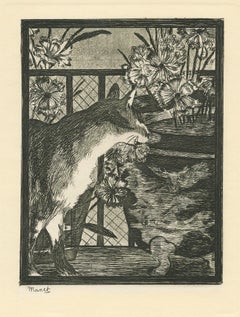
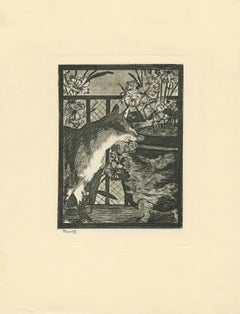
Etching and aquatint on cream laid, watermarked Rives paper. 6 5/8 x 5 inches (167 x 126 mm). Sixth and final state, a posthumous impression. A fine, inky impression with full margin...

Category

1860s Realist Ebenezer Challis Art

Materials

Etching, Aquatint

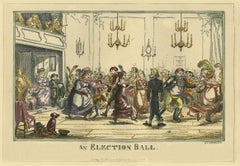
An Election Ball

An Election Ball

By George Cruikshank

Located in Middletown, NY

London: Thomas Mclean, 1835. Etching with hand coloring in watercolor on cream wove paper. 5 3/8 x 7 3/4 inches (135 x 195 mm), full margins. A lovely well inked impression with fres...

Category

Mid-19th Century Victorian Ebenezer Challis Art

Materials

Watercolor, Etching

Ebenezer Challis art for sale on 1stDibs.

Find a wide variety of authentic Ebenezer Challis art available for sale on 1stDibs. You can also browse by medium to find art by Ebenezer Challis in engraving, etching and more. Not every interior allows for large Ebenezer Challis art, so small editions measuring 10 inches across are available. Customers who are interested in this artist might also find the work of Samuel Chamberlain, David Roberts, and Bernard Brussel-Smith. Ebenezer Challis art prices can differ depending upon medium, time period and other attributes. On 1stDibs, the price for these items starts at $446 and tops out at $501, while the average work can sell for $473.

Artists Similar to Ebenezer Challis