Eleanor Parke Custis Art
to
2
1
1
1
Overall Width
to
Overall Height
to
5
1
2
1
1
1
2
2
1
2
1
1
1
1
1
1
3
3
3
2
2
5
10,164
2,784
2,504
1,380
5
5
Artist: Eleanor Parke Custis
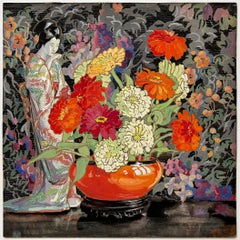
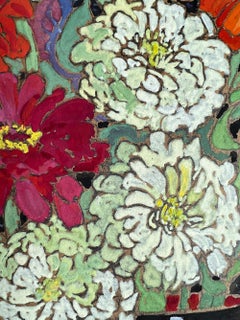
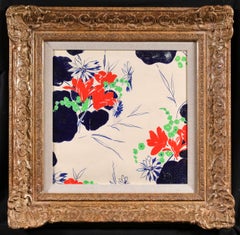
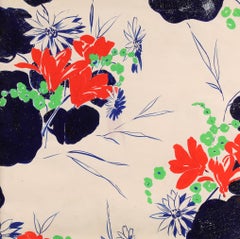
Fauve Still Life with Flowers - Early Female Artist
By Eleanor Parke Custis
Located in Miami, FL
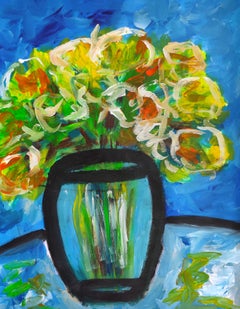
This colorful painting by Eleanor Parke Custis is in the spirit of Louis Valtat and the Fauves. The subject of flowers in the foreground is repeated in the backdrop. It straddles the line between abstraction and representation. Signed lower right - Work is framed.
Eleanor Parke Custis studied in Corcoran School of the Arts and Design under Edmund C. Tarbell and Pennsylvania Academy of the Fine Arts with Henry B. Snell. Initially, she began her art career as a painter, creating watercolors. Custis created illustrations for Scribner's Magazine, Harper's, Doubleday, Harcourt. She started to take photographs in her youth, using a Brownie camera...
Category
1910s Fauvist Eleanor Parke Custis Art
Materials
Gouache, Board
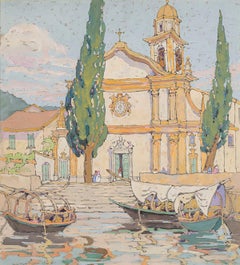
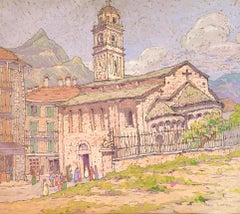
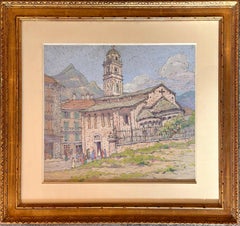
Eleanor Parke Custis Gouache “San Giacomo” Italian Church Landscape
By Eleanor Parke Custis
Located in Rockport, MA
This refined gouache painting titled "San Giacomo" by American artist Eleanor Parke Custis depicts a historic Italian church set against a mountainous landscape, animated by small fi...
Category
20th Century American Impressionist Eleanor Parke Custis Art
Materials
Gouache
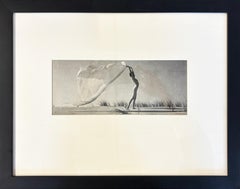
Decorative Frieze of Nude at Beach
By Eleanor Parke Custis
Located in New York, NY
This marvelous photograph taken by Eleanor Park Custis is an iconic nude reflecting trends in the late 1920's and 1930's with the female form in art. In dance and the applied arts -...
Category
1930s American Modern Eleanor Parke Custis Art
Materials
Photographic Paper, Bromoil
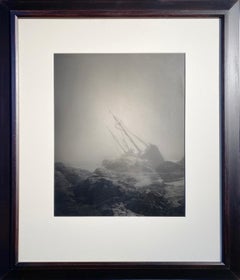
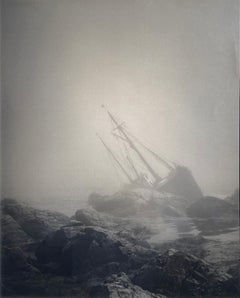
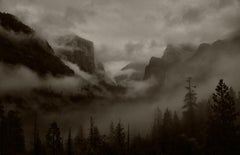
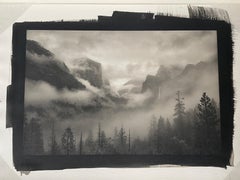
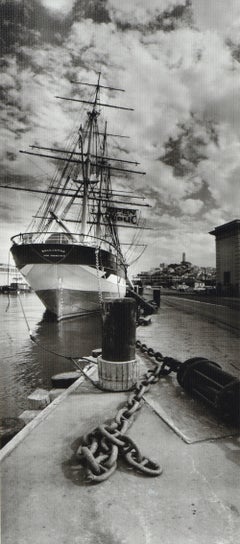
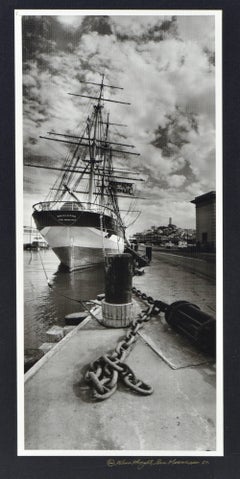
Fog, Gloucester vintage photography
By Eleanor Parke Custis
Located in New York, NY
A haunting and unusual photograph by one of America's earlier female photographers - First Lady of Pictorialism - Eleanor Parke Custis. Probably taken in the Gloucester, Mass environ...
Category
1930s Realist Eleanor Parke Custis Art
Materials
Bromoil
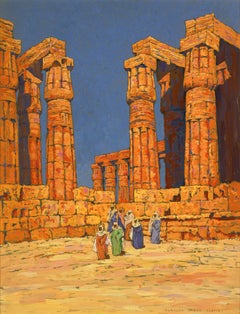
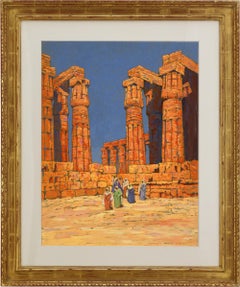
Karnak by Eleanor Parke Custis
By Eleanor Parke Custis
Located in New Orleans, LA
Eleanor Parke Custis
1897-1983 American
Karnak
Signed 'Eleanor Parke Custis -' (lower right)
Gouache and charcoal on paper
American painter Eleanor Parke Custis demonstrates her mastery of the gouache medium in Karnak. A celebration of color and a relic of the artist’s travels abroad, the composition is well-balanced, exuding photojournalistic and documentarian qualities.
In Karnak, Custis paints a compelling and dynamic image of a great ancient Egyptian ruin. Seven distant men, likely Bedouins dressed...
Category
20th Century Realist Eleanor Parke Custis Art
Materials
Paper, Charcoal, Gouache
Related Items
"Train Station, " Max Kuehne, Industrial City Scene, American Impressionism
By Max Kuehne
Located in New York, NY
Max Kuehne (1880 - 1968)
Train Station, circa 1910
Watercolor on paper
8 1/4 x 10 1/4 inches
Signed lower right
Provenance:
Private Collection, Illinois
Max Kuehne was born in Halle, Germany on November 7, 1880. During his adolescence the family immigrated to America and settled in Flushing, New York. As a young man, Max was active in rowing events, bicycle racing, swimming and sailing. After experimenting with various occupations, Kuehne decided to study art, which led him to William Merritt Chase's famous school in New York; he was trained by Chase himself, then by Kenneth Hayes Miller. Chase was at the peak of his career, and his portraits were especially in demand. Kuehne would have profited from Chase's invaluable lessons in technique, as well as his inspirational personality. Miller, only four years older than Kuehne, was another of the many artists to benefit from Chase's teachings. Even though Miller still would have been under the spell of Chase upon Kuehne's arrival, he was already experimenting with an aestheticism that went beyond Chase's realism and virtuosity of the brush. Later Miller developed a style dependent upon volumetric figures that recall Italian Renaissance prototypes.
Kuehne moved from Miller to Robert Henri in 1909. Rockwell Kent, who also studied under Chase, Miller, and Henri, expressed what he felt were their respective contributions: "As Chase had taught us to use our eyes, and Henri to enlist our hearts, Miller called on us to use our heads." (Rockwell Kent, It's Me O Lord: The Autobiography of Rockwell Kent. New York: Dodd, Mead and Co., 1955, p. 83). Henri prompted Kuehne to search out the unvarnished realities of urban living; a notable portion of Henri's stylistic formula was incorporated into his work.
Having received such a thorough foundation in art, Kuehne spent a year in Europe's major art museums to study techniques of the old masters. His son Richard named Ernest Lawson as one of Max Kuehne's European traveling companions. In 1911 Kuehne moved to New York where he maintained a studio and painted everyday scenes around him, using the rather Manet-like, dark palette of Henri.
A trip to Gloucester during the following summer engendered a brighter palette. In the words of Gallatin (1924, p. 60), during that summer Kuehne "executed some of his most successful pictures, paintings full of sunlight . . . revealing the fact that he was becoming a colorist of considerable distinction." Kuehne was away in England the year of the Armory Show (1913), where he worked on powerful, painterly seascapes on the rocky shores of Cornwall. Possibly inspired by Henri - who had discovered Madrid in 1900 then took classes there in 1906, 1908 and 1912 - Kuehne visited Spain in 1914; in all, he would spend three years there, maintaining a studio in Granada. He developed his own impressionism and a greater simplicity while in Spain, under the influence of the brilliant Mediterranean light. George Bellows convinced Kuehne to spend the summer of 1919 in Rockport, Maine (near Camden). The influence of Bellows was more than casual; he would have intensified Kuehne's commitment to paint life "in the raw" around him.
After another brief trip to Spain in 1920, Kuehne went to the other Rockport (Cape Ann, Massachusetts) where he was accepted as a member of the vigorous art colony, spearheaded by Aldro T. Hibbard. Rockport's picturesque ambiance fulfilled the needs of an artist-sailor: as a writer in the Gloucester Daily Times explained, "Max Kuehne came to Rockport to paint, but he stayed to sail." The 1920s was a boom decade for Cape Ann, as it was for the rest of the nation. Kuehne's studio in Rockport was formerly occupied by Jonas Lie.
Kuehne spent the summer of 1923 in Paris, where in July, André Breton started a brawl as the curtain went up on a play by his rival Tristan Tzara; the event signified the demise of the Dada movement. Kuehne could not relate to this avant-garde art but was apparently influenced by more traditional painters — the Fauves, Nabis, and painters such as Bonnard. Gallatin perceived a looser handling and more brilliant color in the pictures Kuehne brought back to the States in the fall. In 1926, Kuehne won the First Honorable Mention at the Carnegie Institute, and he re-exhibited there, for example, in 1937 (Before the Wind). Besides painting, Kuehne did sculpture, decorative screens, and furniture work with carved and gilded molding. In addition, he designed and carved his own frames, and John Taylor Adams encouraged Kuehne to execute etchings. Through his talents in all these media he was able to survive the Depression, and during the 1940s and 1950s these activities almost eclipsed his easel painting. In later years, Kuehne's landscapes and still-lifes show the influence of Cézanne and Bonnard, and his style changed radically.
Max Kuehne died in 1968. He exhibited his work at the National Academy of Design, the Art Institute of Chicago, the Carnegie Institute in Pittsburgh, the Memorial Art Gallery of the University of Rochester, and in various New York City galleries. Kuehne's works are in the following public collections: the Detroit Institute of Arts (Marine Headland), the Whitney Museum (Diamond Hill...
Category
1910s American Impressionist Eleanor Parke Custis Art
Materials
Paper, Watercolor
$2,800 Sale Price
20% Off
H 13.5 in W 15.5 in
Projet de Tissus - Fauvist Flowers Watercolor & Gouache by Raoul Dufy
By Raoul Dufy
Located in Marlow, Buckinghamshire
Botanical watercolour and gouache on paper circa 1920 by French fauvist painter Raoul Dufy. The work depicts flowers in red, blue and green. This work was executed by Dufy as a fabric design.
Dimensions:
Framed: 19.5"x19.5"
Unframed: 12"x12"
Provenance:
Private collection of works by Raoul Dufy for Bianchini Ferier
Bianchini Ferrier Collection - Christie's London - July 2001
SF Fall Show
Raoul Dufy was one of a family of nine children, including five sisters and a younger brother, Jean Dufy, also destined to become a painter. Their father was an accountant in the employ of a major company in Le Havre. The Dufy family was musically gifted: his father was an organist, as was his brother Léon, and his youngest brother Gaston was an accomplished flautist who later worked as a music critic in Paris. Raoul Dufy's studies were interrupted at the age of 14, when he had to contribute to the family income. He took a job with an importer of Brazilian coffee, but still found time from 1892 to attend evening courses in drawing and composition at the local college of fine arts under Charles Marie Lhullier, former teacher of Othon Friesz and Georges Braque. He spent his free time in museums, admiring the paintings of Eugène Boudin in Le Havre and The Justice of Trajan in Rouen. A municipal scholarship enabled him to leave for Paris in 1900, where he lodged initially with Othon Friesz. He was accepted by the École des Beaux-Arts, where he studied under Léon Bonnat, whose innate conservatism prompted Dufy to remark later that it was 'good to be at the Beaux-Arts providing one knew one could leave'.
And leave he did, four years later, embarking with friends and fellow students on the rounds of the major Paris galleries - Ambroise Vollard, Durand-Ruel, Eugène Blot and Berheim-Jeune. For Dufy and his contemporaries, Impressionism represented a rejection of sterile academism in favour of the open-air canvases of Manet, the light and bright colours of the Impressionists, and, beyond them, the daringly innovative work of Gauguin and Van Gogh, Seurat, Cézanne, Toulouse-Lautrec and others. Dufy was an out-and-out individualist, however, and was not tempted to imitate any of these artists. He produced, between 1935 and 1937, Fée Electricité (Spirit of Electricity), the emblem for the French utilities company Electricité de France (EDF).
Dufy visited the USA for the first time in 1937, as a member of the Carnegie Prize jury. In 1940, the outbreak of war (and his increasingly rheumatic condition) persuaded him to settle in Nice. When he eventually returned to Paris 10 years later, his rheumatism had become so debilitating that he immediately left for Boston to follow a course of pioneering anti-cortisone treatment. He continued working, however, spending time first in Harvard and then in New York City before moving to the drier climate of Tucson, Arizona. The cortisone treatment was by and large unsuccessful, although he did recover the use of his fingers. He returned to Paris in 1951 and decided to settle in Forcalquier, where the climate was more clement. Within a short time, however, he was wheelchair-bound. He died in Forcalquier in March 1953 and was buried in Cimiez.
Between 1895 and 1898, Raoul Dufy painted watercolours of landscapes near his native Le Havre and around Honfleur and Falaise. By the turn of the century, however, he was already painting certain subjects that were to become hallmarks of his work - flag-decked Parisian cityscapes, Normandy beaches teeming with visitors, regattas and the like, including one of his better-known early works, Landing Stage at Ste-Adresse. By 1905-1906 Friesz, Braque, Matisse, Derain, Vlaminck, Van Dongen and Rouault were described collectively as Fauves (the wild beasts). What they had in common was a desire to innovate, but they felt constrained nonetheless to meet formally to set out the guiding principles of what promised to be a new 'movement'. Dufy quickly established that those principles were acceptable; moreover, he was most impressed by one particular painting by Henri Matisse ( Luxury, Calm and Voluptuousness) which, to Dufy, embodied both novelty and a sense of artistic freedom. Dufy promptly aligned himself with the Fauves. Together with Albert Marquet in particular, he spent his time travelling the Normandy coast and painting views similar...
Category
1920s Fauvist Eleanor Parke Custis Art
Materials
Paper, Watercolor, Gouache
$12,714
H 19.5 in W 19.5 in
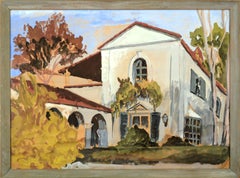
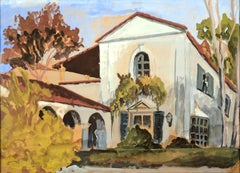
Mid Century California Mission Landscape
Located in Soquel, CA
Beautiful mid century landscape of a historic California mission, highlighting its iconic architectural details such as a columned arches, white was...
Category
Mid-20th Century American Impressionist Eleanor Parke Custis Art
Materials
Paper, Gouache, Cardboard
Charles Partridge Adams California Coastal Watercolor, American Impressionist
By Charles Partridge Adams
Located in Denver, CO
This exquisite California coastal watercolor by American Impressionist Charles Partridge Adams (1858–1942) captures the serene beauty of the shoreline in vibrant hues of blue, green,...
Category
1920s American Impressionist Eleanor Parke Custis Art
Materials
Watercolor
$1,495
H 12.25 in W 15.25 in D 2.5 in
View Of The City
Located in Lake Worth Beach, FL
Early 20th Century European School, view of the city, with buildings in the background, gouache on paper unsigned in a beautiful custom made Haydenryk frame under glass.
Category
Early 20th Century Realist Eleanor Parke Custis Art
Materials
Gouache, Board
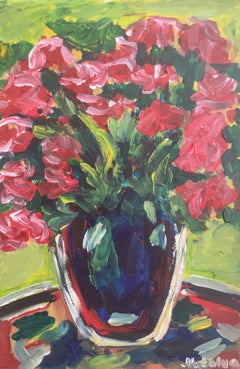
Contemporary expressive still life floral painting "Vase with yellow blossoms"
Located in VÉNISSIEUX, FR
This contemporary post-impressionist Fauvist still life painting titled “Vase with Yellow Blossoms” was created by French artist Natalya Mougenot and belongs to her ongoing still lif...
Category
2010s Fauvist Eleanor Parke Custis Art
Materials
Paper, Acrylic
Mougenot NatalyaContemporary expressive still life floral painting "Vase with yellow blossoms", 2025
$712
H 25.6 in W 19.69 in D 0.04 in
The "New York" 1898, Marine, Seascape, Steamer, Ship at Sea, American, Realism
Located in Wiscasset, ME
Milton James Burns was born in Mt. Gilead, Ohio, in 1853. A founding member of the Salmagundi Club in New York, Burns became a highly acclaimed marine painter, one of the few who was...
Category
Late 19th Century Realist Eleanor Parke Custis Art
Materials
Paper, Gouache
$2,450
H 22.5 in W 27.5 in
Russian School Art Deco Cubist Gouache on Board Painting
Located in Atlanta, GA
This is a beautiful 20th-century Russian Art Deco cubist gouache painting on cardboard. There is no obvious signature on the artwork. Although this painting is a typical example of t...
Category
20th Century Cubist Eleanor Parke Custis Art
Materials
Gouache, Board, Cardboard
$6,500
H 43.31 in W 31.1 in D 1.19 in
Oil Painting of Vibrant Still Life of Sunflowers and Orange Blooms in a Jug
Located in Cirencester, Gloucestershire
Title: Oil Painting of Vibrant Still Life of Sunflowers and Orange Blooms in a Jug
Artist: Roland Pichard
Medium: Oil on oil paper, mounted on card
Size: 10.75 (height) x 9.75 (wi...
Category
Mid-20th Century Post-Impressionist Eleanor Parke Custis Art
Materials
Oil
$398 Sale Price
40% Off
H 10.74 in W 9.75 in D 1 in
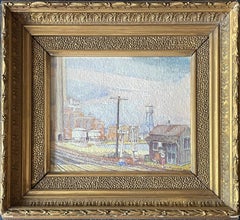
1950s Denver Skyline Painting – Graphite & Watercolor Colorado Cityscape Art
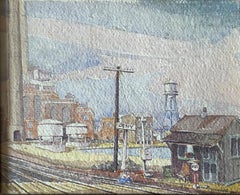
Located in Denver, CO
A captivating midcentury cityscape titled "Denver Skyline", this original 1950s watercolor and graphite painting offers a rare industrial-era view of lower downtown Denver, Colorado....
Category
1950s American Impressionist Eleanor Parke Custis Art
Materials
Watercolor, Graphite
$1,950
H 17.5 in W 21.5 in D 0.75 in
Charles Partridge Adams, Colorado Landscape Gouache, 20th-Century Plein Air Art
By Charles Partridge Adams
Located in Denver, CO
This original circa 1910s plein air field study by celebrated Colorado landscape painter Charles Partridge Adams (1858–1942) beautifully captures the tranquil majesty of the Rocky Mo...
Category
1910s American Impressionist Eleanor Parke Custis Art
Materials
Gouache
$1,880
H 13.75 in W 17.75 in D 0.75 in
Ecole de Paris Mid 20th Century, A City Street Scene
By Henri Miloch
Located in Cirencester, Gloucestershire
Paris, France: A City Street Scene
by Henri Miloch (1898-1979)
unsigned
watercolour and gouache painting on artist's paper, unframed
sheet 9.75 x 12.25 inches
Very nicely execu...
Category
1940s Impressionist Eleanor Parke Custis Art
Materials
Watercolor, Gouache
$493 Sale Price
20% Off
H 9.75 in W 12.25 in D 0.1 in
Previously Available Items
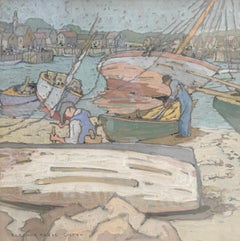
Mending the Boats, Rockport
By Eleanor Parke Custis
Located in New York, NY
Gouache on paper
Category
1920s Eleanor Parke Custis Art
Materials
Gouache
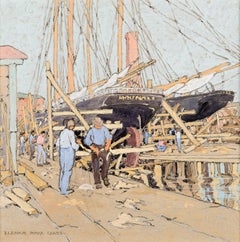
On the Ways - Gloucester
By Eleanor Parke Custis
Located in New York, NY
Signed (lower left): ELEANOR PARKE CUSTIS
Category
1920s American Realist Eleanor Parke Custis Art
Materials
Paper, Gouache
San Giovanni, Florence, Italy
By Eleanor Parke Custis
Located in New York, NY
Signed (at lower left): ELEANOR PARKE CUSTIS
Category
20th Century American Realist Eleanor Parke Custis Art
Materials
Gouache
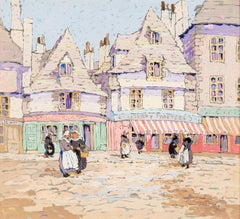
French Street Scene
By Eleanor Parke Custis
Located in New York, NY
Signed (at lower right): Eleanor Parke Custis
Category
20th Century American Realist Eleanor Parke Custis Art
Materials
Gouache
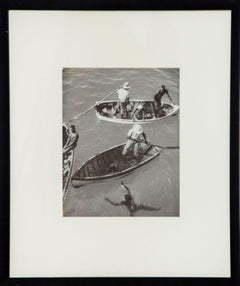
Diving Boats
By Eleanor Parke Custis
Located in New York, NY
The American artist, Eleanor Parke Custis had an amazingly prolific and productive career as a watercolorist and a pictorial photographer of international renown. Custis’ photographi...
Category
1930s Realist Eleanor Parke Custis Art
Materials
Bromoil
Eleanor Parke Custis art for sale on 1stDibs.
Find a wide variety of authentic Eleanor Parke Custis art available for sale on 1stDibs. You can also browse by medium to find art by Eleanor Parke Custis in gouache, paint, watercolor and more. Much of the original work by this artist or collective was created during the 20th century and is mostly associated with the Post-Impressionist style. Not every interior allows for large Eleanor Parke Custis art, so small editions measuring 14 inches across are available. Customers who are interested in this artist might also find the work of Lori Zummo, Robert Lavin, and William Baptiste Baird. Eleanor Parke Custis art prices can differ depending upon medium, time period and other attributes. On 1stDibs, the price for these items starts at $5,800 and tops out at $18,850, while the average work can sell for $7,000.