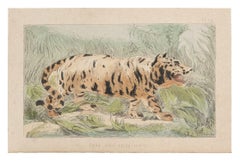
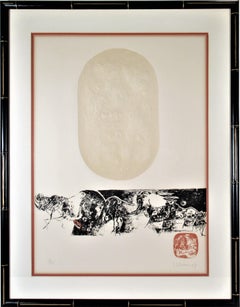
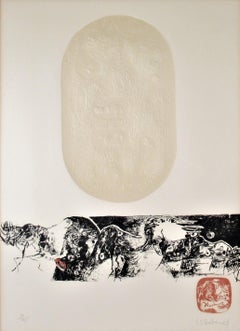
Emile Henri Laporte Art

to
2
Overall Width
to
Overall Height
to
1
1
1
2
2
2
2
1
1
1
1
2
1
2
11,426
2,863
2,494
1,531
2
Artist: Emile Henri Laporte
Related Items
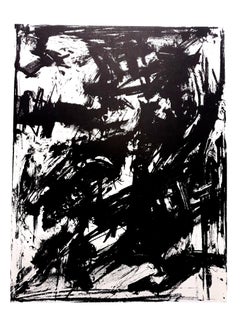
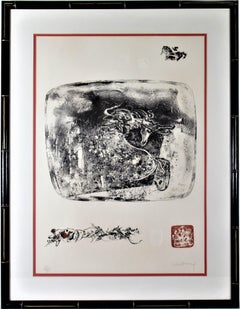
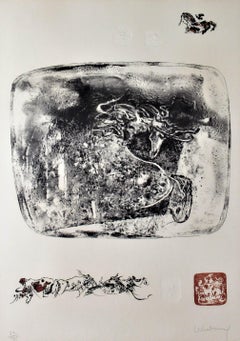
Emilio Vedova - Original Lithograph

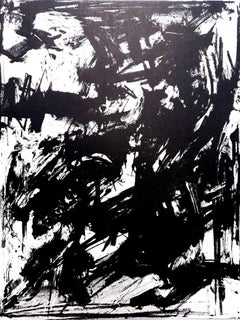
Emilio Vedova - Original Lithograph

By Emilio Vedova

Located in Collonge Bellerive, Geneve, CH

Emilio Vedova - Original Lithograph Abstraction 1961 From the art revue XXe Siecle Dimensions: 32 x 24 Edition: G. di San Lazzaro. Unsigned and unumbered as issued

Category

1960s Modern Emile Henri Laporte Art

Materials

Lithograph

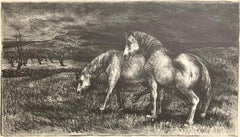
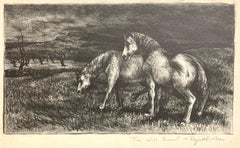
Reginald Wilson, Horses

Reginald Wilson, Horses

By Reginald Wilson

Located in New York, NY

Although this work is titled Horses. It nice to think it could be (Horses in a Field in Woodstock, NY), but it was printed by Will Barnet at the Art Students League, about 1938, and Wilson, who visited Woodstock with Arnold Blanche...

Category

1930s American Modern Emile Henri Laporte Art

Materials

Lithograph

Alexander Calder Circus Reproduction Lithograph After a Drawing

Alexander Calder Circus Reproduction Lithograph After a Drawing

By (after) Alexander Calder

Located in Surfside, FL

(after) Alexander Calder "Calder's Circus" offset lithograph on wove paper after drawings by the artist Published by Art in America and Perls gallery in 1964 (from drawings done in the 1930's) these range slightly in size but they are all about 13 X 17 inches (with minor variations in size as issued.) These have never been framed. The outer folio is not included just the one lithograph. James Sweeny from the introduction “The fame of Calder’s circus spread quickly between the years 1927 and 1930. All the Paris art world came to know it. It brought him his first great personal success. But what was more important, the circus also provided the first steps in Calder’s development as an original sculptor” Clive Gray wrote ”A visit to the studio of Alexander Calder led to the chance discovery of some hundred masterful circus drawings completed over thirty years ago. We publish, for the first time, a choice of sixteen from that group.” With signed introduction by Miro. These whimsical drawings, done in the style of wire sculpture, include acrobats, clowns, jugglers, trapeeze artists, an elephant, dog and lion. they are great. Alexander Calder is widely considered to be one of the most important American sculptors of the 20th century. He is best known for his colorful, whimsical abstract public sculptures and his innovative mobiles, kinetic sculptures powered by motors or air currents, which embraced chance in their aesthetic. Born into a family of accomplished artists, Calder's work first gained attention in Paris in the 1930s and was soon championed by the Museum of Modern Art in New York, resulting in a retrospective exhibition in 1943. Major retrospectives were also held at the Solomon R. Guggenheim Museum (1964) and the Museum of Contemporary Art, Chicago (1974). Calder’s work is in many permanent collections, most notably in the Whitney Museum of American Art, but also the Guggenheim Museum; the Museum of Modern Art; the National Gallery of Art, Washington, D.C.; and the Centre Georges Pompidou. He produced many large public works, including .125 (at JFK Airport, 1957), Pittsburgh (Carnegie International prize winner 1958, Pittsburgh International Airport) Spirale (UNESCO in Paris, 1958), Flamingo and Universe (both in Chicago, 1974), and Mountains and Clouds (Hart Senate Office Building, Washington, D.C., 1976). Although primarily known for his sculpture, Calder was a prodigious artist with a restless creative spirit, whose diverse practice included painting and printmaking, miniatures (such as his famous Cirque Calder), children’s book illustrations, theater set design, jewelry design, tapestry and rug works, and political posters. Calder was honored by the US Postal Service with a set of five 32-cent stamps in 1998, and received the Presidential Medal of Freedom, posthumously in 1977, after refusing to receive it from Gerald Ford one year earlier in protest of the Vietnam War. Calder moved to New York and enrolled at the Art Students League, studying briefly with Thomas Hart Benton, George Luks, Kenneth Hayes Miller, and John Sloan. While a student, he worked for the National Police Gazette where, in 1925, one of his assignments was sketching the Ringling Bros. and Barnum & Bailey Circus. Calder became fascinated with the action of the circus, a theme that would reappear in his later work. In 1926, Calder moved to Paris, enrolled in the Académie de la Grande Chaumière, and established a studio at 22 rue Daguerre in the Montparnasse Quarter. In June 1929, while traveling by boat from Paris to New York, Calder met his future wife, Louisa James (1905-1996), grandniece of author Henry James and philosopher William James. They married in 1931. While in Paris, Calder met and became friends with a number of avant-garde artists, including Fernand Léger, Jean Arp, and Marcel Duchamp. Cirque Calder (on view at the Whitney Museum of American Art at present) became popular with the Parisian avant-garde. He also invented wire sculpture, or "drawing in space," and in 1929 he had his first solo show of these sculptures in Paris at Galerie Billiet. Hi! (Two Acrobats) in the collection of the Honolulu Museum of Art is an early example of the artist's wire sculpture. The painter Jules Pascin, a friend of Calder's from the cafes of Montparnasse, wrote the preface to the catalog. A visit to Piet Mondrian's studio in 1930, where he was impressed by the environment-as-installation, "shocked" him into fully embracing abstract art, toward which he had already been tending. Dating from 1931, Calder’s sculptures of discrete movable parts powered by motors were christened “mobiles” by Marcel Duchamp, a French pun meaning both "motion" and "motive." At the same time, Calder was also experimenting with self-supporting, static, abstract sculptures, dubbed "stabiles" by Jean Arp in 1932 to differentiate them from mobiles. Public commissions increasingly came his way in the 1960s. Notable examples are .125 for JFK Airport in 1957, Spirale for UNESCO in Paris 1958 and Trois disques, commissioned for Expo 67 in Montreal, Quebec, Canada. Calder's largest sculpture at 25.7 meters high was El Sol Rojo, constructed outside the Aztec Stadium for the 1968 Summer Olympics "Cultural Olympiad" events in Mexico City. Many of his public works were commissioned by renowned architects; I.M. Pei commissioned his La Grande Voile (1966), a 25-ton, 40-foot high stabile for the Massachusetts Institute of Technology. Part of Calder's repertoire includes pivotal stage sets for more than a dozen theatrical productions, including Nucléa, Horizon, and most notably, Martha Graham’s Panorama (1935), a production of the Erik Satie symphonic drama Socrate (1936), and later, Works in Progress (1968). In addition to sculptures, Calder painted throughout his career, beginning in the early 1920s. He picked up his study of printmaking in 1925, and continued to produce illustrations for books and journals.As Calder’s professional reputation expanded in the late 1940s and 1950s, so did his production of prints. Masses of lithographs based on his gouache paintings hit the market, and deluxe editions of plays, poems, and short stories illustrated with fine art prints by Calder became available for sale. One of Calder's most celebrated and unconventional undertakings was a commission from Dallas-based Braniff International Airways to paint a full-size Douglas DC-8-62 four-engined jet as a "flying canvas." Calder created over 2,000 pieces of jewelry over the course of his career, many of them as gifts for friends and relatives. For his lifelong friend Joan Miró, he set a shard of a broken porcelain vessel in a brass ring. Peggy Guggenheim received enormous silver mobile earrings and later commissioned a hammered silver headboard...

Category

1930s American Modern Emile Henri Laporte Art

Materials

Lithograph

Modern Israeli Lithograph Reuven Rubin Views Of Israel Judaica Horses, Riders

Modern Israeli Lithograph Reuven Rubin Views Of Israel Judaica Horses, Riders

By Reuven Rubin

Located in Surfside, FL

Lithograph printed by Chez Daniel Jacomet, Paris, France 1960 offset lithograph in colors on Arches, signed in crayon on the justification sheet (this auction is just for the one lithograph pictured as the 1st photo, the justification sheet with the original drawing is just included for provenance and is not part of this sale), on Arches deckle edged paper. limited edition of 250. plate signed and hand signed in pencil. Israeli views Lithograph by Israeli Master. Reuven Rubin 1893 -1974 was a Romanian-born Israeli painter and Israel's first ambassador to Romania. Rubin Zelicovici (later Reuven Rubin) was born in Gala?i to a poor Romanian Jewish Hasidic family. He was the eighth of 13 children. In 1912, he left for Ottoman-ruled Palestine to study art at Bezalel Academy of Art and Design in Jerusalem. Finding himself at odds with the artistic views of the Academy's teachers, he left for Paris, France, in 1913 to pursue his studies at the École Nationale Supérieure des Beaux-Arts. At the outbreak of World War I, he was returned to Romania, where he spent the war years. In 1921, he traveled to the United States with his friend and fellow artist, Arthur Kolnik, with whom he had shared a studio in Cernovitzu. In New York City, the two met artist Alfred Stieglitz, who was instrumental in organizing their first American show at the Anderson Gallery.Following the exhibition, in 1922, they both returned to Europe. In 1923, Rubin emigrated to Mandate Palestine. Rubin met his wife, Esther, in 1928, aboard a passenger ship to Palestine on his return from a show in New York. She was a Bronx girl who had won a trip to Palestine in a Young Judea competition. He died in 1974 Artistic career Joseph Zaritsky...

Category

1960s Modern Emile Henri Laporte Art

Materials

Lithograph, Offset

Alexander Calder Circus Reproduction Lithograph After a Drawing

Alexander Calder Circus Reproduction Lithograph After a Drawing

By (after) Alexander Calder

Located in Surfside, FL

(after) Alexander Calder "Calder's Circus" offset lithograph on wove paper after drawings by the artist Published by Art in America and Perls gallery in 1964 (from drawings done in t...

Category

1930s American Modern Emile Henri Laporte Art

Materials

Lithograph

Columbus, Ohio State Artist Judaica Wedding Engagement Lithograph

Columbus, Ohio State Artist Judaica Wedding Engagement Lithograph

By Sid Chafetz

Located in Surfside, FL

Description: Medium: Lithograph. Hand signed Print Image Size: 23 3/8 x 18 1/8 inches. Print Edition: no edition. this is marked B.A.T. Alternate Medium: Lithograph. Ink(s): black. ...

Category

1990s Modern Emile Henri Laporte Art

Materials

Archival Paper, Lithograph

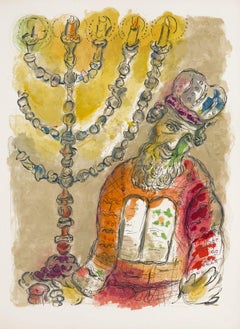
"Thou shalt also anoint Aaron…" (The Story of Exodus, M.458), 1966

"Thou shalt also anoint Aaron…" (The Story of Exodus, M.458), 1966

By Marc Chagall

Located in Greenwich, CT

Thou shalt also anoint Aaron and his sonnes, and shalt consecrate them, that they may minister unto me in the Priests offices. (M.458)" from Marc Chagall's "The Story of Exodus," 196...

Category

20th Century Modern Emile Henri Laporte Art

Materials

Paper, Lithograph

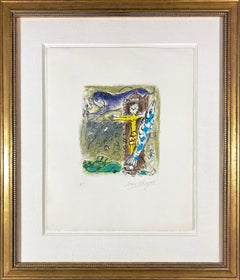
Le Christ a l'Horloge, Paris (Christ in the Clock)

Le Christ a l'Horloge, Paris (Christ in the Clock)

By Marc Chagall

Located in Missouri, MO

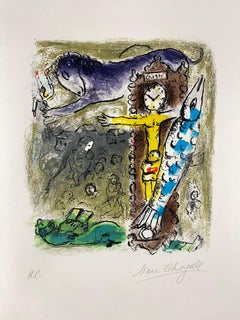
Marc Chagall "Le Christ a l'Horloge, Paris" (Christ in the Clock) 1957 (M. 196) Color Lithograph on Arches Wove Paper Signed in Pencil "Marc Chagall" Lower Right Initialed "H.C." (Hors Commerce) Lower Left, aside from numbered edition of 90 *Floated in Gold Frame with Linen Matting, UV Plexiglass Sheet Size: 18 3/4 x 14 3/4 inches (47.5 cm x 38 cm) Image Size: 9 3/4 x 8 1/2 inches Framed Size: 28.5 x 24.25 inches Marc Chagall was a man of keen intelligence, a shrewd observer of the contemporary scene, with a great sympathy for human suffering. He was born on July 7, 1887 in Vitebsk, Russia; his original name was Moishe Shagal (Segal), but when he became a foremost member of the Ecole de Paris, he adopted French citizenship and the French spelling of his name. Vitebsk was a good-sized Russian town of over 60,000, not a shtetl. His father supported a wife and eight children as a worker in a herring-pickling plant. Sheltered by the Jewish commandment against graven images, the young Chagall never saw so much as a drawing until, one day, he watched a schoolmate copying a magazine illustration. He was ridiculed for his astonishment, but he began copying and improvising from magazines. Both Chagall's parents reluctantly agreed to let him study with Yehuda Pen, a Jewish artist in Vitebsk. Later, in 1906, they allowed their son to study in St. Petersburg, where he was exposed to Russian Iconography and folk art. At that time, Jews could leave the Pale only for business and employment and were required to carry a permit. Chagall, who was in St. Petersburg without a permit, was imprisoned briefly. His first wife, Bella Rosenfeld, was a product of a rich cultivated and intellectual group of Jews in Vitebsk. Chagall was made commissar for the arts for the area, charged with directing its cultural life and establishing an art school. Russian folklore, peasant life and landscapes persisted in his work all his life. In 1910 a rich patron, a lawyer named Vinaver, staked him to a crucial trip to Paris, where young artists were revolutionizing art. He also sent him a handsome allowance of 125 francs (in those days about $24) each month. Chagall rejected cubism, fauvism and futurism, but remained in Paris. He found a studio near Montparnasse in a famous twelve-sided wooden structure divided into wedge-shaped rooms. Chaim Soutine, a fellow Russian Jew, and Modigliani lived on the same floor. To Chagall's astonishment, he found himself heralded as one of the fathers of surrealism. In 1923, a delegation of Max Ernst, Paul Eluard and Gala (later Salvador Dali's wife) actually knelt before Chagall, begging him to join their ranks. He refused. To understand Chagall's work, it is necessary to know that he was born a Hasidic Jew, heir to mysticism and a world of the spirit, steeped in Jewish lore and reared in the Yiddish language. The Hasidim had a special feeling for animals, which they tried not to overburden. In the mysterious world of Kabbala and fantastic ancient legends of Chagall's youth, the imaginary was as important as the real. His extraordinary use of color also grew out of his dream world; he did not use color realistically, but for emotional effect and to serve the needs of his design. Most of his favorite themes, though superficially light and trivial, mask dark and somber thoughts. The circus he views as a mirror of life; the crucifixion as a tragic theme, used as a parallel to the historic Jewish condition, but he is perhaps best known for the rapturous lovers he painted all his life. His love of music is a theme that runs through his paintings. After a brief period in Berlin, Chagall, Bella and their young daughter, Ida, moved to Paris and in 1937 they assumed French citizenship. When France fell, Chagall accepted an invitation from the Museum of Modern Art to immigrate to the United States. He was arrested and imprisoned in Marseilles for a short time, but was still able to immigrate with his family. The Nazi onslaught caught Chagall in Vichy, France, preoccupied with his work. He was loath to leave; his friend Varian Fry rescued him from a police roundup of Jews in Marseille, and packed him, his family and 3500 lbs. of his art works on board a transatlantic ship. The day before he arrived in New York City, June 23, 1941, the Nazis attacked Russia. The United States provided a wartime haven and a climate of liberty for Chagall. In America he spent the war years designing large backdrops for the Ballet. Bella died suddenly in the United States of a viral infection in September 1944 while summering in upstate New York. He rushed her to a hospital in the Adirondacks, where, hampered by his fragmentary English, they were turned away with the excuse that the hour was too late. The next day she died. He waited for three years after the war before returning to France. With him went a slender married English girl, Virginia Haggard MacNeil; Chagall fell in love with her and they had a son, David. After seven years she ran off with an indigent photographer. It was an immense blow to Chagall's ego, but soon after, he met Valentine Brodsky, a Russian divorcee designing millinery in London (he called her Fava). She cared for him during the days of his immense fame and glory. They returned to France, to a home and studio in rustic Vence. Chagall loved the country and every day walked through the orchards, terraces, etc. before he went to work. Chagall died on March 28, 1985 in the south of France. His heirs negotiated an arrangement with the French state allowing them to pay most of their inheritance taxes in works of art. The heirs owed about $30 million to the French government; roughly $23 million of that amount was deemed payable in artworks. Chagall's daughter, Ida and his widow approved the arrangement. Written and submitted by Jean Ershler Schatz, artist and researcher from Laguna Woods, California. Sources: Hannah Grad Goodman in Homage to Chagall in Hadassah Magazine, June 1985 Jack Kroll in Newsweek, April 8, 1985 Andrea Jolles in National Jewish Monthly Magazine, May 1985 Michael Gibson...

Category

1950s Modern Emile Henri Laporte Art
Materials

Lithograph

Between a Rock & a Hard Place (Satirical, Figurative, Funny, Cat, Portrait)

Between a Rock & a Hard Place (Satirical, Figurative, Funny, Cat, Portrait)

Located in Kansas City, MO

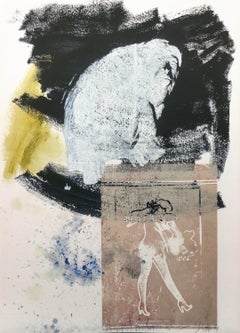
Patti Warashina Between a Rock & a Hard Place Original 5 Plate Lithograph on Rives BFK, White Year: 2017 Edition: 20 of 24 Paper Size: 24 × 18.5 inches (60.96 × 46.99 cm) Image ...

Category

2010s Modern Emile Henri Laporte Art
Materials

Handmade Paper, Lithograph

Columbus, Ohio State Artist Lithograph "Heavenly Bliss" Angels, Biplane

Columbus, Ohio State Artist Lithograph "Heavenly Bliss" Angels, Biplane

By Sid Chafetz

Located in Surfside, FL

Description: Medium: Lithograph. Hand signed and editioned BAT Print Image Size: 26 x 16 inches. Print Edition: 8. Alternate Medium: Color lithograph. Ink(s): blue, green, yellow, pi...

Category

1990s Modern Emile Henri Laporte Art
Materials

Archival Paper, Lithograph

"Jacob's Ladder" Message Biblique (Peintures Bibliques Recentes, 1966-76)

"Jacob's Ladder" Message Biblique (Peintures Bibliques Recentes, 1966-76)

By Marc Chagall

Located in Greenwich, CT

"Jacob's Ladder” from 1977 was a poster created to celebrate Chagall's retrospective of biblical paintings and artwork from the years 1966 – 1976 at the Musée National Message Bibliq...

Category

20th Century Modern Emile Henri Laporte Art
Materials

Paper, Lithograph

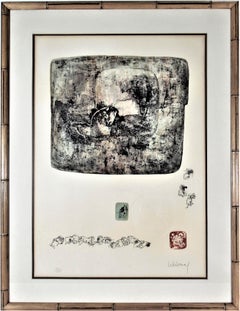
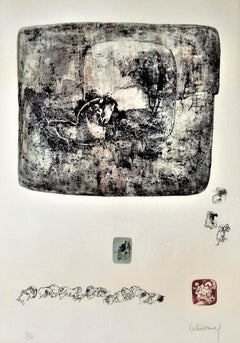
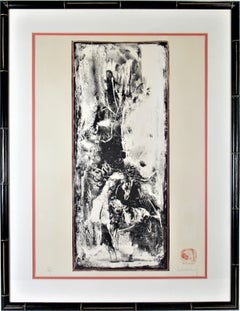
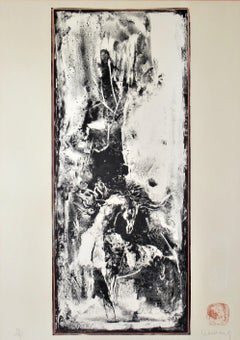
Emile Henri Laporte art for sale on 1stDibs.

Find a wide variety of authentic Emile Henri Laporte art available for sale on 1stDibs. You can also browse by medium to find art by Emile Henri Laporte in lithograph, paper and more. Much of the original work by this artist or collective was created during the 1970s and is mostly associated with the modern style. Not every interior allows for large Emile Henri Laporte art, so small editions measuring 7 inches across are available. Emile Henri Laporte art prices can differ depending upon medium, time period and other attributes. On 1stDibs, the price for these items starts at $223 and tops out at $291, while the average work can sell for $257.