Antique French Marquetry, Ormolu and Jasperware Bureau du Roi by Beurdeley
By Emmanuel-Alfred Beurdeley
Located in London, GB
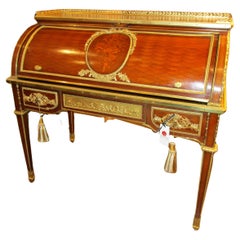
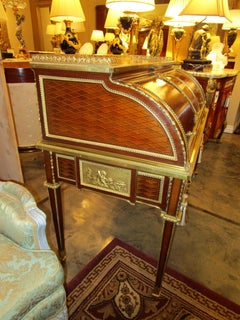
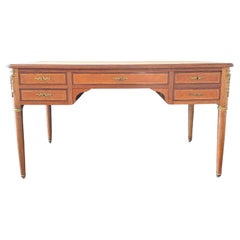
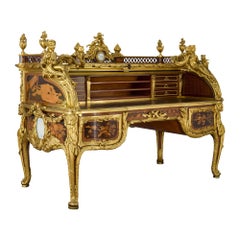
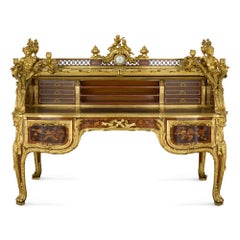
Antique French marquetry, ormolu and jasperware Bureau du Roi by Beurdeley French, c. 1890 Height 151cm, width 190cm, depth 100cm The Bureau du Roi, also known as the secrétaire à cylindre, is among the most celebrated masterpieces of 18th century furniture design—an unparalleled example of French craftsmanship and regal opulence. Originally commissioned by King Louis XV in 1760, the project was entrusted to ébéniste du roi Jean-François Oeben (1721–1763). However, Oeben passed away before its completion and his successor, Jean-Henri Riesener (1734-1806), finalised the desk in 1769. During the 19th century, several master cabinetmakers sought to replicate this extraordinary creation, including the esteemed Emmanuel Alfred Beurdeley (1847–1919). The present example, produced circa 1890, was exhibited at the 1893 Chicago World’s Fair, where it garnered admiration for its exceptional artistry. Following the exhibition, it was acquired by financier George Jay Gould I (1864–1923) and later photographed in the Lakewood, New Jersey residence of his wife, actress Edith Kingdon Gould (1864–1921). This magnificent desk is crowned with a decorative clock, draped in festoons and accompanied by two playful putti and a finely sculpted dog. Twin ormolu urns rest atop an openwork gallery, leading to additional flower-filled ormolu vases. Flanking the central roll-top panel are finely cast ormolu figures of Apollo and Calliope, each supporting a twin-light scrolling acanthus candelabrum. With a turn of a key, the roll-top slides open to reveal an exquisite arrangement of three pull-out shelves and three drawers, each front panel adorned with delicate ormolu banding and intricate floral trellis parquetry. A gilt-tooled leather writing surface unfolds, featuring a pop-up central panel that lifts to reveal a folding folio stand alongside three additional storage compartments. Below, a central kneehole drawer, embellished with an ormolu bow, is flanked by twin-divided drawers, all decorated with finely detailed floral marquetry. Every aspect of this Bureau du Roi is a testament to superior craftsmanship, featuring elaborate marquetry and parquetry designs. The upper section consists of three panels, with the tambour roll-top inlaid with intricate mythological motifs. Two side medallions bear Latin inscriptions drawn from Cesare Ripa’s Iconologia (1555–1622): NON. NISI. GRANDIA. CANTO. / IRRIDENS. CUSPIDE. FIGO. and BREVI. COMPLECTOR. SINGULA. CANO / PASTORUM. CARMINA. LUDO. These decorative elements, along with the marquetry on the roll-top and upper surfaces, celebrate the arts, literature, and architecture. The bombé sides of the desk are richly decorated with marquetry panels depicting symbols of both naval and terrestrial warfare, framed by elegant ormolu laurel swags. These ornamental details complement a series of exquisite blue and white Wedgwood Jasperware medallions...
Late 19th Century French Louis XV Antique Emmanuel-Alfred Beurdeley Furniture
Ormolu