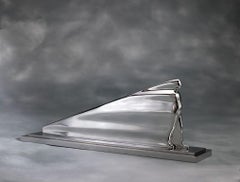
Flowing Man
By Ernest Trova
Located in Boca Raton, FL
Edition 37/99
Category
21st Century and Contemporary Contemporary Ernest Trova Sculptures
Materials
Stainless Steel
Flowing Man
By Ernest Trova
Located in Boca Raton, FL
Edition 37/99
Stainless Steel
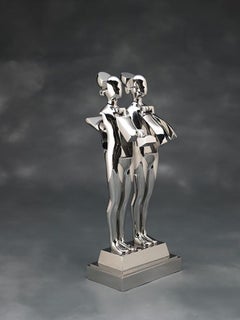
Double Flapman
By Ernest Trova
Located in Boca Raton, FL
AP 2 Ernest Trova was an artist whose signature creation, a gleaming humanoid known as “Falling Man,” appeared in a series of sculptures and paintings and became a symbol of an imperfect humanity hurtling into the future. Mr. Trova was largely known as a sculptor, but his “Falling Man,” a standard of Pop Art, began life as a painted figure, taking shape on his easel in the early 1960s. Faceless, armless, with a hint of a belly and, its name notwithstanding, of indeterminate sex, the figure struck a variety of poses, sometimes juxtaposed with other like figures, sometimes with mechanical appendages. In October 1963 his one-man show, “Falling Man Paintings,” was the inaugural exhibition of the Pace Gallery on West 57th Street in Manhattan; it sold out, with the works purchased by the Museum of Modern Art, the Whitney Museum, the architect Philip Johnson and others. In three dimensions, the “Falling Man” figure was made from different materials over the years — nickel and chrome-plated bronze, enamel on aluminum, stainless steel — and often, like the Oscar statuette, was polished to an industrial sheen. It was clearly a space age creation, a forerunner of C3PO, the golden robot in “Star Wars.” “He found the space age both inspiring and dehumanizing,” Arne Glimcher, who founded the Pace Gallery, now PaceWildenstein, said in an interview on Friday. By the end of the 1960s, “Falling Man” had become Mr. Trova’s trademark, provoking Hilton Kramer, the art critic of The New York Times, to write that Mr. Trova had subjected his favorite figure “to almost as many variations as the Kama Sutra describes for the act of love.” Ernest Tino Trova Jr. was born in St. Louis on Feb. 19, 1927. Shortly after his high school graduation his father, an industrial tool designer and inventor, died, and young Ernie, as he was known, went to work, most significantly as a window dresser for a department store. His early paintings were in the Abstract Expressionist mode, but his attentiveness to the mannequins had an influence on his art. Through the 1970s and 1980s he continued with “Falling Man,” though he also became interested in formalized, almost mechanical-seeming landscapes, and the figures began to appear, reduced in size, within the context of abstractly rendered gardens. A self-taught artist with an impish wit and an eccentric turn of mind, Mr. Trova craved the recognition that was available to artists only in New York City, but he never visited for more than a week at a time and made almost no friends among New York artists. He did befriend Ezra Pound. As a fevered fan of Julio Iglesias...
Stainless Steel
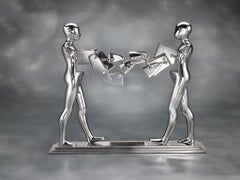
Double Walking Figure
By Ernest Trova
Located in Boca Raton, FL
rnest Trova was an artist whose signature creation, a gleaming humanoid known as “Falling Man,” appeared in a series of sculptures and paintings and became a symbol of an imperfect humanity hurtling into the future. Mr. Trova was largely known as a sculptor, but his “Falling Man,” a standard of Pop Art, began life as a painted figure, taking shape on his easel in the early 1960s. Faceless, armless, with a hint of a belly and, its name notwithstanding, of indeterminate sex, the figure struck a variety of poses, sometimes juxtaposed with other like figures, sometimes with mechanical appendages. In October 1963 his one-man show, “Falling Man Paintings,” was the inaugural exhibition of the Pace Gallery on West 57th Street in Manhattan; it sold out, with the works purchased by the Museum of Modern Art, the Whitney Museum, the architect Philip Johnson and others. In three dimensions, the “Falling Man” figure was made from different materials over the years — nickel and chrome-plated bronze, enamel on aluminum, stainless steel — and often, like the Oscar statuette, was polished to an industrial sheen. It was clearly a space age creation, a forerunner of C3PO, the golden robot in “Star Wars.” “He found the space age both inspiring and dehumanizing,” Arne Glimcher, who founded the Pace Gallery, now PaceWildenstein, said in an interview on Friday. By the end of the 1960s, “Falling Man” had become Mr. Trova’s trademark, provoking Hilton Kramer, the art critic of The New York Times, to write that Mr. Trova had subjected his favorite figure “to almost as many variations as the Kama Sutra describes for the act of love.” Ernest Tino Trova Jr. was born in St. Louis on Feb. 19, 1927. Shortly after his high school graduation his father, an industrial tool designer and inventor, died, and young Ernie, as he was known, went to work, most significantly as a window dresser for a department store. His early paintings were in the Abstract Expressionist mode, but his attentiveness to the mannequins had an influence on his art. Through the 1970s and 1980s he continued with “Falling Man,” though he also became interested in formalized, almost mechanical-seeming landscapes, and the figures began to appear, reduced in size, within the context of abstractly rendered gardens. A self-taught artist with an impish wit and an eccentric turn of mind, Mr. Trova craved the recognition that was available to artists only in New York City, but he never visited for more than a week at a time and made almost no friends among New York artists. He did befriend Ezra Pound. As a fevered fan of Julio Iglesias, he went to the singer’s concerts all over the United States. “Ernie had a fabulous fantasy life,” Richard Solomon, the president of Pace Prints, the publishing arm of PaceWildenstein, said in an interview. “He had a persona he used to hide behind that he called ‘Junior Person.’ He was a wonderful man, but an oddball to beat the band.” Mr. Trova left the Pace Gallery in the mid-1980s and signed with an inexperienced dealer in St. Louis. His profile went into decline, except in his hometown, where his donation of many of his works helped create the Laumeier Sculpture Park. He continued to work until shortly before his death. Most recently he was making collages using magazine...
Stainless Steel
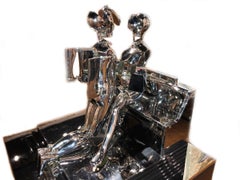
Price Upon Request
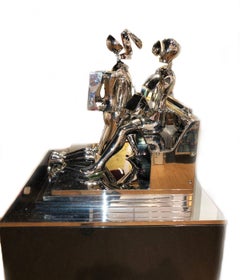
The Encounter
By Ernest Trova
Located in Missouri, MO
Ernest Trova "The Encounter" 1994 Chrome Plated Steel Approx 24 x 26 x 24 inches Edition 1/8 Known for his Falling Man series in abstract figural sculpture, he created hard-edge ima...
Stainless Steel
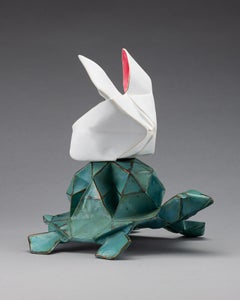
Road Trip- desktop 11/50- Kevin Box and Beth Johnson
By Kevin Box
Located in Napa, CA
It took two years of tireless experimentation for me to develop the process of casting paper into bronze, another seven years to perfect, and it continues to evolve today.” - Kevin B...
Bronze, Stainless Steel
$4,900
H 21 in W 13 in
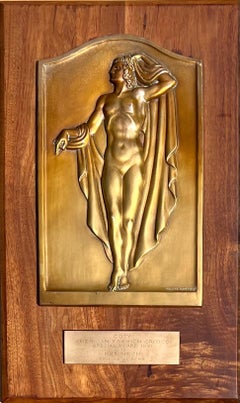
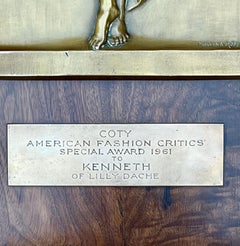
1961 Coty Award Plaque Kenneth Hairdresser Jacqueline Onassis Bronze Fashion
Located in New York, NY
1961 Coty Award Plaque Kenneth Hairdresser Jacqueline Onassis Bronze Fashion Bronze on wood. The wood plaque measures 12 3/4" by 20 3/4 inches. The bronze plaque itself is 13 3/4 x 8 3/4 inches and the the bronze inscription, which reads "COTY, American Fashion Critics Special Award 1961 to KENNETH of LILY DACHE...
Bronze
$3,600
H 12 in W 8.5 in D 6.75 in
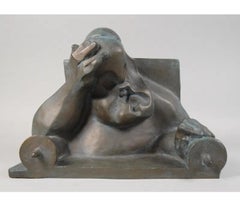
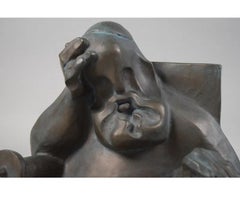
Ted Egri Taos Modernist Judaica Cubist Bronze Sculpture Rabbi & Torah WPA Artist
By Ted Egri
Located in Surfside, FL
Ted Egri (American, 1913-2010) Bronze sculpture Rabbi Signed Egri and numbered 4/30 on side. Dimensions: 12"L x 8.5"H x 6.75" D Born in New York city in 1913 to a Hungarian Jewish emigre family (both of his parents were born in Hungary), Egri was first exposed to music later dropping that for art. He studied with Howard Giles at the Master Institute of the Roerich Museum in New York where he was introduced to Oriental arts, Chinese and Japanese art forms, and later with Hans Hofmann. He worked for the Federal Arts Project, the WPA, making mural paintings and silkscreen prints as well as easel painting. Once WWII began, Egri signed up to serve as a map maker for the Navy, and was witness to some of the fiercest battles in the Pacific. As an artist, he painted many important depictions of his wartime experiences and these works have all be donated to the U.S. Naval Museum. Already a practicing painter and instructor at the Kansas City Art Institute, Ted Egri came to Taos, New Mexico with his wife Kit in 1950 to continue his study of painting at Ribak's Taos Valley Art School on the GI Bill. Louis Ribak quickly introduced Egri to Eulalia Emetaz, the owner of La Galleria Escondida, who gave him his first one-person show in 1951. A prolific and versatile artist, as well as arts organizer and advocate, Egri's contributions to underserved African American, Native American, Hispanic and women were honored by two Taos mayors, with no less than two Ted Egri days during his 50-year art career in Taos. Egri remained in Taos. He became widely known for his sculpture, influenced by cubism and painting, with his style ranging from abstract to realistic. Egri had incredible draftsmanship - charcoal, pencil, pastel, watercolor, oils, mixed media, pen and ink, acrylic, gouache Over time his work gradually shifted from its focus on human struggle to an exploration of natural elements and the changes that come about as a result of living in a physical environment like Taos. "The impact of the majestic Sangre de Cristo Mountain Range and the vast spaces of the mesas directed me toward space and form. I moved into sculpture," Egri said in a 1987 interview with ARTSPACE magazine. He was included in a show at Stables Gallery along with Emil Bisttram, Louis Catusco, Edward Corbett, Lawrence Calcagno, Keith Crown, Andrew Dasburg, John De...
Bronze
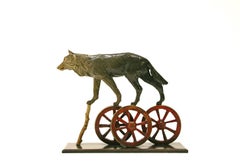
Renegade
By Brad Rude
Located in Bozeman, MT
Ed. 3/6 Artist Brad Rude was born in Montana and has lived in Walla Walla, Washington most of his life. His journeys through his grandfather's folk art st...
Bronze, Enamel
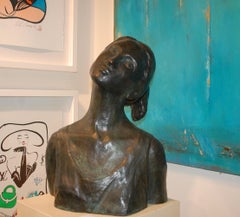
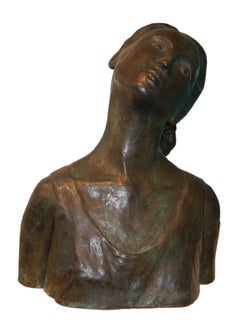
Bust Of A Young Woman bronze
By Kevin Berlin
Located in Lake Worth Beach, FL
Bust Of A Young Woman Bronze sculpture signed by the artist inside the cast and dated 1988, 1st cast in London. Kevin Berlin is an international arti...
Bronze
Combined Effort
By Brad Rude
Located in Bozeman, MT
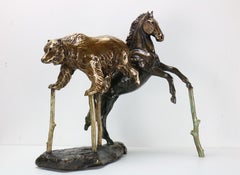
Artist Brad Rude was born in Montana and has lived in Walla Walla, Washington most of his life. His journeys through his grandfather's folk art studio left...
Bronze, Enamel
$2,800
H 60 in W 16 in D 16 in
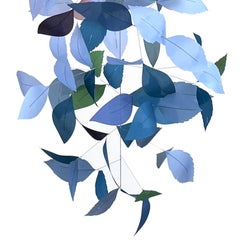
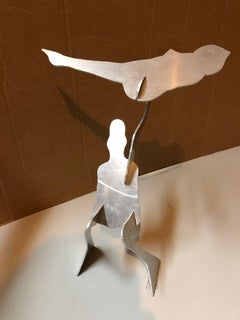
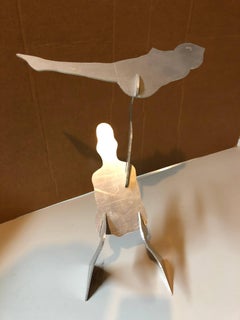
"Renewal" (2024) By Jan R Carson, Original Sculpture, Silk and Steel Wire
By Jan R Carson
Located in Denver, CO
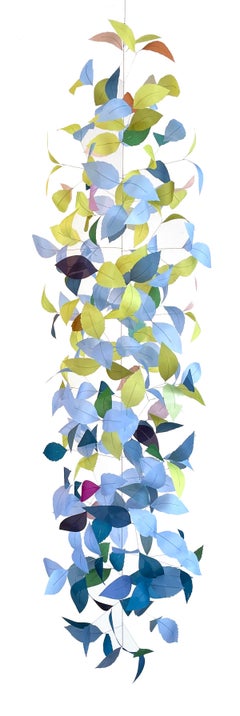
"Renewal" (2024) By Jan R Carson is an original handmade sculpture made with silk and stainless-steel wire. This piece depicts leaves falling and changing color as they fall.
Stainless Steel
$1,000
H 20.5 in W 12.5 in D 6.75 in
The Test, Assembled Kinetic Modernist Sculpture Puzzle Construction
By William King (b.1925)
Located in Surfside, FL
"The Test," 1970 Aluminum sculpture in 5 parts. Artist's cipher and AP stamped into male figure, front, 20 5/16" x 12 1/2" x 6 5/7" (approx.) American sculptor King is most noted fo...
Metal
$2,950
H 24.5 in W 17.5 in D 1 in
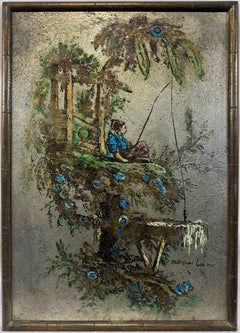
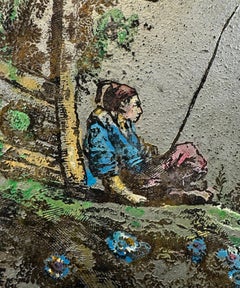
“Chinoi Plaque #2” Philip & Kelvin LaVerne Etched Bronze & Pewter Wall Plaque
Located in Yardley, PA
In “Chinoi #2,” Philip and Kelvin LaVerne return to their favorite theme of Chinoiserie reverie, rendering a lyrical vignette from acid etched bronze and pewter. A lone boy sits with...
Bronze, Metal
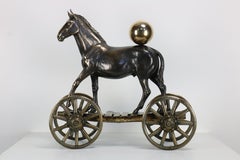
Show of Interest
By Brad Rude
Located in Bozeman, MT
Artist Brad Rude was born in Montana and has lived in Walla Walla, Washington most of his life. His journeys through his grandfather's folk art studio left...
Bronze, Enamel
$5,750
H 16.5 in W 4 in D 3 in
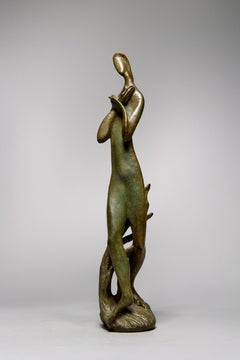
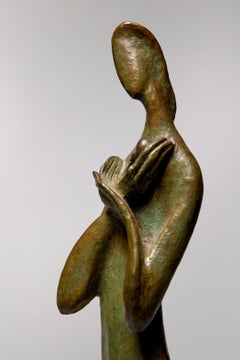
Vernal Equinox, 20th Century Bronze Figure of Woman, Cleveland School Artist
Located in Beachwood, OH
Edris Eckhardt (American, 1905-1998) Vernal Equinox, c. 1975 Bronze Signed on base 16.5 x 4 x 3 inches Born in Cleveland, Ohio January 28, 1905, Edris was given the name Edythe Alin...
Bronze
$18,500
H 103 in W 24 in D 26 in
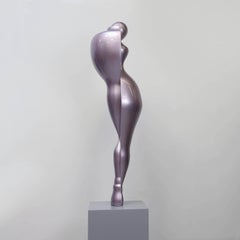
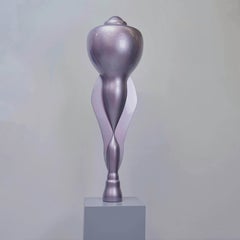
Contemporary Venus Inspired Automotive Painted Sculpture
By Roger Reutimann
Located in Boulder, CO
Inspired by the timeless elegance of the Venus de Milo - the iconic 2,100-year-old Greek sculpture at the Louvre depicting Aphrodite, goddess of love and beauty - this contemporary f...
Steel, Stainless Steel
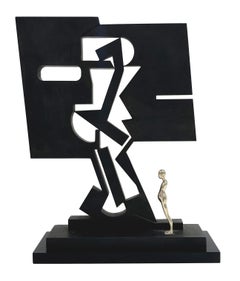
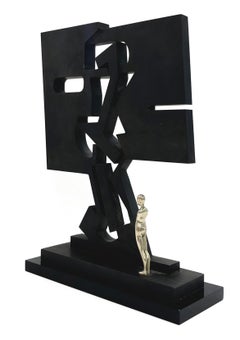
FALLING MAN GOX (SCULPTURE)
By Ernest Trova
Located in Aventura, FL
Bronze and steel sculpture with black patination, on black acrylic base. Etched artist signature with title, date and edition to base underside. Published by Pace Editions. From t...
Bronze, Steel
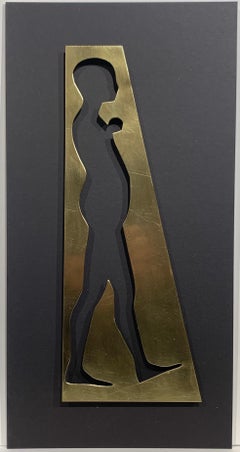
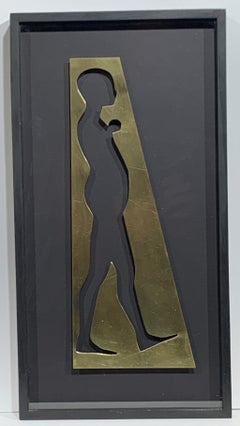
Walking Man with Disc
By Ernest Trova
Located in Wilton Manors, FL
Beautiful figural sculpture by American artist, Ernest Tino Trova (1927-2009). Walking Man with Disc (working study), 1966. Brass sheet with cut-out figure in profile, sheet measures...
Brass
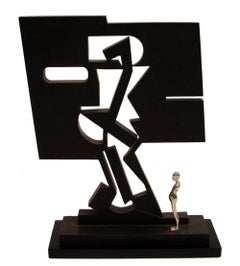

TRISTAN GOX (SCULPTURE)
By Ernest Trova
Located in Aventura, FL
Steel and bronze sculpture. Inscribed signature and numbered. Artwork is in excellent condition. Certificate of authenticity included. Edition of 125. All reasonable offers will be...
Bronze, Steel