By Ferdinand Barbedienne
Located in New York, NY
Ferdinand Barbedienne
(Saint-Martin-de-Fresnay 1810 – 1892 Paris)
after Lorenzo Ghiberti
(Florence, 1378 – 1455)
The Story of Joseph from the Second Baptistery Doors,
Florence (“The Gates of Paradise”)
Signed at the lower right of the principal relief: F. BARBEDIENNE FONDEUR
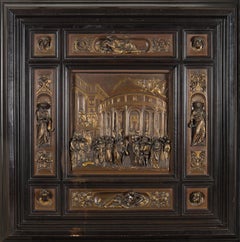
Nine bronze reliefs set into a wooden frame
27 ½ x 27 ½ inches (70 x 70 cm)
The present work is a half-size reduction of nine panels from the famous Gates of Paradise by Lorenzo Ghiberti, made for the Baptistery of Florence and now housed in the Museo del Opera del Duomo. The central scene is one of the most remarkable, The Story of Joseph, comprised of seven episodes from the Biblical narrative integrated into one composition: Joseph cast by his brethren into the well, Joseph sold to the merchants, the merchants delivering Joseph to the pharaoh, Joseph interpreting the pharaoh’s dream, the pharaoh paying him honor, Jacob sending his sons to Egypt, and Joseph recognizes his brothers and returns home. The surrounding reliefs—two vertical figures in niches, two recumbent figures, and four portrait heads in roundels—are as well faithful reductions of Ghiberti’s original bronzes on other parts of the doors.
The maker of these casts was the renowned 19th-century French fondeur Ferdinand Barbedienne. Gary Radke has recently written of this great enterprise:
“The Parisian bronze caster Ferdinand Barbedienne began making half-sized copies of ancient and Renaissance sculpture in the 1830s. His firm benefitted enormously from the collaboration of Achille Collas, whom Meredith Shedd has shown was one of numerous pioneers in the mechanical reproduction of sculpture. Their competitors largely devoted themselves to reproducing relief sculpture, but Collas devised a process for creating fully three-dimensional copies. A tracing needle, powered by a treadle, moved over the surface of a full-sized plaster cast or bronze of the original and triggered a complementary action in a cutting stylus set over a soft plaster blank…He signed an exclusive contract with Barbedienne on November 29, 1838, and won medals for his inventions in 1839 and 1844.
Barbedienne’s half-sized copies of the Gates of Paradise were famous not only for their fidelity to the original, but also for the way their gilding…suggested the glimmering surface that was hidden under centuries of dirt. Some critics even saw Collas’s and Barbedienne’s work as ‘philanthropic, an exemplary adaptation of industry to the requirements of art, the artist, the workers, and the public alike.’
At 25,000 francs, Collas’s and Barbedienne’s reduction of the Gates of Paradise was singularly more expensive than any other item for sale in their shop. All the reliefs, individual statuettes, and busts were cast separately and could be purchased either by the piece or as an ensemble. Fittingly, Barbedienne’s accomplishment earned him the Grand Prix at the 1878 Paris Exposition Universelle, along with numerous other medals.”
Only two complete examples of the Barbedienne-Ghiberti doors are known. One, first installed in a chapel in the Villa Demidoff of San Donato near Pratolino, was later acquired by William Vanderbilt...
Category
19th Century Old Masters Ferdinand Barbedienne Sculptures