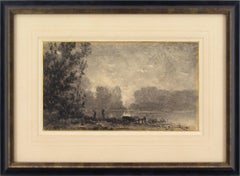
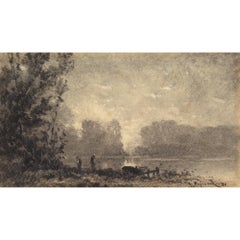
Frank Charles Peyraud Art

to
2
1
Overall Width
to
Overall Height
to
3
2
1
3
1
1
1
3
3
2
1
1
3
11,586
2,876
2,492
1,593
3
3
Artist: Frank Charles Peyraud
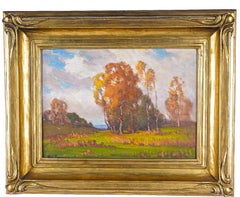
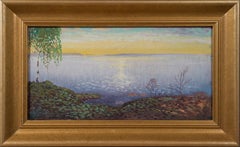
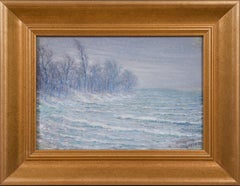
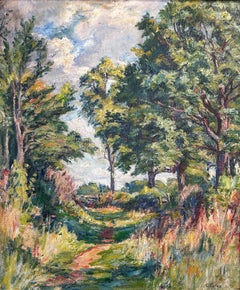
American Landscape With Birch Trees

American Landscape With Birch Trees

By Frank Charles Peyraud

Located in Lake Worth Beach, FL

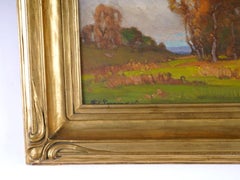
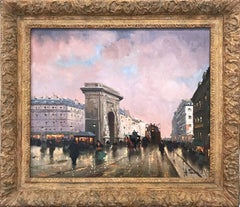
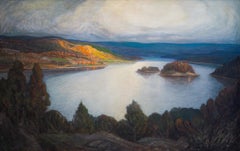
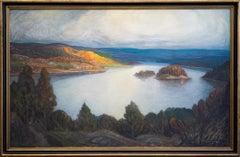
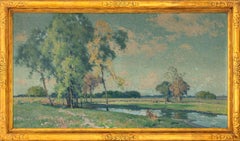
Landscape signed lower left beautiful original gold leaf frame. ​ Frank Peyraud earned a lasting reputation for rural landscapes, especially snow scenes in broadly defined forms and glowing colors. Excepting a trip from 1921 to 1923 to Italy and Switzerland, he was based in Chicago, where a Registrar of the Chicago Art Institute in materials for a traveling exhibition, described him as the "dean of Chicago landscape artists." (Richter) Peyraud was one of the first American painters to focus on the Midwestern landscape and did many river and farm scenes including his signature snowscapes. Many of his paintings reflected Impressionism, an abstract style executed with rapid technique and broken brushstrokes brought over from France towards the end of the 19th Century. Impressionism received much attention in Chicago in some of the artwork exhibited at the 1893 Exposition. Of Peyraud and Impressionism, it was written that "he was the most successful of the progressive Chicago painters who experimented with impressionist approaches in the years following Exposition." He was credited with more discipline of execution than many of his peer impressionists and with a "valid impressionism", (Greenhouse) that conveyed poetic interpretations to what many persons regarded as very ordinary rural Illinois landscape. His snow scene haystack painting, Winter Light on the Farm, in the Marshall Collection of Peoria and exhibited at the Terra Museum, shows "crystalline atmosphere and fleeting light of a waning winter afternoon". (Greenwood) and seems to reference the serial haystack paintings by Claude Monet. Many of Peyraud's works had luminous back-lighting, and careful arrangement of contrasting shapes, and a tone inviting the viewer into a "slightly enchanted world into which quotidian human elements rarely intrude." (Richter) Peyraud was born in Bulle, Switzerland, and enrolled as an architecture student at the Ecole des Beaux-Arts in Paris. In 1881, at age 22 and an established architect in France, he emigrated to Chicago where he spent the remainder of his career. He found employment there as a cyclorama painter, which meant creating huge panoramic paintings in the round, "forerunner of the wide-screen motion picture." (Richter). In 1891, he became involved in retouching Paul Phillipoteaux's panorama, The Battle of Gettysburg, when it came to Chicago for exhibition He continued to work on panoramic and cycloramas spectacles including The Creation for the 1903 Louisiana Exposition. Spring Painted Desert in the Santa Fe Railroad Collection shows at least one trip West. Peyraud also did mural painting, several of them in Peoria, Illinois including a series of allegorical murals with Hardesty Maratta in the Peoria at the newly-built Public Library. In Peoria, he also taught classes and gave lectures. In 1906, he married Elizabeth Krisher, a portrait painter, and illustrator. Sources include: Marianne Richter, Union League Club of Chicago Art Collection, "Frank Charles Peyraud...

Category

1940s Frank Charles Peyraud Art
Materials

Oil, Board

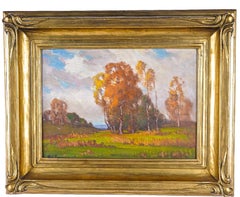
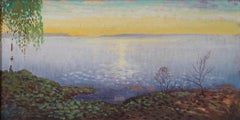
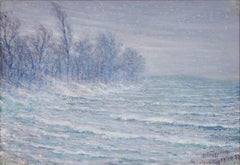
American Landscape With Birch Trees

American Landscape With Birch Trees

By Frank Charles Peyraud

Located in Lake Worth Beach, FL

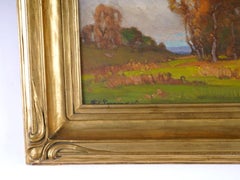
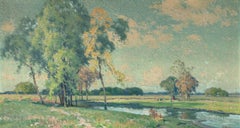
Landscape signed lower left beautiful original gold leaf frame. ​ Frank Peyraud earned a lasting reputation for rural landscapes, especially snow scenes in broadly defined forms and glowing colors. Excepting a trip from 1921 to 1923 to Italy and Switzerland, he was based in Chicago, where a Registrar of the Chicago Art Institute in materials for a traveling exhibition, described him as the "dean of Chicago landscape artists." (Richter) Peyraud was one of the first American painters to focus on the Midwestern landscape and did many river and farm scenes including his signature snowscapes. Many of his paintings reflected Impressionism, an abstract style executed with rapid technique and broken brushstrokes brought over from France towards the end of the 19th Century. Impressionism received much attention in Chicago in some of the artwork exhibited at the 1893 Exposition. Of Peyraud and Impressionism, it was written that "he was the most successful of the progressive Chicago painters who experimented with impressionist approaches in the years following Exposition." He was credited with more discipline of execution than many of his peer impressionists and with a "valid impressionism", (Greenhouse) that conveyed poetic interpretations to what many persons regarded as very ordinary rural Illinois landscape. His snow scene haystack painting, Winter Light on the Farm, in the Marshall Collection of Peoria and exhibited at the Terra Museum, shows "crystalline atmosphere and fleeting light of a waning winter afternoon". (Greenwood) and seems to reference the serial haystack paintings by Claude Monet. Many of Peyraud's works had luminous back-lighting, and careful arrangement of contrasting shapes, and a tone inviting the viewer into a "slightly enchanted world into which quotidian human elements rarely intrude." (Richter) Peyraud was born in Bulle, Switzerland, and enrolled as an architecture student at the Ecole des Beaux-Arts in Paris. In 1881, at age 22 and an established architect in France, he emigrated to Chicago where he spent the remainder of his career. He found employment there as a cyclorama painter, which meant creating huge panoramic paintings in the round, "forerunner of the wide-screen motion picture." (Richter). In 1891, he became involved in retouching Paul Phillipoteaux's panorama, The Battle of Gettysburg, when it came to Chicago for exhibition He continued to work on panoramic and cycloramas spectacles including The Creation for the 1903 Louisiana Exposition. Spring Painted Desert in the Santa Fe Railroad Collection shows at least one trip West. Peyraud also did mural painting, several of them in Peoria, Illinois including a series of allegorical murals with Hardesty Maratta in the Peoria at the newly-built Public Library. In Peoria, he also taught classes and gave lectures. In 1906, he married Elizabeth Krisher, a portrait painter, and illustrator. Sources include: Marianne Richter, Union League Club of Chicago Art Collection, "Frank Charles Peyraud...

Category

1940s Frank Charles Peyraud Art
Materials

Oil, Board

Related Items
Amercan Merchant Ship in Philadelphia Harbor

Amercan Merchant Ship in Philadelphia Harbor

By Thomas Birch

Located in Costa Mesa, CA

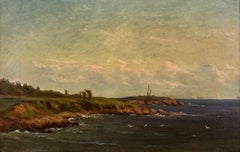
Thomas Birch is considered one of the earliest American Marine painters of importance both in his own time and historically, forming the foundation of what would become a great American Maritime movement in the successive years of the 19th century. Born in England, Birch started as a landscape painter but after the War of 1812 he turned to marine subjects, taking inspiration from the best of both English and Dutch maritime traditions but refining these techniques into a very recognizable style all his own. The work featured here is a classic of Birch's later period, when he focused specifically on maritime subjects, mainly the busy waterways of Philadelphia Harbor. Here we see one of those scenes- a series of ships plying their trade, all framed by the city as it sits across the Delaware River, with the tall, white spire of what is either Independence Hall or Christ Church to the left of the main vessel. The details of the city are particularly good in this painting, with the wharf building to the left and the long line of buildings all along the shore. The American Merchant Bark at the center of this painting is rendered in excellent detail, from her house flag and pennant, to her rigging and sails, and down to her deck filled with the activity of crewmembers readying the ship to head out, her gilt billet...

Category

1840s Other Art Style Frank Charles Peyraud Art
Materials

Canvas, Oil, Board

Pointillist - Scandinavian Winter Landscape, 1907 by Arthur Percy

Pointillist - Scandinavian Winter Landscape, 1907 by Arthur Percy

Located in Stockholm, SE

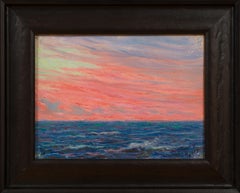
Introducing "Scandinavian Winter Landscape, 1907" a mesmerizing painting by the artist Arthur Percy Carlsson, later known as Arthur C:son Percy (1886-1976). Born in Vickleby, Öland, Percy's artistic journey was one defined by unwavering determination and exceptional talent. This landscape painting presents a winter landscape, likely set during the early spring season. The canvas portrays a vast, snow-filled meadow, blanketed in pristine white. Above, the sky comes alive in a captivating pointillist style, with hues of blue, turquoise, and yellow forming delicate, scattered dots, while small clouds grace the horizon. The scene unfolds with an enchanting backdrop of a distant forest, its trees adorned with a touch of winter's charm. Between the enchanting forest and the expansive meadow, a few humble houses...

Category

Early 1900s Pointillist Frank Charles Peyraud Art
Materials

Canvas, Oil

Landscape Painting from Dalsland, Sweden by Axel Zachrison

Landscape Painting from Dalsland, Sweden by Axel Zachrison

Located in Stockholm, SE

Axel Zachrison was a Swedish painter known for his landscapes from Dalsland. Born in Tydje, Dalsland, Zachrison's artistic journey was shaped by his experiences at sea and his encounters with influential artists such as Otto Hesselbom, a relative on his mother's side. This captivating landscape painting titled "Landscape from Dalsland, Sweden" showcases Zachrison's artistic talent and his ability to capture the beauty of nature. The sky, painted in shades of white and gray, features distinct lines around the clouds add a sense of movement and depth to the scene, reminiscent of Hesselbom's painting technique. In the background, we can see some blue mountains, their majestic presence contributing to the overall sense of grandeur. And In the left part, the viewer can see some land illuminated by the warm rays of the afternoon sun. The vibrant colors of orange, green, and yellow bring the landscape to life, infusing it with a sense of vitality and serenity. A shimmering body of water in the the center, reflecting the luminous white light and creating captivating mirror-like reflections. The foreground of the painting consists of a darker forest area which skillfully framing the lower part of the composition. This deliberate contrast adds depth and visual interest to the artwork, drawing the viewer's attention to the enchanting scenery. It's undated but likely executed in the 1920s, the painting carries an undeniable "wow" factor upon first sight. Zachrison's skillful brushwork and his masterful use of decorative color choices create a captivating and immersive experience for the viewer. His ability to evoke emotional responses through his art is a testament to his talent and artistic vision. Zachrison studied under the guidance of renowned artist Carl Wilhelmson...

Category

1920s Post-Impressionist Frank Charles Peyraud Art
Materials

Canvas, Oil

"October Inspiration" Landscape Painting with Aspens Fall Colors

"October Inspiration" Landscape Painting with Aspens Fall Colors

Located in Austin, TX

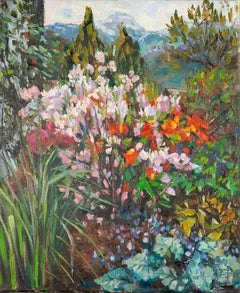
A luminous landscape painting of an aspen forest with white tree trunks and vibrant fall foliage in orange and gold. The distant background features a purple, Rocky Mountain vista...

Category

21st Century and Contemporary Post-Impressionist Frank Charles Peyraud Art
Materials

Canvas, Oil

Summer landscape, Marie-Lucie Nessi, Woman Post-impressionist, Oil on canvas

Summer landscape, Marie-Lucie Nessi, Woman Post-impressionist, Oil on canvas

By Marie Lucie Nessi

Located in New York, NY

Marie Lucie Nessi-Valtat Summer landscape, ca. 1950 Oil on canvas Canvas: 17 1/3 × 21 in l 44 × 53 cm Frame: 19 2/3 x 23 1/4 l 50 x 59 cm Signed lower right Marie-Lucie Nessi Valta...

Category

1950s Post-Impressionist Frank Charles Peyraud Art
Materials

Canvas, Oil

"Deauville" 20th century French beach scene oil on canvas

"Deauville" 20th century French beach scene oil on canvas

Located in New York, NY

Signed lower left: F. gall Provenance: Private Collection Anne French Fine Arts, 2009 Private Collection, Florida Francois Gall was born in Kolozsvar, Hungary in 1912. He began hi...

Category

20th Century Post-Impressionist Frank Charles Peyraud Art
Materials

Canvas, Oil

Summer, Quaker Hill oil painting by Nell Blaine

Summer, Quaker Hill oil painting by Nell Blaine

By Nell Blaine

Located in Hudson, NY

This work by Nell Blaine was exhibited at the Poindexter Gallery, as well as the Tibor de Nagy Gallery, both in New York City. It is signed lower left, and signed, titled, and dated ...

Category

1960s American Impressionist Frank Charles Peyraud Art
Materials

Oil, Board

Adirondack Stream by Hudson River artist Joseph Antonio Hekking (1830-1903)

Adirondack Stream by Hudson River artist Joseph Antonio Hekking (1830-1903)

By Joseph Antonio Hekking

Located in New York, NY

Painted by Hudson River School artist Joseph Antonio Hekking (1830-1903), "Adirondack Stream in Fall" is oil on board and measures 8.5 x 6.5 inches. The painting is signed at the low...

Category

19th Century Hudson River School Frank Charles Peyraud Art
Materials

Oil, Board

Summer's Day in Haga, Stockholm by Erik Tryggelin, Oil Painting from 1902

Summer's Day in Haga, Stockholm by Erik Tryggelin, Oil Painting from 1902

By Erik Tryggelin

Located in Stockholm, SE

In the vast realm of art history, there are certain works that transcend time and space, transporting us to a world of beauty and serenity. One such painting is by the renowned Swedi...

Category

1910s Post-Impressionist Frank Charles Peyraud Art
Materials

Canvas, Oil, Board

Hudson Highlands by Lockwood DeForest (American, 1850-1932)

Hudson Highlands by Lockwood DeForest (American, 1850-1932)

By Lockwood DeForest

Located in New York, NY

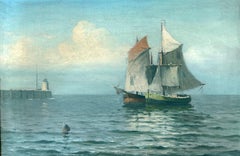
"Hudson Highlands," by Hudson River School painter Lockwood DeForest (American, 1850-1932) is oil on artists card-stock and measures 9.5 x 14 inches. The work is framed in an elegant, period appropriate frame, and ready to hang. Lockwood de Forest was born in New York in 1850 to a prominent family. He grew up in Greenwich Village and on Long Island at the family summer estate in Cold Spring Harbor. As was customary for a cultivated family in the Gilded Age, the de Forests made frequent trips abroad. Excursions to the great museums, which were prominent on the de Forests agenda, deepened the young Lockwood's familiarity with European painting and sculpture. Though he had begun drawing and painting somewhat earlier, it was during a visit to Rome in 1868 that nineteen-year-old de Forest first began to study art seriously, taking painting lessons from the Italian landscapist Hermann David Salomon Corrodi (1844–1905). More importantly, on the same trip, Lockwood met one of America’s most celebrated painters, (and his maternal great- uncle by marriage) Frederic Edwin Church (1826–1900), who quickly became his mentor. DeForest accompanied Church on sketching trips around Italy and continued this practice when they both returned to America in 1869. Early on in his career, de Forest made a habit of recording the date and often the place of his oil sketches, as to create a visual diary of his travels. Lockwood’s profession as a landscape painter can be primarily attributed to Frederic E. Church and his belief in the young artist’s talent. De Forest often visited Church in the Hudson River community of Catskill where, in addition to sketching trips and afternoons of painting, he assisted with the architectural drawings and planning of Olana. In 1872, de Forest took a studio at the Tenth Street Studio Building in New York. During these formative years de Forest counted among his friend’s artists such as Sanford Robinson Gifford (1823–80), George Henry Yewell (1830–1923), John Frederick Kensett (1816–72), Jervis McEntee (1828–91), and Walter Launt Palmer (1854–1932). Over the next decade de Forest experienced success as a painter. He exhibited for the first time at the National Academy of Design in 1872, and made two more painting trips abroad, in 1875–76 and 1877–78, traveling to the major continental capitals but also the Middle East and North Africa. His trip to the Middle East and the library at Church’s home, Olana, established his interest in design during his mid-twenties. From about 1878 to 1902, landscape painting was overshadowed by his activities and preoccupation with East Indian architecture and décor, a style that became quite fashionable in late nineteenth century America. From 1879-1883, de Forest founded Associated Artists along with Louis Comfort Tiffany, Candace Wheeler...

Category

19th Century Hudson River School Frank Charles Peyraud Art
Materials

Oil, Board

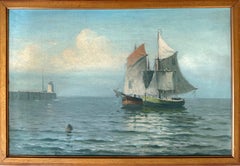
Untitled Jacques Rouby (1953-2019) Contemporary abstract art painted cardboard

Untitled Jacques Rouby (1953-2019) Contemporary abstract art painted cardboard

By Jacques Rouby

Located in Paris, FR

Painted sculpted cardboard Unique work Coming from the artist's studio Jacques ROUBY, the aesthetics of mystery "Experimental dreamer, passionate about graphic adventures, delibera...

Category

1990s Abstract Frank Charles Peyraud Art
Materials

Oil, Cardboard

New England Sunrise, 1910 by Lockwood DeForest (American, 1850-1932)

New England Sunrise, 1910 by Lockwood DeForest (American, 1850-1932)

By Lockwood DeForest

Located in New York, NY

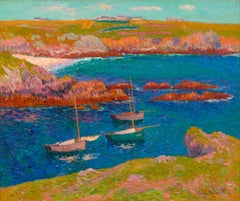
"New England Sunrise," 1910 by Hudson River School painter Lockwood DeForest (American, 1850-1932) is oil on artists card-stock and measures 9.75 x 14 inches. The work is signed by DeForest and dated Sept. 17, 1910 at lower left. The work is framed in an elegant, period appropriate frame, and ready to hang. Lockwood de Forest was born in New York in 1850 to a prominent family. He grew up in Greenwich Village and on Long Island at the family summer estate in Cold Spring Harbor. As was customary for a cultivated family in the Gilded Age, the de Forests made frequent trips abroad. Excursions to the great museums, which were prominent on the de Forests agenda, deepened the young Lockwood's familiarity with European painting and sculpture. Though he had begun drawing and painting somewhat earlier, it was during a visit to Rome in 1868 that nineteen-year-old de Forest first began to study art seriously, taking painting lessons from the Italian landscapist Hermann David Salomon Corrodi (1844–1905). More importantly, on the same trip, Lockwood met one of America’s most celebrated painters, (and his maternal great- uncle by marriage) Frederic Edwin Church (1826–1900), who quickly became his mentor. DeForest accompanied Church on sketching trips around Italy and continued this practice when they both returned to America in 1869. Early on in his career, de Forest made a habit of recording the date and often the place of his oil sketches, as to create a visual diary of his travels. Lockwood’s profession as a landscape painter can be primarily attributed to Frederic E. Church and his belief in the young artist’s talent. De Forest often visited Church in the Hudson River community of Catskill where, in addition to sketching trips and afternoons of painting, he assisted with the architectural drawings and planning of Olana. In 1872, de Forest took a studio at the Tenth Street Studio Building in New York. During these formative years de Forest counted among his friend’s artists such as Sanford Robinson Gifford (1823–80), George Henry Yewell (1830–1923), John Frederick Kensett (1816–72), Jervis McEntee (1828–91), and Walter Launt Palmer (1854–1932). Over the next decade de Forest experienced success as a painter. He exhibited for the first time at the National Academy of Design in 1872, and made two more painting trips abroad, in 1875–76 and 1877–78, traveling to the major continental capitals but also the Middle East and North Africa. His trip to the Middle East and the library at Church’s home, Olana, established his interest in design during his mid-twenties. From about 1878 to 1902, landscape painting was overshadowed by his activities and preoccupation with East Indian architecture and décor, a style that became quite fashionable in late nineteenth century America. From 1879-1883, de Forest founded Associated Artists along with Louis Comfort Tiffany, Candace Wheeler...

Category

Early 20th Century Hudson River School Frank Charles Peyraud Art
Materials

Oil, Board

Previously Available Items

Frank Charles Peyraud art for sale on 1stDibs.

Find a wide variety of authentic Frank Charles Peyraud art available for sale on 1stDibs. You can also browse by medium to find art by Frank Charles Peyraud in board, charcoal, oil paint and more. Not every interior allows for large Frank Charles Peyraud art, so small editions measuring 20 inches across are available. Frank Charles Peyraud art prices can differ depending upon medium, time period and other attributes. On 1stDibs, the price for these items starts at $646 and tops out at $3,500, while the average work can sell for $2,073.