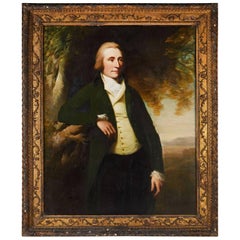
George Romney Art

English, 1734-1802

George Romney is best known as one of British society’s foremost portrait painters of the 18th century, rivaling other widely acknowledged portraitists such as Thomas Gainsborough and Joshua Reynolds.

Born in 1734 in Dalton-on-Furness, Romney was the son of a cabinetmaker. In 1755, he began his artistic career as an apprentice to portrait painter Christopher Steele before traveling to northern England to establish a painting studio in Kendal. Romney’s talent in portraiture proved fruitful. By 1762, he had made enough money to set up a studio in London, where he became renowned for an “ability to paint flattering images regardless of personality.” 

During the 1760s, Romney had hoped to become a history painter but was unsuccessful. To refine and improve his technique, he traveled to Rome in 1773, where he spent two years studying the Old Masters, including Titian, Correggio and Raphael. While there, he was also influenced by the works of Swiss painter Henry Fuseli.  

Upon his return to London, in 1775, and with his newly honed painting style, Romney became even more popular among the British aristocracy and nobility. Although his primary aspiration was to make a living as a historical painter, Romney was in demand as a portraitist. His favorite subjects were children and women, particularly his muse, Emma Hart — who later became Lady Hamilton and mistress of Admiral Lord Nelson. Romney painted several Romantic portraits and drew many sketches of Lady Hamilton, whom he considered to represent the ideal of feminine beauty.

In his later years, Romney produced several portraits and drawings of Shakespearean subjects for John Boydell’s Shakespeare Gallery in 1790. 

Romney’s figurative works, portraits and prints are held in collections of numerous major museums and galleries, including the National Portrait Gallery in London, the National Gallery of Canada in Ottawa, the Metropolitan Museum of Art and the Frick Collection in New York. In 2002, an exhibition commemorating the bicentenary of Romney’s death was organized by the National Museums Liverpool in partnership with the National Portrait Gallery and the Huntington Library, Art Collections and Gardens in San Marino, California. 

On 1stDibs, find a range of original George Romney drawings, paintings and prints.

to
2
3
1
1
3
Overall Width
to
Overall Height
to
6
1
1
1
6
6
6
2
8
7
4
3
2
1
1
1
1
1
5
5
2
2
2
9
10,164
2,784
2,504
1,378
7
6
2
Artist: George Romney
Portrait of Anne Evelyn - British 18thC Old master oil painting excellent prov.
By George Romney
Located in Hagley, England
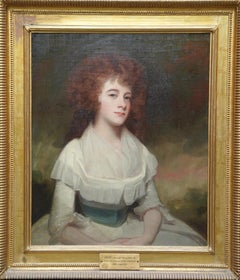
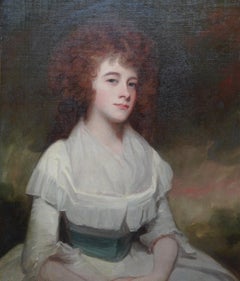
This stunning British 18th century Old Master portrait oil painting, with exceptional provenance, is by noted artist George Romney. It was painted in 1788, commissioned by James Evelyn of Felbridge as it is of his younger daughter Anne, aged 20 years old. James was a Doctor of Law and Anne's mother was his second wife, Jane. Felbridge house, Anne's home, was in the village of Godstone in Surrey. This superb oil painting is a seated portrait of Anne, wearing a white dress with a green sash, her forearms exposed and her hands in her lap. Anne is blessed with the most wonderful long auburn curly hair and is visually stunning. Her body is partly turned away from the artist/viewer and she is slightly gazing down at us with confident, clear eyes. Anne is pictured in a landscape with a dramatic sky behind her. Romney's brushwork on her dress, hair and the background is superb. The delicate detailing of her facial features is also stunning. Sometimes Old Master portraits can be a little staid, but this one of Anne with her wild auburn hair and bold look is just magnificent. This is a fantastic example of George Romney's work and of an 18th century British Old Master with exceptional detailed provenance. Name plate states: Anne, younger daughter of James Evelyn of Fellbridge Esq. 1788, aged 20. Romney. Provenance. With Charles Cecil Cope Jenkinson, 3rd Earl of Liverpool (1784-1851) With The Hon. Henry Berkeley Portman (1860-1923), Later 3rd Viscount Portman; with Emma, Viscountess Portman (1862-1929) By 1926; with her daughter Lady Moyra Dawson-Damer (1897-1962) Thence by family descent. Painted in 1788. There are various labels verso. Mentioned in Lord Hawkesbury's Catalogues of Portraits at Compton Place and at Buxted Park, in Sussex, 1903, p.18, no. 3, at Buxted Park, as in the 'Dining Room, South Wall'. Further Bibliography: Gower (R. S.) Romney, London, 1904, p. 175 Kidson (Alex) George Romney, A Complete Catalogue of his Paintings, New Haven and London: Yale University Press, 2015, I, p. 205, no. 422 (illus).Ward (Humphrey) and Roberts (William) Romney: A Biographical and Critical Essay, London: T Agnew & Sons, 1904, p. 51 Condition. Oil on canvas. Image size 30 inches by 24 inches and in good condition. Frame. Housed in an ornate gilt frame with name plate, 37 inches by 31 inches and in good condition. George Romney (1734-1802) was born in Dalton-on-Furness, Lancashire, on 15 December 1734, the third of the eleven children of John Romney and Anne Simpson. Leaving school at the age of eleven, he worked for eight years in his father's cabinetmaking workshop before being apprenticed to a local painter, Christopher Steele, with whom he served for two years, from 1755 to 1757, in Kendal, York, and Lancaster. He married a Kendal girl, Mary Abbot...
Category

1780s Old Masters George Romney Art
Materials

Oil

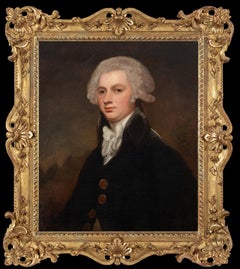
Portrait of a Gentleman, traditionally identified as Edward Addison, Esq., 1780s
By George Romney
Located in Henley-on-Thames, England
George Romney (1734-1802) Portrait of a Gentleman, traditionally identified as Edward Addison, Esq., c.1780s Oil on canvas In a period carved and gilded swept frame 76.3 x 63.2 cm.; ...
Category

1780s Old Masters George Romney Art
Materials

Oil

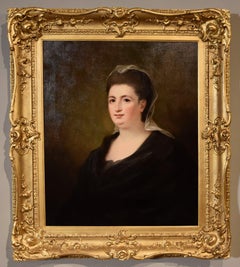
Portrait of Lady Caroline Price
By George Romney
Located in Miami, FL
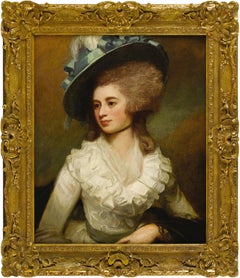
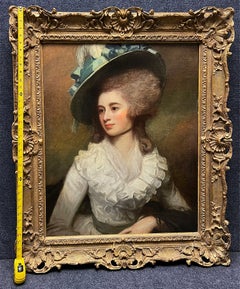
DESCRIPTION: Perhaps the best Romney in private hands. If Vogue Magazine existed in the late 18th century, this image of Lady Caroline Price would be ...
Category

1970s Old Masters George Romney Art
Materials

Oil, Canvas

Portrait of Lady Anne Dutton, Oil on canvas, 18th English Century Painting
By George Romney
Located in London, GB
Oil on canvas, unsigned Image size: 22 x 20 inches (22.75 x 51 cm) Pierced gilt carved frame Provenance Commissioned by James Lenox Dutton (1713-1777) Sherborne House, Dorset Family descent This half-length portrait shows the sitter with her head and eyes looking over her shoulder, to the right. She is dressed in a delicate blue dress and blue shawl with her hair tied up away from her face. The composition of the painting is simple but effective; the woman stands out and is the undeniable focus of the viewer's attention. George Romney's artistic style is characterised by its focus on the beauty and elegance of human forms. Here, one can appreciate his ability to capture the delicacy of facial features and the soft textures of clothing. In addition, Romney has used a soft and diffuse brushstroke technique that creates a light and soft effect in the work. The dark and diffused background highlights the young woman's figure even more, creating an effect of depth and realism. The sitter of this painting is likely Anne Dutton, the daughter of James Lenox Dutton and Jane Bond. Anne Dutton (1743-1821) was the 13 x great great granddaughter of King Edward III, and married politician Samuel Blackwell. Anne sat for portraits by Francis Cotes which bear a striking resemblance to this portrait, and her father was a known patron of Romney. George Romney Romney was a fashionable portrait painter of late 18th-century English society. In his portraits Romney avoided delving into the character or sensibilities of the sitter. His great success with his society patrons depended largely on just this ability for dispassionate flattery. Line rather than colour dominates; the flowing rhythms and easy poses of Roman classical sculpture underlie the smooth patterns of his compositions. From 1755 to 1757 Romney was the pupil of Christopher Steele, an itinerant portrait and genre painter. Romney’s career began when he toured the northern English counties painting portraits for a few guineas each. In 1762 he went to London. His history painting The Death of General Wolfe won him an award from the Society of Arts; nonetheless he turned almost immediately to portrait painting. In 1764 he paid his first visit to Paris, where he was befriended by Joseph Vernet. Romney especially admired the work of Nicolas Le Sueur, whose use of the antique strongly appealed to him. In 1773 he went to Italy for two years, where he studied Raphael’s Stanze frescoes in Rome, Titian’s paintings...
Category

18th Century George Romney Art

Materials

Canvas, Oil

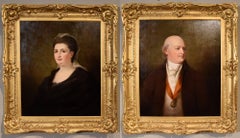
Oil Painting by George Romney "Portraits of a Lady and Gentleman"
By George Romney
Located in Mere, GB
Oil Painting Pair circle of by George Romney "Portraits of a Lady and Gentleman" 1734 - 1802 Romney was a leadway society portrait painter of the Georgian ear...
Category

1780s George Romney Art

Materials

Oil

18th century ink study for the Leveson-Gower Children
By George Romney
Located in London, GB
Collections: J. Goodfriend, USA. Brown wash and pencil on laid paper Framed dimensions: 13.25 x 11.75 inches This powerful drawing was made at the time that Romney was painting the famous group portrait of the Gower Children now in Abbot Hall Art Gallery, Kendal. Romney was a bold and incisive draughtsman who made numerous rich brown ink studies, principally for historical compositions; by contrast, comparatively few studies linked directly to his portraits survive. The existence of a group of studies for the Gower Children underscores its importance to Romney. The sitters were the five youngest of the eight children of Granville, 2nd Earl Gower who, at the time the portrait was commissioned, was President of the Council in Lord North’s government and one of the best-connected and most influential people in England. The present drawing which is a large scale treatment of the composition in its final form perfectly distils Romney’s conceit: the younger children dancing whilst their elder sister, in the guise of a Bacchante plays the tambourine. The bold and dramatic study underlines both the artistic confidence and classical grandeur Romney gained during his trip to Italy between 1773 and 1775. The commission from Granville, 2nd Earl Gower to paint five of his children came shortly after Romney’s Continental tour. The initial idea, as represented by the present drawing, seems to have been to paint Lady Anne, the figure on the right of the composition playing the tambourine, who was the youngest of Gower’s first four children by his second wife Lady Louisa Egerton and who married the Rev. Edward Vernon Harcourt, later Archbishop of York, with three of her younger half-siblings by Gower’s third wife, Lady Susanna Stewart: at the left Lady Georgina, who became Countess of St Germans following her marriage to the Hon. William Eliot; at the right Lady Charlotte Sophia, later Duchess of Beaufort and in the centre Lady Susanna, later Countess of Harrowby. Romney added a fifth child to the finished portrait, Gower’s son: Lord Granville, later created Viscount Granville and Earl Granville. In Italy Romney had produced a large number of studies of classical antiquities and old master paintings. The commission from Gower offered Romney the opportunity to explore a complex multi-figural group, putting into practice the kind of ambitious classical quotations that Reynolds was currently exploiting. In 1773 Reynolds had completed the remarkable group portrait of the Montgomery Sisters, now in the Tate Gallery, London, which showed them adorning a herm of the Roman god Hymen; the composition used a garland to link the three figures who were shown in classical costume dancing at the foot of a Roman sculpture. Scholars have long pointed to a similar sources for the two compositions: the works of Nicolas Poussin. Whilst the Montgomery Sisters is based, in part, on a Bacchanal now in the Musée des Beaux-Arts, the Gower Children has always been associated with Poussin’s Dance to the Music of Time, now in the Wallace Collection, London. It seems more likely that Romney was looking to an antique source in the form of the Borghese Dancers, a Roman relief, then in Palazzo Borghese in Rome. Romney would have seen the relief of interlocking, dancing maidens and would also have known Guido Reni’s Aurora...
Category

18th Century Old Masters George Romney Art

Materials

Ink, Pencil

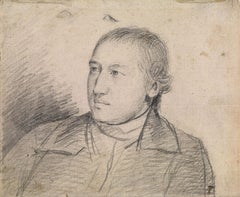
18th century portrait drawing of the Rev. William Atkinson
By George Romney
Located in London, GB
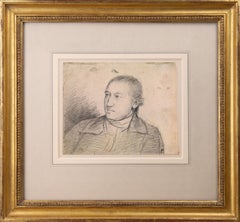
Collections: Henry Scipio Reitlinger (1882-1950); Private collection, UK to 2019 Framed dimensions: 14.50 x 15.38 inches This drawing is one of only two known portrait drawings by Romney (as opposed to preliminary studies for portraits) and is dated by Alex Kidson as being executed no later than 1769. It is likely that the present drawing was originally part of a sketchbook, now largely dismembered (Abbot Hall Art Gallery, Kendal), which Kidson notes, contained some of Romney’s most beautiful early drawings. This drawing, and a second sheet formerly with Andrew Wyld, have been identifying as depicting the Rev. William Atkinson...
Category

18th Century Old Masters George Romney Art

Materials

Pencil

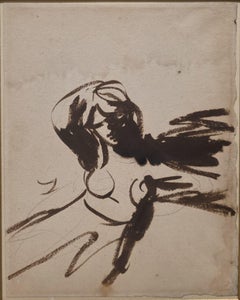
The Expulsion of Adam and Eve from the Garden of Eden
By George Romney
Located in New York, NY
Pen and ink drawing on laid paper by British Master George Romney. The expulsion of Adam and Eve from the Garden of Eden, circa 1770 The Royal Academy in London has a collection of pen and ink drawings on laid paper by George Romney which appear to be from the same period. This is double sided work which causes a shadow on the front. Provenance: Collection of Alfred de Pass The Truro Museum, Cornwall, England Christopher Powney, London Private Collection, CT Christopher Powney of Berwick Fine Art, dated 25 August 1967, authenticated this work. The original letter is included on back of the framed work. Christopher Powney was a London fine art dealer known for his expertise in British Drawings. He is recognized by the British Museum as a London art dealer...
Category

Early 1800s Old Masters George Romney Art
Materials

Ink, Laid Paper, Pen

Related Items
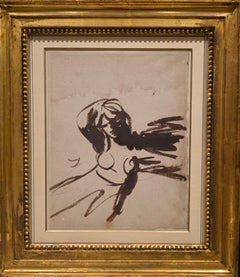
Portrait Paint Oil on canvas Old master 16/17th Century Italian Raffaello Art
Located in Riva del Garda, IT
Tuscan painter active towards the end of the 16th century Portrait of Captain Niccolò Orsini (Pitigliano, 1442 - Lonigo, 1510), count of Pitigliano and Nola. Tuscany, end of the 16th century Oil on canvas, 64 x 47 cm., Framed 89 x 73 cm. The portrait we present to you shows the effigy of a vigorous high-ranking male figure in armor, in the most typical Renaissance pose, half-length and taken in profile, with his face and gaze turned to the side; the serious and intense expression and the facial features evoke at first glance the portraiture of early Florentine mannerism. He is Niccolò III Orsini (Pitigliano, 1442 - Lonigo, 1510), count of Pitigliano and Nola and son of Aldobrandino Orsini, famous leader and captain (or capitano di ventura) who lived between the fifteenth and sixteenth centuries, who served for the state Pontifical in Naples and Florence and above all for the Republic of Venice. Portraiture with these characters, which derives from ancient coinage, was used in the sixteenth century in the sequences of Portraits of Illustrious Men, both in painting and in sculpture. The profile portrait was in fact a genre reserved, according to the Renaissance tradition, for celebrations, presenting those characteristics of imperturbability typical of the military role covered. Our painting is a work created by an author active in Tuscany towards the end of the sixteenth century, adhering to those pictorial styles made famous by the portraitist Cristofano di Papi dell'Altissimo (1530-1605), a pupil of Bronzino and then of Pontormo, known for having created a collection of about 500 portraits of illustrious men, known as the 'Gioviana Series' (now in the Uffizi Gallery); and among these it is possible to identify one dedicated to Niccolò Orsini. Our painting is inspired, in particular, by a print taken from the collection of prints...
Category

16th Century Old Masters George Romney Art
Materials

Oil

Saint Michael Archangel López 18th Century Paint Oil on canvas Spanish school
Located in Riva del Garda, IT
18th-century Spanish Colonial School Attributed to Juan Pedro López (Caracas, Venezuela, 1724 - 1787) Saint Michael the Archangel Oil on canvas 91 x...
Category

18th Century Old Masters George Romney Art

Materials

Oil

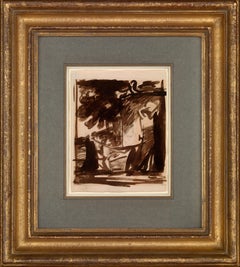
Ecce Homo Coxie Paint 16/17th Century Paint Oil on table Old master Flemish Art
Located in Riva del Garda, IT
Circle of Michael Coxie (Malines, 1499 - Malines, 1592) Ecce Homo with Pontius Pilate Oil on panel Flemish school 16th-17th century 112 x 81 cm - framed 121 x 90 cm. The proposed p...
Category

16th Century Old Masters George Romney Art
Materials

Oil

Portrait of a Girl, 17th Century English School Old Masters Oil
By Gilbert Jackson
Located in London, GB
Gilbert Jackson English Active: 1620 - 1650 Portrait of a Girl Oil on panel, signed upper left and Inscribed upper right Image size: 24 ½ x 20 inches Contemporary style hand made...
Category

17th Century Old Masters George Romney Art
Materials

Oil

Study Of A Head
By Artus Wolfort
Located in Paris, Île-de-France
Artus WOLFAERTS (1581-1641) Study of a head Oil on paper, transferred on panel. 39,5 x 29 cm Unsigned Provenance Private collection, France Firstly thought to be from Rubens’s S...
Category

17th Century Old Masters George Romney Art
Materials

Oil, Laid Paper

Study Of A Head
Study Of A Head
$8,924
H 15.56 in W 11.42 in
17th Century Italian Old Master Oil Painting Moses Striking Water from the Rock
By Pier (Pietro) Dandini
Located in Cirencester, Gloucestershire
Moses Striking Water from the Rock; Circle of Pietro Dandini, Italian 1646-1712 Italian School, late 17th century oil on canvas, framed framed: 3...
Category

Early 18th Century Old Masters George Romney Art
Materials

Canvas, Oil

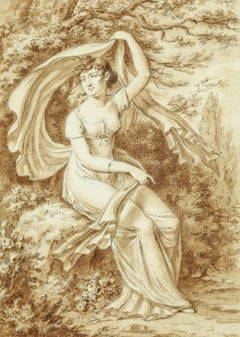
Jean-Henri Cless (1774-1812) Portrait of a young woman, signed drawing
Located in Paris, FR
Jean-Henri Cless (1774-1812) Portrait of a young woman in a landscape signed "Cless fec" for fecit on the lower left Brown ink and brown ink wash on paper Size of the sheet : 31.5 x 22 cm Size of the motive : 24.5 x 17 cm very simply framed under glass without actual frame 32 x 22.5 cm This pre...
Category

Early 1800s Old Masters George Romney Art
Materials

Ink, Pencil

Fine Italian Old Master Oil Painting Angel & Saints Appearing to Figures
Located in Cirencester, Gloucestershire
Artist/ School: Italian Old Master, 18th century Title: Angel and Saints appearing to figures, one dressed in a white ruff collar. Medium: oil on canvas...
Category

Early 18th Century Old Masters George Romney Art
Materials

Canvas, Oil

Two royal portraits (the Duc d'Angoulême and the Duc de Berry) by H.P. Danloux
Located in PARIS, FR
These two royal portraits are a major historical testimony to the stay of the Comte d'Artois (the future Charles X) and his family in Edinburgh in 1796-1797. Given by the sitters to Lord Adam Gordon, the Governor of Edinburgh, and kept by family descent to this day, these two portraits provide us with a vivid and spontaneous image of the Duc d’Angoulême and his brother the Duc de Berry. Danloux, who had emigrated to London a few years before, demonstrate his full assimilation of the art of British portrait painters in the brilliant execution of these portraits. 1. Henri-Pierre Danloux, a portraitist in the revolutionary turmoil Born in Paris in 1753, Henri-Pierre Danloux was first a pupil of the painter Nicolas-Bernard Lépicié (1735 - 1784) and then, in 1773, of Joseph-Marie Vien (1716 - 1809), whom he followed to Rome when, at the end of 1775, Vien became Director of the Académie de France. In Rome he became friends with the painter Jacques-Louis David (1748 - 1825). Returning to France around 1782, he settled in Lyon for a few years before returning to Paris in 1785. One of his first portraits was commissioned by the Baroness d'Etigny, the widow of the former Intendant of the Provinces of Gascony, Bearn and Navarre Antoine Mégret d'Etigny (1719 – 1767). He then became close to his two sons, Mégret de Sérilly and Mégret d'Etigny, who in turn became his patrons. In 1787, this close relationship with the d'Etigny family was further strengthened by his marriage to Antoinette de Saint-Redan, a relative of Madame d'Etigny. After his marriage, he left for Rome and did not return to France until 1789. It was during the winter of 1790-1791 that he painted one of his masterpieces, the portrait of Baron de Besenval. Set in a twilight atmosphere, this portrait of an aristocrat who knows that his death is imminent symbolizes the disappearance of an erudite and refined society which would be swept away by the French Revolution. The Jacobin excesses led Danloux to emigrate to England in 1792; many members of his family-in-law who remained in France were guillotined on 10 May 1794. Danloux enjoyed great success as a portrait painter in England before returning to France in 1801. During his stay in England, Danloux was deeply under the influence of English portraitists: his colors became warmer (as shown by the portrait of the Duc d'Angoulême that we are presenting), and his execution broader. 2. Description of the two portraits and biographical details of the sitters The Duc d'Angoulême (1775-1844) was the eldest son of the Comte d'Artois, the younger brother of King Louis XVI (the future King Charles X), and his wife Marie-Thérèse of Savoie. He is shown here, in the freshness of his youth, wearing the uniform of colonel-general of the "Angoulême-Dragons" regiment. He is wearing the blue cordon of the Order of the Holy Spirit, which was awarded to him in 1787, and two decorations: the Cross of Saint-Louis and the Maltese Cross, as he was also Grand Prior of the Order of Malta. Born on 16 August 1775 in Versailles, Louis-Antoine d'Artois followed his parents into emigration on 16 July 1789. In 1792, he joined the émigrés’ army led by the Prince de Condé. After his stay in Edinburgh (which will be further discussed), he went to the court of the future King Louis XVIII, who was in exile at the time, and in 1799 married his first cousin Marie-Thérèse Charlotte of France, the daughter of Louis XVI and the sole survivor of the royal family. The couple had no descendants. He became Dauphin of France in 1824, upon the accession to the throne of his father but played only a minor political role, preferring his military position as Grand Admiral. Enlisted in Spain on the side of Ferdinand VII, he returned home crowned with glory after his victory at Trocadero in 1823. He reigned for a very short time at the abdication of Charles X in 1830, before relinquishing his rights in favor of his nephew Henri d'Artois, the Duc de Bordeaux. He then followed his father into exile and died on 3 June 1844 in Gorizia (now in Italy). His younger brother, the Duc de Berry, is shown in the uniform of the noble cavalry of the émigrés’ Army. He is wearing the blue cordon of the Order of the Holy Spirit, awarded to him in May 1789, and the Cross of Saint-Louis (partly hidden by his blue cordon). Born on 24 January 1778 in Versailles, Charles-Ferdinand d'Artois also followed his parents into emigration and joined the émigrés’ army in 1792. After his stay in Edinburgh, he remained in Great Britain, where he had an affair with Amy Brown...
Category

1790s Old Masters George Romney Art
Materials

Canvas, Oil, Wood Panel

Painting Male Portrait 19thC
Located in Milan, IT
Oil on Canvas. French school of the late 1700s-early 1800s. Portrait of a gentleman in elegant bourgeois dress. The canvas has slight tears and is in need of cleaning. It is presente...
Category

19th Century Other Art Style George Romney Art

Materials

Oil

Painting Male Portrait  19thC
$2,736
H 37.41 in W 31.5 in D 3.94 in
19th century English Portrait of a Young boy in a Cavalier costume
Located in Woodbury, CT
This elegant English 19th-century portrait of a young boy dressed in a Cavalier costume, painted circa 1860, is a striking example of Victorian portraiture that seamlessly combines h...
Category

1860s Old Masters George Romney Art
Materials

Canvas, Oil

King Charles 1st Antique Oil Painting Portrait of Famous British Monarch
Located in Cirencester, Gloucestershire
King Charles I British artist, early 20th century signed with initials oil on canvas, framed framed: 36 x 29 inches canvas: 32 x 26 inches provenance: p...
Category

Early 1900s Old Masters George Romney Art
Materials

Oil, Canvas

Previously Available Items
18th Century, English Portrait
By George Romney
Located in Los Angeles, CA
Large, softly painted, oil-on-canvas portrait of a British nobleman from the circle of important English artist, George Romney (1734-1802). The piece ...
Category

Late 18th Century George Romney Art

Materials

Canvas, Oil

English 18th century portrait of Richard Oliver, 1791
By George Romney
Located in Bath, Somerset
Portrait of Richard Oliver, three-quarter length, seated in a green velvet armchair, wearing a navy jacket with gold buttons over a white shirt and silk waistcoat...
Category

18th Century Old Masters George Romney Art
Materials

Canvas, Oil

18th century Portrait of a Gentleman
By George Romney
Located in Bath, Somerset
Portrait of a gentleman, believed to be Captain John Stables, three-quarter length, seated in an interior on a green velvet chair, wearing a red jacket with gold buttons and with brown breeches. c.1785. A reference to a portrait of a Captain...
Category

18th Century Old Masters George Romney Art
Materials

Canvas, Oil

English 18th century portrait of Mr Holland, c. 1785
By George Romney
Located in Bath, Somerset
Isherwood Fine Art are pleased to present this fine portrait of a Mr Holland by English artist George Romney (1734-1802). Oil on canvas in the original English Saunders 18th century frame. c.1785. This portrait is featured in Alex Kidson's ', George Romney: A Complete Catalogue of his Paintings', no. 666, volume 1, page 313, 2015. Mr Holland was recorded by Romney as living in Wimpole Street, London and in Romney's rough lists, this portrait is assigned to 1785, the year for which his sitter book is missing. Romney recorded being paid his 20 guinea fee by Mr Holland on 10 September 1786, and there is an appointment recorded with him on 15 September that year: perhaps a finishing session or Mr Holland collecting the picture. This portrait is believed to be of Richard Holland...
Category

Late 18th Century Old Masters George Romney Art
Materials

Oil

Portrait of a Gentleman, English, 18th century.
By George Romney
Located in Bath, Somerset
Portrait of a gentleman, possibly a Mr Scotney, three-quarter length, seated in an interior wearing a red jacket. c.1770. A reference to a portrait of a Mr Scotney is listed in 'Geor...
Category

Mid-18th Century Old Masters George Romney Art
Materials

Oil

George Romney art for sale on 1stDibs.

Find a wide variety of authentic George Romney art available for sale on 1stDibs. You can also browse by medium to find art by George Romney in oil paint, paint, canvas and more. Much of the original work by this artist or collective was created during the 18th century and is mostly associated with the Old Masters style. Not every interior allows for large George Romney art, so small editions measuring 5 inches across are available. Customers who are interested in this artist might also find the work of George Morland, Sir Godfrey Kneller, and Studio of Sir Peter Lely. George Romney art prices can differ depending upon medium, time period and other attributes. On 1stDibs, the price for these items starts at $150 and tops out at $1,495,000, while the average work can sell for $12,178.

Artists Similar to George Romney

Questions About George Romney Art
  • 1stDibs ExpertApril 5, 2022
    George Romney studied under Christopher Steel from 1755-1757. Romney then went on to become one of the most fashionable portrait artists of his day. You can shop a selection of George Romney’s pieces from some of the world’s top art dealers on 1stDibs.
Still Thinking About These?
All Recently Viewed