Harry Lane Figurative Sculptures

American, 1891-1973

Harry Lane was a native of New York City who studied in the US and throughout Europe. After living in New York City for years, he moved to the Berkshires in 1949, where he established his studio. He had many one-man shows by various galleries including Kennedy. Lane is represented in the Metropolitan Museum of Art, in the permanent collections of the Worcester Museum, the Museum of Fine Arts in Boston, the Museum of Fine Arts in Springfield, Massachusetts and the Berkshire Museum in Pittsfield, Massachusetts. Lane also did murals in United States Post Offices at Port Washington, New York and Oakdale, Los Angeles. He is represented in the corporate collection of the Standard Oil Company and in numerous private collections.

1
Overall Width
to
Overall Height
to
1
1
1
1
1
1
1
1
1
10
139
110
92
71
1
Artist: Harry Lane
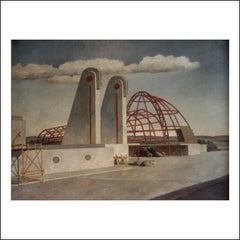
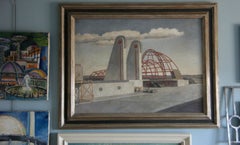
1939 World’s Fair NYC, 1000 piece Museum Quality Collection of Art & Objects

1939 World’s Fair NYC, 1000 piece Museum Quality Collection of Art & Objects

By Harry Lane

Located in New York, NY

1,000 piece Museum Quality Collection of Art & Objects from NYC 1939 Worlds Fair Harry Lane (1891-1973) "1939 World’s Fair Construction," 30 x 40 inches, Oil on canvas, signed lower...

Category

1930s American Modern Harry Lane Figurative Sculptures
Materials

Canvas, Oil, Plaster, Photographic Paper

Related Items
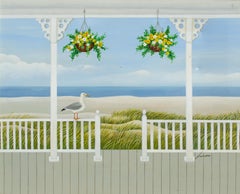
Modernist Cityscape
Modernist Cityscape

Modernist Cityscape

By Esther Rollick

Located in Buffalo, NY

An original modernist oil painting by American female artist Esther Rollick.

Category

1940s American Modern Harry Lane Figurative Sculptures
Materials

Canvas, Oil

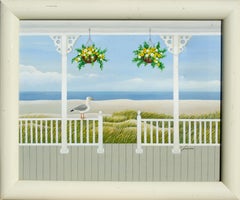
"Cubist Landscape" Albert Heckman, American Modernism, Woodstock, Earth Tones

"Cubist Landscape" Albert Heckman, American Modernism, Woodstock, Earth Tones

By Albert Heckman

Located in New York, NY

Albert Heckman Cubist Landscape Oil on canvas 16 x 20 inches Albert Heckman was born in Meadville, Western Pennsylvania, 1893. He went to New York City to try his hand at the art w...

Category

1940s American Modern Harry Lane Figurative Sculptures
Materials

Canvas, Oil

Boats in the Harbor, Abstract Oil Painting on Canvas by David Azuz

Boats in the Harbor, Abstract Oil Painting on Canvas by David Azuz

By David Azuz

Located in Long Island City, NY

Artist: David Azuz, Israeli/French (1942 - 2014) Title: Boats in the Harbor Year: 1960 Medium: Oil on Canvas, signed l.l. and verso Size: 31 x 25.5 in. (78.74 x 64.77 cm) Frame Size:...

Category

1970s American Modern Harry Lane Figurative Sculptures
Materials

Oil, Canvas

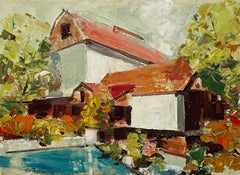
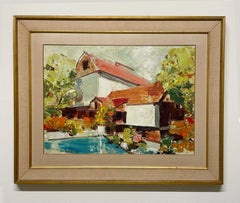
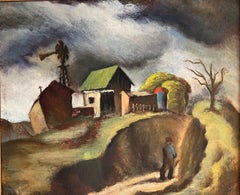
"Cluster of Houses near Woodstock" Albert Heckman, American Modernist Landscape

"Cluster of Houses near Woodstock" Albert Heckman, American Modernist Landscape

By Albert Heckman

Located in New York, NY

Albert Heckman Cluster of Houses near Woodstock Signed lower right Oil on canvas 10 x 14 inches Albert Heckman was born in Meadville, Western Pennsylvania, 1893. He went to New Yor...

Category

1940s American Modern Harry Lane Figurative Sculptures
Materials

Canvas, Oil

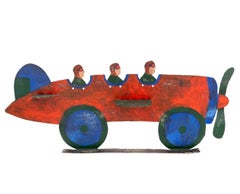
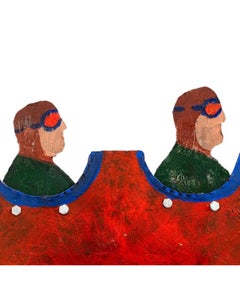
Pilots in Plane Painting on Metal Sculpture Wall Hanging Seymour Chwast Airplane

Pilots in Plane Painting on Metal Sculpture Wall Hanging Seymour Chwast Airplane

By Seymour Chwast

Located in Surfside, FL

Seymour Chwast (American, b. 1931) Three Pilots Ready for Take Off Mixed Media Painted Sculpture Hand-painted metal, (galvanized steel or aluminum) large wall hanging Hand signed to ...

Category

20th Century American Modern Harry Lane Figurative Sculptures
Materials

Metal

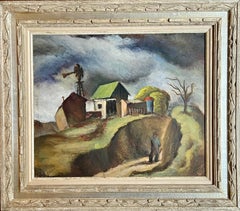
The Old Monastery Wall

The Old Monastery Wall

By William S. Schwartz

Located in New York, NY

Signed (at lower left): WILLIAM S. SCHWARTZ

Category

Early 20th Century American Modern Harry Lane Figurative Sculptures
Materials

Canvas, Oil

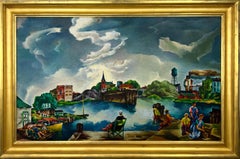
San Pedro Harbor
San Pedro Harbor

Paul SampleSan Pedro Harbor, 1937

$275,000

H 30 in W 40 in

San Pedro Harbor

By Paul Sample

Located in New York, NY

It is infrequent, to say the least, that a diagnosis of tuberculosis proves fortuitous, but that was the event, in 1921, that set Paul Starrett Sample on the road to becoming a professional artist. (The best source for an overview of Sample’s life and oeuvre remains Paul Sample: Painter of the American Scene, exhib. cat., [Hanover, New Hampshire: Hood Museum of Art, 1988] with a detailed and definitive chronology by Sample scholar, Paula F. Glick, and an essay by Robert L. McGrath. It is the source for this essay unless otherwise indicated.) Sample, born in Louisville, Kentucky, in 1896 to a construction engineer and his wife, spent his childhood moving with his family to the various locations that his father’s work took them. By 1911, the family had landed in Glencoe, Illinois, settling long enough for Paul to graduate from New Trier High School in 1916. Sample enrolled at Dartmouth College, in Hanover, New Hampshire, where his interests were anything but academic. His enthusiasms included the football and basketball teams, boxing, pledging at a fraternity, and learning to play the saxophone. After the United States entered World War I, Sample, to his family’s dismay, signed on for the Naval Reserve, leading directly to a hiatus from Dartmouth. In 1918 and 1919, Sample served in the U.S. Merchant Marine where he earned a third mate’s license and seriously contemplated life as a sailor. Acceding to parental pressure, he returned to Dartmouth, graduating in 1921. Sample’s undergraduate life revolved around sports and a jazz band he formed with his brother, Donald, two years younger and also a Dartmouth student. In November 1933, Sample summarized his life in a letter he wrote introducing himself to Frederick Newlin Price, founder of Ferargil Galleries, who would become his New York art dealer. The artist characterized his undergraduate years as spent “wasting my time intensively.” He told Price that that “I took an art appreciation course and slept thru it every day” (Ferargil Galleries Records, circa 1900–63, Archives of American Art, Smithsonian Institution, available on line). In 1920, Donald Sample contracted tuberculosis. He went for treatment to the world-famous Trudeau Sanitorium at Saranac Lake, in New York State’s Adirondack Mountains for the prescribed regimen of rest, healthful food, and fresh air. Visiting his brother in 1921, Paul also contracted the disease. Tuberculosis is highly contagious, and had no certain cure before the development of streptomycin in 1946. Even for patients who appeared to have recovered, there was a significant rate of recurrence. Thus, in his letter to Price, Sample avoided the stigma conjured by naming the disease, but wrote “I had a relapse with a bad lung and spent the next four years hospitalized in Saranac Lake.” The stringent physical restrictions imposed by adherence to “the cure” required Sample to cultivate an alternate set of interests. He read voraciously and, at the suggestion of his physician, contacted the husband of a fellow patient for instruction in art. That artist, then living in Saranac, was Jonas Lie (1880–1940), a prominent Norwegian-American painter and an associate academician at the National Academy of Design. Lie had gained renown for his dramatic 1913 series of paintings documenting the construction of the Panama Canal (The Metropolitan Museum of Art, New York; United States Military Academy, West Point, New York). Primarily a landscape artist, Lie had a particular affinity for scenes with water. His paintings, impressionistic, atmospheric, and brushy, never strayed from a realistic rendering of his subject. Sample regarded Lie as a mentor and retained a lifelong reverence for his teacher. Sample’s early paintings very much reflect Lie’s influence. ` In 1925, “cured,” Sample left Saranac Lake for what proved to be a brief stay in New York City, where his veteran’s benefits financed a commercial art course. The family, however, had moved to California, in the futile hope that the climate would benefit Donald. Sample joined them and after Donald’s death, remained in California, taking classes at the Otis Art Institute in Los Angeles. In Sample’s account to Price, “I couldn’t stomach the practice of painting a lot of High Sierras and desert flowers which seemed to be the only kind of pictures that were sold here so I got a job teaching drawing and painting at the art school of the University of Southern California.” Initially hired as a part-time instructor, Sample progressed to full-time status and ultimately, by the mid-1930s, to the post of Chairman of the Fine Art Department. Sample, however, did not want to wind up as a professor. “Teaching is all right in small doses,” he wrote, “but I have a horror of drifting into being a college professor and nothing more.” At the same time as he taught, Sample began to exhibit his work in a variety of venues at first locally, then nationally. Though he confessed himself “a terrible salesman,” and though occupied with continued learning and teaching, Sample was nonetheless, ambitious. In 1927, he wrote in his diary, “I am eventually going to be a painter and a damned good one. And what is more, I am going to make money at it” (as quoted by Glick, p. 15). In 1928, Sample felt sufficiently solvent to marry his long-time love, Sylvia Howland, who had also been a patient at Saranac Lake. The Howland family were rooted New Englanders and in summertime the Samples regularly traveled East for family reunion vacations. While the 1930s brought serious hardship to many artists, for Paul Sample it was a decade of success. Buttressed by the financial safety net of his teacher’s salary, he painted realist depictions of the American scene. While his work addressed depression-era conditions with a sympathetic eye, Sample avoided the anger and tinge of bitterness that characterized much contemporary realist art. Beginning in 1930, Sample began to exhibit regularly in juried exhibitions at important national venues, garnering prizes along the way. In 1930, Inner Harbor won an honorable mention in the Annual Exhibition of the Art Institute of Chicago. That same year Sample was also represented in a show at the Albright-Knox Gallery in Buffalo and at the Biennial Exhibition of the Corcoran Gallery of Art, Washington, D.C. In 1931, Dairy Ranch won the second Hallgarten Prize at the Annual Exhibition of the National Academy of Design, in New York. Sample also made his first appearances at the Carnegie Institute, Pittsburgh, and The Pennsylvania Academy of the Fine Arts, Philadelphia. In 1936, Miner’s Resting won the Temple Gold Medal at the Pennsylvania Academy’s Annual Exhibition. Always interested in watercolor, in 1936, Sample began to send works on paper to exhibitions at the Whitney Museum, New York. While participating in juried exhibitions, Sample also cultivated commercial possibilities. His first New York art dealer was the prestigious Macbeth Gallery in New York, which included his work in a November 1931 exhibition. In 1934, Sample joined the Ferargil Galleries in New York, after Fred Price arranged the sale of Sample’s Church Supper to the Michele and Donald D’Amour Museum of Fine Arts in Springfield, Massachusetts. In 1937, The Metropolitan Museum of Art purchased Sample’s Janitor’s Holiday from the annual exhibition of the National Academy of Design, a notable honor. As prestigious as this exhibition schedule may have been, by far Sample’s most visible presence in the 1930s and 1940s was the result of his relationship with Henry Luce’s burgeoning publishing empire, Time, Inc. Sample’s first contribution to a Luce publication appears to have been another San Pedro...

Category

20th Century American Modern Harry Lane Figurative Sculptures
Materials

Canvas, Oil

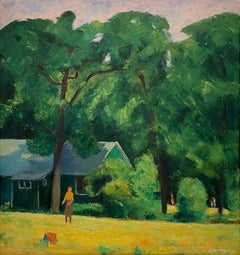
Vintage Painting of a Tropical Boat Dock

Vintage Painting of a Tropical Boat Dock

Located in Palm Beach, FL

Transporting oil painting on canvas of a tropical bayscape, possibly the Florida Keys, with boats, pelicans and figures executed in a bold modern style. Signed in the lower right S. ...

Category

20th Century American Modern Harry Lane Figurative Sculptures
Materials

Canvas, Oil

"Moving Houses" Mischa Askenazy, Modernist, 1930s, California Hills Landscape

"Moving Houses" Mischa Askenazy, Modernist, 1930s, California Hills Landscape

Located in New York, NY

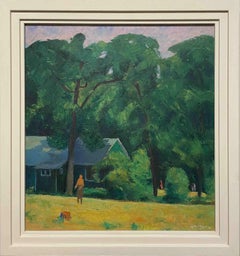
Mischa Askenazy Moving Houses Signed lower right Oil on canvas 26 x 38 inches Mischa Askenazy was born near Odessa, on February 22, 1888. At age four, Askenazy immigrated with his ...

Category

1930s American Modern Harry Lane Figurative Sculptures
Materials

Canvas, Oil

Original Oil Painting American Modern Mediterranean Village Colorful Cityscape

Original Oil Painting American Modern Mediterranean Village Colorful Cityscape

By Dorothy Rivo

Located in Buffalo, NY

Dorothy Rivo Untitled (Mediterranean Village), c. 1960s–70s Oil on canvas Framed dimensions: 24 in. H × 36 in. W Presented in a contemporary white floater frame In Untitled (Mediter...

Category

Mid-20th Century American Modern Harry Lane Figurative Sculptures
Materials

Canvas, Oil

Mid Century Serene Lakeside Landscape

Mid Century Serene Lakeside Landscape, 1960

$895

H 11.25 in W 14.25 in D 1 in

Mid Century Serene Lakeside Landscape

Located in Soquel, CA

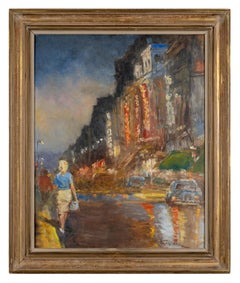
Serene mid century lakeside landscape by an unknown artist (American, 20th Century). Presented in a rustic giltwood frame. Image: 9"H x 12"W. Framed: 11.25"H x 14.25"W. Excellent w...

Category

1960s American Modern Harry Lane Figurative Sculptures
Materials

Canvas, Oil, Illustration Board

"Manhattan Looking East, " Herman Rose, WPA New York City View from Midtown

"Manhattan Looking East, " Herman Rose, WPA New York City View from Midtown

By Herman Rose

Located in New York, NY

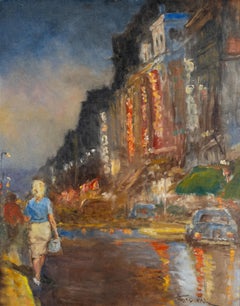
Herman Rose (1909 - 2007) Manhattan Looking East (View from Midtown), 1952-54 Oil on canvas 26 x 28 inches Signed lower right Fairfield Porter wrote an essay in ArtNews on this exact painting in 1955. Please inquire for a copy of the article. Literature: Fairfield Porter, "Herman Rose Paints a Picture," ArtNews, April 1955 Volume 54, Number 2, illustrated. Herman Rose was best known for his depictions of cityscapes of New York City. Herman Rappaport was born in Brooklyn, New York. in 1909. Herman Rose was the professional pseudonym of Herman Rappaport. Originally trained as a draftsman and studied at the National Academy of Design from 1927 to 1929, he was later employed by the Works Progress Administration's Murals Division under Arshile Gorky from 1934 until 1939. In 1939, after experimenting with a variety of contemporary expressionistic styles, Rose decided to paint from life. Working mostly in East New York and East Canarsie in Brooklyn, and in Manhattan, Rose began to paint roof tops and street scenes. Rappaport began using the name Herman Rose when he held his first solo art exhibition in 1946 at the Charles Egan Gallery in New York City. Although he initially began as an Expressionistic painter, he became known for small, light-filled Impressionist paintings of still life, cityscapes and skies by the early 1950s. His paintings and images were often composed of very small dabs of paint and tiny, blurry "squares," which combined to create the image on canvas, his favorite medium. Often described as a "lyrical painter" Rose's work "interpreted traditional subjects: landscape, still life and the figure like the Post-Impressionists from whom he developed his own style, Rose built up forms from distinct touches of color that don't entirely blend in the viewer's eye. This gives his surfaces an active quality that flattens forms, one of the great lessons of modernism." Herman Rose's work received official recognition when Ms. Dorothy Miller of Museum of Modern Art (MoMA) included his work in an exhibition called, "15 Americans," alongside work by Clyfford Still, Mark Rothko and Jackson Pollock. New York Times art critic Hilton Kramer wrote of Rose's work in 1981, "{he} must surely be counted among the most beautiful works anyone has produced in this challenging medium for many years." The Art in America art critic Lawrence Campbell...

Category

1950s American Modern Harry Lane Figurative Sculptures
Materials

Oil, Canvas

Harry Lane figurative sculptures for sale on 1stDibs.

Find a wide variety of authentic Harry Lane figurative sculptures available for sale on 1stDibs. You can also browse by medium to find art by Harry Lane in canvas, fabric, oil paint and more. Much of the original work by this artist or collective was created during the 1930s and is mostly associated with the modern style. Not every interior allows for large Harry Lane figurative sculptures, so small editions measuring 40 inches across are available. Customers who are interested in this artist might also find the work of Tom Binger, Chaim Gross, and John W. Mills.