Max Pechstein Art

German, 1881-1955

Pechstein was born in Zwickau, the son of a craftsman who worked in a textile mill. Early contact with the art of Vincent van Gogh stimulated Pechstein's development toward expressionism. After studying art first at the School of Applied Arts and then at the Royal Art Academy in Dresden, Pechstein met Erich Heckel and joined the art group Die Brucke in 1906. He was the only member to have formal art training. Later in Berlin, he helped to found the Neue Sezession and gained recognition for his decorative and colorful paintings that were lent from the ideas of Van Gogh, Matisse, and the Fauves. His paintings eventually became more primitivist, incorporating thick black lines and angular figures.

From 1933, Pechstein was vilified by the Nazis because of his art. A total of 326 of his paintings were removed from German museums. Sixteen of his works were displayed in the Entartete Kunst (Degenerate Art) exhibition of 1937. During this time, Pechstein went into seclusion in rural Pomerania. He was a prolific printmaker, producing 421 lithographs, 315 woodcuts and linocuts, and 165 intaglio prints, mostly etchings. Pechstein was a professor at the Berlin Academy for ten years before his dismissal by the Nazis in 1933. He was reinstated in 1945, and subsequently won numerous titles and awards for his work. He died in West Berlin. He is buried on the Evangelischer Friedhof Alt-Schmargendorf in Berlin.

to
4
3
1
Overall Width
to
Overall Height
to
8
2
2
2
7
5
3
6
5
4
3
1
1
1
1
1
1
1
1
2
2
2
1
1
8
10,917
2,844
2,494
1,424
3
1
6
2
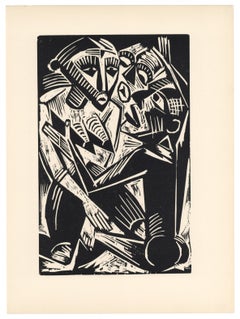
Artist: Max Pechstein
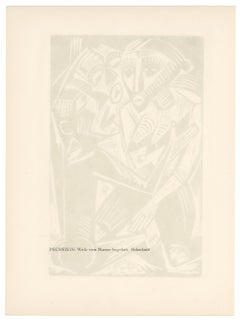
"Woman Desired by Man" original woodcut

"Woman Desired by Man" original woodcut

By Max Pechstein

Located in Henderson, NV

Medium: original woodcut. Printed in 1920 for the Deutsche Graphiker der Gegenwart portfolio, and published in Leipzig by Klinkhardt & Biermann in an edition of 500. Catalogue re...

Category

1920s Expressionist Max Pechstein Art

Materials

Woodcut

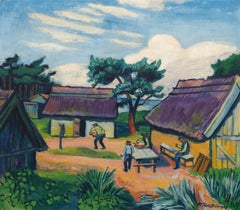
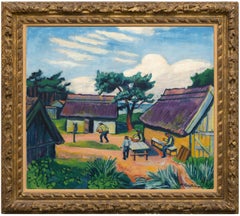
Alte Fischerhutten - Expressionist Oil Painting of Fisherman’s Village, 1949

Alte Fischerhutten - Expressionist Oil Painting of Fisherman’s Village, 1949

By Max Pechstein

Located in Palm Desert, CA

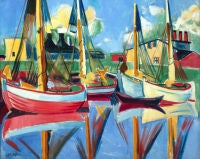
Alte Fischerhütten (1949) by Max Pechstein is an oil on canvas in which the artist transforms a humble cluster of weathered fishing huts into a study of light, form, and atmosphere. Broad, rhythmic brushstrokes delineate the worn timbers and thatched roofs, while a sky streaked with lavender and rose imbues the scene with a quiet, almost meditative luminosity. Pechstein's bold outlines and flattened perspective are tempered by a late-career restraint, allowing the simple geometry of dunes, huts, and sea to resonate with an almost timeless calm. The artwork is signed lower right, "HMPechstein 1949" and signed verso, "Alte Fischerhütten 1949 HMPechstein” Provenance: Private Collection, Europe Lempertz, Cologne, June 15, 1966, lot 531 Selected Artists Galleries, New York, acquired by 1970 Private Collection, New York, acquired from the above Private Collection, by descent from above Phillips, New York, Wednesday, November 15, 2023, lot 123 Private Collection, acquired from the above Literature: Aya Soika, Max Pechstein The Catalgoue raisonne of oil paintings, Volume II 1919–1954, Munich, 2011, no. 1949/12, p. 490, illustrated Hermann Max Pechstein was born on December 31, 1881, in Zwickau, into a working-class family headed by his father, a textile-mill craftsman. Drawn to art early on, he apprenticed as a decorative painter from 1896 to 1900 before enrolling at Dresden’s School of Applied Arts and, from 1902, studying under Otto Gussmann at the Royal Academy of Fine Arts. His academic grounding—unique among his future peers—laid a solid foundation for the bold, expressive work that would follow. In 1906 Erich Heckel invited Pechstein to join Die Brücke, the pioneering Expressionist collective, and he quickly became one of its most active members. Exposure to ethnographic wood carvings in Dresden in 1905 spurred his first woodcuts, and travels to Italy (1907) and Paris (1908)—where he befriended the Fauvist Kees van Dongen—expanded his palette and compositional daring. After relocating to Berlin in 1908, he co-founded the New Secession in 1910, serving as its chairman and gaining acclaim for richly colored prints inspired by Van Gogh, Matisse, and the Fauves. With the outbreak of World War I, Pechstein’s peripatetic life took him from internment in Japan to service on the Western Front in 1916. In the revolution’s aftermath, he aligned with radical socialist art...

Category

Mid-20th Century Expressionist Max Pechstein Art

Materials

Canvas, Oil

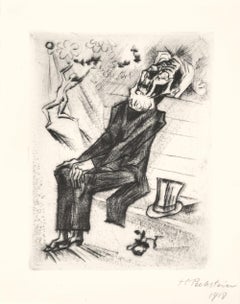
DER SCHATTEN II - Rich Drypoint - 1st State

DER SCHATTEN II - Rich Drypoint - 1st State

By Max Pechstein

Located in Santa Monica, CA

MAX PECHSTEIN (1881 -1955) DER SCHATTEN II 1918 (Knupp 79, Fecher 143 I/ii) Rich drypoint, signed and annotated, FIRST STATE. Image: 8 1/4 x 6 inches on japan paper; 15 x 11 1/4 i...

Category

1910s Expressionist Max Pechstein Art

Materials

Drypoint

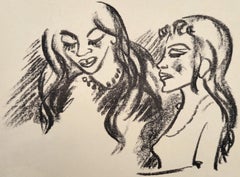
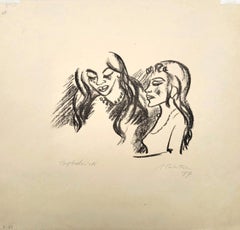
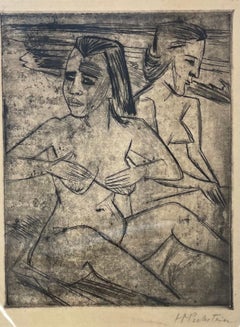
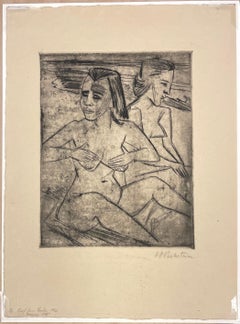
Frau und Mädchen (Woman and Girl) /// Max Pechstein German Expressionist Litho

Frau und Mädchen (Woman and Girl) /// Max Pechstein German Expressionist Litho

By Max Pechstein

Located in Saint Augustine, FL

Artist: Hermann Max Pechstein (German, 1881-1955) Title: "Frau und Mädchen (Woman and Girl)" Portfolio: Paraphrasen zur Samländischen Ode (Paraphrases of the Samland Ode) *Signed and...

Category

1910s Expressionist Max Pechstein Art

Materials

Lithograph

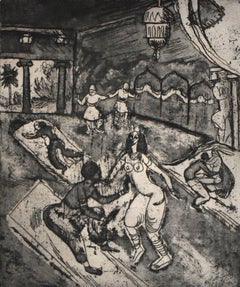
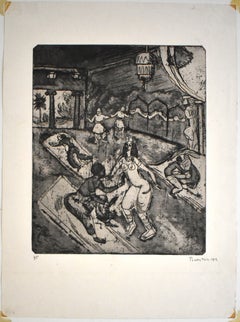
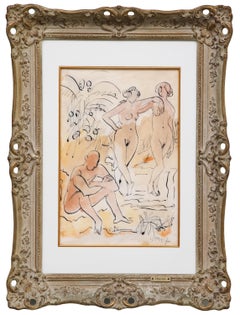
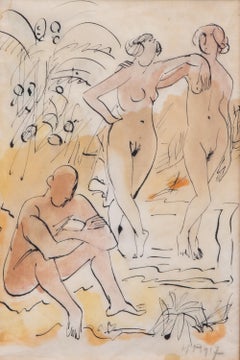
NACH DEM BAD (AFTER THE BATH)

NACH DEM BAD (AFTER THE BATH)

By Max Pechstein

Located in Portland, ME

Pechstein, Hermann Max (German, 1881-1955): NACH DEM BAD (AFTER THE BATH). Krueger R 118. Etching and drypoint, 1920. Signed in pencil. Published by Die Schaffenden...

Category

1920s Max Pechstein Art

Materials

Drypoint, Etching

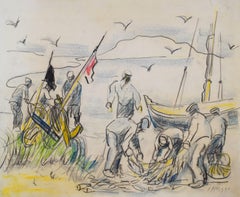
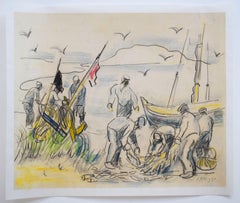
Return of the Fishermen - Fishermen German Expressionism

Return of the Fishermen - Fishermen German Expressionism

By Max Pechstein

Located in London, GB

This chalk drawing is signed and dated in pencil by the artist "HMP 1931" in the lower right image. Note: The drawing was created in the region of Pomerania, Northern Poland, near t...

Category

1930s Expressionist Max Pechstein Art

Materials

Chalk

Related Items
Max Weber Woodcut Print from "Primitives" Poetry Book Signed

Max Weber Woodcut Print from "Primitives" Poetry Book Signed

By Max Weber

Located in Detroit, MI

ONE WEEK ONLY SALE This woodcut print is an expressionist print on one of the poems from Max Weber's poetry collection "Primitives: Poems and Woodcuts". This work is signed in penci...

Category

1920s Expressionist Max Pechstein Art

Materials

Woodcut

Dancing in the Dark

Dancing in the Dark

By Joan Snyder

Located in New York, NY

Joan Snyder has been called an autobiographical, even confessional artist, who draws from her experiences and surroundings to create her paintings. While her subjects vary widely, Sn...

Category

1980s Expressionist Max Pechstein Art

Materials

Woodcut

Shark - Original Offset and Lithograph by George Grosz - 1923

Shark - Original Offset and Lithograph by George Grosz - 1923

By George Grosz

Located in Roma, IT

Shark is an original offset and lithograph, realized by George Grosz. The artwork is the plate n. 66 from the porfolio Ecce Homo published between 1922/1923, edition of Der Malik-Ve...

Category

1920s Expressionist Max Pechstein Art

Materials

Lithograph, Offset

SITZENDER HARLEKIN
SITZENDER HARLEKIN

SITZENDER HARLEKIN

By Heinrich Campendonk

Located in Portland, ME

Campendonk, Heinrich. SITZENDER HARLEKIN. Engels/Sohn 59. Woodcut, 1922. 15 x 11 3/8 inches; 380 x 290 mm. Signed in pencil. In Excellent condition. Framed.

Category

20th Century Expressionist Max Pechstein Art

Materials

Woodcut

Auction

Bernhard KretzschmarAuction, 1921

$4,000

H 13.5 in W 15.5 in D 0.1 in

Auction

By Bernhard Kretzschmar

Located in New York, NY

Bernard Kretzschmar (1889-1972), Auction, etching, drypoint, and burnished aquatint, 1921, signed and dated (’20) in pencil lower right [also initialed in the plate lower left] Refe...

Category

1920s Expressionist Max Pechstein Art

Materials

Drypoint, Etching, Aquatint

Marc Chagall, Paradise I, from Drawings for the Bible, 1960

Marc Chagall, Paradise I, from Drawings for the Bible, 1960

By Marc Chagall

Located in Southampton, NY

This exquisite lithograph by Marc Chagall (1887–1985), titled Paradise I (Paradise I), from Marc Chagall, Dessins Pour La Bible (Drawings for the Bible), Verve: Revue Artistique et Litteraire, Vol. X, No. 37-38, originates from the July 29, 1960 issue published by Editions de la revue Verve, Paris, under the direction of Teriade, Editeur, Paris, and printed by Mourlot Freres, Paris, 1960. This visionary composition reflects Chagall’s poetic interpretation of the biblical paradise, evoking a realm of harmony, innocence, and divine presence through his luminous color and dreamlike symbolism. The flowing forms and radiant imagery convey a sense of spiritual unity and transcendence, capturing the timeless serenity and mystical beauty of Eden within Chagall’s distinctive visual language. Infused with movement and lyricism, the work transforms sacred narrative into a meditative vision of paradise and the enduring connection between humanity and the divine. The piece forms part of Chagall’s celebrated series of lithographs and drawings created for Dessins Pour La Bible, a monumental project uniting art, scripture, and mysticism in one of the artist’s most important achievements. Executed as a lithograph on velin du Marais paper, this work measures 14 x 10.5 inches (35.56 x 26.67 cm). Unsigned and unnumbered as issued. The edition exemplifies the superb craftsmanship of the Mourlot Freres atelier, renowned for its collaborations with the greatest modern masters of the 20th century. Artwork Details: Artist: Marc Chagall (1887–1985) Title: Paradise I (Paradise I), from Marc Chagall, Dessins Pour La Bible (Drawings for the Bible), Verve: Revue Artistique et Litteraire, Vol. X, No. 37-38, July 29, 1960 Medium: Lithograph on velin du Marais paper Dimensions: 14 x 10.5 inches (35.56 x 26.67 cm) Inscription: Unsigned and unnumbered as issued Date: 1960 Publisher: Editions de la revue Verve, Paris, under the direction of Teriade, Editeur, Paris Printer: Mourlot Freres, Paris Catalogue raisonne references: Chagall, Marc, et al. Chagall Lithographe. Andre Sauret, 1960-1986, illustration 230-276. Cramer, Patrick, and Meret Meyer. Marc Chagall: Catalogue Raisonne des Livres Illustres. P. Cramer ed., 1995, illustration 42. Condition: Well preserved, consistent with age and medium Provenance: From Marc Chagall, Dessins Pour La Bible (Drawings for the Bible), Verve: Revue Artistique et Litteraire, Vol. X, No. 37-38, published by Editions de la revue Verve, Paris, 1960 Notes: Excerpted from the folio (translated from French), This double issue of Verve includes the drawings that Marc Chagall executed in 1958 and 1959 on biblical themes that he had not generally dealt with in his illustration for the Bible, engraved with etching and which were included in issue 33/34 of Verve. This album has 96 renderings in black and 24 color litbographies as well as the cover that were specially made for this album. It was completed printing on July 29, 1960 by Draeger Freres for black gravures and by Mourlot Freres for color lithography. About the Publication: Marc Chagall, Dessins Pour La Bible (Drawings for the Bible), published as Verve Vol. X, No. 37-38 on July 29, 1960, represents a significant continuation and expansion of Chagall’s profound engagement with biblical imagery and spiritual narrative. Conceived and directed by the visionary publisher Teriade, the publication builds upon the earlier Verve issue devoted to Chagall’s Bible illustrations by presenting a new body of work executed in 1958 and 1959, exploring themes and episodes that had not been fully addressed in the initial series. Printed in Paris by Draeger Freres for black gravures and Mourlot Freres for color lithography, the edition demonstrates an exceptional level of technical refinement and artistic collaboration. The publication includes an extensive suite of ninety six black reproductions and twenty four color lithographs, as well as specially created cover imagery, reflecting Chagall’s continued innovation in translating sacred themes into graphic form. As part of the broader tradition of Verve, one of the most important artistic and literary publications of the twentieth century, this issue exemplifies the fusion of text, image, and craftsmanship at the highest level. Today, Verve Vol. X, No. 37-38 stands as a major achievement within Chagall’s graphic oeuvre, reaffirming his role as one of the foremost interpreters of biblical narrative in modern art. About the Artist: Marc Chagall (1887–1985) was a Belarus-born French painter, printmaker, and designer whose visionary imagination, radiant color, and deeply poetic symbolism made him one of the most beloved and influential artists of the 20th century. Rooted in the imagery of his Jewish heritage and the memories of his childhood in Vitebsk, Chagall’s art wove together themes of faith, love, folklore, and fantasy with a dreamlike modern sensibility. His unique style merging elements of Cubism, Fauvism, Expressionism, and Surrealism defied categorization, transforming ordinary scenes into lyrical meditations on memory and emotion. Influenced by Russian icon painting, medieval religious art, and the modern innovations of artists such as Pablo Picasso, Henri Matisse, and Georges Braque, Chagall developed a profoundly personal visual language filled with floating figures, vibrant animals, musicians, and lovers that symbolized the transcendent power of imagination and love. During his early years in Paris, he became an integral part of the Ecole de Paris circle, forming friendships with Amedeo Modigliani, Fernand Leger, and Sonia Delaunay, and his creative spirit resonated with that of his peers and successors Alexander Calder, Alberto Giacometti, Salvador Dali, Joan Miro, Wassily Kandinsky, Marcel Duchamp, and Man Ray, artists who sought to push the boundaries of perception, emotion, and form. Over a prolific career that spanned painting, printmaking, stained glass, ceramics, and stage design, Chagall brought an unparalleled poetic sensibility to modern art, infusing even the most abstract subjects with human warmth and spiritual depth. His works are held in the most prestigious museums around the world, including the Museum of Modern Art, the Centre Pompidou, the Tate, and the Guggenheim, where they continue to inspire generations of artists and collectors. The highest price ever paid for a Marc Chagall artwork is approximately 28.5 million USD, achieved in 2017 at Sotheby’s New York for Les Amoureux (1928). Marc Chagall Paradise...

Category

1960s Expressionist Max Pechstein Art

Materials

Lithograph

"Canyon River" (2025), Original Expressionist Impasto Landscape, Oil Painting

"Canyon River" (2025), Original Expressionist Impasto Landscape, Oil Painting

By Sandra Pratt

Located in Denver, CO

"Canyon River" (2025) is a beautiful original impasto oil painting, created on linen panel by American artist Sandra Pratt, which depicts a vast forest, captured in an expressionisti...

Category

2010s Expressionist Max Pechstein Art

Materials

Canvas, Oil

H.O. Miethke Das Werk folio "Judith I" collotype print

H.O. Miethke Das Werk folio "Judith I" collotype print

By Gustav Klimt & K.K. Hof-und Staatsdruckerei

Located in Palm Beach, FL

Judith I, no. 9 from the second installment of Das Werk Gustav Klimts Much like his treatment of the Classical personage, Danae, from Greek mythology, Klimt’s depiction of Judith takes an Old Testament character, a heroine who avenges the death of her husband by killing an Assyrian king, and firmly positions her in his present-day Vienna. His multicolored collotype rips the canvas from its gilded frame which directly references the subject with its title: “Judith und Holofernes”. Now in print form, Judith, holding the severed head of a male in murky shadow, is the ultimate Viennese femme fatale. Her likeness is unmistakably similar to a former lover of Klimt’s and famous Viennese soprano, Anna von Mildenburg. Though his allusion to ancient Assyria is apt, Klimt literally lifted the gold patterned background’s design motif from a relief detail from Sennacherib’s Palace displayed in a London museum. His context then is contemporary. In a sensual and sexually powerful tour de force, Klimt’s Judith...

Category

Early 1900s Vienna Secession Max Pechstein Art

Materials

Paper, Ink

Max Eisler Eine Nachlese folio “The Bride” collotype print

Max Eisler Eine Nachlese folio “The Bride” collotype print

By (after) Gustav Klimt

Located in Palm Beach, FL

After Gustav Klimt, Max Eisler #30, Brautzug; multi-color collotype after unfinished 1917/18 painting in oil on canvas. Painted in the last months of Klimt’s life, The Bride was one...

Category

1930s Vienna Secession Max Pechstein Art

Materials

Paper

Gerlach's Allegorien Folio, plate #58: "Sculpture" Lithograph, Gustav Klimt.

Gerlach's Allegorien Folio, plate #58: "Sculpture" Lithograph, Gustav Klimt.

By Gustav Klimt

Located in Palm Beach, FL

As an artist trained in the applied arts, Gustav Klimt valued all forms of art, including the graphic arts. This final design from 1896 for inclusion in Allegorien published by Gerlach & Schenk demonstrates respect for artistic precedent and for a wide range of media and technique. The publication was printed in an unknown number of copies. Klimt’s rendering in latin of the title, “SCVLPTVR.,” with three-dimensional effect on the wall, is a figurative allusion to this medium as well as a literal reference to Ancient Rome. By doing the same with his signature and date in roman numerals on the right hand side of the image, Klimt places himself, The Artist, firmly in this linear and legitimizing context of art history and as its modern standard-bearer. Playing on Classical mythology and the story of Pygmalion, in which a statue comes to life, Klimt presents his modern Venus holding an apple. Klimt’s Venus exhibits a curvilinear softness; there are no angles. Klimt deftly shows the possibilities in a graphic image to give life to dark, wavy hair and tenderness to swelling breasts and belly. To further emphasize the allegory of thriving modern art, he contrasts his Venus with the cold, hard ancient classical head whose eyes are vacuous and whose hair is but a stylized mass of curls. Klimt’s living Venus stands in front of the large bust and large classical pillar upon which is a sculpture of a Sphinx and a Greek Attic bust. As if a gallery to represent sculpture’s “best of” through the ages, the upper horizontal panel includes bust depictions in marble, cast metal and wood...

Category

1890s Vienna Secession Max Pechstein Art

Materials

Lithograph

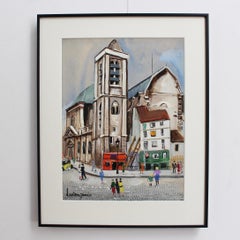
French Modernist Large Paris Street Oil Painting Expressionist Henry D'anty

French Modernist Large Paris Street Oil Painting Expressionist Henry D'anty

By Henri d'Anty

Located in Surfside, FL

Large oil on canvas Paris, France street scene with house and tree. Hand signed Framed Dimensions 41 x 48.5 Canvas is 40 X 32 inches Henri Maurice D'Anty, listed French artist, Henry d'Anty 1910-1998 Born 1910 in Belleville France. Died in December 4 1998. Educated at the Académie de la Grande Chaumière and the Académie Julian Paris. Painter of the school of Paris. ((painter of de l'Ecole de Paris et Peintre Témoin de son Temps) He participated in numerous exhibitions and was rewarded number of prizes for his work in France and abroad D'Anty was born in Belleville, and it was here that he came to know the picturesque architectural quality of small sloping streets, sometimes broken by flights of steps, like those of Montmartre. Afterwards he moved to Saint Maurice, where he came under the spell of the banks of the Marne with its blue green reflections, the heavy river barges, sail boats, and the lock with its large dark mass, which all made their impressions, as did a later visit in northern France, long before he thought seriously about painting. But in both eye and mind, he was already storing secret visions and emotions. During a holiday in Brittany, he discovered an entirely new awareness of colors, or rather of colors of the enchanting, subtle tones which make up the varied atmospheres of the Breton scene. He is linked to both post impressionism and expressionism. He was part of the Ecole de Paris (School of Paris) and showed with Francois Arnal, Franz Priking, Isis Kischka, Roland Dubuc, Bernard Maurice Quentin, Michel Patrix, Roger Bezombes, Lucien Joseph Fontanarosa, Bernard Buffet, Jean Marzelle, Maurice Blond, Isaac Antcher, Francis Bott, Jean Jansem, Alfred Charles Weber...

Category

20th Century Expressionist Max Pechstein Art

Materials

Oil, Canvas

Previously Available Items
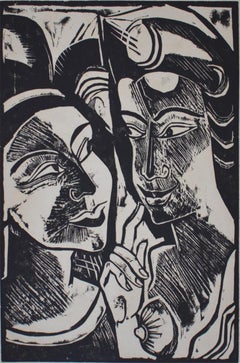
Zwiesprache - Original Woodcut Print by Max Pechstein - 1918

Zwiesprache - Original Woodcut Print by Max Pechstein - 1918

By Max Pechstein

Located in Roma, IT

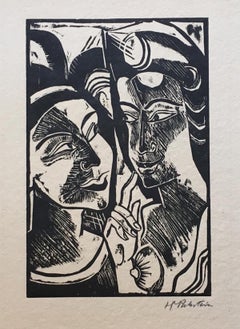
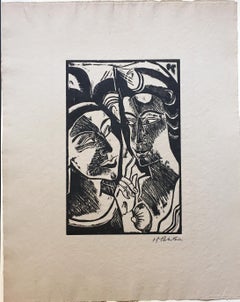
Woodcut on beige heavy paper. Signed in pencil by the artist on the lower right margin, Edition of 75 prints, published in Berlin by Fritz Gurlitt in 1920 for the suite “H.M.Pechstein Holzschnitte 1919”. Single state. Excellent impression with very dense ink. Wide margins and excellent overall conditions of sheet. Max Pechstein (Zwickau, 1881- Berlin, 1955), German Expressionist painter and printmaker, Max Pechstein is known above all for his boldly colored nudes and landscapes. Primarily working in the Impressionist tradition, after joining the group of the Die Brücke together with E.L. Kirchner and H. Heckle, he began painting in a vibrant Fauvist palette. In a similar way as Gauguin, Pechstein was influenced by primitive art of other cultures after visiting the Dresden Ethnographical Museum. When the artist travelled to Italy (1907) he was struck by Giotto’s paintings...

Category

1910s Expressionist Max Pechstein Art

Materials

Woodcut

Der Schatten II - Etching and Drypoint by Max Pechstein - 1918

Der Schatten II - Etching and Drypoint by Max Pechstein - 1918

By Max Pechstein

Located in Roma, IT

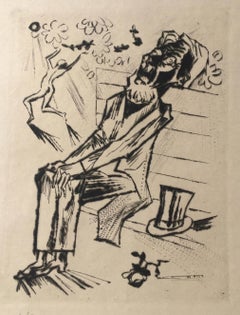
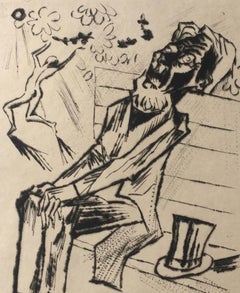
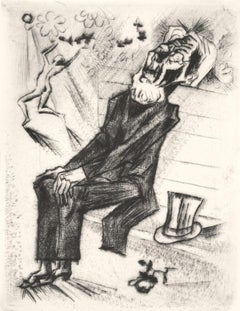
Der Schatten II (Johannes Teuber sitzende ) is an original etching and drypoint, realized by Max Pechstein in 1918, signed and dated. Edition of 200 prints. Included a frame. In very good conditions. The artwork represents an old man seated in a bench with a flower fallen on the ground and his head bend toward the back as he is dreaming, in the background there is a nude dancing woman here the artwork represents skillful Expressionistic style of expression with strong lines and color. Max Pechstein (Zwickau, 1881- Berlin, 1955), German Expressionist painter and printmaker, Max Pechstein is known above all for his boldly colored nudes and landscapes. Primarily working in the Impressionist tradition, after joining the group of the Die Brücke together with E.L. Kirchner and H. Heckle, he began painting in a vibrant Fauvist palette. In a similar way as Gauguin, Pechstein was influenced by primitive art of other cultures after visiting the Dresden Ethnographical Museum. When the artist traveled to Italy (1907) he was struck by Giotto’s paintings...

Category

1910s Expressionist Max Pechstein Art

Materials

Drypoint, Etching

Weib Vom Manne Begehrt (Woman Desired by Man) /// Max Pechstein Woodcut Modern

Weib Vom Manne Begehrt (Woman Desired by Man) /// Max Pechstein Woodcut Modern

By Max Pechstein

Located in Saint Augustine, FL

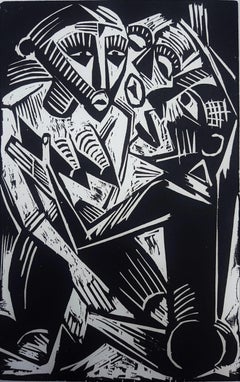
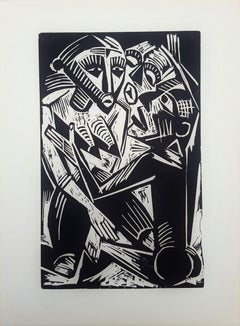
Artist: Hermann Max Pechstein (German, 1881-1955) Title: "Weib Vom Manne Begehrt (Woman Desired by Man)" Portfolio: Deutsche Grapiker der Gegenwart (German Printmakers of Our Time) *Unsigned edition Year: 1919, (published 1920) Medium: Original Woodcut Engraving on cream wove paper Limited edition: 500, (there was also a signed and numbered edition of 30) Printer: Unknown Publisher: Klinkhardt & Biermann, Leipzig, Germany Reference: "Das Graphische Werk Max Pechsteins" - Krüger No. 224; Fechter No. 157; Rifkind No. 2252; Söhn I, page 108-114 Framing: Recently beautifully framed in a modern gold moulding with 100% cotton rag matting and Museum Glass Framed size: 19.69" x 16.13" Sheet size: 12.75" x 9.5" Image size: 9.88" x 6.25" Condition: One small skillfully repaired tear lower left in margin. It is otherwise a strong impression in excellent condition Notes: Provenance: private collection - Kiel, Germany. Comes from the 1920 "Deutsche Grapiker der Gegenwart (German Printmakers of Our Time)" portfolio of fifteen lithographs, eight woodcuts, eight reproductions, and one lithographed cover by various artists. The artists who contributed to this portfolio were George Grosz, Ernst Barlach, Lovis Corinth, Richard Seewald, Heinrich Campendonk, Erich Heckel, Otto Mueller, Karl Schmidt-Rottluff, Lyonel Feininger, Conrad Felixmüller, Max Unold, Karl Caspar, Max Lieberman, René Beeh, Adolf Ferdinand Schinnerer, Ludwig Meidner, Max Beckmann, Richard Seewald, Käthe Kollwitz, August Gaul, Rudolf Grossman, Alfred Kubin, and Paul Klee. This very same work is within many permanent museum collections including the Museum of Modern Art, New York, NY. "Deutsche Graphiker der Gegenwart (German Printmakers of Our Time)" brings together woodcuts, lithographs, and reproductions by thirty-one artists representing a cross-section of styles from Impressionism to Expressionism, uniting under a single cover works ranging from naturalistic self-portraits to left-wing political caricatures. It features works by artists associated with the Berlin Secession (an exhibiting society comprised primarily of German Impressionists), with Expressionist groups like the Brücke and Der Blaue Reiter, and with the political Novembergruppe, as well as artists like Max Beckmann who were not affliliated with any group. In his introduction, art historian Kurt Pfister identified Expressionism as the leading force in German art at the time, while stressing the plurality of approaches to style and subject matter that the movement encompassed. Pfister emphasized the openness of German artists to foreign sources, and cited the importance of Paul Cézanne, Edvard Munch, and Pablo Picasso as well as Japanese, Indian, African, and Gothic art for the development of German art. There was a fifty-year difference in age between the oldest artist, Max Liebermann, and the youngest, Conrad Felixmüller, featured in the collection. The volume also included Lyonel Feininger, an American who had lived in Germany since 1896, as well as Austrian artists Oskar Kokoschka and Alfred Kubin. Biography: Pechstein was born in Zwickau, the son of a craftsman who worked in a textile mill. Early contact with the art of Vincent van Gogh stimulated Pechstein's development toward expressionism. After studying art first at the School of Applied Arts and then at the Royal Art Academy in Dresden, Pechstein met Erich Heckel and joined the art group Die Bru¨cke in 1906. He was the only member to have formal art training. Later in Berlin, he helped to found the Neue Sezession and gained recognition for his decorative and colorful paintings that were lent from the ideas of Van Gogh, Matisse, and the Fauves. His paintings eventually became more primitivist, incorporating thick black lines and angular figures. From in 1933, Pechstein was vilified by the Nazis because of his art. A total of 326 of his paintings were removed from German museums. Sixteen of his works were displayed in the Entartete Kunst (Degenerate Art...

Category

1920s Expressionist Max Pechstein Art

Materials

Engraving, Woodcut
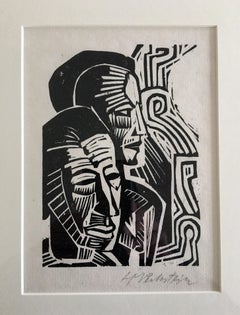
Two Heads
Two Heads

Max PechsteinTwo Heads, 1922

Sold

H 7.13 in W 5 in

Two Heads

By Max Pechstein

Located in New York, NY

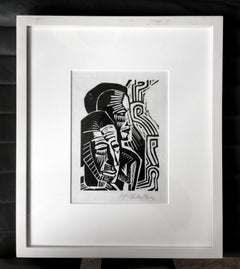
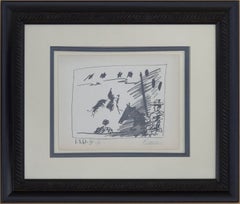
Max Pechstein (1881-1955), Two Heads (Zwei Kopfe), woodcut, 1922, signed in pencil lower right. Reference: Kruger 275. From the edition of 50. In very good ...

Category

1920s Expressionist Max Pechstein Art

Materials

Woodcut
Dialogue, from: HM Pechstein Woodcuts  Zwiesprache: HM Pechstein Holzschnitte

Dialogue, from: HM Pechstein Woodcuts Zwiesprache: HM Pechstein Holzschnitte

By Max Pechstein

Located in London, GB

HERMANN MAX PECHSTEIN 1881-1955 Zwickau 1881 - 1955 Berlin (German) Title: Dialogue, from: HM Pechstein Woodcuts Zwiesprache: HM Pechstein Holzschnitte, 1918 Technique: Original H...

Category

1910s Max Pechstein Art

Materials

Woodcut
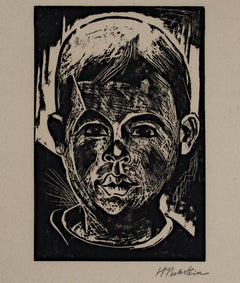
"Head of a Boy/Kopf des Jungen, " Original Woodcut signed by Max Pechstein
"Head of a Boy/Kopf des Jungen, " Original Woodcut signed by Max Pechstein
By Max Pechstein

Located in Milwaukee, WI

"Head of a Boy/Kopf des Jungen" is an original woodcut print by Max Pechstein. The artist signed the piece lower right and wrote the edition number (V/XX) in the lower left. This pie...
Category

Early 20th Century Expressionist Max Pechstein Art

Materials

Woodcut

FIVE NATIVE WOMEN
FIVE NATIVE WOMEN

FIVE NATIVE WOMEN

By Max Pechstein

Located in Santa Monica, CA

MAX PECHSTEIN (German 1881 – 1955) FIVE NATIVE WOMEN, 1919 (KL 340: Rifkind 2228-37) Lithograph, edition 50, from the portfolio edition of Reisebilder, Italien -...

Category

1910s Expressionist Max Pechstein Art
Materials

Lithograph

[The Lord’s Prayer]

[The Lord’s Prayer]

By Max Pechstein

Located in New York, NY

Das Vaterunser. [The Lord’s Prayer] Plate 12 From Portfolio of 12 Woodcuts with watercolor on wove paper. Printed by F. Voigt for Proplaen Verlag, Berlin 1921. Signed by the artist a...

Category

1920s Expressionist Max Pechstein Art

Materials

Woodcut

Weib Vom Manne Begehrt (Woman Desired by Man)

Weib Vom Manne Begehrt (Woman Desired by Man)

By Max Pechstein

Located in Saint Augustine, FL

An original woodcut by German artist Max Pechstein (1881-1955) titled "Weib Vom Manne Begehry (Woman Desired by Man)", 1920, from: Kurt Pfister "Deutsche Graphiker der Gegenwart, Lei...

Category

Early 19th Century Expressionist Max Pechstein Art

Materials

Woodcut

Max Pechstein art for sale on 1stDibs.

Find a wide variety of authentic Max Pechstein art available for sale on 1stDibs. You can also browse by medium to find art by Max Pechstein in lithograph, woodcut print, drypoint and more. Much of the original work by this artist or collective was created during the 20th century and is mostly associated with the Expressionist style. Not every interior allows for large Max Pechstein art, so small editions measuring 5 inches across are available. Customers who are interested in this artist might also find the work of Conrad Felixmuller, Erich Heckel, and Otto Mueller. Max Pechstein art prices can differ depending upon medium, time period and other attributes. On 1stDibs, the price for these items starts at $2,000 and tops out at $8,800, while the average work can sell for $3,750.

Artists Similar to Max Pechstein