JACOB KRAMER Art

Ukrainian, 1892-1962

Jacob Kramer was born in the small town of Klintsy, in 1892, then part of the Russian Empire, into an artistic middle-class Jewish family. His father, Max, was a painter who had studied at the St Petersburg Fine Art Academy under Ilya Repin (1844–1930) and had become a court painter to Baron Ginsburg. Kramer's mother, Cecilia, was also artistic, being a trained singer who was well known for touring a regional network of theatres established by her father, at which she performed traditional Slavic and Hebrew folk songs. In 1902, aged only ten, Kramer ran away from his new home in Leeds, taking various jobs in different parts of the north of England, and even going away to sea for six months. During this sojourn away from his family, Kramer attended occasional art classes, but his first formal art education was at Leeds School of Art which he attended from 1907–13. During this time, he was also to become involved in the radical modernist organization the Leeds Arts Club, which introduced him to the ideas of expressionist artists, such as Wassily Kandinsky (1866–1944) and the spiritualist beliefs that came to underpin his work.

With a scholarship from the Jewish Educational Aid Society, Kramer was able to study at the Slade School of Art from 1913–14. He befriended other leading artists of the day, including Augustus John (1878–1961), David Bomberg (1890–1957) and William Roberts (1895–1980). Kramer was involved in the Vorticist movement led by Roberts and Wyndham Lewis, although he was never really a follower of the style. Nonetheless, several of his woodcuts did appear in the Vorticist literary magazine Blast, and other periodicals including Colour, Rhythm and Art and Letters. In London, Kramer rapidly became well known in the hedonistic artistic circles that dominated before the WWI and was to be seen frequently at well-known artistic haunts, including the cabaret-club The vae of the Golden Calf, The Cafe Royal and The Tour Eiffel. In the early 1920s, Kramer returned to Leeds, where he became something of a local artistic celebrity. After the collapse of the Leeds Arts Club in 1923 he had numerous schemes to establish a new artistic meeting place in the city, almost all of which came to nothing. The great exception to this was the informal gathering called the Yorkshire Luncheon Club, which met regularly at Whitelock's public house in Leeds and invited some of the leading cultural figures of the 1930s, 40s and 50s to Leeds to speak.

For the most part, however, Kramer's return to Leeds was not a triumph, and he lived in utter poverty and alcoholism, often producing poor quality portraits of local figures to pay for his drinks. None of this later work does justice to the startling quality and originality of Kramer's earlier work, including paintings such as The Day of Atonement, The Talmudists, The Jew, Mother and Child, and the 1922 Abstract Expressionist painting Musical Theme. His friend Jacob Epstein made a bust of him, copies of which can be found in the Tate in London and at Leeds City Art Gallery. The Tate, the Victoria & Albert Museum and the British Museum all hold examples of Kramer's work, but the most extensive collections can be found in Leeds at the Leeds City Art Gallery and Leeds University Art Gallery.
to
6
6
4
4
1
1
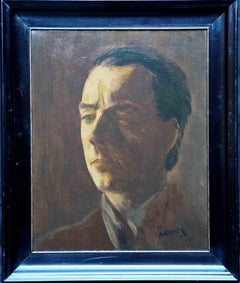
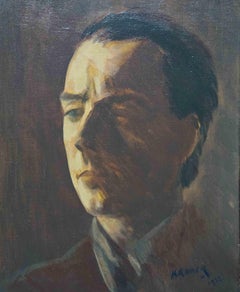
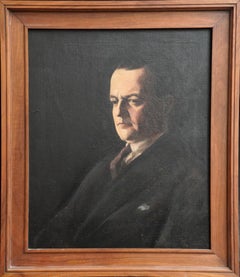
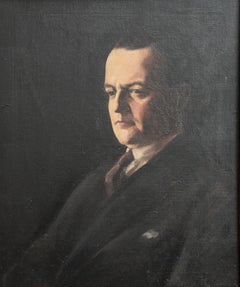
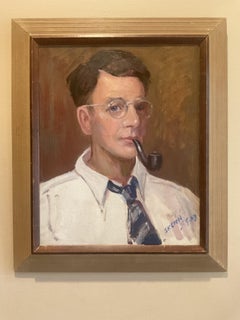
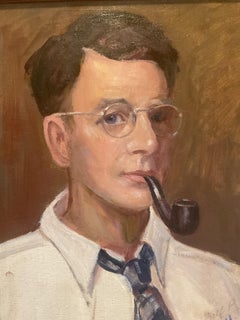
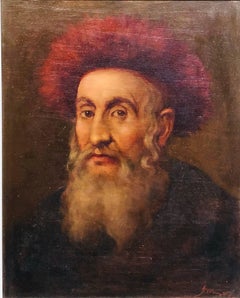
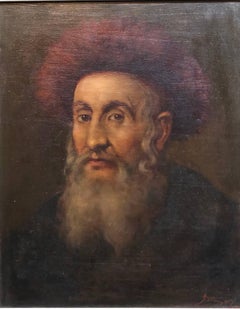
Portrait Head and Shoulders of a Man - Jewish 20s art male portrait oil painting

Portrait Head and Shoulders of a Man - Jewish 20s art male portrait oil painting

By Jacob Kramer

Located in Hagley, England

Jacob Kramer is a Jewish artist who migrated with his family to Leeds to escape the Russian pogroms when Kramer was only eight. This portrait oil painting was painted when Kramer was thirty, in 1922, shortly after his return to Leeds from living in London. It is a head and shoulders portrait of a gentleman with dark hair, gazing to his right, his identity unknown. The light from the left hand side of the painting strongly illuminates the left side of the gentleman's face, making it stand out from the darker background and casts strong shadow on the right. The brushwork is bold and confident in its execution. This is an excellent example of Kramer's Post Impresionist work in the early 1920's when at his artistic peak. Signed and dated 1922 lower right. Provenance. Yorkshire estate. Condition. Oil on canvas, 20 inches by 16 inches and in good condition. Frame. Housed in an ebonised frame, 23 inches by 19 inches, in good condition. Jacob Kramer (1892-1962) was born in the small town of Klintsy in 1892, then part of the Russian Empire, into an artistic middle class Jewish family. His father, Max, was a painter who had studied at the St Petersburg Fine Art Academy under Ilya Repin, and had become a court painter to Baron Ginsburg. Kramer's mother, Cecilia, was also artistic being a trained singer who was well known for touring a regional network of theatres established by her father, at which she performed traditional Slavic and Hebrew folk songs. Following the accession of Tsar Nicholas II in 1894 a new virulent anti-semitic policy was introduced to force Russian Jews...

Category

1920s Post-Impressionist JACOB KRAMER Art

Materials

Oil

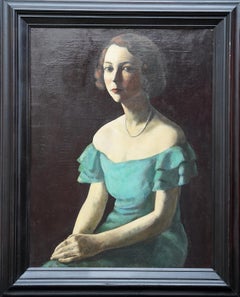
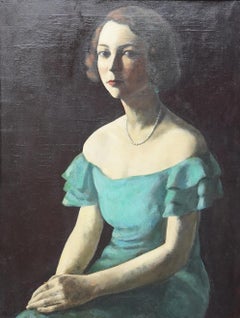
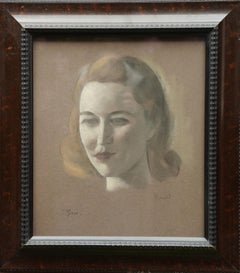
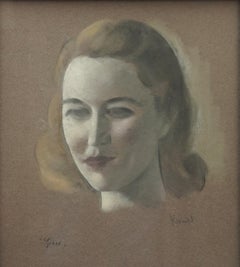
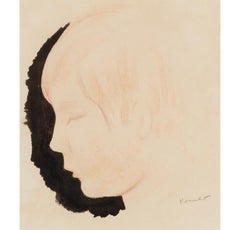
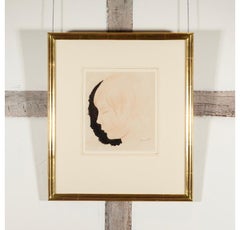
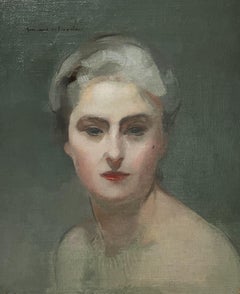
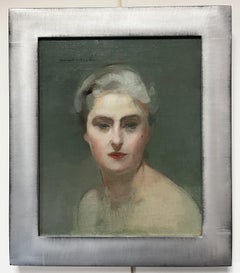
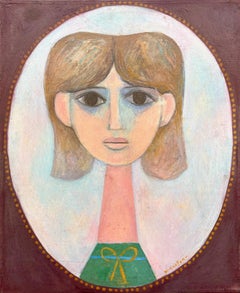
Portrait of Grace - British 1920's art female chalk portrait

Portrait of Grace - British 1920's art female chalk portrait

By Jacob Kramer

Located in Hagley, England

This enigmatic 1920's Art Deco portrait is by noted Russian born British artist Jacob Kramer. Worked in chalk/pastel on paper it is a portrait of 'Grace'. There is strong emphasis on...

Category

1920s JACOB KRAMER Art

Materials

Chalk, Pastel

Related Items
Portrait - Drawing by Jacqueline Barbet - 1938

Portrait - Drawing by Jacqueline Barbet - 1938

By Jacqueline Barbet

Located in Roma, IT

Portrait is an artwork realized by the french Artist Jacqueline Barbet (1902-1975), in 1938. Pencil, pastel and charcoal rawing on paper. Hand-signed and dated in pencil in Roman nu...

Category

1930s Modern JACOB KRAMER Art

Materials

Charcoal, Pastel, Pencil

Berty Seuron, 1st Dancer by Leon-Laurent Galand - Drawing - 43x57 cm

Berty Seuron, 1st Dancer by Leon-Laurent Galand - Drawing - 43x57 cm

By Leon-Laurent Galand 1

Located in Geneva, CH

Sold without the frame. Léon Laurent Galand is a French painter and illustrator born April 18, 1872 in Montpellier (Hérault) and died November 4, 1960 in Clichy (Hauts-de-Seine). L...

Category

1930s Modern JACOB KRAMER Art

Materials

Chalk, Crayon

Gerberas - Contemporary Figurative Oil Painting, Realistic Little Girl Portrait

Gerberas - Contemporary Figurative Oil Painting, Realistic Little Girl Portrait

By Kamil Lisek

Located in Salzburg, AT

KAMIL LISEK (born in 1980) Studied under the guidance of prof. Maciej Świeszewski at the faculty of painting at the Academy of Fine Arts in Gdansk. He graduated with distinction obta...

Category

2010s Realist JACOB KRAMER Art

Materials

Canvas, Oil, Linen

Rabbis

Mane KatzRabbis, c.1935

$12,500

H 18 in W 14.5 in

Rabbis

By Mane Katz

Located in New York, NY

MANE-KATZ RABBIS, c. 1935 Oil on canvas 18 H. x 14 W. 1/2 in. (45.5 x 35.8 cm.) Signed PROVENANCE Dominion Gallery, Montreal Christies, New York, November 04, 1982. Lot 177: $11,000 Private Collection, New Jersey, 1982-2021 Estate of the above, 2021. Raised in an orthodox Jewish family in Russia, Mane-Katz was born in the Ukraine and became an early 20th-century artist, known especially for portraits and paintings with Jewish themes. From childhood, he had been influenced by stories of Jewish mysticism, which was reflected in his paintings. He had a peripatetic life between Russia, France, Israel, and America. He first studied art in Kiev at the Beaux Arts Academy, and in 1913, went to Paris where he associated with Chaim Soutine and Marc Chagall and continued his art studies there at the Beaux Arts Academy. During World War I, he tried to join the Foreign Legion but was rejected because he was too short. He went back in Russia again, this time joining the Soviet Revolution but rejected the cause because he was so horrified by Josef Stalin. He worked briefly for the Russian ballets, and in 1921, he returned to Paris where in 1927 he took French citizenship. For the next twelve years, he traveled widely, showing his art work and doing many paintings. In 1939, as World War II was breaking out, he was drafted by the French and then was taken prisoner by the Germans. He escaped and went to the United States and remained there until 1945, exhibiting his paintings at Katia Granoff Gallery and Wildenstein Gallery. After the war, he returned to Paris where he had exhibited in the Salons. In Paris to the end of his career, he worked happily, painting hundreds of portraits of rabbis...
Category

Early 20th Century Fauvist JACOB KRAMER Art

Materials

Canvas, Oil

Plage a Belle Ile - Post Impressionist Landscape Oil by Georges D'Espagnat

Plage a Belle Ile - Post Impressionist Landscape Oil by Georges D'Espagnat

By Georges d'Espagnat

Located in Marlow, Buckinghamshire

Signed post impressionist landscape oil on panel by popular French painter Georges D'Espagnat. The piece depicts the beach at Belle Ile, an island off the coast of Brittany in France, at sunset. An exceptional early painting by D'Espagnat which shows the precursor influence of Fauvism which was to dominate his paintings in the following few years. Signature: Signed lower right Dimensions: Framed: 23"x26" Unframed: 15"x18" Provenance: Private French collection A certificate of authenticity from Mr. Jean-Dominique Jacquemond is available upon request. This work will be included in the catalogue raisonne of Georges D'Espagnat under preparation by Mr. Jacquemond From the beginning of his career, it was a constant concern of Georges d'Espagnet to assert his originality. His studies at the École des Arts Décoratifs, Paris, did not last very long, for he wanted immediate independence and decided to follow courses in the private academies of Montparnasse. In about 1900, he became acquainted with Maurice Denis, Bonnard and Vuillard, and his collaboration with Denis led to a renewal of religious art in France. In 1903, d'Espagnet was one of the founders of the Salon d'Automne, and was appointed professor in charge of studios at the École des Beaux-Arts, Paris, in 1934. He illustrated a number of books: Rémy de Gourmont's Evil Prayers ( Oraisons mauvaises) (1896), The Saints of Paradise ( Les Saintes du paradis) (1898), Simone (1907), Sistine ( Sixtine) (1922); Alphonse Daudet's The Immortal ( L'Immortel) (1930); André Gide's The Pastoral Symphony ( La Symphonie pastorale); Francis Jammes' Clearings in the Sky ( Chairières dans le ciel) (1948). D'Espagnet belongs to the group of artists who made the Courrier Français so successful. The drawings of his which are published in it are strongly expressive and some bear comparison with the designs of the great Renaissance masters. He also contributed to L'Image. He often placed cheerful nudes in a landscape, reminding us that, though he moved away from the Fauves, he retained their freedom of colour and arabesque. He painted many portraits, including those of Albert André, André Barbier, Victor Boucher, Déodat de Séverac, Albert Marque, André Marty and Albert Roussel. He also painted mural decorations, including a wall for the Palais de la Découverte (1937), the ceiling of the Victor Hugo Room in the Palais du Luxembourg (1939), a decorative panel for the Palais de Justice, Toulouse (1941) and interior decorations for private houses. His landscapes are Impressionist in inspiration, and work for a certain sobriety, an intimacy, both in their composition - one, two or three sketched figures and large open spaces - and in the choice of colours and treatment with the special hazy brushstroke that marks his style. D'Espagnet took part in a number of annual Parisian exhibitions, including the Salon des Indépendants, the Salon de la Société Nationale des Beaux-Arts, the Salon d'Automne (from 1903 to 1949, except in special circumstances), the Salon de la Libre Ésthétique, Brussels (1899, 1901), the Berlin Secessionists (1940). He also exhibited at the first Salon de la Société de la Gravure sur Bois. Among other exhibitions were 1912, A Century of French Art ( Centenaire de l'art français), St Petersburg; 1916, Kunstverein, Winterthur; 1918, 1926, Galerie M. Bertheim, Paris; 1930, Contemporary French Art...
Category

Early 1900s Post-Impressionist JACOB KRAMER Art

Materials

Oil, Panel

'Ephemeral Spring' - still life - floral, botanical, impressionism, landscape

'Ephemeral Spring' - still life - floral, botanical, impressionism, landscape

Located in Atlanta, GA

This painting features hues of yellow, orange and purple. Chattanooga-based artist Christina Renfer Vogel’s “Turning Towards the Sun” features paintings that reflect an intentional turn towards beauty in the face of the tension & uncertainty of recent years. Through nourishing periods of focused observation, she has allowed herself to delight in jubilant color, playful pattern & sensual gesture. Her works delight in the delicate unfurling of a tender leaf & the gentle turn towards an open window, as flowers seek warmth & stretch towards sunlight in the space of a painting session. “Bringing plants...

Category

2010s Post-Impressionist JACOB KRAMER Art

Materials

Oil, Canvas

French Art Deco Portrait 1920s Oil Painting

French Art Deco Portrait 1920s Oil Painting

Located in Holywell, GB

French Art Deco Portrait 1920s Oil Painting A captivating French Art Deco–era portrait, possibly portraying a dancer, silent film star, or flapper girl. Her striking dark eye makeup ...

Category

1920s Art Deco JACOB KRAMER Art

Materials

Oil

Portrait of a Young Man - Mid Century French Impressionist Interior Oil Painting

Portrait of a Young Man - Mid Century French Impressionist Interior Oil Painting

Located in Sevenoaks, GB

A beautiful signed and dated 1952 French post-impressionist oil on canvas portrait of a young man in an interior. Wonderful quality portrait of the young man wearing wide brim trous...

Category

1950s Post-Impressionist JACOB KRAMER Art

Materials

Oil

Antique Horse Painting "Standing Grey Horse, Facing Right" Georg Wolf dated 1907

Antique Horse Painting "Standing Grey Horse, Facing Right" Georg Wolf dated 1907

Located in SANTA FE, NM

Antique Horse Painting “Standing Grey Horse, Facing Right” Georg Wolf (Germany 1882-1962) Oil on canvas Signed and dated 1907 lower right 27 x 19 (35 x 27 frame) inches With it's bobbed tail cut short so it doesn't become tangled, it's apparent that this fine specimen was a draught horse...

Category

Early 20th Century Post-Impressionist JACOB KRAMER Art

Materials

Canvas, Oil

The Seated Man – An Intimate Glimpse into Daily Life

The Seated Man – An Intimate Glimpse into Daily Life

Located in Stockholm, SE

This masterfully executed painting by Emerik Stenberg (1873–1927) captures an intimate and atmospheric moment. The composition features a seated man, engrossed in his daily chores, b...

Category

Early 20th Century Realist JACOB KRAMER Art

Materials

Canvas, Oil

Portrait of a Young Boy Seen from Behind

Portrait of a Young Boy Seen from Behind

Located in Stockholm, SE

This intimate oil painting presents a young boy viewed from a three-quarter rear angle, caught in a quiet, reflective moment. The child’s back is turned gently toward the viewer, ren...

Category

1890s Realist JACOB KRAMER Art

Materials

Canvas, Oil, Board

Previously Available Items
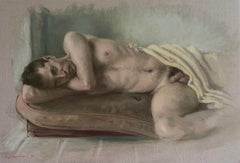
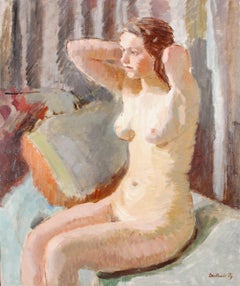
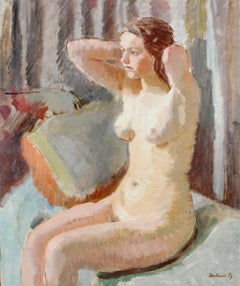
Nude
Nude

Jacob KramerNude, Mid 20th Century

Sold

H 18 in W 18 in D 2.5 in

Nude

By Jacob Kramer

Located in Douglas, Isle of Man

Jacob Kramer 1892 - 1962, was a Ukrainian born painter. Kramer was born in the former Russian Empire now known as Ukraine, his parents were artistically trained his father was a pain...

Category

Mid-20th Century JACOB KRAMER Art

Materials

Oil, Panel

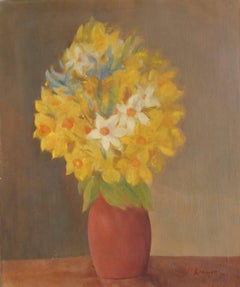
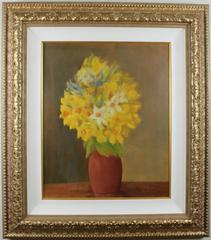
Vase of Flowers
Vase of Flowers

Vase of Flowers

By Jacob Kramer

Located in London, GB

61 x 51 cm (24 x 20 inches) Signed lower right, Kramer Born in the small Ukrainian (Russian Empire) town of Klincy in 1892, Kramer’s father Max, and his uncle Cion, were both painte...

Category

20th Century Modern JACOB KRAMER Art

Materials

Canvas, Oil

Jacob Kramer art for sale on 1stDibs.

Find a wide variety of authentic JACOB KRAMER art available for sale on 1stDibs. You can also browse by medium to find art by JACOB KRAMER in chalk, crayon, oil paint and more. Much of the original work by this artist or collective was created during the 1920s and is mostly associated with the Post-Impressionist style. Not every interior allows for large JACOB KRAMER art, so small editions measuring 12 inches across are available. Customers who are interested in this artist might also find the work of Henri Edmond Cross, Adriaan Lubbers, and Charles Picart le Doux. JACOB KRAMER art prices can differ depending upon medium, time period and other attributes. On 1stDibs, the price for these items starts at $1,504 and tops out at $5,351, while the average work can sell for $3,980.

Artists Similar to JACOB KRAMER