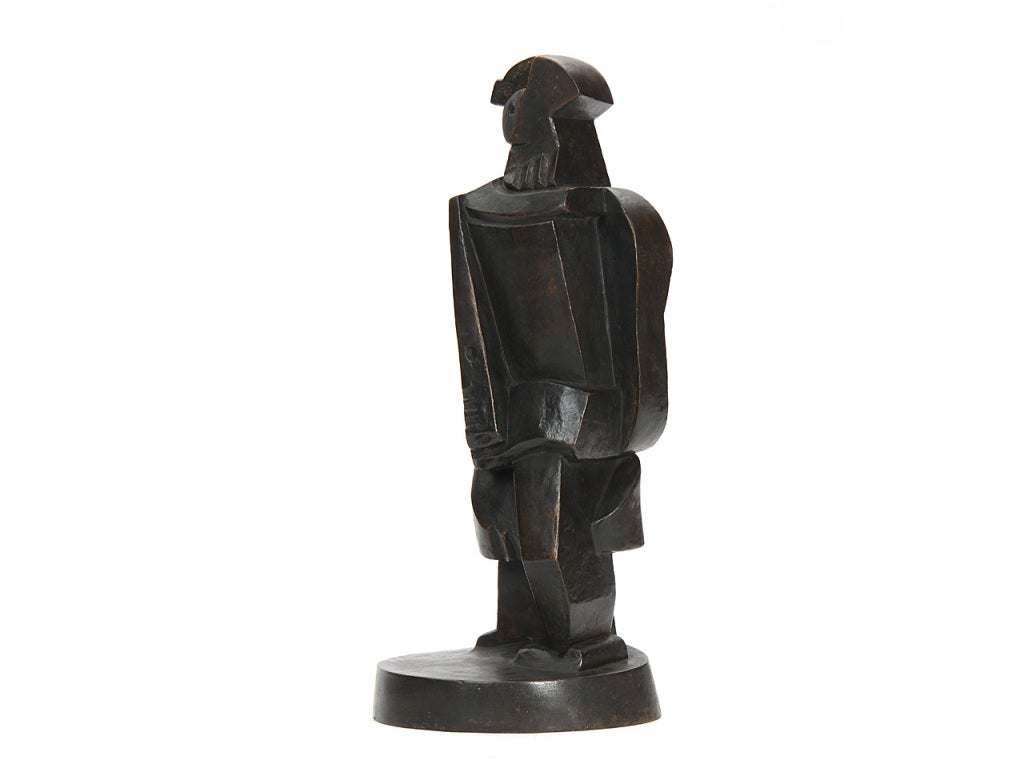
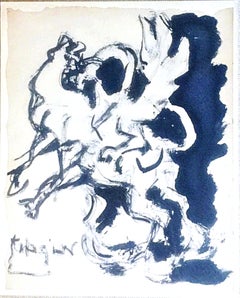
By Jacques Lipchitz
Located in New York, NY
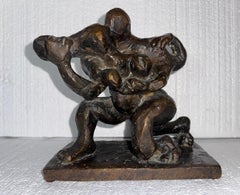
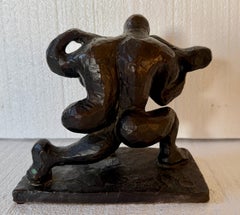
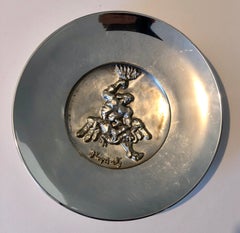
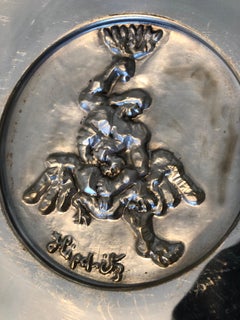
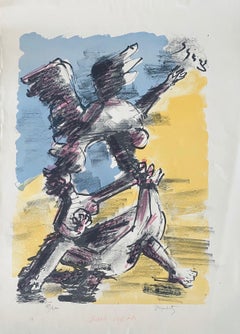
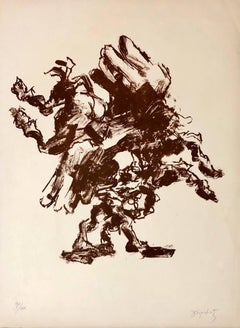
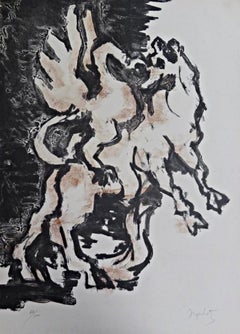
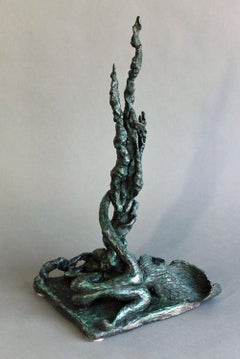
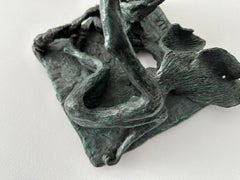
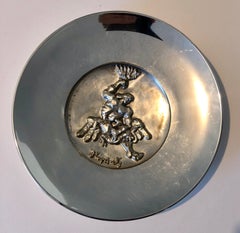
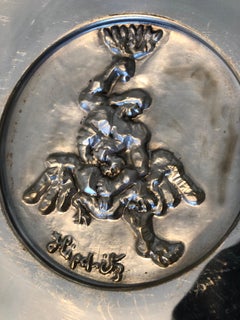
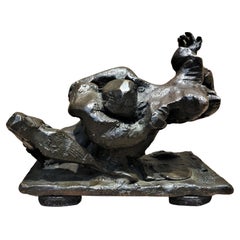
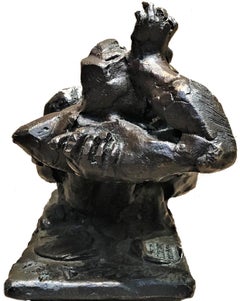
This small but very powerful sculpture depicting the passionate interweaving of two bodies of lovers was completed in the year of the death of the master in his beloved Pietrasanta, Italy; and cast in bronze at the local foundry ‘Fonderia Luigi Tomassi Pietrasanta’.
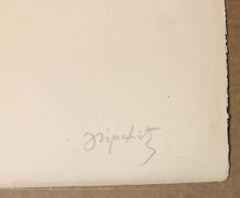
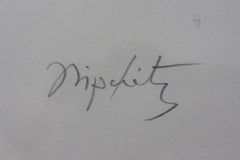
Signed ‘Lipschitz’ and dated ‘23’
Foundry stamp ‘Fonderia Luigi Tomassi Pietrasanta’.
Original dark brown-black patina.
Dimensions:
Height: 3.57 inches (8.9cm)
Width: 5 inches (12.5cm)
Depth: 3.13 inches (7.82cm)
Jacques Lipchitz (1891 – 1973) was a Cubist sculptor. Lipchitz retained highly figurative and legible components in his work leading up to 1915–16, after which naturalist and descriptive elements were muted, dominated by a synthetic style of Crystal Cubism In 1920, Lipchitz held his first solo exhibition, at Leonce Rosenberg’s Galerie L'Effort Moderne in Paris. Fleeing the Nazis he moved to the US and settled in New York City and eventually Hastings-on-Hudson.
Jacques Lipchitz was born Chaim Jacob Lipschitz, in a Litvak family, son of a building contractor in Druskinikai, Lithuania, then within the Russian Empire He studied at Vilnius grammar school and Vilnius Art School. Under the influence of his father he studied engineering in 1906–1909, but soon after, supported by his mother he moved to Paris (1909) to study at the Ecole-des-Beaux-Arts and the Academy Julian.
It was there, in the artistic communities of Monmartre and Montparnasse, that he joined a group of artists that included Juan Gris and Pblo Picasso, as well as where his friend, Amedeo Modigliani, painted Jacques and Berthe Lipschitz.
Living in this environment, Lipchitz soon began to create Cubist sculpture. In 1912, he exhibited at the Salon de la Societe des Beaux-Arts and the Salon d’Automne with his first solo show held at Leonce Rosenberg’s's Galerie L'Effort Moderne in Paris in 1920. In 1922 he was commissioned by the Barnes Foundation in Merion, Pennsylvania to execute seven bas-reliefs and two sculptures.
With artistic innovation at its height, in the 1920s he experimented with abstract forms he called transparent sculptures. Later he developed a more dynamic style, which he applied with telling effect to bronze compositions of figures and animals.
In 1924-25 Lipchitz became a French citizen through naturalization and married Berthe Kitrosser. With the German occupation of France during World War II, and the deportation of Jews to the Nazi death camps, Lipchitz had to flee France. With the assistance of the American journalist Varian Fry in Marceille, he escaped the Nazi regime and went to the United States. There, he eventually settled in Hastings-on-Hudson, New York.
He was one of 250 sculptors who exhibited in the Third Sculpture International Exhibition held at the Philadelphia Museum of Art in the summer of 1949. He has been identified among seventy of those sculptors in a photograph Life magazine published that was taken at the exhibition. In 1954 a Lipchitz retrospective traveled from The Museum of Modern Art in New York to the Walker Art Center in Minneapolis and The Cleveland Museum of Art. In 1959, his series of small bronzes To the Limit of the Possible was shown at Fine Arts Associates in New York.
In his later years Lipchitz became more involved in his Jewish faith, even referring to himself as a "religious Jew" in an interview in 1970. He began abstaining from work on Shabbat and put on Tefillin daily, at the urging of the Lubavitcher Rebbe, Rabbi Menachem Schneerson.
Beginning in 1963, he returned to Europe for several months of each year and worked in Pietrasanta, Italy. He developed a close friendship with fellow sculptor, Fiore de Henriquez...
Category
1920s Italian Art Deco Vintage Jacques Lipchitz Art