James Smillie Art

to
3
1
Overall Width
to
Overall Height
to
4
3
1
1
1
1
1
1
3
1
4
10,998
2,845
2,494
1,427
1
4
Artist: James Smillie
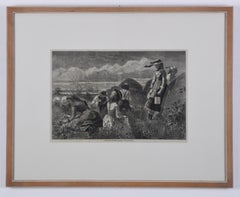
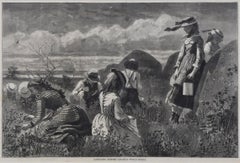
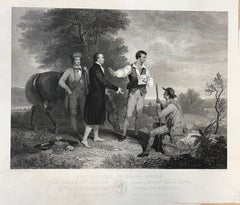
THE CAPTURE OF MAJOR ANDRE

THE CAPTURE OF MAJOR ANDRE

By James Smillie

Located in Portland, ME

Smillie, James and Robert Hinshelwood and Alfred Jones. THE CAPTURE OF MAJOR ANDRE. Engraving after the painting by Asher B. Durand, 1845. Printed on cream-colored wove paper. 13 1/8 x 17 inches 333 x 431 mm.(image). In the margin, just under the image, left: "Painted by A.M. Durand," center: "Figures engr'd by Alfred Jones," right: "Landscaped engr'd by Smillie & Hinshelwood." Ttiled "The Capture of Major Andre" in the margin, Center, and further annotated "From a painting by A. B. Durandin the possession of the Honble James K.Paulding / Published by the American Art Union...

Category

1840s James Smillie Art

Materials

Engraving
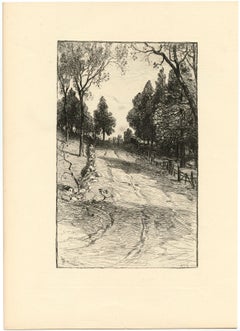
"At Marblehead Neck" original etching

"At Marblehead Neck" original etching

By James Smillie

Located in Henderson, NV

Medium: original etching. Executed in 1883; this is a rich, dark impression on heavy cream wove paper, from the "Original Etchings by American Artists" portfolio, published in 1883 b...

Category

1880s James Smillie Art

Materials

Etching

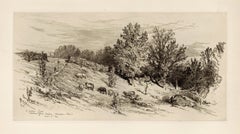
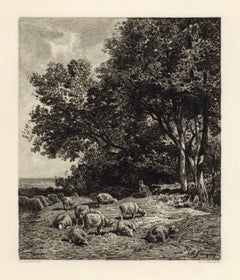
"Landscape with Sheep" etching

"Landscape with Sheep" etching

By James Smillie

Located in Henderson, NV

Medium: etching. Etched by James D. Smillie after this charming pastoral composition by Barbizon artist Charles Emile Jacque. This is a rich, dark impression on wove paper, printed i...

Category

1880s James Smillie Art

Materials

Etching

"A Fallow Field" original etching

"A Fallow Field" original etching

By James Smillie

Located in Henderson, NV

Medium: original etching. This is a rich, dark impression on wove paper, printed in 1885 for the Sylvester R. Koehler portfolio of etchings and published by Cassell & Company. Plate ...

Category

1880s James Smillie Art

Materials

Etching

Related Items
Symphony in White No. 2, The Little White Girl

Symphony in White No. 2, The Little White Girl

By James Abbott McNeill Whistler

Located in Fairlawn, OH

Clifford James (active 1900-1930) After James Abbott NcNeill Whistler (1834-1903) Symphony in White No. 2, The Little White Girl Color mezzotint, 1922 Signed in pencil by James (see ...

Category

1920s Pre-Raphaelite James Smillie Art

Materials

Mezzotint

Crucifixion
Crucifixion

Crucifixion

Located in Fairlawn, OH

Jean Pichore workshop, 1500-1541 Crucifixion Metal cut engraving printed on vellum with vintage hand coloring c. 1500-1541 Miniature (image) size: 4 3/4 x 3 1/8" Including decorated ...

Category

16th Century Old Masters James Smillie Art

Materials

Engraving
Early Morning Rain
Early Morning Rain

Early Morning Rain

By Norman Ackroyd

Located in Fairlawn, OH

Early Morning Rain Etching & color aquatint, 1977 Signed, titled, numbered and dated in pencil Edition: 40 (39/40) Published by Associated American Artists, New York Condition: Mint ...

Category

1970s Modern James Smillie Art

Materials

Aquatint

Indian Friendship Dance

Gene KlossIndian Friendship Dance, 1953

$2,500

H 8.19 in W 11.94 in

Indian Friendship Dance

By Gene Kloss

Located in Fairlawn, OH

Indian Friendship Dance Drypoint, 1953 Signed in pencil lower right, (see photo) Edition 200 Published by The Society of American Graphic Artists, New York An impression is in the collection of SAAM, Washington and RISD Museum, Condition: Excellent Very rich impression with burr and selective whiping of the ink for atmospheric nocturnal effect. Image/Plate size: 8 3/16 x 11 15/16 inches Sheet size: 11 1/8 x 17 inches Reference: Kloss 450 "'Indian Friendship Dance' is an eloquent statement of something which Gene Kloss has both observed and participated in. It is an Indian dance that is thought of as entertainment, rather than ceremony, but it is essentially an idea expressed in action, and an idea that has universal meaning. The young men who dance wear costumes of exquisite workmanship, intricately wrought with beads and feathers and subtle combinations of colors. The dancers are trained from childhood but develop their own steps and exhibit distinctive strength and grace. Singers and a tom-tom accompany the dance and since it usually takes place at night, a campfire is the source of light. The conclusion occurs when all the onlookers, old and young and from many places, join hands with the dancers in a slow revolving movement, while those who can, sing the difficult but meaningful Indian song that flows with the rhythmical dance step and speaks of fellowship, brotherhood, friendship." - An excerpt from a descriptive statement, written by Lynd Ward, and distributed with the drypoint at the time of publication." Courtesy Old Print Shop Born Alice Glasier in Oakland, CA, Kloss grew up amid the worldly bustle of the San Francisco Bay Area. She attended the University of California at Berkeley, graduating with honors in art in 1924. She discovered her talents in intaglio printmaking during a senior-year course in figurative drawing. The professor, Perham Nahl, held up a print from Kloss’ first plate, still damp from the printing process, and announced that she was destined to become a printmaker. In 1925, Gene married Phillips Kloss, a poet and composer who became her creative partner for life. The match was uncanny, for in her own way Gene, too, was a poet and a composer. Like poetry, her artworks capture a moment in time; like music, her compositions sing with aesthetic harmony. Although she was largely self-taught, Kloss was a printmaking virtuoso. On their honeymoon the Klosses traveled east from California, camping along the way. They spent two week is Taos Canyon – with a portable printing press cemented to a rock near their campsite – where Gene learned to appreciate the wealth of artistic subject matter in New Mexico. The landscape, the cultures, and the immense sky left an indelible impression on the couple, who returned every summer until they made Taos their permanent home 20 years later. Throughout her life, Kloss etched more than 625 copper plates, producing editions ranging from five to 250 prints. She pulled every print in every edition herself, manually cranking the wheel of her geared Sturges press until she finally purchased a motorized one when she was in her 70s. Believing that subject matter dictated technique, she employed etching, drypoint, aquatint, mezzotint, roulette, softground, and a variety of experimental approaches, often combining several techniques on the same plate. She also produced both oil and watercolor paintings. Kloss’ artworks are filled with drama. Her prints employ striking contrasts of darkness and light, and her subjects are often illuminated by mysterious light sources. Though she was a devout realist, there is also a devout abstraction on Kloss’ work that adds an almost mythical quality. For six decades Kloss documented the cultures of the region-from images of daily life to those of rarely seen ceremonies. She and her husband shared a profound respect for the land and people, which made them welcome among the Native American and Hispanic communities. Kloss never owned a camera but relied instead on observation and recollection. Her works provide an inside look at the cultures she depicted yet at the same time communicate the awe and freshness of an outsider’s perspective. Although Kloss is best known for her images of Native American and Penitente scenes, she found artistic inspiration wherever she was. During the early years of their marriage, when she and Phil returned to the Bay Area each winter to care for their aging families, she created images of the California coast. And when the Klosses moved to southwestern Colorado in 1965, she etched the mining towns and mountainous landscapes around her. In 1970 the Klosses returned to Taos and built a house north of town. Though her artwork continued to grow in popularity, she remained faithful to Taos’ Gallery A, where she insisted that owner Mary Sanchez keep the prices of her work reasonable regardless of its market value. Kloss continued to etch until 1985, when declining health made printmaking too difficult. From her first exhibition at San Francisco’s exclusive Gump’s in 1937 to her 1972 election to full membership in the National Academy of Design, Kloss experienced a selective fame. She received numerous awards, and though she is not as well known as members of the Taos Society of Artists...

Category

1950s American Realist James Smillie Art

Materials

Drypoint

Profile Bust of a Girl - Woman's Head in Profile (Havard)

Profile Bust of a Girl - Woman's Head in Profile (Havard)

By Elie Nadelman

Located in Fairlawn, OH

Profile Bust of a Girl - Woman's Head in Profile (Havard) Drypoint, 1920 Unsigned (as issued) From: The Drypoints of Elie Nadelman, 21 unpublished prints by the sculptor, proof from ...

Category

1920s American Modern James Smillie Art

Materials

Drypoint

Yosemite Blue Mountain, Cyanotype on Watercolor Paper, Landscape in Indigo

Yosemite Blue Mountain, Cyanotype on Watercolor Paper, Landscape in Indigo

By Kind of Cyan

Located in Barcelona, ES

This is an exclusive handprinted limited edition cyanotype. This cyanotype shows one of the mountains in beautiful Yosemite National park in California. Details: + Title: Yosemite Blue Mountain + Year: 2021 + Edition Size: 100 + Stamped and Certificate of Authenticity provided + Measurements : 70x100 cm (28x 40 in.), a standard frame size + All cyanotype prints are made on high-quality Italian watercolor paper * Frame is for illustrative purposes only. Artwork shipped carefully rolled and packaged in a tube. WHAT IS A CYANOTYPE? The cyanotype (a.k.a. sun-print) process is one of the oldest in the history of photography, dating back to the 1840's. Cyanotypes were then made famous by Anna Atkins, considered the first female photographer. Inspired by nature, we feel the need to look back at a craft that is handmade, analogue, and using an all-natural light source: the sun. Our cyanotypes are made by coating high-quality Italian watercolor paper with a light-sensitive emulsion. We then expose it in direct sunlight for several minutes using a photo negative to get the best image quality. Finally, the print is washed and fixed with water to stop the reaction and prevent fading. What you get is an amazing, royal blue image...

Category

2010s Photorealist James Smillie Art

Materials

Emulsion, Watercolor, Photographic Paper, C Print, Engraving, Etching, M...

The Web
The Web

Ray H. FrenchThe Web, 1950

$950

H 10.75 in W 7.25 in

The Web

By Ray H. French

Located in Fairlawn, OH

The Web Engraving and soft ground, 1950 Signed, titled, dated and numbered by the artist Edition: 35 (26/35) Printed by Master Printer, Jon Clemens, 2000 Provenance: Estate of the ar...

Category

1950s Surrealist James Smillie Art

Materials

Engraving, Etching

Richard Wagner
Richard Wagner

Richard Wagner

Located in Fairlawn, OH

Richard Wagner Etching, c. 1880 Signed in the plate (see photo) Edition: c. 200 impressions Condition: mint Image/Plate size: 6 5/8 x 4 3/4 inches Sheet size: 14 3/8 x 10 7/8 inches ...

Category

1880s Academic James Smillie Art

Materials

Etching

Crucifixion

Ray H. FrenchCrucifixion, 1958

$950

H 17.69 in W 12 in

Crucifixion

By Ray H. French

Located in Fairlawn, OH

Crucifixion Engraving, 1958 Signed, dated, titled, and annotated 'Printers Proof II' in pencil A printed by Master Printer Jon Clemens, c. 2000 A brilliant impression full of burr Im...

Category

1950s American Modern James Smillie Art

Materials

Engraving
Rustic Beauford S.C.

Rustic Beauford S.C.

By Louis Oscar Griffith

Located in Fairlawn, OH

Rustic Beauford S.C. Etching and drypoint on Vidalon paper, c. 1930's Created during the artist's two visits to South Carolina. Signed by the artist in pencil lower right Titled in p...

Category

1930s American Impressionist James Smillie Art

Materials

Etching

Apollo Emerging from the Waters

Apollo Emerging from the Waters

By Simon Thomassin

Located in Houston, TX

Antique engraving titled "Apollon Sortant Des Eaux" over 250 years old by Simon Henri Thomassin, circa 1720. Signed lower right. Original artwork on paper displayed on a white ma...

Category

1720s James Smillie Art

Materials

Engraving
Keresan Dancers
Keresan Dancers

Gene KlossKeresan Dancers, 1962

$2,250

H 13.88 in W 10.88 in

Keresan Dancers

By Gene Kloss

Located in Fairlawn, OH

Keresan Dancers Etching & drypoint, 1962 Signed lower right (see photo) Inscribed lower left: "Artist's Proof Keresan Dancers" Depicts Keresan speaking peoples at Sam Felipe Pueblo Contemporary Puebloans are customarily described as belonging to either the eastern or the western division. The eastern Pueblo villages are in New Mexico along the Rio Grande and comprise groups who speak Tanoan and Keresan languages. Tanoan languages such as Tewa are distantly related to Uto-Aztecan, but Keresan has no known affinities. The western Pueblo villages include the Hopi villages of northern Arizona and the Zuni, Acoma, and Laguna villages, all in western New Mexico. Born Alice Glasier in Oakland, CA, Kloss grew up amid the worldly bustle of the San Francisco Bay Area. She attended the University of California at Berkeley, graduating with honors in art in 1924. She discovered her talents in intaglio printmaking during a senior-year course in figurative drawing. The professor, Perham Nahl, held up a print from Kloss’ first plate, still damp from the printing process, and announced that she was destined to become a printmaker. In 1925, Gene married Phillips Kloss, a poet and composer who became her creative partner for life. The match was uncanny, for in her own way Gene, too, was a poet and a composer. Like poetry, her artworks capture a moment in time; like music, her compositions sing with aesthetic harmony. Although she was largely self-taught, Kloss was a printmaking virtuoso. On their honeymoon the Klosses traveled east from California, camping along the way. They spent two week is Taos Canyon – with a portable printing press cemented to a rock near their campsite – where Gene learned to appreciate the wealth of artistic subject matter in New Mexico. The landscape, the cultures, and the immense sky left an indelible impression on the couple, who returned every summer until they made Taos their permanent home 20 years later. Throughout her life, Kloss etched more than 625 copper plates, producing editions ranging from five to 250 prints. She pulled every print in every edition herself, manually cranking the wheel of her geared Sturges press until she finally purchased a motorized one when she was in her 70s. Believing that subject matter dictated technique, she employed etching, drypoint, aquatint, mezzotint, roulette, softground, and a variety of experimental approaches, often combining several techniques on the same plate. She also produced both oil and watercolor paintings. Kloss’ artworks are filled with drama. Her prints employ striking contrasts of darkness and light, and her subjects are often illuminated by mysterious light sources. Though she was a devout realist, there is also a devout abstraction on Kloss’ work that adds an almost mythical quality. For six decades Kloss documented the cultures of the region-from images of daily life to those of rarely seen ceremonies. She and her husband shared a profound respect for the land and people, which made them welcome among the Native American and Hispanic communities. Kloss never owned a camera but relied instead on observation and recollection. Her works provide an inside look at the cultures she depicted yet at the same time communicate the awe and freshness of an outsider’s perspective. Although Kloss is best known for her images of Native American and Penitente scenes, she found artistic inspiration wherever she was. During the early years of their marriage, when she and Phil returned to the Bay Area each winter to care for their aging families, she created images of the California coast. And when the Klosses moved to southwestern Colorado in 1965, she etched the mining towns and mountainous landscapes around her. In 1970 the Klosses returned to Taos and built a house north of town. Though her artwork continued to grow in popularity, she remained faithful to Taos’ Gallery A, where she insisted that owner Mary Sanchez keep the prices of her work reasonable regardless of its market value. Kloss continued to etch until 1985, when declining health made printmaking too difficult. From her first exhibition at San Francisco’s exclusive Gump’s in 1937 to her 1972 election to full membership in the National Academy of Design, Kloss experienced a selective fame. She received numerous awards, and though she is not as well known as members of the Taos Society of Artists...

Category

1960s American Realist James Smillie Art

Materials

Drypoint

Previously Available Items
"A Fallow Field" original etching

"A Fallow Field" original etching

By James Smillie

Located in Henderson, NV

Medium: original etching. This is a rich, dark impression on wove paper, printed in 1885 for the Sylvester R. Koehler portfolio of etchings and published by Cassell & Company. Plate ...

Category

1880s James Smillie Art

Materials

Etching

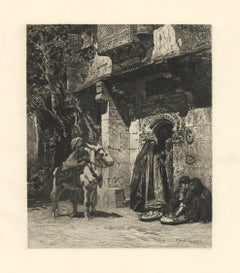
"Lady of Cairo Visiting" etching

"Lady of Cairo Visiting" etching

By James Smillie

Located in Henderson, NV

Medium: etching. Etched by James D. Smillie after the Frederick Arthur Bridgman painting. Printed in 1888 and published by Estes & Lauriat. Image size: 7 5/8 x 6 3/8 inches (195 x 16...

Category

1880s James Smillie Art

Materials

Etching

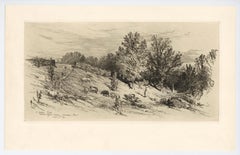
Landscape (Possibly Bronx, NY)

Landscape (Possibly Bronx, NY)

By James Smillie

Located in Saratoga Springs, NY

Signed & dated lower left. A native of New York and the son of an engraver, James David Smillie earned his early reputation for his etching skills but later for watercolor landscapes. He began etching at age 8, learning from his father, James Smillie...

Category

1860s Hudson River School James Smillie Art

Materials

Canvas, Oil

James Smillie art for sale on 1stDibs.

Find a wide variety of authentic James Smillie art available for sale on 1stDibs. You can also browse by medium to find art by James Smillie in etching, engraving and more. Not every interior allows for large James Smillie art, so small editions measuring 7 inches across are available. Customers who are interested in this artist might also find the work of Peter Moran, Charles Courtry, and David Young Cameron. James Smillie art prices can differ depending upon medium, time period and other attributes. On 1stDibs, the price for these items starts at $100 and tops out at $1,600, while the average work can sell for $100.