Jane Calvin Art

to
1
1
Overall Width
to
Overall Height
to
2
1
1
1
1
2
1
1
1
1
1
1
1
2
11,411
2,864
2,494
1,538
1
2
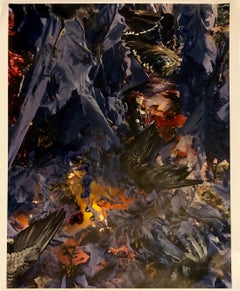
Artist: Jane Calvin
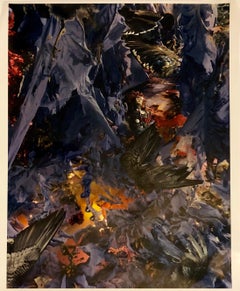
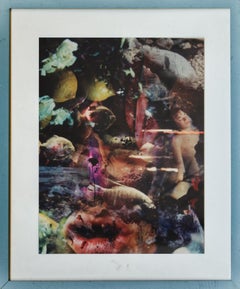
Relics 2 Elaborately Constructed Vintage Color Photograph Surrealist Image

Relics 2 Elaborately Constructed Vintage Color Photograph Surrealist Image

By Jane Calvin

Located in Surfside, FL

Chromogenic photo print. hand signed, titled and dated. This is a vintage print, printed in 1987 and editioned 2/10. Jane L. Calvin (born April 27, 1938) is an artist based in Chicag...

Category

1980s Surrealist Jane Calvin Art

Materials

C Print

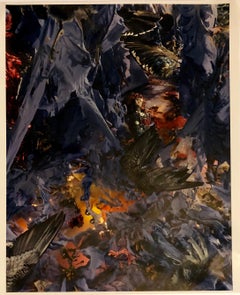
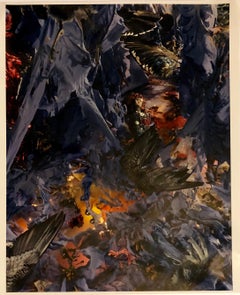
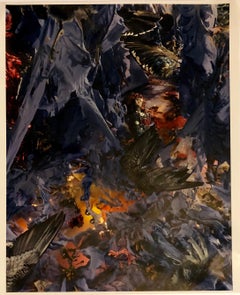
Jane Calvin Composite Photograph, 1990

Jane Calvin Composite Photograph, 1990

By Jane Calvin

Located in New York, NY

Jane Calvin (American, b. 1938) Untitled, 1990 Photograph Sight: 19 1/2 x 15 1/2 in. Framed: 26 7/8 x 22 1/2 x 1 1/4 in. Edition 2/10 Provenance: Collection of Robert Burge, New Y...

Category

1990s Contemporary Jane Calvin Art

Materials

Color

Related Items
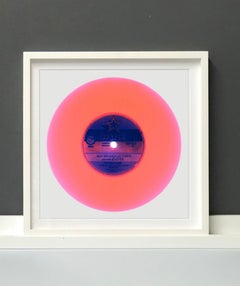
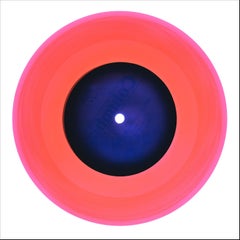
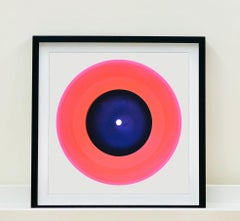
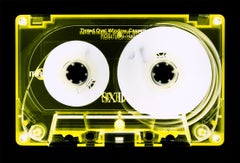
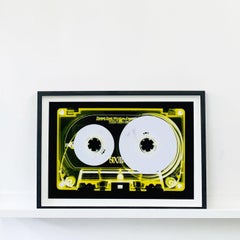
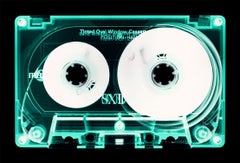
Tape Collection Two Framed Pop Art Red and Yellow Color Limited Edition Prints

Tape Collection Two Framed Pop Art Red and Yellow Color Limited Edition Prints

By Heidler & Heeps

Located in Cambridge, GB

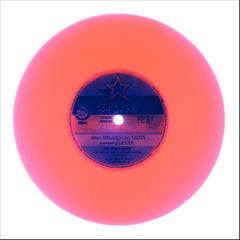
Two framed pop artworks from the Heidler and Heeps Tape Collection 'Ferric 60 (Tinted Red)' and 'Yellow Tinted Cassette' The Heidler & Heeps collaborations are creative representati...

Category

2010s Pop Art Jane Calvin Art

Materials

Photographic Paper, C Print, Color, Silver Gelatin

Biblioteca Palatina, Parma

Biblioteca Palatina, Parma

By Massimo Listri

Located in New York, NY

Biblioteca Palatina, Parma, 2011 Chromogenic lambda print 39.5 x 47.5 inches edition of 5 47.5 x 59 inches edition of 5 71 x 88.5 inches edition of 5 Born in Florence in 1953, ev...

Category

2010s Contemporary Jane Calvin Art

Materials

C Print

Living in a Dream (Till Death do us Part) - Contemporary, Polaroid, Women

Living in a Dream (Till Death do us Part) - Contemporary, Polaroid, Women

By Stefanie Schneider

Located in Morongo Valley, CA

Living in a Dream (Till Death do us Part) - 2005 20x20cm, Edition of 10, Archival C-Print print, based on the Polaroid. Certificate and Signature label, artist Inventory No. 9781. Not mounted. on offer is a piece from the movie "Till Death do us Part" Stefanie Schneider’s Till Death Do Us Part or “There is Only the Desert for You.” BY DREW HAMMOND Stefanie Schneider’s Til Death to Us Part is a love narrative that comprises three elements: 1. A montage of still images shot and elaborated by means of her signature technique of using Polaroid formats with outdated and degraded film stock in natural light, with the resulting im ages rephotographed (by other means) enlarged and printed in such a way as to generate further distortions of the image. 2. Dated Super 8 film footage without a sound track and developed by the artist. 3. Recorded off-screen narration of texts written by the actors or photographic subjects, and selected by the artist. At the outset, this method presupposes a tension between still and moving image; between the conventions about the juxtaposition of such images in a moving image presentation; and, and a further tension between the work’s juxtaposition of sound and image, and the conventional relationship between sound and image that occurs in the majority of films. But Till Death Do Us Part also conduces to an implied synthesis of still and moving image by the manner in which the artist edits or cuts the work. First, she imposes a rigorous criterion of selection, whether to render a section as a still or moving image. The predominance of still images is neither an arbitrary residue of her background as a still photographer—in fact she has years of background in film projects; nor is it a capricious reaction against moving picture convention that demands more moving images than stills. Instead, the number of still images has a direct thematic relation to the fabric of the love story in the following sense. Stills, by definition, have a very different relationship to time than do moving images. The unedited moving shot occurs in real time, and the edited moving shot, despite its artificial rendering of time, all too 2009often affords the viewer an even greater illusion of experiencing reality as it unfolds. It is self-evident that moving images overtly mimic the temporal dynamic of reality. Frozen in time—at least overtly—still photographic images pose a radical tension with real time. This tension is all the more heightened by their “real” content, by the recording aspect of their constitution. But precisely because they seem to suspend time, they more naturally evoke a sense of the past and of its inherent nostalgia. In this way, they are often more readily evocative of other states of experience of the real, if we properly include in the real our own experience of the past through memory, and its inherent emotions. This attribute of stills is the real criterion of their selection in Til Death Do Us Part where consistently, the artist associates them with desire, dream, memory, passion, and the ensemble of mental states that accompany a love relationship in its nascent, mature, and declining aspects. A SYNTHESIS OF MOVING AND STILL IMAGES BOTH FORMAL AND CONCEPTUAL It is noteworthy that, after a transition from a still image to a moving image, as soon as the viewer expects the movement to continue, there is a “logical” cut that we expect to result in another moving image, not only because of its mise en scène, but also because of its implicit respect of traditional rules of film editing, its planarity, its sight line, its treatment of 3D space—all these lead us to expect that the successive shot, as it is revealed, is bound to be another moving image. But contrary to our expectation, and in delayed reaction, we are startled to find that it is another still image. One effect of this technique is to reinforce the tension between still and moving image by means of surprise. But in another sense, the technique reminds us that, in film, the moving image is also a succession of stills that only generate an illusion of movement. Although it is a fact that here the artist employs Super 8 footage, in principle, even were the moving images shot with video, the fact would remain since video images are all reducible to a series of discrete still images no matter how “seamless” the transitions between them. Yet a third effect of the technique has to do with its temporal implication. Often art aspires to conflate or otherwise distort time. Here, instead, the juxtaposition poses a tension between two times: the “real time” of the moving image that is by definition associated with reality in its temporal aspect; and the “frozen time” of the still image associated with an altered sense of time in memory and fantasy of the object of desire—not to mention the unreal time of the sense of the monopolization of the gaze conventionally attributed to the photographic medium, but which here is associated as much with the yearning narrator as it is with the viewer. In this way, the work establishes and juxtaposes two times for two levels of consciousness, both for the narrator of the story and, implicitly, for the viewer: A) the immediate experience of reality, and B) the background of reflective effects of reality, such as dream, memory, fantasy, and their inherent compounding of past and present emotions. In addition, the piece advances in the direction of a Gesammtkunstwerk, but in a way that reconsiders this synaesthesia as a unified complex of genres—not only because it uses new media that did not exist when the idea was first enunciated in Wagner’s time, but also because it comprises elements that are not entirely of one artist’s making, but which are subsumed by the work overall. The totality remains the vision of one artist. In this sense, Till Death Do Us Part reveals a further tension between the central intelligence of the artist and the products of other individual participants. This tension is compounded to the degree that the characters’ attributes and narrated statements are part fiction and part reality, part themselves, and part their characters. But Stefanie Schneider is the one who assembles, organizes, and selects them all. THE RELATIONSHIP BETWEEN THIS IDEA (above) AND PHOTOGRAPHY This selective aspect of the work is an expansion of idea of the act of photography in which the artistic photographer selects that which is already there, and then, by distortion, definition or delimitation, compositional and lighting emphasis, and by a host of other techniques, subsumes that which is already there to transform it into an image of the artist’s contrivance, one that is no less of the artist’s making than a work in any other medium, but which is distinct from many traditional media (such as painting) in that it retains an evocation of the tension between what is already there and what is of the artist’s making. Should it fail to achieve this, it remains, to that degree, mere illustration to which aesthetic technique has been applied with greater or lesser skill. The way Til Death Do Us Part expands this basic principle of the photographic act, is to apply it to further existing elements, and, similarly, to transform them. These additional existing elements include written or improvised pieces narrated by their authors in a way that shifts between their own identities and the identities of fictional characters. Such characters derive partially from their own identities by making use of real or imagined memories, dreams, fears of the future, genuine impressions, and emotional responses to unexpected or even banal events. There is also music, with voice and instrumental accompaniment. The music slips between integration with the narrative voices and disjunction, between consistency and tension. At times it would direct the mood, and at other times it would disrupt. Despite that much of this material is made by others, it becomes, like the reality that is the raw material of an art photo, subsumed and transformed by the overall aesthetic act of the manner of its selection, distortion, organization, duration, and emotional effect. * * * David Lean was fond of saying that a love story is most effective in a squalid visual environment. In Til Death Do Us Part, the squalor of the American desert...

Category

Early 2000s Contemporary Jane Calvin Art

Materials

Archival Paper, Photographic Paper, C Print, Color, Polaroid

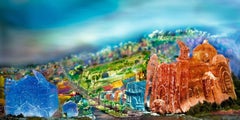
Lower Manhattan, Jelly NYC

Lower Manhattan, Jelly NYC

By Liz Hickok

Located in Sante Fe, NM

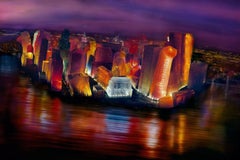
"I create glowing, jellied scale models of urban sites, transforming ordinary physical surroundings into something unexpected and ephemeral. Lit from below, the molded shapes of the ...

Category

21st Century and Contemporary Contemporary Jane Calvin Art

Materials

C Print

The Mission 16th and Dolores, San Francisco in Jell-O

The Mission 16th and Dolores, San Francisco in Jell-O

By Liz Hickok

Located in Sante Fe, NM

"I create glowing, jellied scale models of urban sites, transforming ordinary physical surroundings into something unexpected and ephemeral. Lit from below, the molded shapes of the ...

Category

21st Century and Contemporary Contemporary Jane Calvin Art

Materials

C Print

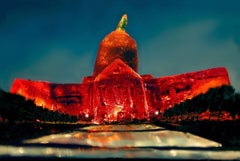
City Hall

Liz HickokCity Hall, 2004

$1,400

H 16 in W 24 in

City Hall

By Liz Hickok

Located in Sante Fe, NM

"I create glowing, jellied scale models of urban sites, transforming ordinary physical surroundings into something unexpected and ephemeral. Lit from below, the molded shapes of the ...

Category

21st Century and Contemporary Contemporary Jane Calvin Art

Materials

C Print

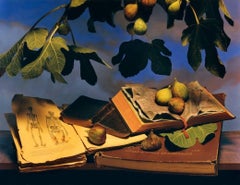
Spheres of Influence

Spheres of Influence

By Jo Whaley

Located in Sante Fe, NM

Santa Fe-based photographer Jo Whaley’s series 'Natura Morta' draws from 17th Century Vanitas still-lifes to craft scenes that expose ironies betwee...

Category

1990s Contemporary Jane Calvin Art

Materials

C Print

Candida Höfer, Museum für Völkerkunde Dresden - Signed Photograph

Candida Höfer, Museum für Völkerkunde Dresden - Signed Photograph

By Candida Hofer

Located in Hamburg, DE

Candida Höfer (German, b. 1944) Museum für Völkerkunde Dresden, 2000/2004 Medium: C-Print on photo paper (incl. artist’s book) Dimensions: 25 x 25 cm Edition of 100 + 20 AP: Hand-sig...

Category

21st Century and Contemporary Contemporary Jane Calvin Art

Materials

C Print

Tincture of Myrrh, Stockton-on-Tees - Vintage Interior Color Photography

Tincture of Myrrh, Stockton-on-Tees - Vintage Interior Color Photography

By Richard Heeps

Located in Cambridge, GB

Tincture of Myrrh, part of Richard Heeps' 'Forward to the Past' series, he was commissioned to photograph Preston Hall Museum before it went through regeneration. The works captured ...

Category

Early 2000s Contemporary Jane Calvin Art

Materials

Photographic Paper, Silver Gelatin, Color, C Print

Fountain Head - Stay, starring Ryan Gosling / expired Polaroid

Fountain Head - Stay, starring Ryan Gosling / expired Polaroid

By Stefanie Schneider

Located in Morongo Valley, CA

Fountain Head (Stay), starring Ryan Gosling 2006 20x20cm, Edition of 10, Archival C-Print, matte surface, based on a Polaroid. Certificate and Signature label, artist Inventory...

Category

Early 2000s Contemporary Jane Calvin Art

Materials

Photographic Film, C Print, Color, Polaroid

Aliens - triptych, analog hand-prints

Aliens - triptych, analog hand-prints

By Stefanie Schneider

Located in Morongo Valley, CA

Aliens - triptych - 1998 Edition of 5, plus 2 Artist Proofs. 48x59cm each, 48x190 installed including the gaps. analog C-Print, hand-printed by the artist on Fuji Crystal Archive P...

Category

1990s Contemporary Jane Calvin Art

Materials

Archival Paper, Photographic Paper, C Print, Color, Polaroid

Tape Collection Two Framed Pop Art Golden and Blue Color Limited Edition Prints

Tape Collection Two Framed Pop Art Golden and Blue Color Limited Edition Prints

By Heidler & Heeps

Located in Cambridge, GB

Two framed pop artworks from the Heidler and Heeps Tape Collection 'All That Glitters is Golden' and 'All That Glitters is Not Golden (Blue). The Heidler & Heeps collaborations are ...

Category

2010s Pop Art Jane Calvin Art

Materials

Photographic Paper, C Print, Color, Silver Gelatin

Previously Available Items
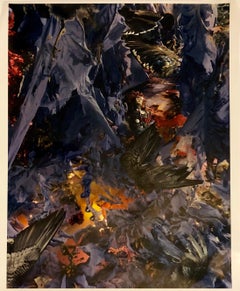
Relics 2 Elaborately Constructed Vintage Color Photograph Surrealist Image

Relics 2 Elaborately Constructed Vintage Color Photograph Surrealist Image

By Jane Calvin

Located in Surfside, FL

Chromogenic photo print. hand signed, titled and dated. This is a vintage print, printed in 1987 and editioned 2/10. Jane L. Calvin (born April 27, 1938) is an artist based in Chicago, Illinois. Jane Calvin was born in Chicago, Illinois. Her father was an avid art collector and Calvin was brought up in the art world from the time she was born. She attended classes at the Art Institute of Chicago as a young child and went on to pursue a degree in Art History from Bryn Mawr College in Pennsylvania in 1959. Calvin worked as a private art dealer for some time before deciding to continue her education and become a fine art photographer. She graduated from the Art Institute of Chicago with her MFA in 1982.[1] Calvin later went on to be a Professor of Photography at The School of the Art Institute, Illinois Institute of Technology, and Beloit College. She was Adjunct Professor of Photography at Columbia College in Chicago until 2005. Since she started making photographs, Calvin has had exhibits across the nation as well as in Germany and China. Calvin constructs her photographs by montaging multiple slide projections and found objects into room-sized assemblages in her studio. She then photographs it, making a tableaux into which layers of meaning are woven. She does not use computer editing, just straight photography. Calvin stated, "The images can be seen as my commentary on the political and social roles projected onto society whose desires, manipulated by language and image, conflict with concerns of gender, sexuality, race and female identity." She says,“I make photographs, I don’t take them,” and in so stating she follows in the path of many Dada and Surrealist precursors, for example, German Kurt Schwitters’ famous Merzbau or Junk House (1923 and following), or Joseph Cornell’s metaphorically vast but physically modestly scaled, even private sculptural interiors of boxes (1930s and following). In her use of projected imagery within and upon the setup of her photographs, Calvin gestures toward earlier 20th century American surrealist photographer Man Ray photographic work, one example of which is Space Writing (Self-Portrait) acquired last year by the Bowdoin College Museum of Art. Calvin’s more recent kindred spirit – although comparatively minimalist in nature and junior chronologically – is Sandy Skoglund. The latter’s photographed installations are a hybrid of unnatural, spectral, coloration and suspended narrative. "I am a maker of meaning, not an observer of it. My medium is photography, although it is includes the processes of sculpture and installation . I build room-sized sets onto which I project images and text, recording the final result with the camera. There are no darkroom or digital tricks. The process is straight photography." For over 25 years, Calvin has been exploring contemporary society’s approach to issues of gender, female identity, sexuality, vulnerability, and love & desire. Eschewing linearity, the work stands in opposition to the simplicity and minimalism prevalent in earlier 20th century image-making. Her images are elliptical, fragmented, layered, reflecting the contemporary world as one of discontinuity and ambiguity with myriad connections, a world less temporally and spatially fixed than ever before. Through the content carried in found materials and appropriated texts, –she addresses— the social and political conditions that are just out of sight, but remain like some kind of background radiation exerting a subtle but undeniable influence on our society. Pop and pulp references throw a humorous light on cultural identity and gender roles projected onto society. The subject matter, appearing disconnected from its place and time, mysteriously overlaps our own collective awareness. –She asks the viewer to see what has been there all along.–—/> Exhibition publication, Gallery 210, University of Missouri, St Louis, 2005, 'Jane Calvin Sentences' Introduction by Terry Suhre, Director, and Essay "Jane Calvin's Phantasmagoric Spaces" by Dr. Mark White. This is a Set-Up: fab photo/fictions This exhibition looked at photographers who utilize fabricated imagery and constructed subjects to create their work. These deliberate fictions, and their position in the realms of photography and art, were explored through the work of several highly acclaimed artists: Jane Calvin, James Casebere, Gregory Crewdson, Barbara Kasten, Abelardo Morell, Patrick Nagatani...

Category

1980s Surrealist Jane Calvin Art
Materials

C Print

Relics 2 Elaborately Constructed Vintage Color Photograph Surrealist Image

Relics 2 Elaborately Constructed Vintage Color Photograph Surrealist Image

By Jane Calvin

Located in Surfside, FL

Chromogenic photo print. hand signed, titled and dated. This is a vintage print, printed in 1987 and editioned 2/10. Jane L. Calvin (born April 27, 1938) is an artist based in Chicago, Illinois. Jane Calvin was born in Chicago, Illinois. Her father was an avid art collector and Calvin was brought up in the art world from the time she was born. She attended classes at the Art Institute of Chicago as a young child and went on to pursue a degree in Art History from Bryn Mawr College in Pennsylvania in 1959. Calvin worked as a private art dealer for some time before deciding to continue her education and become a fine art photographer. She graduated from the Art Institute of Chicago with her MFA in 1982.[1] Calvin later went on to be a Professor of Photography at The School of the Art Institute, Illinois Institute of Technology, and Beloit College. She was Adjunct Professor of Photography at Columbia College in Chicago until 2005. Since she started making photographs, Calvin has had exhibits across the nation as well as in Germany and China. Calvin constructs her photographs by montaging multiple slide projections and found objects into room-sized assemblages in her studio. She then photographs it, making a tableaux into which layers of meaning are woven. She does not use computer editing, just straight photography. Calvin stated, "The images can be seen as my commentary on the political and social roles projected onto society whose desires, manipulated by language and image, conflict with concerns of gender, sexuality, race and female identity." She says,“I make photographs, I don’t take them,” and in so stating she follows in the path of many Dada and Surrealist precursors, for example, German Kurt Schwitters’ famous Merzbau or Junk House (1923 and following), or Joseph Cornell’s metaphorically vast but physically modestly scaled, even private sculptural interiors of boxes (1930s and following). In her use of projected imagery within and upon the setup of her photographs, Calvin gestures toward earlier 20th century American surrealist photographer Man Ray photographic work, one example of which is Space Writing (Self-Portrait) acquired last year by the Bowdoin College Museum of Art. Calvin’s more recent kindred spirit – although comparatively minimalist in nature and junior chronologically – is Sandy Skoglund. The latter’s photographed installations are a hybrid of unnatural, spectral, coloration and suspended narrative. "I am a maker of meaning, not an observer of it. My medium is photography, although it is includes the processes of sculpture and installation . I build room-sized sets onto which I project images and text, recording the final result with the camera. There are no darkroom or digital tricks. The process is straight photography." For over 25 years, Calvin has been exploring contemporary society’s approach to issues of gender, female identity, sexuality, vulnerability, and love & desire. Eschewing linearity, the work stands in opposition to the simplicity and minimalism prevalent in earlier 20th century image-making. Her images are elliptical, fragmented, layered, reflecting the contemporary world as one of discontinuity and ambiguity with myriad connections, a world less temporally and spatially fixed than ever before. Through the content carried in found materials and appropriated texts, –she addresses— the social and political conditions that are just out of sight, but remain like some kind of background radiation exerting a subtle but undeniable influence on our society. Pop and pulp references throw a humorous light on cultural identity and gender roles projected onto society. The subject matter, appearing disconnected from its place and time, mysteriously overlaps our own collective awareness. –She asks the viewer to see what has been there all along.–—/> Exhibition publication, Gallery 210, University of Missouri, St Louis, 2005, 'Jane Calvin Sentences' Introduction by Terry Suhre, Director, and Essay "Jane Calvin's Phantasmagoric Spaces" by Dr. Mark White. This is a Set-Up: fab photo/fictions This exhibition looked at photographers who utilize fabricated imagery and constructed subjects to create their work. These deliberate fictions, and their position in the realms of photography and art, were explored through the work of several highly acclaimed artists: Jane Calvin, James Casebere...

Category

1980s Surrealist Jane Calvin Art
Materials

C Print

Jane Calvin art for sale on 1stDibs.

Find a wide variety of authentic Jane Calvin art available for sale on 1stDibs. You can also browse by medium to find art by Jane Calvin in c print and more. Much of the original work by this artist or collective was created during the 1980s and is mostly associated with the Surrealist style. Not every interior allows for large Jane Calvin art, so small editions measuring 20 inches across are available. Customers who are interested in this artist might also find the work of Jo Ann Callis, Brian Ziff, and Ryan Schude. Jane Calvin art prices can differ depending upon medium, time period and other attributes. On 1stDibs, the price for these items starts at $2,000 and tops out at $2,000, while the average work can sell for $2,000.

Artists Similar to Jane Calvin