John Atherton Art

to
2
2
5
3
4
Overall Width
to
Overall Height
to
14
2
6
4
5
4
1
8
6
8
3
3
1
1
1
1
1
1
1
1
1
1
1
1
1
1
1
1
1
12
5
4
4
4
14
10,042
2,761
1,381
1,375
6
14
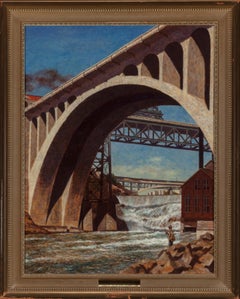
Artist: John Atherton
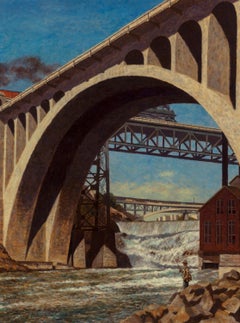
Monroe Street Bridge, Saturday Evening Post cover, June 12, 1948
Located in Fort Washington, PA
In this iconic Saturday Evening Post cover, the artist paints himself as the solitary fisherman underneath a Monroe Street Bridge in Spokane, Washington....
Category

1940s John Atherton Art

Materials

Canvas, Oil

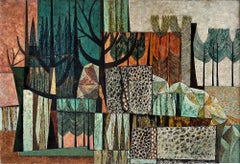
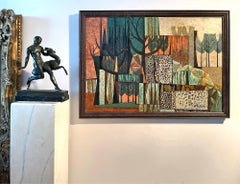
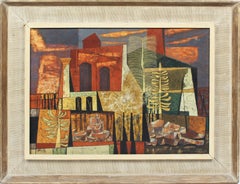
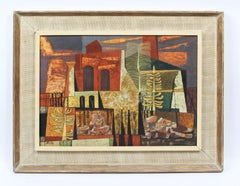
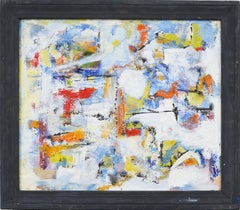
Landscape Abstraction - Mid-Century - Twenty Paintings in One
Located in Miami, FL
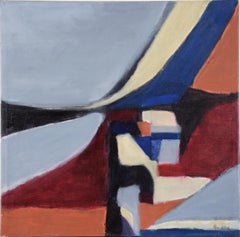
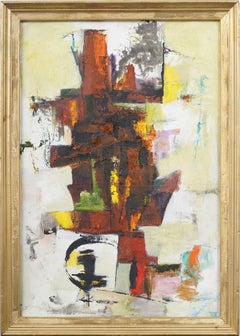
When it comes to abstract painting, the creation date is important. At the height of Abstraction Expressionism, overlooked Academic Artist John Atherton created a wonderfully complex painting that embodies many of the characteristics of what was going on in Mid-Century American Art. The work is simultaneously abstract as it is representational. Like a Bento Box, it's divided into sections by dividers. On close inspection, each section stands on it's own as a beautiful mini-painting yet coalesces as part of the whole. From a distance, it is eye-pleasing, but as the view gets closer and closer, new structures and details gloriously reveal themselves. This is an important painting and not unlike the work of Joaquín Torres-García. It was done in the last year of the artist's life. Signed lower right. Canvas is relined. Framed size: 30 x 41.25. The work is best viewed with top gallery lights to bring out color. Color will look different under different lighting conditions. Atherton exhibited at the famous Julien Levy Gallery in New York and his fine art is mainly associated with Magic Realism. He participated in the seminal 1943 Museum of Modern Art exhibition, American Realists and Magic Realists. The Museum of Modern Art has 4 Atherton paintings in its collection. As an Illustrator, Atherton did covers for the Saturday Evening Post, Fortune and Holiday Magazine...
Category

1950s Abstract Expressionist John Atherton Art

Materials

Canvas, Oil

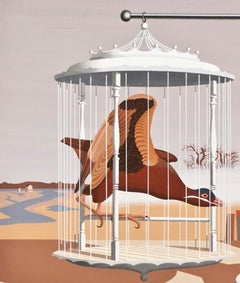
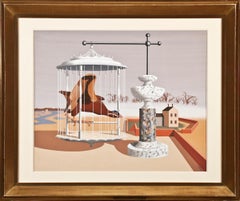
Bird in Cage
Located in New York, NY
Gouache on board, 20 x 24 in. Signed (at lower right): Atherton Painted about 1940 RECORDED: Art News (May 11, 1940), illus. [clipping citation] EXHIBITED: The Art Institute of Chicago, 1940, The International Watercolor Exhibition, no. 156, illus. on cover as Bird in Cage...
Category

Mid-20th Century American Modern John Atherton Art

Materials

Tempera, Wood Panel

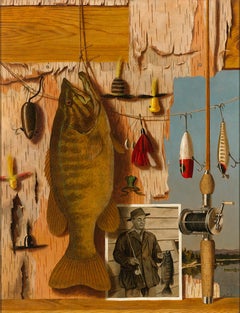
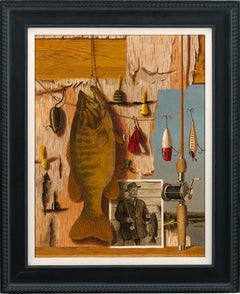
The Bass Season by John Atherton
Located in New Orleans, LA
John Atherton 1900-1952 American The Bass Season Saturday Evening Post cover, June 29, 1946 Signed "Atherton" (lower right) Inscribed "The Bass Season opens in the east July 1st /...
Category

20th Century American Modern John Atherton Art

Materials

Canvas, Oil

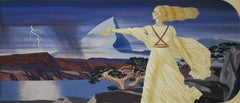
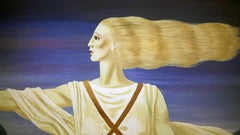
Art Deco Woman in Classical Robes set in Stylized Landscape
Located in Miami, FL
Woman in Surreal Landscape Illustration Published: Woman's Home Companion December 1939, "How to Pray" By Ralph Sadler Meadowcroft Work is Unframed
Category

1930s Art Deco John Atherton Art

Materials

Tempera

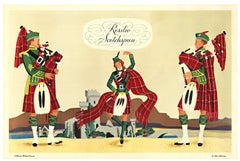
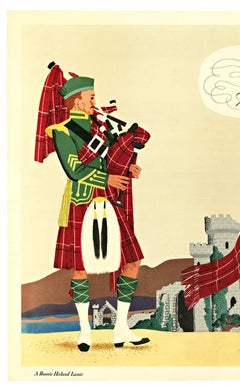
Original Resilio Scotchspun Heiland Lassie vintage fashion poster
Located in Spokane, WA
Original horizontal “Resilio Scotchspun” vintage fashion poster. Archival linen backed and presents in excellent condition. “A Bonnie Heila...
Category

1940s American Modern John Atherton Art

Materials

Lithograph

Original 1939 New York World's Fair Poster by John Atherton
Located in Boca Raton, FL
The poster, which displays surrealist elements as observed by the burnt orange background and a blue floating earth, was created for the 1939 World’s Fair i...
Category

1930s John Atherton Art

Materials

Lithograph

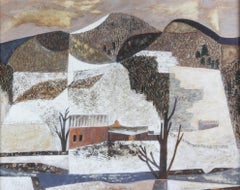
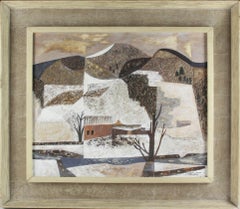
Landscape in Winter
Located in Miami, FL
At a time when Abstract Expressionism was raging, realist painterJohn Atherton nods his head to the movement with a semi-abstract work. Meticulously rendered and carefully thought o...
Category

1950s Abstract Geometric John Atherton Art

Materials

Oil

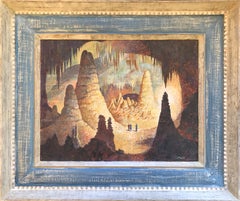
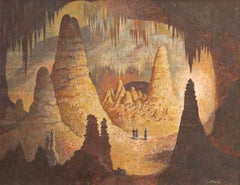
The Cavern 1950 painting by John Atherton
Located in Hudson, NY
Signed lower right: "Atherton", inscribed "John Atherton Original Tempera 7/28/50" on verso. Artwork measures 16" x 20" and framed 20" x 24" x 2 ½" About this artists: John Atherton (1900-1952) did not show an early aptitude for art; rather, his first love was nature and the activities he relished there, mainly fishing and hunting. Born in Brainerd, Minnesota in 1900, he learned to fish with his father from the age of four. Later the family moved to Spokane, Washington, and when he was old enough, Atherton worked at a variety of jobs to help support his family. One such job, in the sorting plant of a lead and silver mine, paid $4.25 a day—a good wage, though he never had time to spend his money, since he worked seven days a week. After serving in the Navy for a year during World War I, Atherton was determined to get an education. He worked as a sign painter and played the banjo in a dance band, finally accumulating enough money to enroll in the California School of Fine Arts in San Francisco. Once there, he worked like a fiend, attending classes both during the day and at night, getting the best training available. Though he had always intended to be a fine artist, Atherton’s first jobs were for commercial art firms. In 1929, using the prize money won for a painting he entered in an art competition, Atherton and his wife moved to New York City. Though the economic situation was difficult in those years, he managed to keep going by taking commissions for magazine illustrations, and over the years he would paint more than forty covers for The Saturday Evening Post. In 1938, an artist friend suggested that he use the same flat, decorative style as his commercial work for his gallery paintings. This was a breakthrough for Atherton; soon afterwards he held a one-man show at the Julien Levy Gallery in New York, and his paintings began to be collected by museums including the Museum of Modern Art in New York and the Metropolitan Museum of Art. Atherton’s reputation increased to a national scale when he designed the art deco stone lithograph poster for the 1939 World’s Fair that strikingly depicted Earth and its atmospheric layers in the lap of Liberty. Atherton was highly influenced by the magic realist...
Category

1950s Modern John Atherton Art

Materials

Masonite, Tempera

Thought Provoking Rock Quarry - Mid Century Abstract
Located in Miami, FL
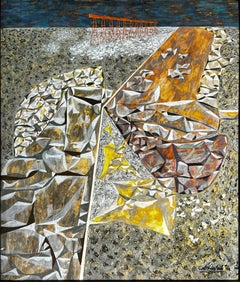
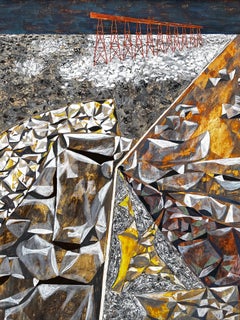
This meticulously planned, designed, and executed work depicts an ultra-wide angle view of a rock quarry/mine. The viewer looks down at close-up-stylized rock formations and then out at a horizon line with rust-colored mine trestles. Atherton hints at perspective with a broken white line that is wider in the foreground and tapers to a hairline as it recedes to the background. The work was done in 1951 at the height of America's most important art movement: Abstract Expressionism. John Atherton absorbs its influences but retains elements of representation. Atherton was an in-demand commercial artist who worked for most blue-chip clients. It is possible that this was an editorial assignment for Fortune Magazine. At the same time, Atherton was also a fine artist and the work could be an expression of pure creative pursuits. The work looks better in person and one can look at it for hours and not get bored. Look carefully and you may discover a deeper meaning in this painting of precisely arranged rocks. Signed lower right. Brooklyn Museum of Art, New York, sold to benefit the acquisitions program ____________________ From Wikipedia, the free encyclopedia John Carlton Atherton (January 7, 1900 - September 16, 1952) was an American painter and magazine illustrator, writer and designer. His works form part of numerous collections, including the Museum of Modern Art,[1] Whitney Museum of American Art and the Smithsonian American Art Museum.[2][3][4] Early Years He was the son of James Chester Atherton (1868-1928) and Carrie B. Martin (1871-1909). He was born in Brainerd, Minnesota.[5] His father was Canadian born. His parents relocated from Minnesota to Washington State, with his maternal grandparents whilst he was still an infant. He attended high school in Spokane, Washington. Career During his early years he never displayed an aptitude for art; rather, his first love being nature and the activities he relished there, mainly fishing and hunting. He enlisted in 1917, serving briefly in the U.S. Navy for a year during World War I. At the end of the war, determined to get an education he worked various part-time jobs, as a sign painter and playing a banjo in a dance band to pay his enrolment fee at the College of the Pacific and The California School of Fine Arts (now the San Francisco Art Institute). Once there, he also worked in the surrounding studios developing his oil painting techniques. A first prize award of $500 at the annual exhibition of the Bohemian Club in 1929, financed his one way trip to New York City, which helped to launch his career as an artist.[6] Atherton had aspired to be a fine artist, however his first paid jobs were for commercial art firms designing advertisements for corporations such as General Motors, Shell Oil, Container Corporation of America, and Dole. However, by 1936, encouraged primarily by friends, such as Alexander Brook, an acclaimed New York realist painter, he returned to the fine arts. Atherton continued to accept numerous commissions for magazine illustrations; such as Fortune magazine, and over the years he would paint more than forty covers for The Saturday Evening Post starting with his December 1942 design, “Patient Dog.” This picture is reminiscent of his friend Norman Rockwell ‘Americana style’ and captures a poignant moment of nostalgia, where a loyal dog looks toward a wall of hunting equipment and a framed picture of his owner in military uniform. Selected One person Exhibitions Atherton accomplished his first one-man show in Manhattan in 1936. His Painting, “The Black Horse” won the $3000 fourth prize from among a pool of 14,000 entries. This painting forms part of the Metropolitan Museum of Art collection in New York.[7] Atherton achieved recognition in New York City and elsewhere during the 1930s. Having exhibited at the Julien Levy Gallery in New York,[8] his paintings began to be collected by museums; including the Museum of Modern Art[9] and the Metropolitan Museum of Art. His reputation increased with his art deco stone lithograph poster for the 1939 New York World's Fair. In 1941, his design won first place in the Museum of Modern Arts “National Defense Poster Competition”. Selected Public Collections Fleming Museum of Art, Burlington, Vermont Albright-Knox Art Gallery,[10] Buffalo, NY Art Institute of Chicago,[11] Chicago Wadsworth Atheneum,[12] Hartford, CT Brooklyn Museum of Art, New York Metropolitan Museum of Art, New York The Museum of Modern Art,[13] New York Whitney Museum of American Art,[14] New York Pennsylvania Academy of the Fine Arts,[15] Philadelphia De Young Museum,[16] San Francisco Smithsonian American Art Museum,[17] Washington DC Butler Institute of American Art[18] Youngstown, OH The Famous Artists School Founded in 1948 in Westport, Connecticut, U.S.A. The idea was conceived by members of the New York Society of Illustrators (SOI), but due to the Society's legal status, could not be operated by it. SOI member Albert Dorne led the initiative to set up a separate entity, and recruited the support of Norman Rockwell, who was also an SOI member. For the founding faculty, Dorne recruited Atherton, as well as accomplished artists such as Austin Briggs, Stevan Dohanos, Robert Fawcett, Peter Helck, Fred Ludekens, Al Parker, Norman Rockwell, Ben Stahl, Harold von Schmidt and Jon Whitcomb.[19] He collaborated with Jon Whitcomb with the book “How I Make a Picture: Lesson 1-9, Parts 1”.[20][21] Society of Illustrators Atherton as an active member from his arrival in New York. The society have owned many of his works. Ex-collection includes: Rocking Horse (ca. 1949) [22] Atherton, as his peers had many of his works framed by Henry Heydenryk Jr.[23] Personal On November 2, 1926, he married Polly “Maxine” Breese (1903-1997).[24][25] They had one daughter, Mary Atherton, born in 1932. Atherton's often chose industrial landscapes, however found himself spending considerable time in Westport, Connecticut, with an active artistic community, and it became home for him, and his family. He then moved to Arlington, Vermont.[26] Norman Rockwell enlisted Atherton in what was to be the only collaborative painting in his career.[27] He was part of a group of artists including a Norman Rockwell, Mead Schaeffer and George Hughes who established residences in Arlington.[28] Atherton and Mead Schaeffer were avid fly fishermen and they carefully chose the location for the group,[29] conveniently located near the legendary Battenkill River. In his free time, Atherton continued to enjoy fly-fishing.[30] He brought his artistic talent into the field of fishing,[31] when he wrote and illustrated the fishing classic, “The Fly and The Fish”.[32] He died in New Brunswick, Canada in 1952,[33] at the age of 52 in a drowning accident while fly-fishing.[34] Legacy The Western Connecticut State University holds an extensive archive on this artist.[35] His wife, Maxine also published a memoir “The Fly Fisher and the River” [36] She married Watson Wyckoff in 1960. Ancestry He is a direct descendant of James Atherton,[37][38] one of the First Settlers of New England; who arrived in Dorchester, Massachusetts in the 1630s. His direct ancestor, Benjamin Atherton was from Colonial Massachusetts...
Category

1950s Abstract Expressionist John Atherton Art

Materials

Mixed Media, Gouache, Board
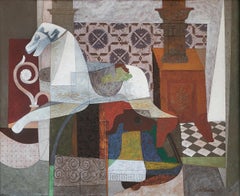
Rocking Horse Children's Room
Located in Miami, FL
Eye-pleasing example of understated and muted colors. Gouache on masonite Ex-collection the Society of Illustrators Meticulously rendered in a post-cubist manner in subtle earth ton...
Category

1940s Abstract Geometric John Atherton Art

Materials

Gouache

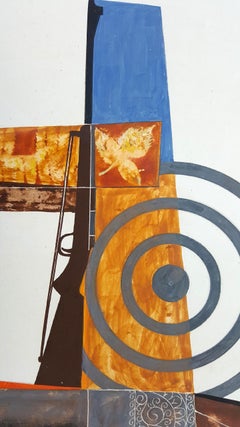
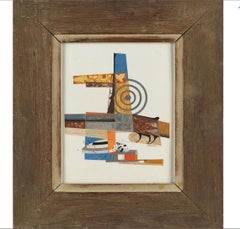
Guns, rifle and Shells Abstraction
Located in Miami, FL
An intriguing and complex composition composed of guns, rifles, ammo and a bullseye. Work is housed in a rustic Heydenryk frame.
Category

1940s Abstract John Atherton Art

Materials

Gouache, Board
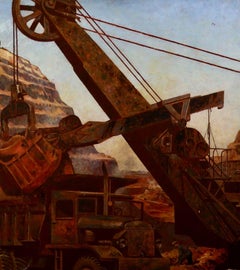
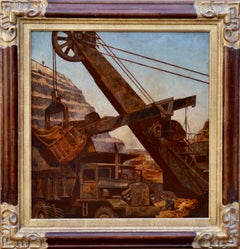
Mining for Ore, Saturday Evening Post Cover, 1947
Located in Fort Washington, PA
Medium: Oil Painting Signature: Signed Lower Left Contact for exact dimensions. Saturday Evening Post Cover, November 22, 1947
Category

1940s John Atherton Art

Materials

Oil, Panel, Board

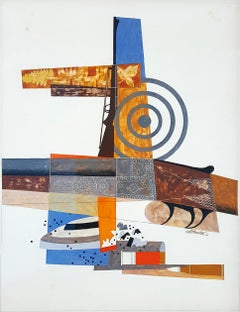
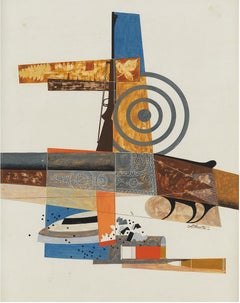
Shotgun Hunting Abstract with Shooting Bullseye
Located in Miami, FL
Complex and masterfully thought out the composition of rifle, gun shells, target shapes, and buck shots. Most likely done for a ad or men's magazine. Signed lower right Atherton. Housed in a rustic House of Heydenryk frame...
Category

1940s Post-Modern John Atherton Art

Materials

Gouache, Board
Related Items
Arnold Ronnebeck 1930s Lithograph – Grand Lake Colorado Yacht Races, WPA Era
By Arnold Rönnebeck
Located in Denver, CO
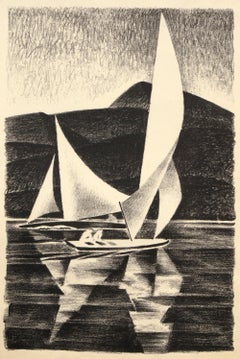
This striking vintage 1930s black-and-white lithograph by celebrated Colorado artist Arnold Ronnebeck (1885–1947) captures the dynamic energy of the Grand Lake...
Category

1930s American Modern John Atherton Art

Materials

Lithograph

J. Brunner 1869 Oil on Canvas Austrian Landscape with Lake and Mountain Painting
Located in Firenze, IT
This very fine quality 19th century oil on canvas in dark brown wood frame with gold leaves details throughout is signed by Joseph Brunner (Vienna 1826-...
Category

19th Century Romantic John Atherton Art

Materials

Canvas, Wood, Oil

1950s "View from the Window" Jack Hooper Mid Century Still Life Oil Painting
By Jack Hooper
Located in Arp, TX
Jack Hooper "View From the Window" c. 1950s Oil on Canvas 32"x25.25" silver and black wood frame 26.5"x33.25" Unsigned Minor wear consistent with age and ...
Category

Mid-20th Century American Modern John Atherton Art

Materials

Canvas, Oil

Making Camp
By Thomas Hart Benton
Located in Columbia, MO
Thomas Hart Benton (American, 1889 - 1975) was a painter, muralist, and printmaker whose sinuous, rhythmic style came to define the Regionalist movement. His paintings and lithograph...
Category

20th Century American Modern John Atherton Art

Materials

Lithograph

Making Camp
Making Camp
$8,640
H 24.75 in W 29.5 in
Trees Park Slope
By Harriet Holden Nash
Located in Buffalo, NY
Harriet was born and raised in Brooklyn, New York, and lived with her husband in Park Slope for over 35 years. She attended the Brooklyn Museum School at...
Category

1950s Abstract Expressionist John Atherton Art

Materials

Canvas, Oil

Manayunk Schuylkill River Factory City Scene Philadelphia GIOVANNI MARTINO 1970
By Giovanni Martino
Located in Rancho Santa Fe, CA
Provenance: Private Collection, San Diego, CA. Framed Giovanni Martino, National Academy of Design* member, was born on May 1, 1908 in Philadelphia PA where all seven brothers and one sister, Filomina, Frank, Antonio, Albert, Ernest, Giovanni, Edmond, and William became painters. They were under the tutelage of their eldest brother, Frank, who in the late 1920s, founded the first commercial art* studio, Martino Studios, at 27 South 18th Street. Besides studying with his two eldest brothers, Giovanni also studied with Albert Jean Adolph at La France Institute, The Pennsylvania Academy of the Fine Arts*, The Graphic Sketch Club, and Spring Garden Institute in Philadelphia. In his mid teens he accompanied his two eldest brothers to New Hope searching for subjects to paint. In the 1930s, he also started to paint in Manayunk, a hilly mill town along the Schuylkill River. At this time he signed his paintings M. Giovanni. These colorful impressionistic* works proceeded more thinly painted dramatically poetic street scenes of the mill town. These images developed into impasto* laden oils in the 1960's with some of the paintings worked with a palette knife*. In Manayunk, he was a common sight on the streets and sidewalks, painting on-the-spot with his wife, Eva Marinelli and his two daughters, Nina & Babette. In the 1980's and 90's he also painted in Conshohocken and Norristown with his youngest daughter, Babette. His paintings became more sharply executed like his earlier work but were more colorful. In the late '90's he worked in his studio to enlarge paintings. He is the recipient of over 100 awards and honors. He received the Benjamin Altman Prize in Landscape Painting in 1975 at the National Academy of Design, NYC where he was elected an Academician (NA) in 1944. He mentored not only his wife and two daughters but also taught at Lehigh University and the Graphic Sketch Club, Philadelphia. He died at his home in Blue Bell on February 1, 1997. (Babette Martino...
Category

1970s American Modern John Atherton Art

Materials

Paper, Mixed Media, Oil, Tempera

Landscape
Located in Los Angeles, CA
Landscape, c. 1930-40s, oil on panel, signed lower right, 16 x 20 inches Jeanette Maxfield Lewis was a California-based landscape painter and etcher. Born in Oakland, she spent much...
Category

1930s American Modern John Atherton Art

Materials

Oil, Panel

Sunflowers of Provence, Abstract Expression 20th C/early 21st C Scottish
Located in Hillsborough, NC
Abstract expression of the Sunflowers in Provence sets the traditional fields ablaze with orange. Painted by Scottish artist Sheila McNab MacMillan, who is known for bold outlines of...
Category

Late 20th Century Abstract Expressionist John Atherton Art

Materials

Canvas, Oil

Prodigal Son
By Thomas Hart Benton
Located in London, GB
A man raises his hand to his chin, his neck tilted and face turned to look at a dilapidated farmhouse, barely held together by planks of wood and exposed to the elements. Behind him ...
Category

1930s American Modern John Atherton Art

Materials

Lithograph

Prodigal Son
Prodigal Son
$4,317
H 19.25 in W 22 in D 1.75 in
'Financial District', New York City — American Modernism
By Howard Norton Cook
Located in Myrtle Beach, SC
Howard Cook, 'Financial District', lithograph, 1931, edition 75, Duffy 155. A fine, richly-inked impression, on cream wove paper, the full sheet with wide margins (2 3/4 to 5 5/8 inches), in excellent condition. Image size 13 5/16 x 10 3/8 inches (338 x 264 mm); sheet size 23 x 16 inches (584 x 406 mm). Matted to museum standards, unframed. Literature: 'American Master Prints from the Betty and Douglas Duffy Collection', the Trust for Museum Exhibitions, Washington, D.C., 1987. Collections: Crystal Bridges Museum of American Art, Library of Congress, Metropolitan Museum of Art, Philadelphia Museum of Art, Smithsonian American Art Museum. ABOUT THE ARTIST Howard Norton Cook (1901-1980) was one of the best-known of the second generation of artists who moved to Taos. A native of Massachusetts, he studied at the Art Students League in New York City and at the Woodstock Art Colony. Beginning his association with Taos in 1926, he became a resident of the community in the 1930s. During his career, he received two Guggenheim Fellowships and was elected an Academician in the National Academy of Design. He earned a national reputation as a painter, muralist, and printmaker. Cook’s work in the print mediums received acclaim early in his career with one-person exhibitions at the Denver Art Museum (1927) and the Museum of New Mexico (1928). He received numerous honors and awards over the years, including selection in best-of-the-year exhibitions sponsored by the American Institute of Graphics Arts, the Brooklyn Museum, the Society of American Etchers, and the Philadelphia Print Club. His first Guggenheim Fellowship took him to Taxco, Mexico in 1932 and 1933; his second in the following year enabled him to travel through the American South and Southwest. Cook painted murals for the Public Works of Art Project in 1933 and the Treasury Departments Art Program in 1935. The latter project, completed in Pittsburgh, received a Gold Medal from the Architectural League of New York. One of his most acclaimed commissions was a mural in the San Antonio Post Office in 1937. He and Barbara Latham settled in Talpa, south of Taos, in 1938 and remained there for over three decades. Cook volunteered in World War II as an Artist War Correspondent for the US Navy, where he was deployed in the Pacific. In 1943 he was appointed Leader of a War Art Unit...
Category

1930s American Modern John Atherton Art

Materials

Lithograph

Down the River
By Thomas Hart Benton
Located in London, GB
In this sentimental work from 1939, Benton expresses his admiration for the rural lifestyle of the Midwest. He highlights the connection between man and the land by depicting two fig...
Category

1930s American Modern John Atherton Art

Materials

Lithograph

Down the River
Down the River
$4,317
H 21.5 in W 18.5 in D 1.5 in
Modern American Still Life Oil Painting Flowers Pitcher Mid Century Female
Located in Buffalo, NY
A mid-century modern oil painting by listed female artist Helen L. Roberts. This painting depicts an interior scene with a vase of beautiful flowers and decorative pitcher. Housed ...
Category

1950s American Modern John Atherton Art

Materials

Canvas, Oil

Previously Available Items
For Freedom's Sake Buy War Bonds, original World War 2 vintage poster
Located in Spokane, WA
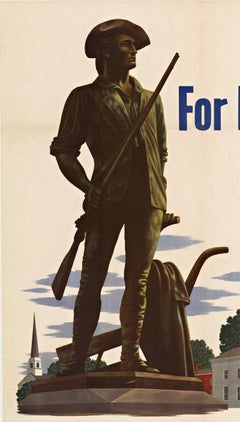
Original For Freedom’s Sake Buy War Bonds. Linen backed. Publisher: [Washington, D.C.] U. S. Government Printing Office. In the foreground is an ima...
Category

1940s American Modern John Atherton Art

Materials

Offset

Antique American Modernist Exhibited Large Abstract Cityscape Rare Oil Painting
Located in Buffalo, NY
Antique American modernist oil painting titled "Ghost Town NY" by John Atherton (1900 - 1952). Oil on canvas, circa 1940. Signed. Displayed in a period modern frame. Image, 27"L x...
Category

1940s Modern John Atherton Art

Materials

Canvas, Oil

John Atherton art for sale on 1stDibs.

Find a wide variety of authentic John Atherton art available for sale on 1stDibs. If you’re browsing the collection of art to introduce a pop of color in a neutral corner of your living room or bedroom, you can find work that includes elements of purple and other colors. You can also browse by medium to find art by John Atherton in paint, oil paint, canvas and more. Much of the original work by this artist or collective was created during the 20th century and is mostly associated with the abstract style. Not every interior allows for large John Atherton art, so small editions measuring 1 inch across are available. Customers who are interested in this artist might also find the work of Carl Holty, Julie Heffernan, and Robert Freiman. John Atherton art prices can differ depending upon medium, time period and other attributes. On 1stDibs, the price for these items starts at $2,168 and tops out at $138,500, while the average work can sell for $39,500.

Artists Similar to John Atherton

Still Thinking About These?

All Recently Viewed