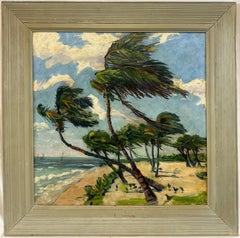
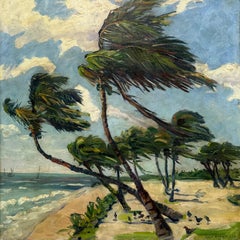
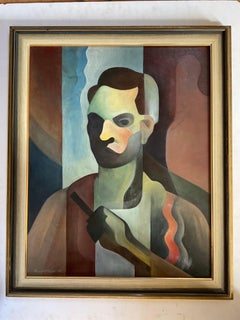
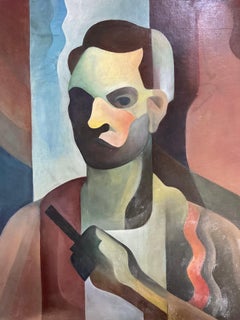
John Edward Costigan Paintings

American, 1888-1972
An American Painter Compositional painter of figures and country animals; watercolor painter Costigan was a largely self-taught artist. He moved from Providence, Rhode Island to New York City as an orphaned teenager in 1904 to work for a commercial poster company. It was here that he learned the rudiments of drawing and painting, skills he furthered with informal study at New York's Kit Kat Club, a popular artists' hangout. Costigan achieved national fame as a painter and printmaker in the1920s and 30s. He won numerous prestigious awards and, despite his lack of formal artistic training, was elected a full member of the National Academy of Design. In 1937 the Smithsonian Institution held a one-person exhibition of his graphic works. Famed American printmaker John Taylor Arms praised Costigan as "a brilliant etcher, particularly noted for his interpretation of life on the American farmstead." Today prints by Costigan can be found in private and public collections around the nation, including the Prints and Photographs Division of the Library of Congress in Washington, which owns twenty-two. The Swope exhibition is the largest devoted to Costigan's work since the late 1960s. Many of the forty-five prints in the exhibition are from the Swope's own extensive holdings of Costigan's works. Other are being lent by private collectors from around the country.
to
1
2
2
1
Overall Width
to
Overall Height
to
6
1
1
1
2
2
1
6
4
4
3
3
1
6
5
2
2
11
754
750
746
660
5
6
Artist: John Edward Costigan
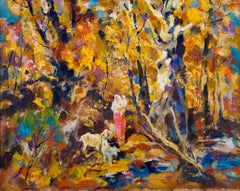
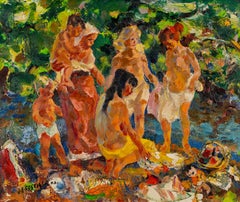
Woman and Child
Woman and Child

Woman and Child

By John Edward Costigan

Located in Sheffield, MA

John Edward Costigan, N.A. American, 1888-1972 Woman and Child Oil on canvas Signed ‘J.E. Costigan N.A.’ lower left 24 by 30 in. W/frame 32 by 38 in. John Costigan was born of Irish-American parents in Providence, Rhode Island, February 29, 1888. He was a cousin of the noted American showman, George M. Cohan, whose parents brought the young Costigan to New York City and was instrumental in starting him on a career in the visual arts. They were less successful in encouraging him to pursue formal studies at the Art Students League (where, however, he later taught) than in exposing him to the commercial art world through the job they had gotten him with the New York lithographing firm that made their theatrical posters. At the H. C. Miner Lithographing Company, Costigan worked his way up from his entry job as a pressroom helper, through various apprenticeships, to the position of sketch artist. In the latter capacity he was an uncredited designer of posters for the Ziegfeld Follies and for numerous silent films. Meanwhile, he had supplemented his very meager formal studies in the fine arts with a self-teaching discipline that led to his first professional recognition in 1920 with the receipt of prizes for an oil painting and watercolor in separate New York exhibitions. A year earlier, Costigan had wed professional model Ida Blessin, with whom he established residence and began raising a family in the sleepy little rural New York hamlet of Orangeburg, the setting for the many idyllic farm landscapes and wood interiors with which he was to become identified in a career that would span half a century. John Costigan’s first national recognition came in 1922 with his winning of the coveted Peterson Purchase prize of the Art Institute of Chicago for an oil on canvas, “Sheep at the Brook.” It marked the start of an unbroken winning streak that would gain him at least one important prize per year for the remainder of the decade. The nation’s art journalists and critics began to take notice, making him the recurring subject of newspaper features and magazine articles. The eminent author and critic Edgar Holger Cahill was just a fledgling reporter when he wrote his first feature, “John Costigan Carries the Flame,” for Shadowland Magazine in 1922. Costigan had his first one-man show of paintings at the Rehn Gallery on New York’s 5th Avenue in November, 1924, to be followed less than three years later by another at the Art Institute of Chicago. In addition, Costigan’s work has been—and continues to be included, side-by-side with that of some of America’s most high-profile artists, in museum and gallery exhibitions throughout the country. His renown had peaked in the early 1930s, by which time his work had been honored with nearly every major award then being bestowed in the fine arts and had been acquired for the permanent collections of several prestigious American museums, including New York’s Metropolitan (which only recently, in 1997, deaccessioned his “Wood Interior,” acquired in 1934). Although Costigan’s celebrity had ebbed by the late 1930s, the Smithsonian Institution saw fit in 1937 to host an exhibition exclusively of his etchings. And, in 1941, the Corcoran Gallery (also Washington, D.C.) similarly honored him for his watercolors. (Another Washington institution, the Library of Congress, today includes 22 Costigan etchings and lithographs in its permanent print collection.) During World War II, Costigan returned briefly to illustrating, mainly for Bluebook, a men’s pulp adventure magazine. A gradual revival of interest in his more serious work began at the end of the war, culminating in 1968 with the mounting of a 50-year Costigan retrospective at the Paine Art Center and Arboretum in Oshkosh, Wisconsin. Oils, watercolors and prints were borrowed from museums and private collections throughout the country, and the exhibition was subsequently toured nationally by the Smithsonian Institution. John Costigan died of pneumonia in Nyack, NY, August 5, 1972, just months after receiving his final prestigious award —the Benjamin West Clinedinst Medal of the Artist’s Fellowship, Inc., presented in general recognition of his “...achievement of exceptional artistic merit...” in the various media he had mastered in the course of his career. This painting depicts one of the artist's favorite themes --the farm family bathing...

Category

1940s Post-Impressionist John Edward Costigan Paintings
Materials

Oil

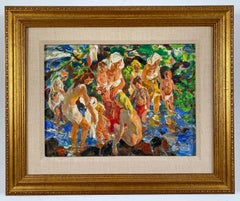
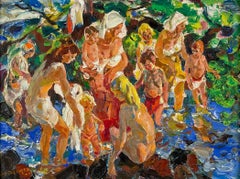
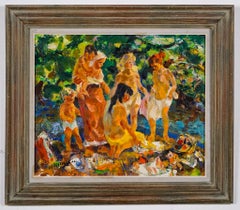
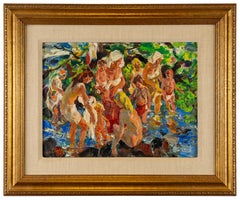
Bathing Group
Bathing Group

Bathing Group

By John Edward Costigan

Located in Sheffield, MA

John Edward Costigan American, 1888-1972 Bathing Group Oil on canvas board 12 by 16 in, w/ frame 19 by 23 in Signed ‘J.E. Costigan N.A.’ lower left John Costigan was born of Irish-...

Category

Mid-20th Century Modern John Edward Costigan Paintings

Materials

Oil

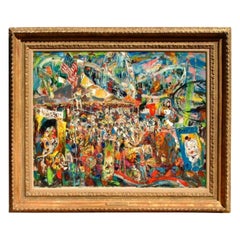
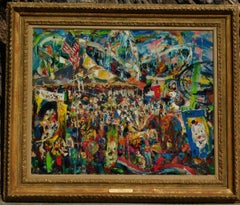
John Edward Costigan Painting, circa 1950's - Carnival

John Edward Costigan Painting, circa 1950's - Carnival

By John Edward Costigan

Located in Phoenix, AZ

John Costigan (1888-1972) oil on canvas, circa: 1950s. In excellent condition. Exciting Expressionist Painting of a lively Carnival Scene. Signed lower right: ''J.E. Costigan", Title...

Category

Mid-20th Century John Edward Costigan Paintings

Materials

Paint

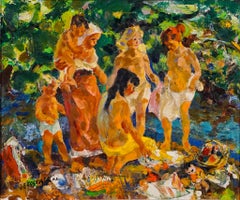
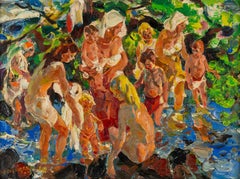
Bathers
Bathers

Bathers

By John Edward Costigan

Located in Sheffield, MA

John Edward Costigan, N.A. American, 1888-1972 Bathers Oil on canvas Signed ‘J.E. Costigan N.A.’ lower left 20 by 24 in. W/frame 26 by 30 in. John Costigan was born of Irish-American parents in Providence, Rhode Island, February 29, 1888. He was a cousin of the noted American showman, George M. Cohan, whose parents brought the young Costigan to New York City and was instrumental in starting him on a career in the visual arts. They were less successful in encouraging him to pursue formal studies at the Art Students League (where, however, he later taught) than in exposing him to the commercial art world through the job they had gotten him with the New York lithographing firm that made their theatrical posters. At the H. C. Miner Lithographing Company, Costigan worked his way up from his entry job as a pressroom helper, through various apprenticeships, to the position of sketch artist. In the latter capacity he was an uncredited designer of posters for the Ziegfeld Follies and for numerous silent films. Meanwhile, he had supplemented his very meager formal studies in the fine arts with a self-teaching discipline that led to his first professional recognition in 1920 with the receipt of prizes for an oil painting and watercolor in separate New York exhibitions. A year earlier, Costigan had wed professional model Ida Blessin, with whom he established residence and began raising a family in the sleepy little rural New York hamlet of Orangeburg, the setting for the many idyllic farm landscapes and wood interiors with which he was to become identified in a career that would span half a century. John Costigan’s first national recognition came in 1922 with his winning of the coveted Peterson Purchase prize of the Art Institute of Chicago for an oil on canvas, “Sheep at the Brook.” It marked the start of an unbroken winning streak that would gain him at least one important prize per year for the remainder of the decade. The nation’s art journalists and critics began to take notice, making him the recurring subject of newspaper features and magazine articles. The eminent author and critic Edgar Holger Cahill was just a fledgling reporter when he wrote his first feature, “John Costigan Carries the Flame,” for Shadowland Magazine in 1922. Costigan had his first one-man show of paintings at the Rehn Gallery on New York’s 5th Avenue in November, 1924, to be followed less than three years later by another at the Art Institute of Chicago. In addition, Costigan’s work has been—and continues to be included, side-by-side with that of some of America’s most high-profile artists, in museum and gallery exhibitions throughout the country. His renown had peaked in the early 1930s, by which time his work had been honored with nearly every major award then being bestowed in the fine arts and had been acquired for the permanent collections of several prestigious American museums, including New York’s Metropolitan (which only recently, in 1997, deaccessioned his “Wood Interior,” acquired in 1934). Although Costigan’s celebrity had ebbed by the late 1930s, the Smithsonian Institution saw fit in 1937 to host an exhibition exclusively of his etchings. And, in 1941, the Corcoran Gallery (also Washington, D.C.) similarly honored him for his watercolors. (Another Washington institution, the Library of Congress, today includes 22 Costigan etchings and lithographs in its permanent print collection.) During World War II, Costigan returned briefly to illustrating, mainly for Bluebook, a men’s pulp adventure magazine. A gradual revival of interest in his more serious work began at the end of the war, culminating in 1968 with the mounting of a 50-year Costigan retrospective at the Paine Art Center and Arboretum in Oshkosh, Wisconsin. Oils, watercolors and prints were borrowed from museums and private collections throughout the country, and the exhibition was subsequently toured nationally by the Smithsonian Institution. John Costigan died of pneumonia in Nyack, NY, August 5, 1972, just months after receiving his final prestigious award —the Benjamin West Clinedinst Medal of the Artist’s Fellowship, Inc., presented in general recognition of his “...achievement of exceptional artistic merit...” in the various media he had mastered in the course of his career. This painting depicts one of the artist's favorite themes --the farm family bathing...

Category

1950s Post-Impressionist John Edward Costigan Paintings
Materials

Oil

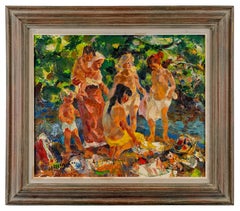
Bathing Group
Bathing Group

Bathing Group

By John Edward Costigan

Located in Sheffield, MA

John Edward Costigan American, 1888-1972 Bathers Oil on canvas 20 by 24 in, w/ frame 26 by 30 in Signed "J.E. Costigan N.A." lower left John Costigan was born of Irish-American par...

Category

Mid-20th Century Impressionist John Edward Costigan Paintings
Materials

Canvas, Oil

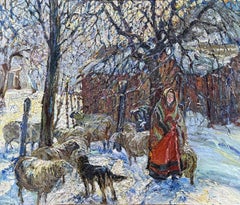
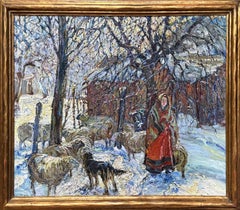
"Barnyard Winter" John Edward Costigan, Snowy Landscape, American Artist

"Barnyard Winter" John Edward Costigan, Snowy Landscape, American Artist

By John Edward Costigan

Located in New York, NY

John Edward Costigan Barnyard Winter, 1922 Signed dated lower right Oil on canvas 25 x 30 inches John Costigan was a self-taught painter and trained printer distinguished by his im...

Category

1920s American Impressionist John Edward Costigan Paintings
Materials

Canvas, Oil

Related Items
Large Catalan Harvest Landscape Painting Pyrenees Olot School Figures Oil Spain

Large Catalan Harvest Landscape Painting Pyrenees Olot School Figures Oil Spain

Located in Sitges, Barcelona

Large Catalan Harvest Landscape Painting Pyrenees Olot School Figures Oil SPECIFICATIONS Artist: Salvador Corriols i Pagès (Olot, 1907 – 1975) Medium: Oil on canvas Date: Mid-20th ...

Category

1950s Post-Impressionist John Edward Costigan Paintings
Materials

Oil

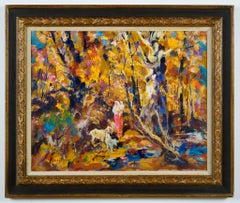
“Impressionist Landscape, c. 1915-1920” California Forest American Impressionist

“Impressionist Landscape, c. 1915-1920” California Forest American Impressionist

By Francis Stillwell Dixon

Located in Yardley, PA

“Impressionist Landscape, c. 1915-1920” by Francis Stillwell Dixon (American, 1879-1967). One of Dixon’s finest canvases, depicting a tranquil forest scene bathed in soft, dappled l...

Category

Early 20th Century American Impressionist John Edward Costigan Paintings
Materials

Canvas, Oil

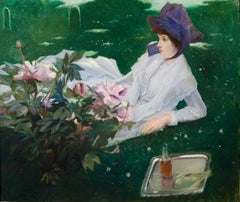
Henriette Chabot with Peonies

Henriette Chabot with Peonies

By Jacques Emile Blanche

Located in Mc Lean, VA

This painting was owned by Comte Robert de Montesquiou (1855–1921), Paris Literature: Jane Roberts, Jacques-Émile Blanche (2012), pg. 47 (color illus.), p. 191. Included as no. R...

Category

Early 20th Century Post-Impressionist John Edward Costigan Paintings
Materials

Canvas, Oil

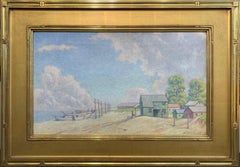
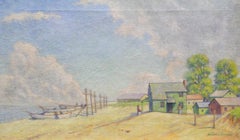
Figures, Boats, and House - Cape May Point, NJ, Impressionist Beach Scene, 1940s

Figures, Boats, and House - Cape May Point, NJ, Impressionist Beach Scene, 1940s

By Albert Van Nesse Greene

Located in Doylestown, PA

"Figures, Boats, and House - Cape May Point, NJ" is a Pennsylvania Beach Scene by American Impressionist painter Albert Van Nesse Greene. The ...

Category

1940s American Impressionist John Edward Costigan Paintings
Materials

Oil, Canvas

"Divine Spontaneity II" Acrylic, Oil Pastels, Pencils Abstract Painting 48"x36"

"Divine Spontaneity II" Acrylic, Oil Pastels, Pencils Abstract Painting 48"x36"

By Karina Gentinetta

Located in New York, NY

"Divine Spontaneity II" 2023, 48" H x 36" W. Vertical abstract painting consisting of acrylics, house paint, oil pastels, color pencils, and carbon pencils on canvas by Argentine-bo...

Category

21st Century and Contemporary Abstract Expressionist John Edward Costigan Paintings
Materials

House Paint, Acrylic, Carbon Pencil, Oil Pastel, Color Pencil

Abstract Watercolor N.8 by Dmitry Samygin

Abstract Watercolor N.8 by Dmitry Samygin

By Dmitry Samygin

Located in Paris, FR

Abstract Watercolor N.8 by Dmitry Samygin Minimalist and geometric paintings. Technique: Watercolor Color: Teal blue Size: H. 35.5 x 27.5 x 0.1 cm Dmitry Samygin is a Furniture a...

Category

21st Century and Contemporary Abstract Geometric John Edward Costigan Paintings
Materials

Watercolor

The Red Hat oil on canvas by Moses Soyer

The Red Hat oil on canvas by Moses Soyer

By Moses Soyer

Located in Hudson, NY

Realist oil painting by Moses Soyer. The artist was often quoted as saying, "My message is people." He was always looking to find who the person within was. Soyer and his brothers Raphael and Isaac were all successful artists. Moses Soyer began his art studies at the Cooper Union and National Academy of Design, the Education Alliance, and eventually moved to the Ferrer Art School in Harlem to study with teachers who promoted the Ashcan style of painting. This style promoted unglamorized representations of everyday life and a focus on social realism. When many artists shifted to abstract expressionism Soyer...

Category

Mid-20th Century Modern John Edward Costigan Paintings
Materials

Canvas, Oil

Early Modern American Portrait, Pennsylvania/Massachusetts, Frank Anderson Trapp

Early Modern American Portrait, Pennsylvania/Massachusetts, Frank Anderson Trapp

Located in Baltimore, MD

This is a very stylized and powerful portrait by the noted artist Frank Anderson Trapp. It is dated 1940, and is very much in the modern style of French painters Ferdinand Leger...

Category

1940s American Modern John Edward Costigan Paintings
Materials

Oil

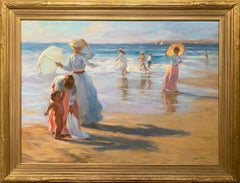
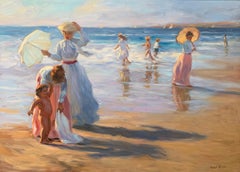
"On The Beach", Greg Harris, Original Oil, Figurative, Landscape, 36x48 in.

"On The Beach", Greg Harris, Original Oil, Figurative, Landscape, 36x48 in.

By Greg Harris

Located in Dallas, TX

"On The Beach" By Greg Harris is a perfect example of his most sought after paintings. Measuring 36x48 in., this painting is timeless with woman and children at the beach...

Category

1980s American Impressionist John Edward Costigan Paintings
Materials

Canvas, Oil

Mid Century Modern Dancers Oil Painting; Listed Artist Albert Michini, ca 1970’s

Mid Century Modern Dancers Oil Painting; Listed Artist Albert Michini, ca 1970’s

Located in Baltimore, MD

If you have an association with dance, yoga or working out, this unusual modernist painting might be an interesting addition to your space. Artist Albert Michini used several models ...

Category

1970s American Modern John Edward Costigan Paintings
Materials

Oil

Oil on Canvas Depicting William Shakespeare's Characters "Othello & Desdemona"

Oil on Canvas Depicting William Shakespeare's Characters "Othello & Desdemona"

By Hamilton Hamilton

Located in LA, CA

Hamilton Hamilton (American, 1847-1928) A large and impressive oil on canvas "Othello and Desdemona" after the William Shakespeare's play "Othello", depicting a young Desdemona pleading with an enraged Othello, and perhaps Iago is the seated figure, within a giltwood craquelure finished frame. Signed (l/r): H. Hamilton, 1921 . Canvas Height: 67 inches (170.2 cm) Canvas Width: 48 inches (121.9 cm) Frame Height: 75 inches (190.5 cm) Frame Width: 57 inches (144.8 cm) Frame Depth: 2 inches (5.1 cm) Hamilton Hamilton (1 April 1847 – 4 January 1928) was a painter and etcher, known mostly for his landscapes of the American West. Born in Oxford, England, he lived most of his life in the Eastern United States. He painted landscapes in New York, Connecticut, the American West, England, and France. He also painted portraits and drew illustrations. Artistic career Hamilton Hamilton was born in Oxford, England, on 1 April 1847. While young, he was a protégé of John Ruskin. In 1872, he began his mostly self-taught career as a portrait artist in Buffalo, New York. He created 47 landscape paintings during an 1873 expedition to Colorado which were chosen to be part of the 1876 Centennial Exposition in Philadelphia. He spent 1878 and 1879 painting in Pont-Aven, Brittany, alongside Barbizon School painters. He moved to New York City in 1881 and shortly after began to practice genre painting and etching.[6] He became an associate member of the National Academy of Design in 1886 and a National Academician in 1889. Until the end of the century, he and his family resided alternately in upstate New York, Long Island, Colorado, and England.[6] In 1907 and 1908, Hamilton spent two years painting landscapes in Southern California. In 1912 he and his family permanently moved to Norwalk, Connecticut. There he became involved with the Silvermine group of artists led by Solon Borglum...

Category

Early 20th Century American Impressionist John Edward Costigan Paintings
Materials

Canvas, Wood, Oil

“Florenz (Florence), c. 1910” Post-Impressionist Italy Tuscany Landscape Oil

“Florenz (Florence), c. 1910” Post-Impressionist Italy Tuscany Landscape Oil

Located in Yardley, PA

An exceptional post-impressionist view of Florence, Italy by Carl Schmitz-Pleis (1877-1943). In the spring of 1910 Schmitz-Pleis and fellow friend/artist Walter Hugo Ophey travelled...

Category

Early 20th Century Post-Impressionist John Edward Costigan Paintings
Materials

Canvas, Oil

Previously Available Items
Bathing Group
Bathing Group

Bathing Group

By John Edward Costigan

Located in Sheffield, MA

John Edward Costigan, N.A. American, 1888-1972 Bathing Group Oil on canvas board Signed ‘J.E. Costigan N.A.’ lower left 12 by 16 in. W/frame 20 by 24 i...

Category

1950s Post-Impressionist John Edward Costigan Paintings
Materials

Oil

John Edward Costigan paintings for sale on 1stDibs.
Find a wide variety of authentic John Edward Costigan paintings available for sale on 1stDibs. You can also browse by medium to find art by John Edward Costigan in oil paint, paint and more. Much of the original work by this artist or collective was created during the 20th century and is mostly associated with the Post-Impressionist style. Not every interior allows for large John Edward Costigan paintings, so small editions measuring 24 inches across are available. Customers who are interested in this artist might also find the work of Charles Picart le Doux, Pascal Cucaro, and Dorothy King. John Edward Costigan paintings prices can differ depending upon medium, time period and other attributes. On 1stDibs, the price for these items starts at $5,400 and tops out at $9,850, while the average work can sell for $7,400.